 ITA
ITAProp Trading Industry Statistics 2026: Every Number Sourced
Prop trading industry statistics for 2026, each with a named, dated source: pass rates, payouts, market size, and the 2024 firm shakeout.

How this article is verified: Every number and claim above is checked against a primary source, ITAfx's own Terms of Service, official product pages, or the trading platform itself, before publication, then re-verified again immediately before this page goes live. Fact-checked and published on July 31, 2026 by Adrian Caldwell.
Why most prop trading statistics you'll read are uncitable
You came here to find out whether a number is trustworthy. Start with the reason so many of them are not.
The three-orders-of-magnitude market size problem
Prop trading has no central data collector. That means anybody can publish a market size, and several people have, with wildly different answers. Jon Light of platform vendor Devexperts put the retail prop trading industry at a $12 billion valuation in 2025, with some expecting $20 billion in 2026, and named no study behind either number (Finance Magnates thought-leadership piece, retrieved 2026-07-31). That is an estimate from an interested party. It is not a measurement, and this article never treats it as one.
The rule used here: named source, date, evidence type
Three tests, applied to every figure on this page.
- Named source. A person, firm, or publication that put its name on the number.
- Publication date. A statistic without a date is a statistic you cannot check.
- Evidence type. Audited firm accounts, a vendor dataset, a firm's own marketing, an on-chain proxy, or a compiled league table. These are not equal, and mixing them is how "$850M" and "$20B" end up on the same page.
The ladder used here, strongest first: firm-level P&L on record, then a multi-firm vendor dataset, then a firm's self-published numbers, then on-chain proxies and compiled league tables, then vendor market-size estimates last.
Why no regulator holds this data
Finance Magnates concluded that prop firms' total-payout claims cannot be independently verified, because prop firms, unlike CFD brokers, are not required to report any data to a regulator (Finance Magnates, retrieved 2026-07-31). That single sentence explains almost every gap in this article. There is no filing, no register, no quarterly return. What exists is what firms and vendors choose to publish.
If evaluations themselves are new to you, start with the beginner guide to forex prop firms and come back. For the no-challenge model behind one fast-growing part of this market, read the prop firm instant funding guide.
Pass rates: what firms and platform vendors have actually published
This is the number most people arrive looking for. Three sources have published something real.
FPFX Tech's 300,000-account dataset
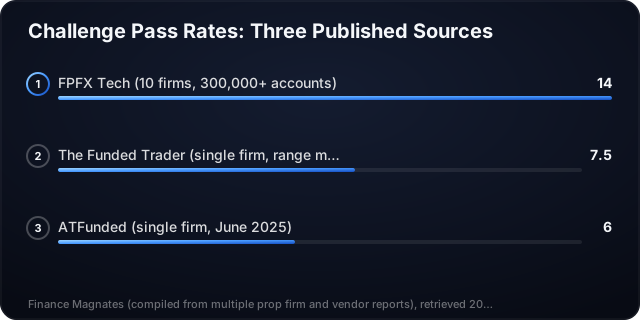
FPFX Tech's dataset, reported exclusively by Finance Magnates, covered over 300,000 prop trading accounts belonging to 100,000 traders across 10 different prop trading companies, the largest published sample of prop-account outcomes on record (Finance Magnates, retrieved 2026-07-31). In that dataset, 14% of traders passed the challenge and obtained a funded account (Finance Magnates, retrieved 2026-07-31).
Passing is not getting paid. Of traders who obtained funded accounts, about 45% achieved a payout, which works out to 7% of all traders who bought a challenge, figures attributed to FPFX Tech founder and CEO Justin Hertzberg (Finance Magnates, retrieved 2026-07-31). And the payouts themselves were modest relative to the nominal account: the average payout in the FPFX Tech dataset was 4% of the plan size, meaning the account value on the plan (Finance Magnates, retrieved 2026-07-31).
Why do so many evaluations end early? Usually a rule breach rather than a bad market call. The mechanics are covered in this guide to prop firm drawdown rules explained, and the behaviour behind the breaches in common mistakes traders make in prop firm challenges.
The Funded Trader's self-published numbers
A firm publishing its own conversion data is rare enough to be worth reading closely. The Funded Trader's CEO Angelo Ciaramello published the firm's own numbers: a challenge pass rate of 5 to 10%, only about 20% of funded traders receiving payouts, and only 1% to at most 2% of overall clients ever achieving a payout (Finance Magnates, retrieved 2026-07-31).
Note the evidence type. This is one firm describing itself. It is useful precisely because it is unflattering, but it is not independently checked.
ATFunded's phase-by-phase June 2025 data
Prop firm ATFunded posted its own June 2025 evaluation data: 22.6% of traders advanced from Phase 1 to Phase 2, and 26.9% of Phase 2 participants reached funded status, an overall success rate of approximately 6% for traders entering the program (Finance Magnates, retrieved 2026-07-31).
The 22.6% and the 26.9% are phase figures. Neither one is a challenge pass rate. Multiply them and you get the roughly 6% overall.
Why "6%" and "14%" don't contradict each other
They measure different things over different populations.
- FPFX Tech's 14% is ten firms, over 300,000 accounts, spanning a long window (Finance Magnates, retrieved 2026-07-31).
- ATFunded's roughly 6% is one firm, one month (Finance Magnates, retrieved 2026-07-31).
- The Funded Trader's 5 to 10% is one firm's own stated range (Finance Magnates, retrieved 2026-07-31).
A single-firm month and a ten-firm multi-year dataset are not the same claim. Rule sets differ, account sizes differ, marketing channels bring in different traders. Anyone averaging these three into "the industry pass rate" is inventing a statistic, a pattern examined further in prop firm challenge failure analysis.
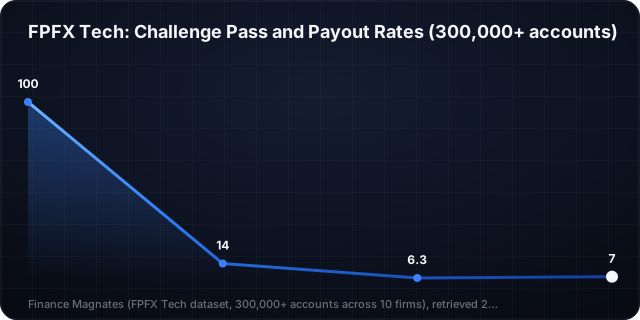
Published pass and payout rates by source
| Source | Type of evidence | Sample and period | Challenge pass rate | Share of all buyers ever paid | Where reported |
|---|---|---|---|---|---|
| FPFX Tech (Justin Hertzberg) | Vendor dataset, 10 firms | 300,000+ accounts, 100,000 traders, 10 firms | 14% | 7% | Finance Magnates exclusive, retrieved 2026-07-31 |
| The Funded Trader (Angelo Ciaramello) | Firm self-published | One firm, stated ranges | 5 to 10% | 1% to at most 2% | Finance Magnates, retrieved 2026-07-31 |
| ATFunded | Firm self-published | One firm, June 2025 only; Phase 1 to Phase 2 22.6%, Phase 2 to funded 26.9% | Approximately 6% overall | Not published | Finance Magnates, from firm social posts, retrieved 2026-07-31 |
One further FPFX Tech figure does not fit a column: the average payout in that dataset was 4% of the plan size (Finance Magnates, retrieved 2026-07-31).
2024's firm-loss shakeout, by trigger and timeline
The table below lines up the trigger event, its date, and its published scale, so the sequence of the 2024 pullback is visible in one place.
| Event | Date | Scale / detail | Source |
|---|---|---|---|
| Platform license terminations | February 2024 | Prop firms' trading-platform licenses terminated, setting off an industry-wide platform migration | Finance Magnates, retrieved 2026-07-31 |
| First public firm closure tied to the pullback | May 2024 | One named firm permanently closed citing financial insolvency, roughly three months after losing platform access | Finance Magnates, retrieved 2026-07-31 |
| Net firms disappeared industry-wide, full year 2024 | 2024 (estimate, Finance Magnates Intelligence) | Between 80 and 100 proprietary trading firms | Finance Magnates, retrieved 2026-07-31 |
Read together, the timeline suggests the platform-access shock in February was the trigger, and the firm closures that followed over the rest of the year were the consequence, not a separate or unrelated wave.
Payout totals: the largest published figures and their limits
Payout totals are the industry's favourite marketing number and its least verifiable one.
FTMO's $450 million, and what a total-payout claim is not
FTMO marked its 10th anniversary in September 2025 by announcing more than $450 million paid out to traders since its 2015 launch, the largest total-payout figure any prop firm has published (Finance Magnates, retrieved 2026-07-31).
Read what that is and is not. It is cumulative over ten years. It is not a profit figure, not a per-trader figure, and not audited by anyone outside the firm. Finance Magnates' conclusion applies directly: these claims cannot be independently verified, because no regulator requires the data (Finance Magnates, retrieved 2026-07-31). If you are weighing firms on this basis, a like-for-like read of the field is in fundednext vs itafx comparison.
The 2025 league table: compiled, not audited
Finance Magnates reported that the 2025 payout league table compiled by Prop Firm Match put full-year industry payouts at roughly $325 million, excluding FTMO and The5ers (Finance Magnates, retrieved 2026-07-31). Two exclusions that large tell you the table is a partial aggregation of self-reported figures, not an industry total.
On-chain payouts as a proxy, and where the growth stalled
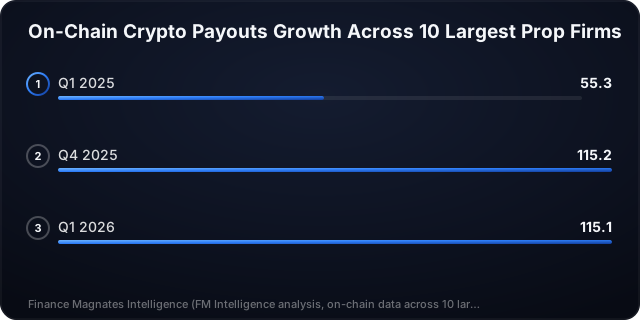
Blockchain data offers something closer to observation. Crypto payouts tracked on public blockchains across the ten largest prop firms rose from $55.3 million in Q1 2025 to $115.1 million in Q1 2026, up 109% year over year, per an FM Intelligence analysis, which notes that on-chain data is a proxy that cannot separate trader payouts from affiliate and vendor payments (Finance Magnates, retrieved 2026-07-31).
Then the interesting part. The same analysis found growth had stalled: Q1 2026's $115.1 million barely moved against the $115.2 million recorded in Q4 2025, a 0.1% sequential change after two years of rapid expansion (Finance Magnates, retrieved 2026-07-31).
For what a payout actually involves at the trader's end, see how profit split works in forex prop firms.
How many prop firms exist? The honest answer is nobody publishes it
What the "2,000+ firms" claim is missing
The total number of prop firms currently active worldwide is not reliably published. The reason is structural, not accidental: prop firms have no duty to report anything to a regulator (Finance Magnates, retrieved 2026-07-31). There is no register to count.
So this page will not print a total. A number invented to fill a table is worse than a blank cell, because it gets quoted.
What is documented instead: net disappearances
The direction of travel is documented, even if the level is not. Finance Magnates Intelligence estimates that between 80 and 100 proprietary trading firms disappeared from the market in 2024 (Finance Magnates, retrieved 2026-07-31). A change without a base is still information: it tells you the sector shrank by dozens of operators in a single year.
The 2024 shakeout
This is the section about whether the firm holding your evaluation will still exist next year. The record here is unusually clear.
February 2024: the platform license terminations
In February 2024, the operator of a widely used trading platform terminated trading-platform licenses that prop firms depended on, setting off an industry-wide platform migration (Finance Magnates, retrieved 2026-07-31). Firms that had built their entire evaluation product on one vendor's software suddenly had to rebuild it.
True Forex Funds, May 2024
The clearest case of platform loss preceding firm death: True Forex Funds, the first prop firm to publicly lose its trading-platform licenses in the February 2024 pullback, permanently closed in May 2024 citing financial insolvency (Finance Magnates, retrieved 2026-07-31). Three months from losing software access to insolvency.
And the estimated 80 to 100 firms that vanished that year were, per Finance Magnates Intelligence, triggered by that same platform vendor stepping back from supporting prop firms (Finance Magnates, retrieved 2026-07-31).
Pattern worth holding onto: 2024 killed firms through infrastructure dependency, and the survivors have since been absorbing each other through acquisition. Individual deal terms are mostly undisclosed and are not restated here without a primary document to check them against. Neither the closures nor the acquisitions are visible in a pass-rate table.
Market size: a $12B-to-$20B estimate, and whose estimate it is
Where the $12B / $20B figure comes from
It comes from one article. Jon Light of platform vendor Devexperts, writing in a Finance Magnates thought-leadership piece, put the retail prop trading industry at a $12 billion valuation in 2025, with some expecting $20 billion in 2026, attributing the figures to no named study (Finance Magnates, retrieved 2026-07-31).
Label it honestly: vendor-published estimate, thought-leadership format, no methodology disclosed. It may well be in the right neighbourhood. You cannot check it, and a vendor selling infrastructure to prop firms benefits from the number being large.
The only public firm-level P&L: FTMO 2023
Against that, here is the one hard financial disclosure on record. FTMO reported a 2023 turnover of almost CZK 5 billion, over $213 million, up 20% on the prior year (Finance Magnates, retrieved 2026-07-31).
Why one firm's revenue can't be scaled into a market
Tempting arithmetic: take FTMO's $213 million, guess its market share, multiply. Do not. Every input to that calculation is missing. The $12 billion figure is an estimate, and the $213 million is a report, and the gap between them is not a market share, it is an unknown.
What would actually close these gaps
The gap raised at the top of this page stays open for one reason: nobody is required to file anything. Prop firms are not required to report data to a regulator, unlike CFD brokers (Finance Magnates, retrieved 2026-07-31).
Be precise about what that means. Voluntary schemes and self-reported league tables can add disclosure at the margin, but they are not a reporting mandate. Firms that never opt in publish nothing, and the data gaps in this article do not close on their own.
Where ITAfx sits in this: evaluations run on simulated capital, and account terms, sizes, and fees live on itafx.com rather than being restated inside a statistics article that would go stale.
How to check any prop firm statistic in five minutes
Five questions. If a page fails the first two, stop reading it.
- Who is the named source? A person or organisation, not "industry data." If the page cannot name one, the number has no author.
- What is the publication date? Every figure in this article carries one, because payout totals, market estimates, and firm counts all move.
- Was it measured or estimated? FTMO's turnover was reported from accounts (Finance Magnates, retrieved 2026-07-31). The $12 billion market size was estimated by a vendor (Finance Magnates, retrieved 2026-07-31). Different species.
- What was the sample? One firm, one month, one phase? Or ten firms and 300,000 accounts (Finance Magnates, retrieved 2026-07-31)?
- Who benefits from the number being large or small? A vendor sizing its own addressable market, or a firm quoting a payout total no regulator audits (Finance Magnates, retrieved 2026-07-31).
The same instinct applies to people, not just numbers, which is the subject of fake trading guru warning signs.
Standing warning on this page: these are volatile fields. Payout totals, market estimates, on-chain quarterly figures, and firm counts all change, and each figure above is stated as of the date its source published it.
Ready to get funded?
50% off instant accounts with code 50CRYPTO.
Get Funded →Frequently Asked Questions
What is the prop firm pass rate in 2026?
There is no single industry pass rate. The largest published sample, FPFX Tech's dataset of over 300,000 accounts across 10 firms, showed 14% of traders passing the challenge (Finance Magnates, retrieved 2026-07-31), while only 7% of all traders who bought a challenge ever received a payout (Finance Magnates, retrieved 2026-07-31). Individual firms have published lower figures: 5 to 10% at The Funded Trader (Finance Magnates, retrieved 2026-07-31) and roughly 6% overall at ATFunded for June 2025 (Finance Magnates, retrieved 2026-07-31).
How many prop firms are there?
Not reliably published. What is documented is the loss: an estimated 80 to 100 firms disappeared in 2024 (Finance Magnates, retrieved 2026-07-31).
How big is the prop trading market?
The most-quoted 2026 figure is a vendor estimate, not a measurement: $12 billion in 2025 with some expecting $20 billion in 2026, from Devexperts' Jon Light in a Finance Magnates piece with no study named (Finance Magnates, retrieved 2026-07-31).
Which prop firm has paid out the most?
FTMO has published the largest total: more than $450 million to traders since 2015, announced at its 10th anniversary in September 2025 (Finance Magnates, retrieved 2026-07-31). Such claims are not independently verifiable, since prop firms report no data to any regulator (Finance Magnates, retrieved 2026-07-31).
Is the prop trading industry still growing?
Mixed. On-chain crypto payouts across the ten largest firms doubled year over year to $115.1 million in Q1 2026 (Finance Magnates, retrieved 2026-07-31), but that figure was essentially flat against $115.2 million in Q4 2025, a 0.1% sequential change (Finance Magnates, retrieved 2026-07-31).
Are prop firms regulated?
Prop firms are not required to report data to a regulator, unlike CFD brokers (Finance Magnates, retrieved 2026-07-31). The first self-regulatory framework built specifically for them, the Financial Commission's voluntary Prop Firm Certification, launched on July 22, 2026 (Financial Commission, retrieved 2026-07-31).
Ready to get funded?
Instant accounts, simulated capital, rules published before you pay. 50% off with code 50CRYPTO.
Get Funded →