 ITA
ITAFundedNext vs ITAfx: Detailed Comparison for Prop Firm Traders in 2026
Compare FundedNext and ITAfx in 2026: rules, payouts, and reliability. Discover which prop firm best fits your trading style and due diligence needs.


FundedNext and ITAfx: An Overview of Two Prop Firms
The prop firm landscape in 2026 spans a wide range of operators, from long-established names with years of published track record to newer, more selective entrants. FundedNext, founded in 2022 in the UAE, has built a well-documented presence, with independent reviews citing tens of thousands of traders across a large number of countries. Its offering spans both CFD and futures challenges, with several evaluation pathways to a funded account.
ITAfx sits in a different part of that spectrum. Where FundedNext appears widely across comparison sites and review aggregators with detailed rule breakdowns, ITAfx keeps a more selective public footprint and centres its model on immediate funding rather than a graded evaluation process. Neither approach is inherently better, they simply put the due-diligence burden in different places: FundedNext gives you more third-party data to check, ITAfx gives you a simpler, faster path to a funded account that rewards doing your own verification first.
FundedNext: Established Presence and Scale
FundedNext's scale shows up in the numbers independent reviewers cite: total trader payouts reported in the tens of millions to high hundreds of millions of dollars depending on the source, alongside a Trustpilot rating that consistently sits in the mid-4s out of 5. Its multi-model approach serves different trader profiles directly, more conservative traders often gravitate to the 2-step challenge, while aggressive, faster-paced traders lean toward the 1-step express route.
ITAfx: A Different Model, Not a Data Gap to Be Afraid Of
ITAfx's lighter footprint across mainstream comparison sites reflects a deliberate choice not to chase review-aggregator rankings, not an indicator of risk on its own. It does mean prospective traders should do a bit more of their own verification before committing capital, the same due diligence any trader should apply to any funding provider, regardless of how many reviews it has. What's concretely on offer: instant funded accounts up to $400K with up to 95% profit split, with no evaluation phase standing between signup and live trading.
Comparison Criteria: What Matters in Prop Firms?
Before comparing specifics, it helps to establish what actually matters. Company age, total payouts, and trader count make for good headlines but tell only part of the story, the details below matter more to your day-to-day experience as a funded trader.
Funding Models: Instant vs. Evaluation
The fundamental divide in prop firms isn't size or reputation, it's funding philosophy. Evaluation models (1-step, 2-step challenges) require traders to demonstrate consistency before capital is released. Instant models skip that proving ground and apply strict risk controls from the first trade instead. Each suits a different trader psychology: evaluations suit those who want external validation of their edge, instant funding suits traders who already trust their process and want to skip the queue.
Profit Splits and Payouts
Beyond the headline split percentage sits the real economics: payout frequency, minimum thresholds, and any withdrawal fees often matter more day to day than the difference between an 80% and a 95% split. The better question isn't just "how much do I keep?" but "how quickly and reliably can I actually access it?"
Drawdown Rules and Risk Management
Drawdown limits define your operational reality more than any other rule. Daily and maximum loss limits shape position sizing, strategy selection, and psychological pressure. A 4% daily / 8% total drawdown creates different trading dynamics than a 3% daily / 6% total structure, the tighter limit forces more conservative sizing but tends to align more closely with institutional-style risk management.
Market Access: CFDs, Futures, and More
FundedNext's dual offering of CFD and futures challenges sets it apart from competitors that only offer CFDs, which matters to traders who specifically want the transparency of exchange-traded futures over CFD broker execution.
Platform, Support, and Community
The trading platform determines your tactical options, while community and support shape your learning curve. Larger, longer-established firms typically bring a bigger peer community, valuable for newer traders who benefit from shared experience and accountability.
What "Funded" Actually Means, and Comparing the Two Head to Head
Across this industry, a "funded account" generally means access to a simulated trading environment backed by the firm's own capital, not a brokerage account holding a trader's personal deposit. That's true of FundedNext, ITAfx, and most of the sector, and it's worth understanding clearly since it affects what protections do and don't apply. With that framing in place, here's how the two compare on the metrics that matter most:
| Metric | FundedNext | ITAfx |
|---|---|---|
| Funding Model | 1-step, 2-step, and instant evaluation options | Instant access, no evaluation phase |
| Profit Split | 90-95% (up to 100% with add-ons on some products) | Up to 95% standard, up to 120% on Instant PRO (100% base + 20% bonus) |
| Drawdown Limits | ~4% daily / ~8% total (balance-based) | 3% daily / 6% total |
| Scaling Ceiling | Up to $4M total funded account | Up to $400K |
| Entry Fees | ~$32-$1,099 depending on account size and model | Comparable one-time fee, varies by tier |
| Market Access | CFDs and futures | CFDs via third-party platform |
| Third-Party Reviews | Extensive (Trustpilot, YouTube, comparison sites) | Limited, requires independent verification |
Read the table as a starting point, not a scoreboard, a bigger scaling ceiling or a slightly higher split only matters if the rest of the model fits how you actually trade.

Head-to-Head: FundedNext's Documented Strengths
FundedNext's strengths cluster around choice, documentation, and scale. Here's what stands out in our review.
Multiple Funding Models (1-Step, 2-Step, Instant)
FundedNext's model diversity reflects real market segmentation: its 2-step challenge follows a familiar structure, two evaluation phases with profit targets (typically 8% then 5%) inside set drawdown limits. The 1-step express model compresses that into a single phase, trading a stricter pass bar for faster capital access. A less-promoted instant account option also exists, providing immediate capital without an evaluation phase at all.
Pricing ranges from around $32 for smaller accounts up to roughly $1,099 for larger allocations, depending on the account size and model selected, wide enough range that traders can start small and scale as results justify it.
High Profit Splits and Evaluation-Phase Payouts
FundedNext's split structure signals real thought about trader retention. Base splits run from 90% to 95% on CFDs, with futures products and add-ons reportedly reaching 100% in some cases. More unusually, they reportedly share a portion of evaluation-phase profits with the trader, a rare feature that addresses the common frustration of profitable challenge trades that otherwise benefit only the firm.
Drawdown Rules and Scaling Up to $4M
FundedNext's core risk parameters on its popular two-step models: maximum overall loss around 8%, daily limits near 4%, calculated on a balance basis rather than a trailing one. That's a comparatively generous profit-to-drawdown ratio, giving most strategies reasonable breathing room. Its scaling plan lets consistently profitable traders grow toward $4 million in total funded capital, a meaningfully higher ceiling than many competitors cap around $2 million, which matters once a trader has already outgrown a smaller account elsewhere.
Extensive Market Access: CFDs and Futures
The CFD/futures duality serves different trader profiles: CFD challenges suit forex and index traders comfortable with broker execution, while futures challenges appeal to traders who want exchange-traded transparency and, in some jurisdictions, more favourable tax treatment.

ITAfx: Instant Funding as a Different Model, Not a Lesser One
ITAfx operates in deliberate contrast to FundedNext's high-visibility, multi-model approach. Its proposition is narrower on purpose: skip the evaluation, fund the account immediately, and rely on strict risk controls rather than a graded test to manage the firm's exposure.
Instant Accounts: Funded From Day One, No Evaluation Required
ITAfx's core offer removes the evaluation phase entirely: the account is funded from day one, without the psychological and financial overhang of a challenge fee that might never convert into a funded account. That appeals most to traders who already consider themselves proven and see an evaluation as a redundant test rather than a useful filter. The trade-off is philosophical as much as practical: an evaluation model assumes traders must first prove they're worth funding, an instant model assumes competence and lets results confirm or disprove it in real time.
Profit Splits and Payouts at ITAfx
ITAfx's splits run up to 95% on standard accounts, with its Instant PRO tier structured as a 100% base plus a 20% bonus, effectively a 120% payout scenario on that tier. Payouts process within roughly 48-72 hours. On top of that, ITAfx charges a single account fee that is final and non-refundable, as set out in its Return Policy, with no refund attached to the first payout, a concrete incentive that FundedNext's evaluation-profit-share addresses in a different way, and worth factoring into any side-by-side cost comparison.
Risk Management: 3% Daily / 6% Total Drawdown
ITAfx's risk parameters run tighter than FundedNext's: 3% daily and 6% total loss limits, versus roughly 4%/8% on FundedNext's popular two-step model. That forces more conservative position sizing from the first trade, which can frustrate aggressive scalpers but tends to suit systematic traders who already size positions with discipline. Trading rules also restrict certain practices common to prop-firm rulebooks generally, arbitraging, grid strategies, and copy-trading between accounts are typically not permitted, standard scalping, day trading, and swing trading are.
Trading Platform: third-party platform
ITAfx runs on third-party platform, which involves a learning curve for traders coming from other platforms but comes with reasonable execution and a feature set built specifically around the instant-funding model. Traders should weigh that switching cost against the benefit of skipping an evaluation phase entirely.

Pricing and Value Analysis: Fees and Account Sizes
The economics of choosing between these two extend well beyond the headline fee, to the total cost of actually reaching (and keeping) a funded account.
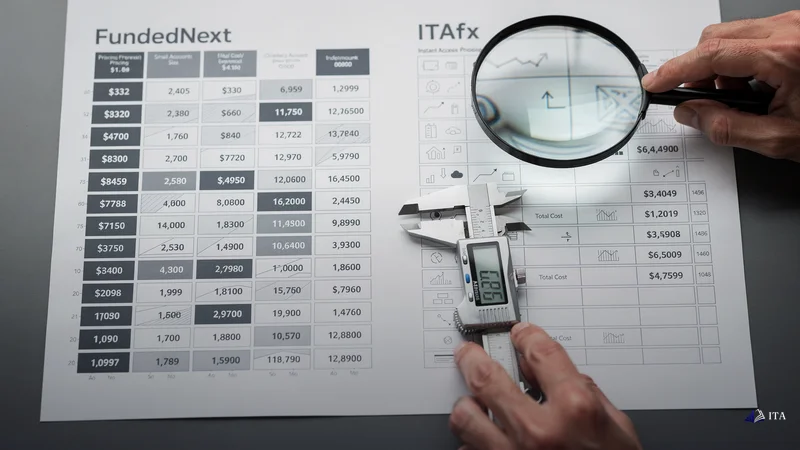
FundedNext Pricing: From $32 to $1,099 Across Models
FundedNext's pricing reflects its multi-model approach: entry-level challenges start around $32 for smaller accounts, scaling to roughly $1,099 for larger allocations. The fee-to-capital ratio varies by model, 2-step challenges typically cost less than 1-step express options for equivalent capital, since the express route trades a lower fee for a stricter, faster pass bar. The full value calculation needs to factor in realistic pass probability: a cheaper challenge with a lower pass rate can end up costing more in total attempts than a pricier one with a higher pass rate, and FundedNext's evaluation-phase profit share shifts that calculation further still in the trader's favour if the account passes.
ITAfx Pricing: One Fee, Immediate Access
ITAfx's instant model prices accessibility differently: by removing the evaluation phase, it also removes the risk of paying a fee and never reaching funded status at all, a cost that never shows up in headline pricing but matters enormously to anyone who's failed a challenge before. The real comparison isn't fee versus fee, it's total cost to funded status. A challenge model can multiply its effective cost across several attempts; an instant account's single fee, even where it's higher upfront, doesn't carry that multiplication risk. That trade-off tends to favour traders with an already-proven strategy who see repeated evaluation attempts as an expensive way to relearn the same lesson.
User Experience and Trust: Verifying Reliability
In an industry where trust directly affects capital access, verification matters as much as marketing claims, for either firm.
FundedNext's Trustpilot Rating and Community Feedback
FundedNext's Trustpilot rating, consistently in the mid-4s across thousands of reviews, offers a reasonable statistical base for confidence in its operations. Beyond the aggregate score, review patterns point to specific operational strengths: consistent payout processing, responsive support during evaluations, and clearly enforced rules. Its YouTube presence adds another layer, independent traders posting payout proofs and account statements, organic content that builds credibility in a way paid marketing can't replicate.
ITAfx: Verification Is on You, and That's Workable
ITAfx's lighter third-party footprint shifts more of the verification burden onto the individual trader. Without an extensive Trustpilot history or a library of YouTube deep-dives to lean on, that means checking corporate registration, requesting payout proof directly, and considering a smaller account size first to test operational reliability before committing larger capital. That's not automatically a red flag, plenty of solid firms don't chase review-site rankings, but it does mean doing the legwork yourself rather than outsourcing it to aggregate scores.

The ITAfx Approach: Why We Built the Model This Way
At ITAfx, the instant account model exists because we saw a real inefficiency in the standard evaluation structure: why require profitable traders to prove consistency through an artificial challenge when their actual trading history already demonstrates it?
Instant Accounts: Funded From Day One
Our instant model removes the evaluation phase entirely, you're not paying for a chance at funding, you're accessing capital immediately, with strict risk controls in place from the first trade instead of a graded test beforehand. We've processed over $1.7 million in payouts to 1,700+ funded traders across 97+ countries on this model.
The psychological difference is real. A challenge creates pressure to pass a test, not simply to trade well, and that test-taking mindset can distort the very consistency it's meant to measure. Removing the test lets a trader run their actual strategy from day one, for better or worse.
Institutional-Style Risk Parameters
Our 3% daily / 6% total loss limits are tighter than some competitors' 4%/8% structure by design, they're meant to enforce the discipline institutional risk desks operate under, not to make the account harder to keep. Tighter limits don't cap upside, they cap the overleveraging that tends to end accounts prematurely.
Transparent Payouts and a Refund on Your First Win
Splits run up to 95% on standard accounts (120% on Instant PRO), with payouts processed within 48-72 hours, no complex payout formulas or extended holding periods behind the number. On top of that, our 100% refund policy returns your original entry fee in full, on top of your withdrawal amount, once you hit your first payout, a direct way of putting our confidence in the model where our fee structure is. Our guide on Best instant funded forex account 2026 covers this in more depth.

Verdict: Which Prop Firm Fits You in 2026?
ITAfx tends to offer better value for experienced traders who want instant capital access, transparent fees, and don't need external validation of their strategy. FundedNext tends to suit traders who want the reassurance of extensive third-party track record, multiple entry paths, and futures market access. Which one is "right" depends far more on where you are as a trader than on any single headline number.
Choose FundedNext If...
FundedNext suits traders who value extensive third-party validation and an active community. If you're newer to prop trading and want the reassurance of thousands of reviews and independent YouTube walkthroughs, its documented track record provides real peace of mind. The multi-model structure also gives you room to start with a 2-step challenge, move to 1-step express, or try the instant option, without switching providers. Its futures offering is also worth a look specifically if you trade commodities or indices and prefer genuine exchange-traded contracts over CFD execution.
Choose ITAfx If...
ITAfx fits traders who already trust their edge and don't need an evaluation to confirm it. If challenge fees feel like an expensive formality standing between you and live trading, the instant model removes that friction, and the tighter 3%/6% risk parameters, rather than being a downside, tend to reward traders who already size positions with institutional-style discipline. It particularly suits traders who've already passed challenges elsewhere and are looking to deploy proven skills without repeating the process.
The Practical Takeaway
Neither model is objectively superior, they solve different problems for different trader profiles, and switching costs between them are lower than most traders assume. Someone still building a track record may get real value from FundedNext's structured evaluation and community support; someone with a proven strategy who's tired of paying to re-prove it may find ITAfx's instant model a better fit for where they are right now. Our guide on instant funding prop firm no evaluation covers the instant-access side of that decision in more depth.
Ready to get funded?
50% off instant accounts with code 50CRYPTO.
Get Funded →Frequently Asked Questions
Is Funded Next a safe and reliable prop firm compared to newer firms like ITAfx?
Funded Next has extensive third-party coverage with a Trustpilot rating consistently in the mid-4s out of 5 and documented payouts, whilst ITAfx operates with limited public data visibility. Both offer legitimate funded accounts, but Funded Next provides more transparency through review sites. ITAfx requires additional due diligence due to less comprehensive third-party validation, though this doesn't automatically indicate unreliability.
What are the exact profit split structures for Funded Next's different models?
Funded Next offers 90-95% profit splits for CFDs, with futures products potentially reaching 100% through add-ons. They also reportedly share a portion of evaluation-phase profits with traders, a detail worth confirming directly with the firm. ITAfx matches with up to 95% on standard accounts and 120% on Instant PRO tiers. Payout processing times vary by firm and account tier: ITAfx targets 48-72 hour turnaround, while Funded Next's schedule should be confirmed directly before relying on it.
How do the drawdown limits compare between Funded Next and ITAfx?
Funded Next uses 4% daily and 8% maximum drawdown limits with balance-based calculations, creating a 1.5:1 profit-to-drawdown ratio. ITAfx employs tighter 3% daily and 6% maximum limits, enforcing more conservative position sizing. The tighter ITAfx limits align with institutional risk management standards but may frustrate aggressive scalpers who prefer Funded Next's breathing room.
Does Funded Next allow news trading and scalping without consistency rules?
Funded Next removes consistency rules once funded in their Express/1-step and futures models, permitting news trading and flexible strategies. Their CFD and futures dual access provides more market options than CFD-only competitors. Most established prop firms including Funded Next allow scalping and expert advisors, with specific rule variations depending on the challenge model selected during evaluation.
What due diligence should traders perform when choosing between established and newer prop firms?
Verify corporate registrations, request payout proofs, check Trustpilot ratings, and start with smaller account sizes to test reliability. Established firms like Funded Next offer extensive review coverage and documented track records. Newer firms require direct investigation of operational history, customer support responsiveness, and actual payout processing times before committing to larger capital allocations.
Key Takeaways
- Choose FundedNext for extensive third-party validation, multiple evaluation models, and futures market access.
- Select ITAfx for instant funded accounts up to $400K with no evaluation required and up to 95% profit splits (120% on Instant PRO).
- FundedNext offers a well-documented track record, tens of thousands of traders, and a Trustpilot rating consistently in the mid-4s.
- ITAfx runs tighter risk parameters (3% daily / 6% total) versus FundedNext's ~4%/8% structure, and restricts arbitraging, grid trading, and copy-trading between accounts.
- FundedNext shares a portion of evaluation-phase profits with traders, a rare feature among challenge-based firms.
- ITAfx's single instant-account fee avoids the retry-cost multiplication that challenge models can carry, and refunds 100% of the entry fee on your first payout.
- Compare FundedNext's $4M scaling ceiling against ITAfx's $400K immediate access, then match the model to your own track record and capital needs.
Ready to get funded?
Instant accounts, simulated capital, rules published before you pay. 50% off with code 50CRYPTO.
Get Funded →