 ITA
ITAProp Firm Drawdown Rules: The Complete 2026 Guide to Daily, Max & Trailing
Master prop firm drawdown rules that determine account survival. Learn daily vs. max drawdown, trailing vs. static limits, and risk management strategies.
Short answer
Prop firm drawdown rules set the maximum loss path allowed on the account. Most evaluation and funded stages apply those rules to simulated capital, so the limit is a contract, not a suggestion.
Simulated capital: prop firm evaluation and funded stages discussed here typically run on simulated accounts. Challenge fees pay for access to that environment; they are not a deposit of trading capital. ITAfx accounts are simulated capital.


Understanding Prop Firm Drawdown: The Core Risk Constraint
Prop firm drawdown rules explained: Most traders approach prop firm challenges thinking drawdown is simply "don't lose more than X percent." This surface-level understanding feels logical. After all, if you have a 10% maximum drawdown on a $100,000 account, you just need to keep your account above $90,000, right?
This is the obvious answer that gets repeated in forums, YouTube videos, and basic prop firm guides. Risk 1-2% per trade, set your stops, don't overtrade, and you'll be fine.
But here's what changes everything: prop firm drawdown isn't one rule. It's a system of interlocking constraints that create a constantly shifting minefield. The interaction between daily limits, maximum limits, and most critically, the calculation methodology (trailing versus static, equity versus balance) creates failure conditions that didn't exist in your retail account.
Let's start with the fundamental distinction that catches most traders off guard. When you trade your own capital, drawdown is straightforward. It's the peak-to-trough decline in your account value. But prop firms layer multiple types of drawdown rules that must all be respected simultaneously. Our guide on How to avoid breaching prop firm drawdown limits covers this in more depth.
Daily drawdown represents your maximum allowable loss in a single trading day. Breach this limit, even once, even if you're profitable overall, and your evaluation or funded account ends immediately. The critical detail most traders miss? Some firms calculate this from your starting daily balance, while others use a rolling calculation that includes your open positions. That distinction alone can mean the difference between survival and termination.
Daily Drawdown Rules: Your Single-Day Loss Limit
Daily drawdown rules set your maximum allowable loss in a single trading session, typically ranging from 3-5% of your account balance depending on the firm's risk parameters.

Maximum overall drawdown sets the total loss limit for your account's entire lifespan. This sounds simple until you discover that many firms use trailing drawdown, where your maximum loss limit moves up with your profits but never moves back down. Every new equity high resets your failure threshold higher, permanently.
The mathematics of trailing drawdown reveal why it's so lethal. Start with a $100,000 account and a 10% maximum trailing drawdown. Your initial stop-out level sits at $90,000. Now you trade brilliantly and grow the account to $110,000. Your new stop-out level? It's not $90,000 anymore (it's $99,000, which is 90% of your new $110,000 peak).
That $9,000 cushion you thought you earned? It's gone. Your maximum allowable loss is now just $11,000 from your peak, not the $20,000 you might have assumed.
This creates what experienced funded traders call "the trailing trap." The more successful you are, the tighter your risk constraints become. A trader who grows their account by 15% actually has less room for drawdown than when they started. It's a paradox that defies conventional risk management logic.
The calculation method goes even deeper. The distinction between balance-based and equity-based drawdown fundamentally changes how you must trade. Balance-based drawdown only considers closed positions. Your floating P&L doesn't affect your drawdown calculation until you close trades. This gives you flexibility to weather intraday volatility.
Maximum Overall Drawdown: The Account's Lifespan Limit
Maximum overall drawdown establishes the total loss threshold for your entire account lifecycle, typically set between 8-12% of your starting balance across most proprietary trading firms.

Equity-based drawdown includes your open positions in real-time. Every tick against you brings you closer to violation. Many firms use intraday trailing equity drawdown (the most restrictive combination possible). Your failure line follows your highest unrealized equity moment by moment, even if you never close those profitable positions.
Here's a practical example that illustrates the danger:
- You're trading a $100,000 account with 5% daily drawdown limit and 10% max trailing drawdown
- You enter a position that quickly shows $3,000 in floating profit
- Under equity-based trailing rules, your new maximum drawdown level just moved up by $3,000
- If that position reverses and you close it for breakeven, you've still permanently raised your stop-out level
- The profit you never actually captured still counts against you
The institutional approach to managing these constraints differs radically from retail risk management. Professional funded traders don't think in terms of "risk per trade." They think in terms of "distance to violation." Every position is sized not based on the setup's merit, but on its maximum possible excursion relative to their current drawdown limits.
Our guide on Prop Firm Drawdown Rules covers this in more depth.
This means building what institutional traders call a "drawdown buffer." Before pursuing profit targets, they intentionally trade smaller to accumulate a cushion above their maximum drawdown level. A 2-3% buffer might seem overly conservative, but it's the difference between surviving a normal market event and account termination.
Balance-Based vs. Equity-Based Drawdown: Which is More Restrictive?
Balance-based drawdown calculates losses from your account's starting balance, whilst equity-based drawdown measures from your highest achieved balance. This makes equity-based rules significantly more restrictive for profitable traders.
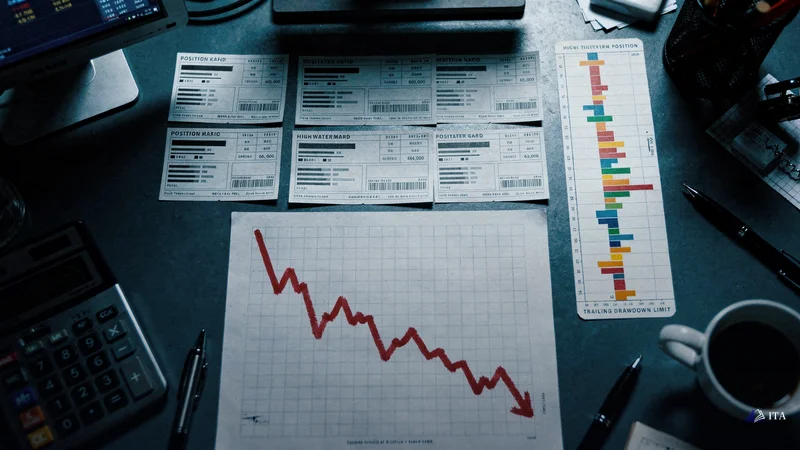
Position sizing under these constraints requires calculating the maximum loss each trade could generate before manually closing to protect your drawdown limits. If you have $2,000 in daily drawdown remaining and your trade could see $1,500 in adverse movement, you're risking 75% of your remaining daily limit on a single position.
The operational rules that emerge from this reality are strict:
- Never risk more than 20% of your remaining drawdown allowance on a single trade
- Stop trading for the day after consuming 50% of your daily limit
- Maintain position documentation showing distance to both daily and max drawdown at all times
- Calculate your effective leverage based on remaining drawdown, not account size
When evaluating prop firms, the drawdown structure often matters more than the advertised profit split or account size. A firm offering 90% profit split with restrictive intraday trailing equity drawdown might be far harder to succeed with than a firm offering 70% split with end-of-day balance-based rules.
Institutional Risk Management for Drawdown Compliance
Institutional risk management for drawdown compliance requires systematic position sizing based on remaining violation distance rather than traditional percentage-per-trade methods.

The critical evaluation criteria include:
- Is the maximum drawdown static or trailing?
- Is the daily drawdown calculated intraday or end-of-day?
- Are calculations balance-based or equity-based?
- How do the rules interact with each other?
- What happens to limits after a payout?
Most futures prop firms now use end-of-day trailing drawdown (a more trader-friendly approach than intraday calculation). However, many firms enforce consistency rules that add another layer of complexity, capping single-day profits relative to your total gain.
Before committing capital to any evaluation, the only reliable approach is systematic testing under the exact drawdown conditions you'll face. This means more than just backtesting. It requires forward testing with self-imposed alerts that mirror the firm's actual termination mechanics.
Evaluating Prop Firms: A Drawdown Comparison Framework
Evaluating prop firms requires testing their drawdown rules against your actual trading strategy through demo simulation before paying evaluation fees.

Create a demo account with identical starting balance, set automated alerts at daily and maximum drawdown levels, then trade your exact strategy for 30-60 days treating every alert as account termination. Include gap opens, news events, and platform outages in your testing.
The truth about prop firm drawdown rules is that they're not designed to accommodate normal trading volatility. They're designed to protect the firm. The tighter the rules, the more likely traders are to fail evaluations and forfeit their fees. This isn't necessarily predatory (it's business reality). Firms need sustainable risk models to offer genuine funded accounts.
At ITAfx, we've taken a different approach with our instant account model. While we maintain protective drawdown limits (6% maximum loss, 3% daily loss), we calculate them in ways that align with real trading conditions. More importantly, our instant account path removes the evaluation pressure where most drawdown breaches occur during the challenge phase when traders push too hard to hit profit targets.
Our guide on how to recover from trading drawdown covers this in more depth.
The revelation that changes everything isn't that drawdown rules are strict. It's that they create a dynamic risk environment where your success actively works against you. The more profit you generate, the more precisely you must trade. The higher your equity peaks, the less room you have for normal trading drawdowns.
Testing Your Strategy: Simulating Drawdown Conditions
Testing your strategy under drawdown conditions requires simulating real market stress scenarios where your risk management faces maximum pressure.
This demands:
- Optimizing for account survival rather than profit maximization
- Sizing positions based on distance from termination rather than opportunity
- Calculating how floating profits affect your failure threshold rather than celebrating unrealized gains
The traders who successfully navigate these constraints share one characteristic: they track their invisible failure line as obsessively as they track their profits. They know exactly how far they are from each drawdown limit at every moment.
They size positions based on worst-case scenarios, not expected outcomes. They understand that in the world of prop trading, the most dangerous moment isn't when you're losing. It's when you're winning. Because that's when the noose tightens.
Ready to get funded?
50% off instant accounts with code 50CRYPTO.
Get Funded →Frequently Asked Questions
What is drawdown in prop firm trading, and how is it different from normal account drawdown?
Prop firm drawdown is a multi-layered risk constraint system that includes daily loss limits and maximum total drawdown limits, calculated in real-time to protect the funded account. Unlike retail trading where drawdown is simply peak-to-trough decline, prop firms use trailing calculations that move your failure threshold higher with profits but never lower it back down.
How do daily drawdown and maximum overall drawdown work in prop firm challenges?
Daily drawdown sets your maximum loss per trading day (typically 5% of starting balance), while maximum overall drawdown limits total losses across the account's lifetime (usually 8-12%). Both must be respected simultaneously, breaching either limit results in immediate account termination, regardless of previous profitability or current equity levels.
What is trailing drawdown, and why do so many prop traders dislike intraday trailing rules?
Trailing drawdown moves your maximum loss limit up with new equity highs but never moves it back down, creating tighter constraints as you become more profitable. Intraday trailing rules calculate this in real-time including open positions, meaning normal pullbacks after floating profits can violate rules even if your closed balance remains positive.
What is the difference between balance-based and equity-based drawdown limits?
Balance-based drawdown only counts closed trades in your loss calculations, giving flexibility to weather intraday volatility. Equity-based drawdown includes open floating P&L in real-time, making every tick against you bring you closer to violation and requiring more precise position management throughout each trading session.
How much should I risk per trade to stay safely within prop firm drawdown rules?
Industry guidance for 2026 suggests risking 0.25-1% per trade on prop accounts, with many experts recommending ≤0.5% per trade. More importantly, never risk more than 20% of your remaining drawdown allowance on a single position, and stop trading after consuming 50% of your daily limit to maintain a protective buffer.
Key Takeaways
- Calculate daily drawdown from your starting balance each day, breach this limit once and your account terminates immediately.
- Understand trailing drawdown mechanics: your stop-out level rises permanently with profits but never falls back down with losses.
- Distinguish between balance-based and equity-based calculations, equity rules include floating losses and are significantly more restrictive.
- Never risk more than 20% of your remaining drawdown allowance on any single position to maintain survival buffer.
- Test prop firm drawdown rules through 30-60 day demo simulation before paying evaluation fees to avoid costly surprises.
- Stop trading after consuming 50% of your daily drawdown limit to prevent emotional overtrading from destroying your account.
- Size positions based on distance to violation, not opportunity, institutional traders prioritise account survival over profit maximisation.
Start Your Trading Evaluation
Simulated funded accounts up to $400K. Up to 95% profit split.
Get Funded