 ITA
ITAHow to Verify a Prop Firm Actually Pays Before You Buy
Before paying for an evaluation, check whether the firm pays. Public ledgers, payout claims, and the shutdown wave that made this urgent.

How this article is verified: Every number and claim above is checked against a primary source, ITAfx's own Terms of Service, official product pages, or the trading platform itself, before publication, then re-verified again immediately before this page goes live. Fact-checked and published on July 30, 2026 by Adrian Caldwell.
The question is not "do prop firms pay" - it's "will this one still be here"
The framing most traders start with is a moral one: is this firm honest or dishonest. That framing is a bad predictor, because the most common way a payout fails to arrive is not a refusal. It is a company that stopped existing.
That failure mode deserves its own check: map what happens to a payout when a prop firm shuts down before treating a historical payment record as protection.
What the 2024 shutdown wave actually killed
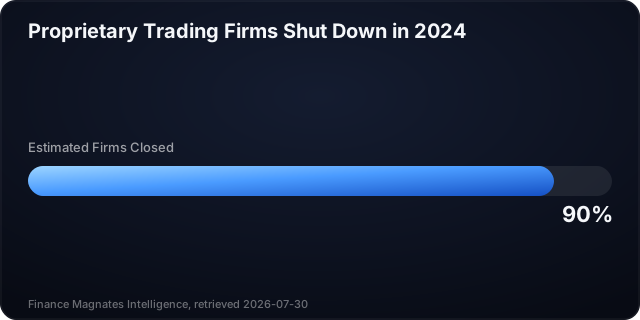
Finance Magnates Intelligence estimates that between 80 and 100 proprietary trading firms disappeared from the market in 2024, triggered by the dominant retail trading-platform vendor stepping back from supporting prop firms (Finance Magnates, retrieved 2026-07-30).
Read the mechanism in that sentence carefully, because it matters more than the number. The trigger was not a fraud sweep. It was platform dependency. A large share of those firms ran their evaluations on trading software they did not own and could not replace quickly, and when access to that software narrowed, the business underneath it had no floor. Traders mid-evaluation at those firms did not lose money to a villain. They lost their progress to a supply chain.
That reframes your verification job. You are not trying to detect bad intentions, which are invisible before the fact. You are trying to estimate durability: is this company's ability to pay you dependent on one vendor, one payment processor, or one marketing channel that could close next quarter. This durability question is also central to weighing prop firm selection mistakes that traders make before they ever get to a payout.
Why an unpaid payout usually starts as an operational failure, not a refusal
Sequence matters. A firm rarely announces that it will not pay you. What happens first is slower: support response times stretch, a payout gets flagged for "review," a rule you had not read gets cited, and the withdrawal sits in a pending state. From the outside, malice and insolvency look identical. Both produce a dashboard that says pending.
If the delay becomes a disagreement, preserve the original terms, support messages, and timestamps before following a prop firm dispute escalation process; escalation without a record is only an argument.
This is why the checks below are weighted toward evidence that exists outside the firm's own systems. A firm under stress can still show you a healthy dashboard. It cannot as easily forge a public record.
If you are not yet clear on which rules can legitimately pause a first withdrawal, read the beginner walkthrough of funded account rules before you buy, not after.
Why testimonials, Trustpilot, and payout screenshots prove almost nothing
Every one of those three artifacts shares a defect: the party being evaluated controls its production or its curation.
A payout screenshot is an image of a number. It has no chain of custody. Nothing in the file tells you whether the transfer settled, whether it was reversed the next day, whether the account belonged to an employee, or whether the image was edited. Screenshots are evidence that someone made an image, and nothing more.
Testimonials are selected. Even when every individual testimonial is truthful, the set you see is chosen by the firm, which means the denominator is hidden. You are shown ten traders who got paid and not the number who applied.
Review platforms sit in the middle. Trustpilot is genuinely harder to manipulate than a testimonial page, and a sudden cluster of complaints about pending withdrawals is a real signal worth reading. But review scores are lagging indicators. They tell you what happened to other people weeks or months ago, and a firm can carry a strong historical score straight into a shutdown. Read the one-star reviews for specifics, ignore the average.
Influencer endorsements are a separate problem with its own method, and this page does not own it. If your shortlist came from a YouTube channel or a Telegram group, go through the warning signs of a fake trading guru first, then come back here to check the firm itself.
The verification ladder: five checks ranked by how hard they are to fake
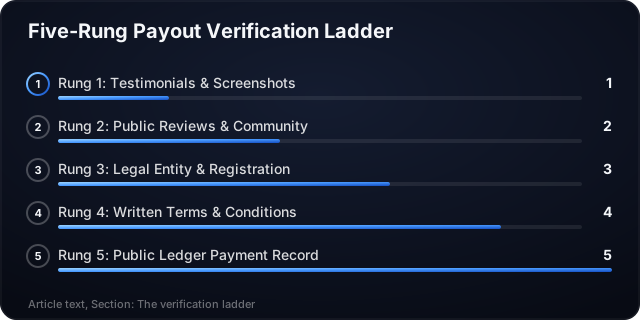
Run these in order. Each rung is harder to fabricate than the one below it. None of them is sufficient alone, and the ranking is the useful part: it tells you how much weight a given piece of evidence deserves.
| Rung | Check | What it proves | What it does not prove |
|---|---|---|---|
| 1 | Testimonials and payout screenshots on the firm's site | The firm is willing to claim it pays | Nothing verifiable |
| 2 | Public review platforms and community threads | Other traders' recent experience, lagging | Current solvency |
| 3 | Named legal entity, jurisdiction, company number | A real company exists and can be looked up | That it is well capitalised |
| 4 | Written, dated terms: payout window, conditions that pause a payout | What the firm has committed to in writing | That it will honour the commitment |
| 5 | Payouts recorded on a public ledger you can query yourself | That specific payments actually settled | That rules were applied fairly |
Rung 1-2: self-reported evidence (what it's still useful for)
Do not throw rungs 1 and 2 away. Use them as a disqualifier, never a qualifier. A firm with no payout evidence at all is a problem. A firm with abundant payout evidence has told you nothing, because that evidence is free to produce. Asymmetric weighting is the trick: absence is meaningful, presence is not.
Rung 3-4: third-party and corporate-record checks
Find the operating entity's legal name, jurisdiction, and registration number, then look it up in that jurisdiction's registry yourself. You are checking three things: that the company exists, that the name on the terms of service is the name on the payment you will eventually receive, and that the entity was not incorporated three weeks ago.
Then read the terms as a contract, not as marketing. You are looking for the payout window in days, the conditions that allow the firm to pause or void a payout, and whether the profit split is stated as a fixed number or as "up to" something. "Up to" is not a lie, but it is a range, and you should know where in the range you sit before you pay. A checklist that walks through this kind of due diligence line by line lives in the prop firm evaluation criteria checklist.
Treat a payout certificate as a pointer to evidence, not the evidence itself; the payout certificates and statistics guide separates what those artifacts prove from what they cannot. Because rules can change after publication, compare the dated terms you saved with a rule-change monitoring process before every withdrawal.
If you are comparing several firms on fees and rules rather than on payment reliability, that comparison lives in the prop firm alternatives breakdown.
Rung 5: payouts on a public ledger you can open yourself
The strongest evidence available to a retail trader today is a payment record the firm does not host. Some prop firms route trader payouts through RISEPAY, an on-chain payment infrastructure on the Arbitrum network, whose transactions are recorded on a public ledger that anyone can independently check (Arbiscan, Rise Pay token tracker, retrieved 2026-07-30).
The reason this outranks everything above it is structural, not technological. A dashboard is a claim rendered by the firm's own server. A public ledger entry is a record the firm wrote to a system it does not control and cannot quietly edit. You are no longer trusting a screenshot; you are reading the same database the firm reads.
Be precise about the limit. A ledger entry proves a payment of a certain size settled at a certain time. It does not prove that the trader was treated fairly, that the rules were applied consistently, or that ten other traders were not denied that week. It answers "did money move," which is exactly the question rungs 1 through 4 could not answer, and no more.
How to read an on-chain payout record without being technical
You do not need to understand cryptography for this. You need to be able to read a table.
A block explorer is a public website that displays the contents of a blockchain in plain rows. For the Arbitrum network, Arbiscan is the common one (Arbiscan, Rise Pay token tracker, retrieved 2026-07-30). You open it, paste in an address or a token contract, and you see a list of transfers with timestamps, amounts, senders, and recipients.
Here is what to actually look at. First, the timestamps: are payouts spread continuously across recent weeks, or do they cluster into a burst that stops abruptly two months ago. A live payout rail looks like a heartbeat. Second, the amounts: real trader payouts vary in messy ways, because real profits are not round numbers. Third, recency: the single most useful data point is whether something settled this week.
What the record cannot tell you: which trader received a given payment, whether that trader was an affiliate or an employee, and whether the total volume represents a hundred traders or four. Addresses are pseudonymous. Treat volume and recency as the signal, and identity as unknowable.
Context on why this rail exists at all: the commercial motive is cross-border settlement without correspondent banking delays, which is the same reason a firm paying traders across many jurisdictions would reach for a stablecoin rail rather than a chain of intermediary banks.
One hard limit, stated plainly: on-chain is not the same as regulated, insured, or supervised. A public ledger improves your ability to audit payments. It creates no consumer protection, no deposit insurance, and no regulator you can complain to. Anyone who tells you otherwise is selling something.
The pre-purchase audit: what to check in the 20 minutes before you pay
Run this sequence on any firm, in this order, before your card details go in.
- Identify the paying entity. Find the legal name and registration number on the terms or legal page. If you cannot find one, stop. Everything below depends on knowing who owes you.
- Locate the stated payout window in writing. Not in a headline. In the terms. Note whether it says "within X hours" as a target or as an obligation, and whether the clock starts on request or on approval.
- List the conditions that can pause a payout. Rule violations, KYC review, minimum days traded, consistency requirements. You want these enumerated before you trade, because a rule you discover during a withdrawal always feels invented. The mechanics behind why drawdown limits trigger these pauses are covered in how to avoid breaching prop firm drawdown limits.
- Read the drawdown definition and confirm you can compute it. This page will not do that math for you; the drawdown calculation guide is where that lives. Confirm only that the firm states which method it uses.
- Check the withdrawal mechanics end to end. How a request is actually submitted and processed is covered in the funded account withdrawal process. Read it, then confirm the firm's process matches a normal one.
- Look for evidence at rung 5. Ask support, directly, whether payouts are routed through an on-chain processor and whether they will point you at the public record. The answer is informative either way, including a non-answer.
- Search the firm's name with the words "pending withdrawal" and a recent month. You are looking for a cluster, not a single angry post.
Twenty minutes. If a firm fails step 1 or step 3, you have saved yourself the fee.
What ITAfx can and cannot prove to you
An article about auditing firms that exempts its own author is worth nothing, so here is ITAfx against its own ladder.
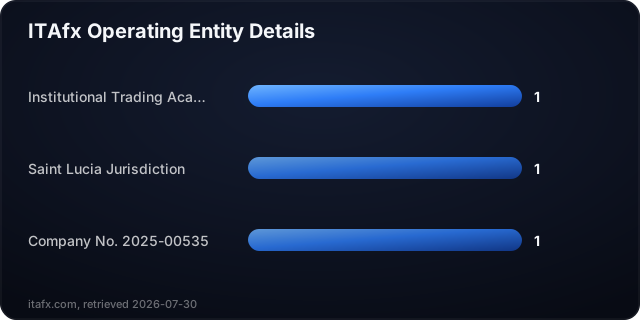
Rung 3, the entity. ITAfx is operated by Institutional Trading Academy Ltd., Saint Lucia, company no. 2025-00535 (itafx.com, retrieved 2026-07-30). You can look that up without asking us.
What the product is. ITAfx provides simulated trading evaluation services. Challenge fees pay for access to evaluation environments, not investments or deposits. All trading in evaluation environments is simulated. ITAfx does not act as a broker, custodian, or investment adviser. The instant-funding model has no evaluation time limit, simulated capital sizes run from $50K to $400K, the profit split is up to 120% on Instant PRO, which pays 100% of the simulated profit plus a separate 20% bonus on top (a figure that only exceeds 100% by counting a promotional bonus on top of the base split; the source does not break out the two), payouts are typically within 24 hours, and fees that are final and non-refundable, as set out in our Return Policy (itafx.com, retrieved 2026-07-30). Trading runs on third-party platform. Those figures change with promotions, so check itafx.com for what is current rather than trusting this page's date. If the difference between a simulated evaluation account and a live account is still fuzzy, the demo versus funded account comparison explains it. For how this instant-funding structure compares to challenge-based models generally, see the prop firm instant account guide.
Rung 4, written terms. The payout window, the profit split, and the conditions that govern withdrawals belong in ITAfx's published terms, and that is where you should read them, not here. Any page restating a rules table goes stale the moment the table changes.
What no instant-funding firm can prove to you. Three things, honestly. It cannot prove it will exist in two years, because durability is not demonstrable in advance; the 80 to 100 firms that vanished in 2024 all looked operational the year before (Finance Magnates, retrieved 2026-07-30). It cannot prove its rules were applied fairly to every trader, because you only ever see your own account. And a firm founded recently cannot show you a long payment history, because the history does not exist yet; a 2025 registration number is a fact about age, not about intent.
What a firm can do is name its entity, publish its rules, and make its payments checkable outside its own dashboard. Hold every firm to that, including this one.
Ready to get funded?
50% off instant accounts with code 50CRYPTO.
Get Funded →Frequently Asked Questions
Do prop firms actually pay out?
Many do, and the more useful question is which ones will still be operating when you qualify. Finance Magnates Intelligence estimates that between 80 and 100 proprietary trading firms disappeared from the market in 2024, triggered by the dominant retail trading-platform vendor stepping back from supporting prop firms (Finance Magnates, retrieved 2026-07-30). Most failed payouts trace to a company ceasing operations, not to a deliberate refusal.
What is the single strongest proof that a firm pays?
A payment record on a public ledger that the firm does not host. Some prop firms route trader payouts through RISEPAY, an on-chain payment infrastructure on the Arbitrum network, whose transactions are recorded on a public ledger that anyone can independently check (Arbiscan, Rise Pay token tracker, retrieved 2026-07-30). It proves payments settled. It does not prove rules were applied fairly.
Are Trustpilot reviews reliable for checking a prop firm?
They are more useful than testimonials and less useful than corporate records. Treat the score as a lagging indicator and read recent one-star reviews for specific, repeated complaints about pending withdrawals.
Does on-chain payment mean a prop firm is regulated?
No. A public ledger makes payments auditable. It provides no licensing, no insurance, and no regulator to appeal to.
How long should the pre-purchase check take?
About twenty minutes: identify the legal entity, find the written payout window, list the conditions that can pause a payout, confirm the drawdown method is stated, and search for recent complaint clusters.
Can I verify a firm's payouts myself without technical skills?
Yes, if the firm uses an on-chain rail. A block explorer such as Arbiscan displays transfers as a plain table of timestamps and amounts (Arbiscan, Rise Pay token tracker, retrieved 2026-07-30). You are checking recency and continuity, not decoding anything.
Ready to get funded?
Instant accounts, simulated capital, rules published before you pay. 50% off with code 50CRYPTO.
Get Funded →Verification of payouts sits next to fee and speed tables. Use the instant funding prop firms comparison alongside the instant funding guide when you shortlist firms.