 ITA
ITAProp Firm Payout Certificates and Stats: What They Prove
Payout certificates, live counters, monthly reports, Deloitte audits, certification badges: what each prop firm payout artifact actually proves, and what it can't.

How this article is verified: Every number and claim above is checked against a primary source, ITAfx's own Terms of Service, official product pages, or the trading platform itself, before publication, then re-verified again immediately before this page goes live. Fact-checked and published on August 2, 2026 by Adrian Caldwell.
The question behind every payout screenshot: does this firm actually pay?
Why "they publish payout proof" is not one claim but five different ones
A per-withdrawal certificate says a specific transaction happened. A live counter says a firm's internal accounting reached a number. A league table says an outside compiler added up what firms told it. A monthly report says a firm is willing to be checked against itself over time. An audit says a named third party examined defined transactions in a defined window. Treating those as interchangeable "trust signals" is how a trader ends up reassured by the weakest artifact in the set, because the weakest one is usually the prettiest.
The structural gap: prop firms report no data to any regulator
Here is the fact that makes artifact type matter more than headline size. Finance Magnates concluded in June 2025 that prop firms' total-payout claims cannot be independently verified, because prop firms, unlike CFD brokers, are not required to report any data to a regulator (Finance Magnates, retrieved 2026-07-30).
There is no filing to pull. No supervisory return, no audited regulatory statement of client money, nothing you can request from an authority and read for yourself. Every aggregate number in this industry originates inside the firm publishing it, unless a named third party has been paid to look, and that almost never happens.
It gets worse before it gets better. Finance Magnates also reports that firms control their own definitions of what counts as a payout, and that distinguishing genuine trader payouts from vendor payments and affiliate commissions run through the same channels is not straightforward, which is how some firms' headline payout totals get inflated (Finance Magnates, retrieved 2026-07-30).
So two firms can both be telling the truth and still be uncomparable, because one counts only trader withdrawals and the other counts everything that left the same bank rail. Which is exactly why you rank the artifact, not the number. Some of the reasons a withdrawal never reaches the payout stage at all are covered in why prop firms deny payouts, a separate question from whether a paid claim can be verified.
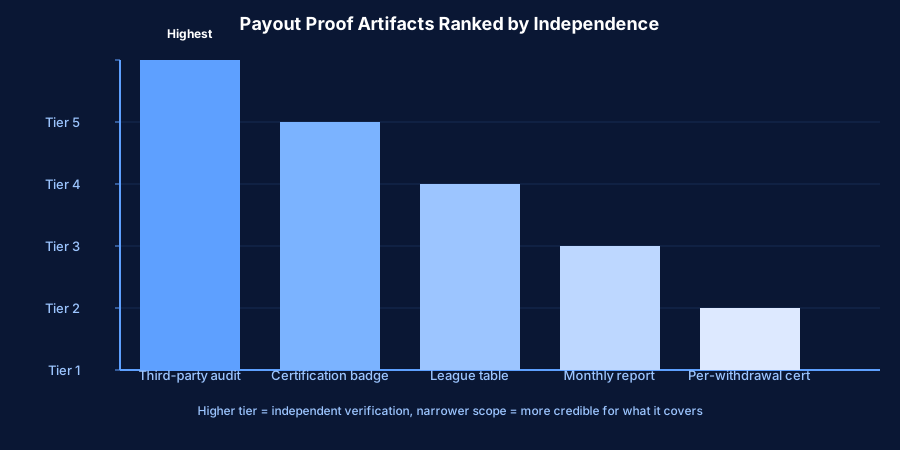
The five payout-proof artifacts, ranked by what they can establish
| Artifact type | Who produced it | What it establishes | What it cannot establish | Worked example |
|---|---|---|---|---|
| Third-party commissioned audit | An outside audit firm, paid by the prop firm | That defined transactions in a defined window behaved as described | Anything outside the window or the audited population; solvency | Deloitte's review of Hola Prime payouts, 15 October 2025 to 15 March 2026 (Finance Magnates, retrieved 2026-07-30) |
| Industry certification badge | An independent self-regulatory body | That the firm submitted to a defined process and met its criteria | Licensing, financial strength, solvency, or any trader's outcome (Financial Commission, retrieved 2026-07-30) | Financial Commission Prop Firm Certification, launched 22 July 2026 (Financial Commission, retrieved 2026-07-30) |
| Third-party compiled league table | An outside aggregator, using figures firms supply | A cross-firm view assembled outside any single firm's marketing | Accuracy of the inputs; it is compiled, not audited, and coverage can exclude major firms | Prop Firm Match's 2025 table, roughly $325 million full-year, excluding FTMO and The5ers (Finance Magnates, retrieved 2026-07-30) |
| Firm-published recurring monthly report | The firm itself, on a schedule | A dated series that can be checked against itself and against outside trackers | Independence; the firm still defines the terms and the totals | FundedNext's February 2026 report, $15.19 million to 8,340 traders (Finance Magnates, retrieved 2026-07-30) |
| Self-generated certificate or curated record | The firm or its platform vendor, per event | That one specific withdrawal was processed | Anything about any other trader, any other period, or the firm's finances | third-party platform's Payout Certificate feature (third-party platform, retrieved 2026-07-30) |
Note the distinction the table is built to protect: independently audited and independently compiled are not the same tier. An auditor examines the underlying transactions. A compiler adds up what it was given.
Per-withdrawal payout certificates: proof of one event, nothing more
What third-party platform's certificate feature actually confirms
This is now a platform feature rather than a bespoke document. Trading platform vendor third-party platform's March 2026 release lets funded-account traders generate and share an official Payout Certificate for every completed withdrawal, a formal, verifiable confirmation of a processed payout meant for external use (social proof, personal record), not a third-party audit of the firm's finances (third-party platform, retrieved 2026-07-30).
Read that carefully, because the vendor is unusually candid about scope. The certificate confirms a processed payout. That is a real fact, and a useful one. If you are the trader holding it, you have documentation that money left the firm and reached you on a date. If you are building a track record, that is worth having.
Why a certificate says nothing about the other 9,000 traders
The ceiling arrives immediately. A certificate is a single-event artifact. It cannot tell you the approval rate for traders who requested a payout the same week. It cannot tell you how many requests were denied on a rule technicality. It cannot tell you whether the firm's payout obligations exceed its incoming challenge revenue. It is one row from a table you are not allowed to see.
Which means the certificate screenshots that fill your feed prove something narrower than they appear to. Ten certificates from ten traders prove ten withdrawals. They do not establish a rate, because you have no denominator. You do not know how many traders requested and got nothing, and nobody posts a certificate they never received. If you want to know what stands between you and any certificate existing at all, that is a rules question rather than a proof question, and the rule set for funded accounts is where it lives. The mechanics of requesting and processing a withdrawal are the process a certificate documents after the fact.
Live counters and "biggest payout" records: the firm as its own scorekeeper
FTMO's self-updating rewards counter and its dated predecessor figure
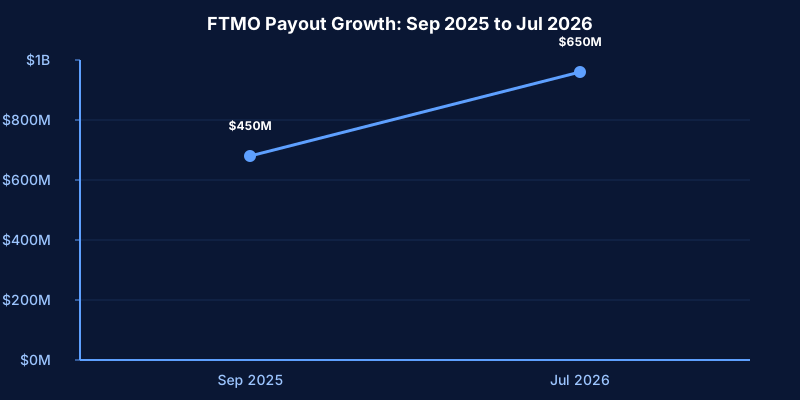
The industry's most visible payout artifact is a number that moves. As of 30 July 2026, FTMO's own testimonials page displays a live running total of more than $650 million paid in rewards worldwide, an aggregate figure the firm publishes and updates itself, distinct from the dated $450 million figure it announced at its September 2025 anniversary (FTMO.com, retrieved 2026-07-30).
The anniversary figure is worth holding beside it. FTMO marked its 10th anniversary in September 2025 by announcing more than $450 million paid out to traders since its 2015 launch, the largest total-payout figure any prop firm has published (Finance Magnates, retrieved 2026-07-30).
Two numbers, one firm, ten months apart, both self-reported. The anniversary figure has a date attached, which makes it checkable in the sense that you can say what was claimed and when. The live counter has no date attached by design, because it is always current, which is also why it can never be pinned down and re-examined later. Counters move. Any counter figure quoted in an article, including the one above, is a snapshot of the day it was read.
Why a curated individual record is a marketing artifact, not an audited one
Then there is the headline case. FTMO's own testimonials page labels trader Dariusz's $1,206,225 reward as the firm's "Biggest Reward" record, an individual-payout artifact the firm itself curates and publishes rather than a figure any outside party has audited (FTMO.com, retrieved 2026-07-30).
A record like that is genuine evidence of one thing: that a payout of that size is possible at that firm. It is evidence of nothing about the median. A record is by definition the extreme of a distribution you are not shown, selected and framed by the party with the strongest interest in how it lands. And because firms define what counts as a payout in the first place (Finance Magnates, retrieved 2026-07-30), the aggregate counter sitting next to that record inherits the definition problem too.
None of this makes a counter a lie. It makes it a self-reported figure, which is a different tier from an audited one. If you are weighing firms against each other rather than assessing one firm's evidence, checking what a prop firm actually is and how the model works via what a prop firm is and how it operates is a useful baseline before comparing anyone's headline numbers.
Monthly payout reports: better than a counter, still self-reported
FundedNext's February 2026 report and the recurring-series pattern
Recurrence is a real upgrade. FundedNext said it disbursed $15.19 million to 8,340 traders in February 2026, publishing this as the first in a recurring series of monthly payout reports, an example of a firm-published recurring aggregate-payout artifact (Finance Magnates, retrieved 2026-07-30).
Why does the series matter more than the size? Because a series creates obligations a counter does not. Dated monthly figures must sum to the cumulative total the firm quotes elsewhere. Trader counts must move plausibly against advertised growth. A month that goes missing is itself information. Publishing on a schedule means submitting to arithmetic that outsiders can perform, which is a meaningful step up from a number that only ever goes up.
What "not independently verified in full" means for you
The same Finance Magnates report that carries the February figure also notes FundedNext's claim of more than $271.4 million in cumulative payouts across 205,380 transactions since launch, adding that this cumulative figure has not been independently verified in full (Finance Magnates, retrieved 2026-07-30). That is the pattern in miniature: the dated monthly slice is checkable against the series, the lifetime total is not. What matters for your own evaluation is the standard, not this one data point: treat every nine-figure lifetime total as a claim, not a finding, until a named third party attaches its name to a defined scope.
Third-party audits and certification badges: real independence, stated limits
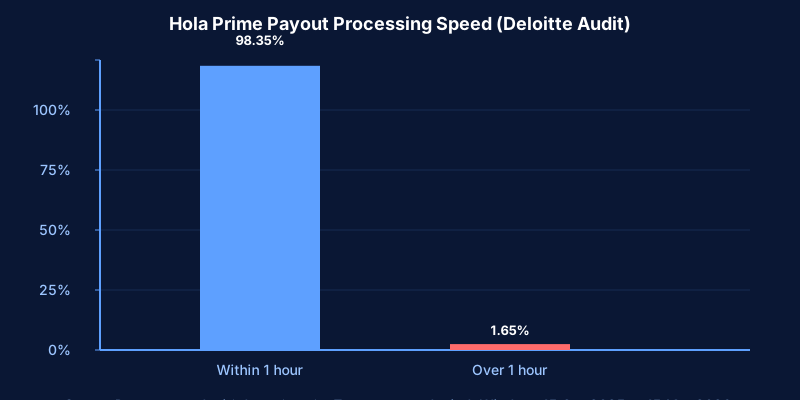
Hola Prime's Deloitte audit: 98.35% within one hour, over five months, pre-approved payouts only
This is the top tier, and it is rare. Hola Prime commissioned Deloitte to audit its payout processing over a specific five-month window (15 October 2025 to 15 March 2026), the rare example of a third-party-audited payout artifact rather than a firm's self-reported figure (Finance Magnates, retrieved 2026-07-30).
The findings are strong and the scope is narrow, and both halves belong in the same sentence. Deloitte's audit of Hola Prime found 98.35% of payouts in the audited window were processed within one hour, 1.65% exceeded that timeline, and zero payouts were denied, but the scope covers only traders already pre-approved for a payout, not the firm's entire trader base (Finance Magnates, retrieved 2026-07-30).
So what did it establish? That among withdrawals already approved, processing was fast and none were refused, for five specific months. What did it not establish? Anything about how many traders reached pre-approval, how many were disqualified before that gate, or what happens in month six. That is not a criticism of the audit. A scoped audit is exactly what an audit is. It is a criticism of anyone who quotes "98.35%" without the clause that follows it.
The Financial Commission's own disclaimer on what certification is not
Certification is a process artifact, and the body running it says so more bluntly than any critic would. The Financial Commission, an independent industry self-regulatory body, launched Prop Firm Certification on 22 July 2026, describing it as the first self-regulatory framework built specifically for proprietary trading firms (Financial Commission, retrieved 2026-07-30).
Then read its own page. The Financial Commission's Prop Firm Certification program page states plainly that certification does not constitute licensing, authorization, or an endorsement of a firm's financial strength, solvency, profitability or future performance, and does not guarantee any trader will receive a profit or any particular commercial result (Financial Commission, retrieved 2026-07-30).
That is the whole boundary, written by the certifier. A badge means a firm volunteered for scrutiny against defined criteria and passed. Volunteering is worth something, in an industry where nobody has to. It is not a solvency opinion, and the body issuing it refuses to let you read it as one.
Why reading the scope paragraph beats reading the badge
Every artifact above ships with a scope statement, and the scope statement is where the evidence actually lives. Deloitte's window and population. The Financial Commission's disclaimer. Finance Magnates' reporting on verifiability. The badge, the percentage, and the counter are the parts designed to be seen from a distance. The scope paragraph is the part written to be accurate.
Proof-page checklist as a table
| Check | What a good answer looks like | Red flag |
|---|---|---|
| Who produced it? | Named auditor, certifier, compiler, or the firm itself, stated on the page | No producer named |
| What period does it cover? | A dated window that can be re-examined | Undated running total only |
| What population? | Explicit scope (all traders, or only pre-approved payouts) | Headline number with no population |
| Payout definition | Trader withdrawals only, or every outgoing on the same rail, stated | Definition left to marketing language |
| Independent verification possible? | Third party named with scope limits | Self-reported total presented as verified |
How to read any firm's proof page in five minutes
- Who produced it? The firm, its platform vendor, an outside compiler, or a named independent auditor. That single answer sets the tier before you read a digit.
- What period does it cover? A dated window can be re-examined. An undated running total cannot.
- What population does it cover? All traders, or only those who already cleared an internal gate, as in the pre-approved-payouts scope of the Deloitte work (Finance Magnates, retrieved 2026-07-30).
- What definition of payout is being used? Trader withdrawals only, or every outgoing on the same rail. Firms set this themselves (Finance Magnates, retrieved 2026-07-30).
- Red flags. An undated total. No scope statement anywhere on the page. No third party named. A record payout displayed with no aggregate beside it. A percentage quoted without the population it was calculated over.
- When the only artifact is a screenshot. Treat it as proof of one event at most, and only if it is a platform-generated certificate rather than an image. Then go looking for the tier above it. If nothing above it exists, you are relying on the firm's word, and you are allowed to price that accordingly.
Notice what is not on this list: the size of the number. A $650 million counter and a $15.19 million monthly report are not ranked by magnitude. They are ranked by who produced them, over what period, for which population, under whose definition.
Where ITAfx stands on payout proof
The honest position is the same one this article applies to everyone else. No prop firm's aggregate payout total can be independently verified today, ours included, because no prop firm reports data to any regulator (Finance Magnates, retrieved 2026-07-30). Any firm telling you its lifetime total is verified is describing something that does not exist yet.
What we can state is what we sell and on what terms. ITA provides simulated trading evaluation services, and challenge fees pay for access to evaluation environments, not investments or deposits (itafx.com, retrieved 2026-07-30). Account (simulated capital) sizes: $50K to $400K. Profit split: up to 120% on Instant PRO, which is a 100% base split plus a 20% bonus paid on top of it, so the figure only exceeds 100% because the bonus is counted alongside the base split. Payouts: contractually guaranteed within 24 clock hours of an approved withdrawal request (itafx.com, retrieved 2026-07-30). Those terms and the ladder behind them are owned by the withdrawal process page, not restated here.
Ready to get funded?
50% off instant accounts with code 50CRYPTO.
Get Funded →Frequently Asked Questions
Is a prop firm payout certificate real proof?
Yes, of one thing: that a specific withdrawal was processed. third-party platform's March 2026 feature generates these per completed withdrawal as a formal confirmation of a processed payout, explicitly not a third-party audit of the firm's finances (third-party platform, retrieved 2026-07-30). It tells you nothing about other traders, denial rates, or solvency.
Can you trust a prop firm's total-payout number?
You cannot verify it. Finance Magnates concluded in June 2025 that such claims cannot be independently verified because prop firms are not required to report any data to a regulator, unlike CFD brokers (Finance Magnates, retrieved 2026-07-30). Firms also define what counts as a payout themselves (Finance Magnates, retrieved 2026-07-30).
Has any prop firm had its payouts audited by a Big Four firm?
Hola Prime commissioned Deloitte to audit payout processing from 15 October 2025 to 15 March 2026 (Finance Magnates, retrieved 2026-07-30). The audit found 98.35% of payouts processed within one hour, 1.65% slower, and zero denied, with scope limited to traders already pre-approved for a payout (Finance Magnates, retrieved 2026-07-30).
Does a certification badge mean a firm is solvent?
No, and the certifier says so. The Financial Commission, which launched Prop Firm Certification on 22 July 2026 (Financial Commission, retrieved 2026-07-30), states that certification does not constitute licensing, authorization, or an endorsement of a firm's financial strength, solvency, profitability or future performance, and does not guarantee any trader will receive any profit or any particular commercial result (Financial Commission, retrieved 2026-07-30).
What is the largest published prop firm payout figure?
FTMO announced more than $450 million paid out to traders at its 10th anniversary in September 2025, the largest total-payout figure any prop firm has published (Finance Magnates, retrieved 2026-07-30). Its own testimonials page showed a live counter above $650 million as of 30 July 2026 (FTMO.com, retrieved 2026-07-30). Both are self-reported.
Are third-party league tables better than firm reports?
They are compiled, not audited. Finance Magnates reported that Prop Firm Match's 2025 league table put full-year industry payouts at roughly $325 million, excluding FTMO and The5ers (Finance Magnates, retrieved 2026-07-30). Compiled data is assembled outside any one firm's marketing, but the inputs still come from firms.
Ready to get funded?
Instant accounts, simulated capital, rules published before you pay. 50% off with code 50CRYPTO.
Get Funded →