 ITA
ITAWhy Prop Firms Deny Payouts: The Hidden Triggers and How to Avoid Them
Discover the hidden reasons prop firms deny payouts, from consistency rules to VPN use.
Short answer
Discover the hidden reasons prop firms deny payouts, from consistency rules to VPN use. In a prop firm context this still sits under simulated-capital rules: fees buy access to the evaluation or funded environment, not a deposit of trading capital.
Simulated capital: prop firm evaluation and funded stages discussed here typically run on simulated accounts. Challenge fees pay for access to that environment; they are not a deposit of trading capital. ITAfx accounts are simulated capital.


The Problem: Understanding Prop Firm Payout Denials
Prop firm payout denials happen when trading firms reject withdrawal requests from profitable traders. They usually cite rule violations, account management issues, or compliance concerns that traders never saw coming during their trading period.
Industry data consistently shows that the vast majority of prop firm traders never receive payouts. That's not just about failing challenges. It reveals systematic issues where even profitable traders face rejection for reasons they never anticipated.
The conventional story sounds logical enough. Payout denials happen because traders breach obvious rules: they hit maximum drawdown, exceed daily loss limits, or fail to meet profit targets. This explanation feels reasonable. It places responsibility squarely on trading performance. Most educational content focuses on these visible metrics, teaching traders to monitor their profit and loss carefully.
Yet industry data tells a different story. Industry analysis shows that only a small percentage of traders successfully withdraw earnings. That figure includes many who never breached the obvious rules. The gap between profitable trading and successful payouts points to hidden mechanisms operating beneath the surface.
The regulatory landscape compounds this complexity. Unlike traditional brokers operating under CFTC or FCA oversight, most prop firms function in a grey zone where prop-challenge customers are not protected by the FCA or FSCS. This structure creates an environment where payout policies can shift without the consumer protections found in regulated financial services.
Technical Triggers: Unintentional Violations Leading to Denials
Beyond the visible trading rules lies a network of technical compliance checks. These catch traders unaware. Automated systems monitor behaviour patterns that most traders never consider part of their trading performance.
Modern prop firms deploy sophisticated session fingerprinting technology. This tracks IP addresses, ISP routing, browser timezone settings, and operating system locale data. When traders use VPNs or log in from locations inconsistent with their submitted KYC documentation, automated systems flag these sessions as potential account sharing or geographic violations.
A trader relocating for work or travelling whilst maintaining their trading routine can trigger these alerts. They never realise the compliance implications.
News trading restrictions create another invisible barrier. Many firms maintain blackout windows around high-impact economic releases, earnings announcements, or geopolitical events. These restrictions often extend beyond the announcement itself, covering periods when volatility remains elevated. Traders who enter positions during these windows face retroactive rule violations that only surface during payout reviews.
Consistency rules represent perhaps the most misunderstood technical trigger. Many firms enforce consistency rules where no single day's profit can exceed a certain percentage of total account profit. A trader generating $3,000 in total profit cannot have earned more than $900-$1,500 on any single day, regardless of how that profit was achieved. This rule can retroactively invalidate otherwise compliant trading performance.
But these systems operate silently during the trading period. No warnings. No alerts. Just quiet data collection that only matters when you request a payout.
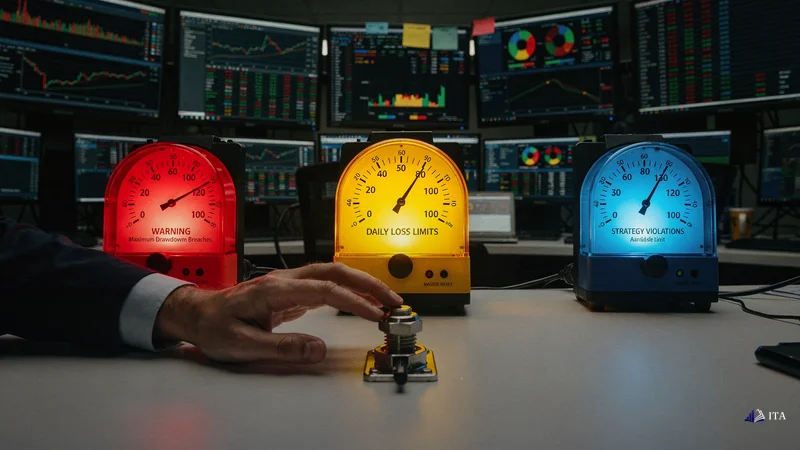
Core Trading Rule Breaches: Max Drawdown, Daily Loss, and Restricted Strategies
Whilst technical triggers operate invisibly, traditional rule breaches remain the most straightforward cause of payout denial. Understanding how these calculations work prevents unintentional violations. They seem obvious in retrospect but catch traders off-guard in real-time.
Maximum drawdown and daily loss limits function differently across firms. However, the core mechanics remain consistent. Maximum drawdown typically measures the largest peak-to-trough decline from the account's highest equity point. Daily loss limits reset at a specific time each day.
The critical detail lies in how these limits interact with floating profit and loss. A trader holding overnight positions may breach daily loss limits due to gap openings, even when their trading decisions were sound.
Position sizing violations often trigger automated reviews. Firms monitor not just lot sizes but also the correlation between position size and account equity. Traders who scale up aggressively after profitable periods may exceed risk management thresholds that firms use to identify potentially unsustainable trading patterns. These algorithms flag accounts showing exponential position size increases, even when individual trades remain within stated limits.
Restricted trading strategies create another category of violations. Latency arbitrage, high-frequency trading techniques, and certain forms of hedging across multiple accounts violate most firms' terms of service. Signal replication arrangements, where traders replicate signals from external sources, often fall into grey areas that firms interpret strictly during payout reviews.
The challenge? Defining these strategies clearly. What constitutes "excessive scalping" or "latency exploitation" often depends on subjective interpretation. One firm's acceptable scalping frequency becomes another firm's violation.

Administrative and Compliance Issues: Non-Trading Reasons for Denial
Payout denials frequently stem from administrative failures that have nothing to do with trading performance. These procedural requirements operate independently of profit generation. They create barriers that catch even successful traders unprepared.
KYC (Know Your Customer) verification failures represent a significant category of non-trading denials. Incomplete identity documentation, mismatched personal information, or expired identification documents can block payouts regardless of trading success. The verification process often intensifies at payout time, with firms requesting additional documentation that wasn't required during account opening.
Tax documentation requirements vary by jurisdiction but consistently create payout obstacles. International traders must navigate complex requirements for forms like W-8BEN or equivalent documentation that establishes tax residency and withholding obligations. Missing or incorrectly completed tax forms can delay payouts indefinitely. Firms cannot process international transfers without proper tax compliance.
Payout method verification adds another layer of administrative complexity. Firms require verification of bank accounts, payment processors, or cryptocurrency wallets before processing withdrawals. This verification process can take weeks. It often requires documentation that traders haven't prepared in advance. Some firms restrict payout methods based on geographic location or require specific banking arrangements that traders must establish after achieving profitability.
Inactivity thresholds create a time-based administrative hurdle. Extended inactivity periods can be grounds for firms to deny or suspend payout requests. Profitable traders who step away from active trading to preserve their gains may inadvertently trigger these clauses. They must resume trading activity before accessing their profits.
Understanding Payout Mechanics: Buffers, Minimum Days, and First Payout Limits
The mechanics of payout calculation involve multiple variables that affect withdrawal eligibility beyond simple profit generation. These structural elements determine not just whether traders can withdraw profits, but how much they can access and when.
Profit buffers function as safety nets that reduce the amount available for withdrawal. These buffers, typically linked to maximum drawdown calculations, ensure that accounts maintain sufficient equity to continue trading after payout processing. A trader with $5,000 in profit on a $100,000 account might find only $3,000 available for withdrawal due to buffer requirements that preserve account stability.
Minimum trading day requirements establish temporal criteria for payout eligibility. Firms typically require traders to demonstrate consistent activity over a specified period, often 5-10 trading days, before allowing withdrawals. This requirement prevents traders from achieving profit through single large trades and immediately withdrawing. It encourages sustained trading performance.
First payout caps represent a risk management tool that limits initial withdrawal amounts regardless of account profit. A trader generating $10,000 in profit might face a first payout limit of $2,000-$5,000, with subsequent payouts available after additional trading periods. These caps protect firms from traders who achieve large profits through high-risk strategies and immediately withdraw maximum amounts.
Payout frequency restrictions determine how often traders can request withdrawals. Most firms operate on monthly or bi-weekly cycles. Some offer weekly payouts for established traders. The timing of these cycles affects cash flow planning and requires traders to align their financial planning with firm-specific schedules.
But these mechanics stack. Buffer requirements plus minimum days plus first payout caps can significantly reduce both the amount and timing of initial withdrawals.

How ITAfx Helps Traders Avoid Payout Denials
At ITAfx (Institutional Trading Academy), the approach to payout compliance emphasises transparency and objective rule sets. This eliminates the ambiguity causing most denials across the industry. The institutional framework addresses the systematic issues that create payout uncertainty for funded traders.
Clear, objective rules form the foundation of ITAfx's compliance structure. Rather than subjective interpretations of trading behaviour, the platform employs quantifiable metrics that traders can monitor in real-time. ITAfx's consistency rules specify exact percentages and calculation methods. No guesswork that leads to unintentional violations. The comprehensive trading rules document every restriction and requirement, ensuring traders understand their obligations before they begin trading.
Automated compliance monitoring provides real-time feedback on rule adherence. Instead of discovering violations during payout reviews, traders receive immediate notifications when approaching risk thresholds or triggering compliance alerts. This proactive approach allows traders to adjust their behaviour before violations occur, rather than discovering problems after they've affected payout eligibility.
The transparent payout process eliminates administrative surprises by clearly documenting required documentation, processing timelines, and eligibility criteria. With over $1.7 million paid out to more than 1,700 funded traders across 97+ countries, ITAfx has demonstrated consistent payout execution. This builds trader confidence in the withdrawal process.
Institutional risk management frameworks ensure that compliance requirements align with professional trading standards rather than arbitrary restrictions. The platform's structure supports traders who approach funded accounts with institutional discipline. It provides the capital allocation and risk management tools necessary for sustainable trading performance.
What sets ITAfx apart? The rules don't change mid-game. No hidden technical triggers. No subjective interpretation of trading behaviour. When you meet the stated requirements, payouts process as documented.

Conclusion: Secure Your Profits with Diligence and Transparency
The prop firm payout denial phenomenon reveals a fundamental misalignment between trader expectations and industry practices. Whilst the obvious trading rules receive extensive attention, the technical triggers and administrative requirements that cause most denials operate in shadows.
Success in funded trading requires understanding compliance as thoroughly as market analysis. The traders who consistently receive payouts master not just profitable strategies, but the complete operational framework governing their trading environment.
The industry is evolving towards greater transparency, driven by competitive pressure and trader advocacy. Firms adopting objective rule sets and clear compliance processes are establishing new standards. These benefit serious traders who approach funded accounts with institutional discipline.
For traders entering the prop firm space, the lesson is clear: due diligence extends beyond strategy development to encompass the complete compliance landscape. Understanding these mechanisms before they affect your trading creates the foundation for sustainable success in funded account management.
Ready to get funded?
50% off instant accounts with code 50CRYPTO.
Get Funded →Frequently Asked Questions
What are the most common rule violations that cause prop firms to deny payouts?
The most common violations are consistency rule breaches (where one day's profit exceeds 30-50% of total profit), VPN usage triggering IP mismatches, news trading during blackout windows, and breaching max drawdown or daily loss limits. These violations occur during trading, not during withdrawal requests.
How do consistency rules affect my ability to withdraw profits from prop firms?
Consistency rules typically prevent any single trading day from generating more than 30-50% of your total account profit. If you earn $3,000 total profit, no single day can exceed $900-$1,500. Violating this rule can lead to full or partial payout denial even when overall performance is positive.
Can using a VPN lead to payout rejection at prop firms?
Yes, prop firms use sophisticated session fingerprinting that tracks IP addresses, browser timezone, and geographic data. Using VPNs or logging in from locations inconsistent with your KYC documentation often triggers automated reviews and can be treated as account sharing violations, leading to payout denials.
What recourse do traders have if their payout is denied unfairly?
Limited options exist due to the unregulated nature of most prop firms. Traders can appeal through internal processes, but these reviews often favour the firm's interpretation. Some jurisdictions offer consumer protection, but enforcement remains inconsistent across the global prop trading industry.
How does ITAfx help traders avoid payout denials?
ITAfx employs clear, objective rules with real-time compliance monitoring instead of subjective interpretations. Traders receive immediate notifications when approaching risk thresholds, preventing violations before they occur. With over $1.7 million paid out to 1,700+ funded traders, ITAfx demonstrates consistent payout execution through transparent processes.
Key Takeaways
- Understand technical compliance triggers like IP address monitoring and session fingerprinting that automatically flag accounts for payout denial reviews.
- Maintain complete KYC documentation and tax forms before achieving profitability to avoid administrative blocks during withdrawal processing.
- Monitor consistency rules closely, many firms enforce the 30-50% rule where no single day can exceed that percentage of total profits.
- Avoid VPN usage during trading sessions as automated systems flag geographic inconsistencies between login data and KYC documentation.
- Document all trading activity meticulously to appeal potential denials and demonstrate rule compliance throughout your trading period.
- Choose platforms with transparent, objective rule sets and real-time compliance monitoring rather than subjective interpretation systems.
- Prepare for extended verification processes at payout time including additional documentation that wasn't required during account opening phases.
Ready to get funded?
Instant accounts, simulated capital, rules published before you pay. 50% off with code 50CRYPTO.
Get Funded →