 ITA
ITAIf a Prop Firm Shuts Down, What Happens to Your Payout?
Your legal position when a prop firm closes, the documented range of outcomes from full refund to nothing, and steps to take before it happens.

How this article is verified: Every number and claim above is checked against a primary source, ITAfx's own Terms of Service, official product pages, or the trading platform itself, before publication, then re-verified again immediately before this page goes live. Fact-checked and published on August 1, 2026 by Adrian Caldwell.
The short answer: you are an unsecured creditor, not an account holder
If a prop firm shuts down owing you a payout, you are an unsecured creditor of a private company. You are not an account holder at a custodian. There is no segregated pot with your name on it, because your balance was never money sitting somewhere. It was a number in a simulated account, and your right to a share of it comes from a contract, not from ownership of cash.
What you actually own: a contractual claim on simulated-account profit, not custodied cash
In an evaluation or funded-account model, the trading happens in a simulated environment. The firm promises to pay you an agreed share of the profit that account produces, under conditions it wrote. What you own is that promise. If you want the mechanical difference between a simulated evaluation account and a live brokerage account spelled out, that distinction is the whole basis of your legal position here, and it starts with understanding what a funded forex account actually is.
So when the firm dissolves, your claim does not attach to a segregated account. It queues behind the firm's other obligations, at whatever priority the law of its incorporation gives an ordinary trade creditor.
Why no compensation scheme catches you
Traders assume some backstop exists because one exists in retail banking and, partially, in the regulated securities industry. It does not extend here. The Securities Investor Protection Corporation's own rules state it does not protect commodity futures contracts, unless held in a special portfolio margining account, or foreign exchange trades, so the main U.S. investor-protection scheme would not cover a forex trading claim even at a member brokerage (Securities Investor Protection Corporation, retrieved 2026-07-31).
Read that twice. The exclusion applies even at a SIPC member firm. A prop firm is usually not a member of anything, and the instrument you traded is usually one the scheme excludes anyway. Two independent reasons why you are not covered.
Why "my balance was $47,000" is not the same as "I am owed $47,000"
Your balance is the firm's own report of a simulated account's performance, measured by the firm's rules, subject to the firm's review. Between that number and cash in your bank sit the profit split, the payout eligibility conditions, KYC checks, and any rule violation the firm decides to apply retroactively. In a solvent firm those steps usually resolve. In a collapsing one, every one of them is a place where the number can shrink to zero.
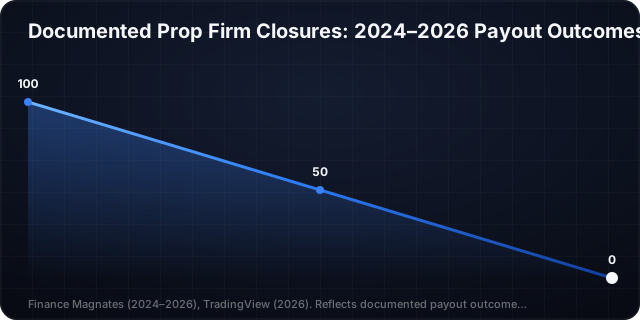
The documented outcomes range: what actually happened to traders in 2024-2026
There is no single answer to "what happens", because the record shows a range. The useful move is to look at what firms actually did, in their own notices, rather than at what a shutdown tracker says.
At the responsible end, FundingTicks announced its wind-down in January 2026 and said all active evaluation and Master accounts would be refunded in full, regardless of profit or drawdown (Finance Magnates, retrieved 2026-07-31). It also set out terms for live accounts in profit: a refund, plus 90% of realized profit, plus 20% of the initial balance (Finance Magnates, retrieved 2026-07-31).
In the middle sits a time-boxed, partial path. MyFundedFX's operator Seacrest announced that all prop trading accounts and open positions would be closed on February 6, 2026, framing the move as a shift to focus entirely on its contract-for-difference brokerage rather than a bankruptcy (Finance Magnates / TradingView, retrieved 2026-07-31). Traders with active, unbreached challenge accounts were told they could request a full refund of their challenge fee through an official refund form by February 28, 2026 (Finance Magnates / TradingView, retrieved 2026-07-31). Note the split paths: unbreached challenge accounts got the fee back, while funded account holders were told to request their final payout balance through the Seacrest dashboard by the same deadline (Finance Magnates / TradingView, retrieved 2026-07-31). Two different requests, one shared cutoff, and both required the trader to act.
At the hard end is insolvency. True Forex Funds ceased operations in May 2024, telling traders it was unable to improve its financial situation, leading to the discontinuation of its services (Finance Magnates, retrieved 2026-07-31). A firm that says it cannot fix its finances is telling you the queue is longer than the money.
Abrupt cessation is its own category. SurgeTrader closed and ceased all operations on Friday, May 24, 2024 (Finance Magnates, retrieved 2026-07-31).
And a regulator can act against a firm before it fails commercially. Enforcement, however, runs on the regulator's timetable and its purpose is not to pay you.
How big is this risk, honestly
Sizing matters, because "firms sometimes close" is not actionable and "they all collapse" is not true.
The 2024 closure wave
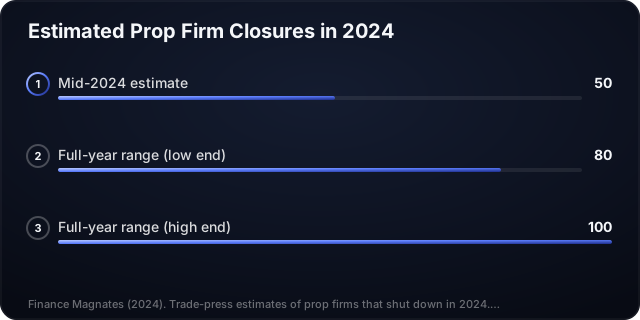
By mid-2024, data presented by prop-tech vendor FunderPro estimated that around 50 prop firms had already shut down that year (FunderPro figures as reported by Finance Magnates, retrieved 2026-07-31). For the full year, trade-press reporting put the figure between 80 and 100 firms that may have disappeared from the market (Finance Magnates, retrieved 2026-07-31). Both are estimates, published as estimates, in one trade-press investigation, and the mid-year figure comes from an industry vendor rather than an independent count. Nobody maintains an audited registry of prop-firm deaths, so treat them as an order of magnitude, not a count.
Why 2024 was unusual
That year had a specific trigger. Trade press attributed the wave of closures to a major trading-platform vendor's decision to step back from supporting prop firms (Finance Magnates, retrieved 2026-07-31). A shared dependency broke, and firms that had built on it went with it.
What that does and does not tell you about your firm
It tells you the sector has concentrated infrastructure risk that can kill dozens of firms at once for reasons unrelated to any single firm's trading book. It does not give you a failure probability for the firm you use. You cannot divide an 80-to-100 estimate by an unknown denominator of firms and get a number that means anything. What you can do is stop treating an unwithdrawn balance as safe.
The warning signs that preceded the documented closures
None of these prove a collapse is coming. Each one appeared before at least one that did.
Payout timelines quietly lengthening. Not a refusal. A drift: two days becomes five, five becomes "under review". The stated policy stays the same while the lived experience changes.
Rule changes applied to existing accounts. A firm rewriting drawdown or consistency terms for accounts already trading is managing a payout liability it did not plan for. Knowing how to avoid breaching prop firm drawdown limits under stable rules is one thing; watching those rules move under you is another signal entirely.
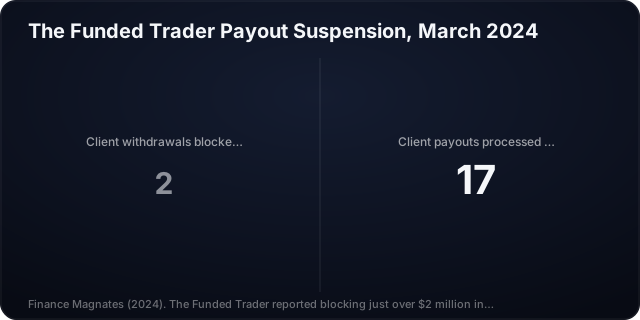
Payout delays framed as audits. In March 2024, The Funded Trader's CEO told traders that withdrawals had not been suspended but that a thorough internal audit was underway, and that payouts would take another two to four weeks (Finance Magnates, retrieved 2026-07-31). In the same update he presented a graphic saying the firm had paid out over $17 million to clients in the first two months of 2024 while blocking just over $2 million in withdrawals, which he attributed to suspected prohibited strategies or gambling (figures from the firm's own broadcast, reported by Finance Magnates, retrieved 2026-07-31). Both halves of that matter, and both come from the firm itself, which is an interested source. A payout delay is not proof of collapse, and a firm can be paying most people while a minority is stuck.
Silence on a stated deadline. A firm that publishes a refund or payout date and then says nothing on that date has told you something. Screenshot the announcement when it appears, not later.
If you are unsure which of a firm's rules are normal industry mechanics and which are unusual, read the rules themselves rather than a review, and apply the same verification habits described in how to know if a prop firm pays to any online financial claim.
The one lever you control: withdraw early and often
You cannot audit a private company's balance sheet. You cannot make an unregulated firm segregate anything. You can control how long your money sits on their side of the line.
Cadence beats balance
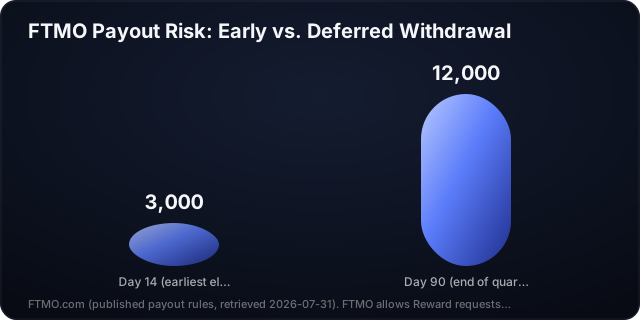
Request at the earliest eligible date, not at the biggest number. A $3,000 payout received is worth more than a $12,000 balance that exists only in a dashboard, because the received one cannot be reversed by a wind-down notice. Traders let balances build for a reason that feels sensible, wanting a round number or a milestone screenshot, and that reason evaporates the moment the portal goes dark.
A worked example using a published earliest-eligible rule
Published payout rules differ by firm, so use whichever one governs your account. FTMO's own rules, as one published example, let a trader request a payout (Reward) on the 14th or any following day after the first placed trade on the account (FTMO.com, retrieved 2026-07-31). Its stated default profit split on the 2-Step Challenge is 80% of the profit to the trader, rising to 90% if Scaling Plan or Premium Programme conditions are met (FTMO.com, retrieved 2026-07-31).
Apply that mechanically. A trader who requests on day 14, then again at each following eligible point, carries a small exposure continuously. A trader who waits for a quarter carries the entire quarter's profit as an unsecured claim for three months. Same trading, very different risk. That is a description of one firm's published cadence, not a recommendation about strategy or amounts. The mechanics of the funded account profit withdrawal process itself are worth knowing before you need them urgently.
Why an unwithdrawn balance is exposure
Say it plainly: an unwithdrawn balance is an unsecured claim on a private company. A withdrawn payout is your money. Nothing about the firm's marketing, its size, or its sponsorship budget changes which side of that line your profit is on today.
Splitting capital across firms, and what that does not fix
Running accounts at two or three firms caps how much a single closure can take from you. That is real and worth doing. It does not create protection. Three unsecured claims are still three unsecured claims, and 2024 showed that a shared platform dependency can hit several firms in the same month (Finance Magnates, retrieved 2026-07-31). Diversification limits the size of the loss. It does not change its nature. Comparing firms on fees and rules is a useful step before you split anything, and it starts with understanding what a prop firm is and how it works.
What to check before you pay a challenge fee
This is due diligence you can complete in fifteen minutes, before money moves.
Who is the legal entity, and where is it incorporated. A brand name is not a company. Find the registered name and jurisdiction, and note that many prop firms are incorporated offshore, which affects what an insolvency process would even look like.
Is the payout policy published and dated, or only in support chat. A policy that lives in a screenshot from a support agent is not a policy you can hold anyone to. You want a URL.
Is there a published payout record you can check. Not testimonials. Dated, verifiable statements from the firm about what it has paid.
What the terms say about closure, refunds and account termination. Read the termination clause before you need it. Most terms let the firm close accounts at its discretion; what varies is what it says happens to a pending payout when it does. Knowing which rules govern the account beforehand is the cheapest protection available, and it is worth understanding what a prop firm challenge actually commits both sides to if you are new to the model.
For its part, ITAfx operates simulated evaluation accounts under Institutional Trading Academy Ltd, Saint Lucia, company no. 2025-00535 (itafx.com/llms.txt, retrieved 2026-07-31). Its account structure and payout terms live on itafx.com rather than in this article, so you can read them at source and apply the same four checks above to them.
How three documented 2024-2026 shutdowns compared
| Firm | What happened | Stated outcome for traders |
|---|---|---|
| FundingTicks (Jan 2026) | Orderly wind-down announcement | Full refund of active Eval/Master accounts; live accounts in profit got a refund plus 90% of realized profit plus 20% of initial balance (Finance Magnates, retrieved 2026-07-31) |
| MyFundedFX / Seacrest (Feb 2026) | Prop trading closed, reframed as a shift to CFD brokerage | Unbreached challenge holders could request a full fee refund via a form by Feb 28, 2026; funded account holders had to request their final payout balance through the firm's dashboard by the same deadline (Finance Magnates / TradingView, retrieved 2026-07-31) |
| True Forex Funds (May 2024) | Insolvency-driven shutdown | Firm cited inability to improve its financial situation; services discontinued (Finance Magnates, retrieved 2026-07-31) |
If it already happened: what you can and cannot do now
Document everything before the portal goes dark. Account statements, payout history, the terms as they read today, the closure announcement, every support ticket. Portals get switched off quickly, and a claim you cannot evidence is not a claim.
Take the refund path if the firm offers one, and take it early. The Seacrest/MyFundedFX wind-down is the documented pattern: a refund form, a defined eligibility test, and a hard deadline (Finance Magnates / TradingView, retrieved 2026-07-31). These windows close, and nobody reopens them for you.
Understand chargeback limits. Card and processor disputes run on their own clock, which generally starts at the transaction rather than at the closure, and they address a fee you paid, not a payout you earned. The exact window depends on your card network, your issuer and the reason code, so ask your issuer rather than assuming. For a challenge fee bought months ago, it may already be gone.
Expect little from a regulator complaint. File it, because a pattern of complaints is how enforcement starts. But enforcement is not a payout mechanism: it runs for years on the regulator's timetable, aims at penalties and injunctions rather than at making a given trader whole, and can be derailed by procedural failures on either side.
Ready to get funded?
50% off instant accounts with code 50CRYPTO.
Get Funded →Frequently Asked Questions
Is my funded account balance protected if the firm goes bankrupt?
No. It is a contractual claim against a private company, not custodied money. The Securities Investor Protection Corporation's rules state it does not protect commodity futures contracts, unless in a special portfolio margining account, or foreign exchange trades, so the main U.S. investor-protection scheme would not cover a forex claim even at a member firm (Securities Investor Protection Corporation, retrieved 2026-07-31).
Can I get my challenge fee back if the firm closes?
Sometimes, if the firm runs an orderly wind-down and you act inside its window. Seacrest/MyFundedFX told traders with active, unbreached challenge accounts they could request a full refund through an official refund form by February 28, 2026 (Finance Magnates / TradingView, retrieved 2026-07-31). A firm citing insolvency, as True Forex Funds did in May 2024, may offer nothing (Finance Magnates, retrieved 2026-07-31).
Does regulation of a prop firm mean my payout is safe?
No. Regulatory attention is not payout protection. In 2023 the U.S. Commodity Futures Trading Commission charged the operator of My Forex Funds with fraud, alleging it had taken over $300 million from customers hoping to become professional traders (FX News Group, retrieved 2026-07-31). A regulator's mandate is to police conduct and impose penalties, not to recover a trader's balance, and an investigation can run for years without a cent reaching the people who filed the complaints.
How often should I request a payout?
As early as your firm's published rules allow, rather than waiting for a larger balance. FTMO's rules, as one published example, allow a Reward request on the 14th or any following day after the first placed trade (FTMO.com, retrieved 2026-07-31). Check your own firm's stated eligibility date and treat it as the default.
Is an acquisition the same as a shutdown?
No, and the difference matters. In an acquisition the entity holding your contract usually survives, so your claim survives with it, though terms can change. A shutdown ends the entity. Seacrest framed the MyFundedFX prop closure as a strategic shift to its CFD brokerage rather than a bankruptcy, which sits between the two (Finance Magnates / TradingView, retrieved 2026-07-31).
How does ITAfx fit into this?
ITAfx operates simulated evaluation accounts under Institutional Trading Academy Ltd, Saint Lucia, company no. 2025-00535 (itafx.com/llms.txt, retrieved 2026-07-31). Its account structure and payout terms are published on itafx.com, and the same due-diligence checks described in this article apply to it as to any other firm.
Ready to get funded?
Instant accounts, simulated capital, rules published before you pay. 50% off with code 50CRYPTO.
Get Funded →