 ITA
ITAHow to Escalate a Dispute With a Prop Firm: Step by Step
The real escalation ladder: support ticket, formal complaint, compliance review, then an external body. What evidence survives, and why chargebacks backfire.

How this article is verified: Every number and claim above is checked against a primary source, ITAfx's own Terms of Service, official product pages, or the trading platform itself, before publication, then re-verified again immediately before this page goes live. Fact-checked and published on August 1, 2026 by Adrian Caldwell.
Where escalation actually starts: the rung most traders skip
The support ticket is a record, not a conversation
Traders treat the first ticket as a chat: "hey, what happened to my account?" Then, three replies later, they start attaching screenshots. By then the useful timestamps are gone and the file reads like an argument that grew.
Write the first message as if a compliance officer who has never met you will read it cold, because that is exactly who reads it at rung three. One message, complete: account identifier, date, time, what happened, what you expected, what you want done.
That structure is not a preference. Prop-firm terms that describe how to report a technical issue typically require the account to be identified and the issue described with the date and time. Send less and you are not yet inside the process.
FundedNext's own wording: a review you can request, not one you are owed
Here is the part nobody quotes back to you. FundedNext's own CFD Challenge Terms define the internal review step of its dispute ladder as contacting support with a clear explanation and evidence; FundedNext is explicit that it is not obliged to grant that review, only to consider the request (FundedNext CFD Challenge Terms, Section 9.6, retrieved 2026-07-30).
Read that twice. The internal review is discretionary. Nothing in that clause promises a second look. What it does promise, implicitly, is that a request with a clear explanation and evidence is the version of your case they will consider. So the first message is not a warm-up. It is the whole case, filed once, on the record. For a broader look at how FundedNext stacks up against a firm like ITAfx on published rules generally, see this side-by-side comparison of FundedNext and ITAfx.
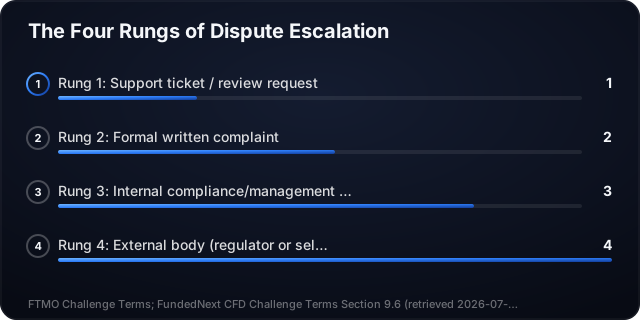
The four rungs of the ladder, in the firms' own words
| Rung | What it is | Published basis |
|---|---|---|
| 1 | Support ticket or review request, with account ID, date, time, explanation, evidence | FundedNext CFD Challenge Terms Section 9.6 review request (FundedNext CFD Challenge Terms, Section 9.6, retrieved 2026-07-30) |
| 2 | Formal written complaint, sent to the channel the firm's own terms name, treated as a complaint rather than a query | Firm-specific complaint clause; check your own firm's terms for the named channel and deadline |
| 3 | Compliance or management review inside the firm | Rarely specified in published terms; FundedNext's review clause is discretionary (FundedNext CFD Challenge Terms, Section 9.6, retrieved 2026-07-30) |
| 4 | External body: consumer channel or industry self-regulator | Financial Commission dispute process (Dispute Resolution Process - Financial Commission, retrieved 2026-07-30); plus any consumer out-of-court body named in your firm's own terms |
Rung 1: support ticket / review request
Covered above. One complete message. Keep your copy of it.
Rung 2: formal written complaint
The jump from rung one to rung two is a change of category, not a change of tone. A complaint is a document that says the word "complaint," states the outcome you want, and goes to the channel the terms name.
Check your own firm's terms for the named complaint channel, and send it there in writing so that the filing date is on the record.
Rung 3: compliance or management review
This is where published wording thins out to almost nothing. The contract examined here does not describe an internal appeal panel, a named reviewer, or a service level for a management escalation. FundedNext's terms go the other way and state that the provider may, but is not obliged to, review decisions (FundedNext CFD Challenge Terms, Section 9.6, retrieved 2026-07-30).
Set expectations accordingly. Rung three is real in practice, firms do route hard cases upward, but it is not a right you can point to in a clause. Treat it as the last chance to add evidence, not as an appeal court.
Rung 4: an external body
Two exist for prop-firm traders right now, and they are not interchangeable. One is a consumer channel tied to a specific firm's jurisdiction. The other is an industry self-regulatory body that opened a prop-firm-specific door in July 2026. Both are covered further down.
Every rung has a clock: the deadlines that decide your case
Deadlines are the reason evidence discipline pays. Miss the outer window and the strongest file in the world is unreadable, because nobody has authority to open it.
Note the units carefully. Calendar days and business days are not the same measure, and the two bodies below use both.
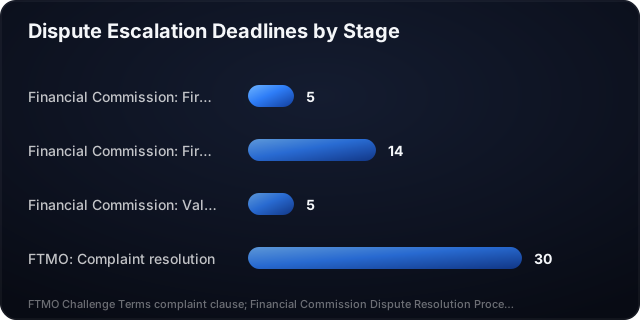
The Financial Commission's published dispute-resolution process gives a member firm 5 days to acknowledge that a client complaint was received and 14 days to answer it through the member's internal dispute resolution procedure, before the complaint can be escalated to the Commission itself (Dispute Resolution Process - Financial Commission, retrieved 2026-07-30).
| Clock | Published by | Starts when | Limit | Unit |
|---|---|---|---|---|
| Complaint acknowledgement | Financial Commission | Client complaint reaches the member firm | 5 | days |
| Member's IDR answer | Financial Commission | Client complaint reaches the member firm | 14 | days |
| Validity investigation | Financial Commission | Complaint reaches the Commission | 5 | business days |
Your firm's own complaint clock
Some firms publish a resolution deadline for complaints and a promise to confirm receipt in writing. Find that number in the terms before you need it, and diary the date the moment you get the receipt confirmation.
Financial Commission: 5 days to acknowledge, 14 days for the firm's answer
Once the complaint reaches the Commission, the Financial Commission's published dispute-resolution process states that it investigates the grounds of the complaint and verifies its validity within 5 business days (Dispute Resolution Process - Financial Commission, retrieved 2026-07-30).
The structure is worth noticing: the external body will not look at your case until the internal ladder has had its 14 days. Escalating early does not accelerate anything.
Outer limits on consumer channels
Consumer out-of-court channels are usually gated twice: the two sides must have failed to resolve the dispute directly, and the filing must arrive inside a stated window after first contact about the disputed right. The Financial Commission publishes its own outer limit of 45 days from the incident (Dispute Resolution Process - Financial Commission, retrieved 2026-07-30). A dispute that drifts for months of polite emails can expire on the way to the door.
What evidence survives scrutiny (and what a firm can ignore)
Why timestamps are contractual, not optional
Firm terms that set out how to report a problem ask for the account identified and a description of the issue including the date and time. A report without a timestamp is not a report the contract recognises, and a firm reviewing hundreds of tickets a week will treat "last Tuesday around lunch" as unverifiable, because it is.
The account identifier, the date, the time, the description
Build every escalation message on four fields:
- Account identifier exactly as the platform shows it, not "my 50k."
- Date, written out: 14 July 2026, not a numeric format that flips between locales.
- Time, with the timezone stated, plus the server time if you know it.
- Description, one paragraph, factual, no adjectives about fairness.
Then attach. Screenshots with the clock visible. The trade history export. The email chain, forwarded intact rather than pasted.
Preserving what a platform will overwrite
Dashboards refresh. Trade lists paginate away. Support widgets lose history when a ticket closes. Export your trade history the day something goes wrong, not the week you decide to complain, and save the raw file rather than a screenshot of it.
One category needs specialist care: execution and slippage disputes, where the argument is about the price you got versus the price you expected. Understand what execution slippage is, before you argue it was unfair, and if the dispute is about a delayed withdrawal rather than a rule breach, check how a normal payout request is supposed to flow, so you can tell a delay from a dispute, before you escalate.
Why a chargeback is not a shortcut
The temptation is obvious. The firm ignores you, your bank does not, and a chargeback feels like leverage. The contract examined here anticipated that move.
FundedNext: account pause and withheld rewards on suspected chargeback
FundedNext's own CFD Challenge Terms state that initiating, authorising, or being reasonably suspected of initiating a chargeback or payment dispute lets FundedNext suspend or restrict the account and withhold, reverse, or deny any pending or future performance reward until the matter is fully resolved to FundedNext's satisfaction (FundedNext CFD Challenge Terms, Section 11.2, retrieved 2026-07-30).
The trigger word is suspected. Not proven. A firm acting on reasonable suspicion can pause an account before any bank has ruled on anything, and pending rewards sit inside the scope of that clause.
When a payment dispute is the only remaining option
None of this is legal advice, and none of it says a chargeback is never appropriate. It says the cost is documented in the contract you signed, and that cost usually lands on the account and the pending payout you were trying to protect. If you are considering it, read your own firm's payment-dispute clause first, and understand that you may be choosing between the fee and the relationship.
The external rung: where a complaint goes when the firm stops answering
EU consumers: the out-of-court channel named in your firm's own terms
Firms incorporated in the EU commonly name a national consumer authority responsible for out-of-court settlement of consumer disputes in their terms. Read that clause in your own firm's terms and copy down the name, the channel and the deadline.
Two limits usually follow from the wording. It is a consumer dispute channel tied to one firm's jurisdiction, so it is not a generic prop-firm complaints desk. And a documented internal attempt is normally a precondition, which is another reason rung two must be in writing.
The Financial Commission's dispute process for prop-firm traders
The Financial Commission, an independent industry self-regulatory body, launched Prop Firm Certification on July 22, 2026, describing it as the first self-regulatory framework built specifically for proprietary trading firms (Financial Commission, retrieved 2026-07-30). The certification's code of conduct commits certified firms to five principles, one of which is respectful trader engagement that includes access to the Financial Commission's independent dispute-submission process (Financial Commission, retrieved 2026-07-30). The framework itself is a separate subject; here it matters only as the last rung.
Two practical details. The Financial Commission states that its services are free for traders, so filing a dispute costs the trader nothing (Dispute Resolution Process - Financial Commission, retrieved 2026-07-30). And the clock discipline above applies: 5 days for the firm to acknowledge, 14 for its internal answer, then 5 business days for the Commission to verify validity (Dispute Resolution Process - Financial Commission, retrieved 2026-07-30).
Finance Magnates, reporting on the July 22, 2026 launch, quoted Financial Commission COO Nikolai Isayev describing the certification's goal for the prop-firm sector as bringing "transparent rules, fair enforcement and clear payouts" (Finance Magnates, retrieved 2026-07-30).
What "binding" does and does not yet cover
Be precise about the limit, because this is where hope outruns the paperwork. The Financial Commission's published dispute-resolution process states that its Dispute Resolution Committee decisions are binding on member brokers; the binding-decision language on that page refers to brokers, the Commission's pre-certification membership category, and does not yet name certified prop firms (Dispute Resolution Process - Financial Commission, retrieved 2026-07-30).
So as of July 2026, a prop-firm trader gets a documented external process on a published clock, free to use. What is not yet published is a statement that the outcome binds a certified prop firm the way it binds a broker member. Useful, real, and narrower than the headlines suggest.
Read the rules before you need them
The three clauses to find in any firm's terms before you pay
The cheapest dispute is the one the contract already answered. Before you buy a challenge, find these three things:
- The complaint clause. Is there a named channel and a stated deadline, and does the firm commit to confirming receipt in writing? If no deadline is published at all, treat that as information.
- The review clause. Is an internal review a right or a discretion? FundedNext says the provider may, but is not obliged to, review decisions (FundedNext CFD Challenge Terms, Section 9.6, retrieved 2026-07-30).
- The payment-dispute clause. What happens if you charge back? FundedNext reserves the right to restrict the account and withhold rewards on suspicion alone (FundedNext CFD Challenge Terms, Section 11.2, retrieved 2026-07-30).
While you are reading, it helps to know the account rules a dispute is usually argued against, and, before you buy a challenge with any firm, it is worth learning what a prop firm challenge actually involves and how to check whether a prop firm actually pays out before you commit. If the decision ends up standing and escalation is genuinely over, there is a separate discipline in rebuilding confidence after a prop firm challenge fails.
How ITAfx publishes its rules
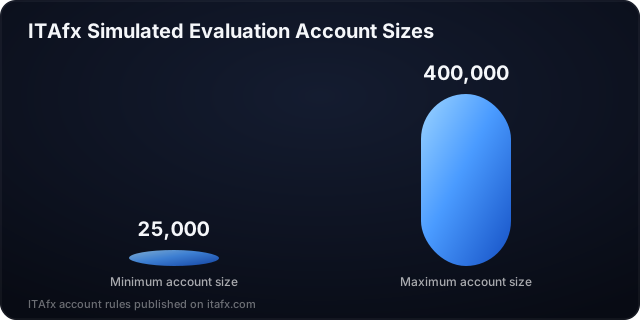
ITAfx sells access to simulated evaluation accounts, and its rules, account sizes from $50K to $400K, an instant-funding model with no evaluation time limit, and its payout terms, are published on itafx.com so you can read them before you pay rather than dispute them afterwards.
Ready to get funded?
50% off instant accounts with code 50CRYPTO.
Get Funded →Frequently Asked Questions
How long should I wait before escalating a support ticket?
Use the published clocks rather than your patience. If your firm is FTMO, the complaint stage carries a commitment to resolve within 30 calendar days with written confirmation of receipt and settlement. If your firm publishes no deadline at all, treat that as information about the firm.
Will a chargeback get my challenge fee back faster?
It may also end the relationship. FundedNext's own CFD Challenge Terms allow it to suspend or restrict the account and withhold pending or future performance reward if the customer initiates, authorises, or is reasonably suspected of initiating a chargeback or payment dispute (FundedNext CFD Challenge Terms, Section 11.2, retrieved 2026-07-30). FTMO's terms similarly entitle it to stop providing services and refuse future services where you dispute the Challenge Fee with your bank or payment provider.
Is there a regulator I can complain to about a prop firm?
Not a regulator in the banking sense. EU-resident consumers dealing with FTMO have a named out-of-court channel, the Czech Trade Inspection Authority, available only after a direct attempt and only within one year of first contact. Separately, the Financial Commission, an independent industry self-regulatory body, opened a dispute-submission process for certified prop firms on July 22, 2026 (Financial Commission, retrieved 2026-07-30).
Does the Financial Commission's decision force a prop firm to pay?
Its published process states that Dispute Resolution Committee decisions are binding on member brokers, and that language does not yet name certified prop firms (Dispute Resolution Process - Financial Commission, retrieved 2026-07-30). Read the process as documented and free to use, not as an enforcement guarantee.
What evidence matters most?
Timestamped records tied to an account identifier. FTMO's terms require the account identified and a description including the date and time, which is the contractual floor for a report being considered at all.
Do I have to pay to file with the Financial Commission?
No. The Financial Commission states its services are absolutely free for traders (Dispute Resolution Process - Financial Commission, retrieved 2026-07-30).
Ready to get funded?
Instant accounts, simulated capital, rules published before you pay. 50% off with code 50CRYPTO.
Get Funded →