 ITA
ITAHow to Track a Prop Firm's Rule Changes Before They Cost You
Prop firm terms change on real dates. A practical workflow: firm changelogs, purchase-day archive snapshots, and free change-monitoring tools.

How this article is verified: Every number and claim above is checked against a primary source, ITAfx's own Terms of Service, official product pages, or the trading platform itself, before publication, then re-verified again immediately before this page goes live. Fact-checked and published on August 1, 2026 by Adrian Caldwell.
Prop firm terms really do change, on dates you can name
The strongest argument for this habit is not a suspicion. It is a short list of changes with dates attached, published by the firms themselves.
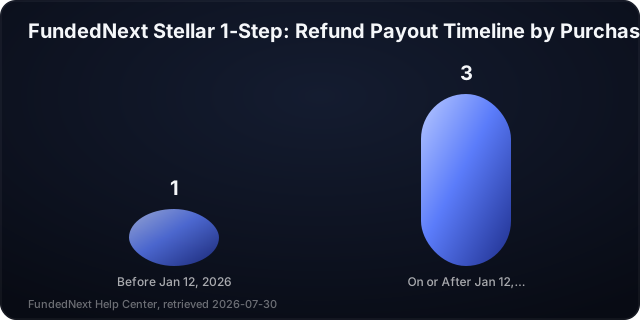
FundedNext's Stellar 1-Step refund schedule changed on 12 January 2026
FundedNext's Stellar 1-Step refund schedule changed on January 12, 2026: for accounts purchased or reset before that date, the Refundable Fee is paid out with the first Performance Reward, but for accounts purchased or reset on or after that date, it is instead paid only when the Performance Reward is disbursed for the third time (FundedNext Help Center, retrieved 2026-07-30).
Read what that does to a trader's cash timeline. Same fee, same product name, same page URL, and the money arrives at the third payout instead of the first. Nothing about the page tells a reader which side of the line their account sits on unless they know their own purchase date. This is the same mechanic that shows up when firms deny a payout outright over a technicality nobody flagged in advance.
The same date moved a second FundedNext rule. Stellar Instant Accounts purchased or reset on or after January 12, 2026 follow a new Scale-Up program, replacing the prior scale-up criteria for the post-Tier-10 progression; the plan requires cumulative 10% growth in the current tier, measured as total disbursed withdrawal amount divided by the current tier's starting balance, plus at least one withdrawal in that tier, growing the account up to 10x the initial balance before continuing to a $2 million cap (FundedNext Help Center, retrieved 2026-07-30).
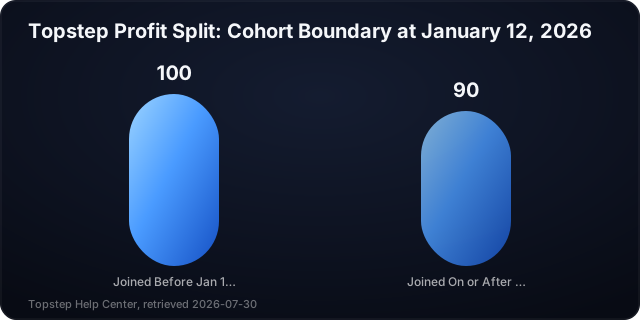
Topstep's 100%-of-first-$10,000 cohort closed on the same date
Topstep gives traders who joined its new dashboard before January 12, 2026 100% of their first $10,000 in lifetime profits, with the 90/10 split applying only after that threshold; traders who joined on or after that date are on the 90/10 split from the start (Topstep Help Center, retrieved 2026-07-30).
That is a cohort boundary, which is the most confusing kind of change to read about secondhand. Two traders describing the same firm honestly will describe different splits, and both are right. Forum threads and reviews written by the earlier cohort stay online and keep sounding current, and the mechanics of how profit split works at any given firm are worth understanding on their own terms before you compare cohorts.
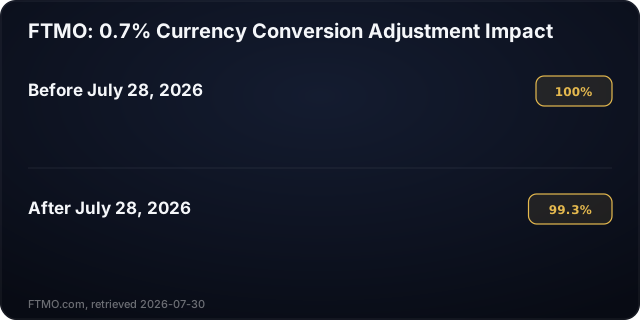
FTMO's 28 July 2026 update added a 0.7% currency conversion adjustment
FTMO announced in its 28 Jul 2026 Trading Update that its Terms and Conditions and FTMO Account Agreement were being modified to introduce a 0.7% currency conversion adjustment on realized profit or loss when the profit currency differs from the account currency, with the effective date depending on the trader's product stage as specified in their own applicable agreement (FTMO.com, retrieved 2026-07-30).
Notice the shape of that one. It is not a rule about how you trade. It is an adjustment applied to the money on the way out, and it lives in the Terms and Conditions rather than the rules page most traders bookmark. If you only watch the page that lists your maximum daily loss, you will miss changes like this entirely. The baseline of what a standard rule set contains is worth reading first, because you cannot notice a change to a document you never understood, and the same applies to a firm's consistency rule, which is a case where a single reworded clause changes who qualifies for a payout.
Where firms actually announce changes (and where they don't)
Firm-run dated changelogs: FTMO's Trading Updates page as the working model
Some firms publish changes themselves, with dates. FTMO runs its own public, dated changelog at ftmo.com/en/trading-updates/, publishing individually dated Trading Update entries roughly weekly through 2026, for example 28 Jul 2026, 23 Jul 2026, 16 Jul 2026, 9 Jul 2026 and 2 Jul 2026, so a trader can watch this single page directly for firm-announced changes instead of relying on secondhand reports (FTMO.com, retrieved 2026-07-30).
That is the model to look for at any firm you are considering. One page, dated entries, published by the firm. If it exists, it is the first URL you save. If a firm has no equivalent page, that is not proof of anything sinister, but it does mean the entire burden of record-keeping falls on you.
Help-center "Updated over a week ago" stamps: what they do and don't tell you
Most firms run their documentation through a hosted help center, and those platforms stamp articles with a relative marker rather than a date.
FundedNext's own help-center articles, Intercom-hosted, display a relative "Updated over a week ago" stamp near the title instead of an absolute date, so the stamp alone cannot tell a trader exactly when a rule last changed, only that it changed at some point in the trailing window, which is why a trader's own dated snapshot on purchase day is the only way to pin down the exact prior wording (FundedNext Help Center, retrieved 2026-07-30).
Topstep's own help-center articles use the same relative "Updated over a week ago" stamp convention as FundedNext's, near the article title, and the same imprecision applies: the stamp confirms a change happened recently but not the exact date or the exact prior wording (Topstep Help Center, retrieved 2026-07-30).
So the stamp is useful for one thing: it tells you the document is not frozen. It is useless for the two things you would actually need in a dispute, which are the date of the change and the text before it. Treat it as a smoke detector, not a record.
Email, dashboard banners, and Discord: why they are not a record
Announcements in these channels are real and worth reading, but each one has the same weakness: the firm controls the copy, the delivery, and how long it stays visible. Emails land in spam. Dashboard banners are dismissed and do not come back. Chat messages scroll away and get edited. None of them gives you a fixed, independently held copy of the wording you agreed to. That is a gap you close yourself, in about two minutes, on the day you buy.
The purchase-day snapshot: your only proof of the rules you bought
Using Internet Archive Save Page Now to get a timestamped URL
The Internet Archive's Save Page Now tool at web.archive.org/save lets anyone submit a URL, archives that page's content at that moment, and returns a timestamped snapshot URL hosted by the Archive rather than by the firm: a free, generic way for a trader to create a dated, independently hosted record of a firm's rules page on the day they purchase an evaluation, separate from anything the firm itself controls.
The mechanics are as plain as they sound. Open the page, paste the URL, submit, and copy the resulting archived link. The value is not technical, it is custodial: the copy sits somewhere the firm cannot revise. When a page later reads differently, you are no longer arguing from memory.
One limit to be honest about. Content behind a login, inside a dashboard, or rendered only after you accept a click-through agreement often will not archive cleanly. For those, take your own dated screenshots and save the PDF the firm gives you at checkout, and keep the file named with the date.
Which four pages to snapshot: rules, payout policy, T&Cs, account agreement
Four documents cover almost every money-affecting clause:
- The trading rules page. Loss limits, and the drawdown calculation method, which is the clause most likely to change quietly and most likely to end an account, including any trailing drawdown mechanics specifically.
- The payout policy. Split, thresholds, minimum holding periods, request windows, and the end-to-end withdrawal process.
- The general Terms and Conditions. Where fee and currency adjustments live, as FTMO's July 2026 update shows (FTMO.com, retrieved 2026-07-30).
- The account agreement. The document that names which version binds you and from what date.
If a firm publishes a consistency rule, snapshot that page too. Its exact wording, the percentage and what the percentage is measured against, is a case where a single reworded clause changes who qualifies for a payout.
Where to store the snapshot URLs so you can find them in six months
A snapshot you cannot locate is not evidence. Keep one plain file, one row per purchase: firm, product name, purchase date, and one archived URL per document. A note app or a spreadsheet is enough. Add the order number and the amount paid, because a dispute usually starts with a payout ticket, not a legal question, and the support agent will ask for both.
Automating the watch with free change-detection tooling
changedetection.io self-hosted via Docker or pip (Apache 2.0, no fee)
changedetection.io is a free, open-source, Apache 2.0 licensed website change-detection tool a trader can self-host via Docker or Python pip to get an alert whenever a specific prop firm rules or terms page changes, without paying for a monitoring subscription; the same project also offers an optional paid managed-hosting tier, listed at $8.99/month as of 2026-07-30, for traders who do not want to self-host.
Self-hosting means running it on your own machine or a small server. If you already run Docker, this is a one-container job. If not, the pip route works on an ordinary desktop, with the caveat that the machine has to be awake for a check to run.
Choosing the right URL and narrowing what counts as a change
Point the watcher at the specific document, not the marketing homepage. Homepages change constantly, and constant alerts are alerts you learn to ignore. Two habits keep the signal clean: watch the exact rules, payout, and terms URLs you snapshotted, and restrict the monitored region to the article body so cookie banners, promo countdowns and rotating testimonials do not trigger a notice. A firm's dated changelog page, where one exists, is the single highest-value URL to watch, because the firm is already summarizing the change for you (FTMO.com, retrieved 2026-07-30).
Set the check interval to daily. Terms do not move hourly, and a daily check gives you days of warning rather than discovering the change inside a payout dispute.
When the paid managed tier is worth it instead
Self-hosting is free but not effortless: something has to stay running and something has to deliver the alert. The same project offers the paid managed tier, listed at $8.99/month as of 2026-07-30. If you are running one or two accounts and enjoy the tooling, the free self-hosted version does the identical job. There is no version of this decision where the paid tier watches better.
Which changes to prioritize, ranked by what they cost you
Not every edit deserves your attention. These four types, all drawn from the 2026 record above, are the ones that touch money.
| Change type | Example from the 2026 record | Why it hits your payout | How you'd detect it |
|---|---|---|---|
| Refund timing | FundedNext Stellar 1-Step: fee refund moved from the first Performance Reward to the third, for accounts purchased or reset on or after January 12, 2026 (FundedNext Help Center, retrieved 2026-07-30) | Delays recovery of your fee by two payout cycles | Purchase-day snapshot of the refund article, plus a watcher on that URL |
| Split threshold or cohort cutoff | Topstep: 100% of the first $10,000 in lifetime profits for traders who joined before January 12, 2026, 90/10 from the start for those joining on or after (Topstep Help Center, retrieved 2026-07-30) | Changes your take on the first block of profit | Snapshot the payout policy on the day you join, and record your join date |
| Scaling criteria | FundedNext Stellar Instant: new Scale-Up program for accounts purchased or reset on or after January 12, 2026, requiring cumulative 10% tier growth plus one withdrawal, up to 10x initial balance and a $2 million cap (FundedNext Help Center, retrieved 2026-07-30) | Resets the targets that govern future account size | Watch the scaling help article; compare to your snapshot |
| Currency or fee adjustment | FTMO: 0.7% currency conversion adjustment on realized profit or loss where profit currency differs from account currency, announced 28 Jul 2026, effective date per product stage (FTMO.com, retrieved 2026-07-30) | Shaves a percentage off money on the way out | Watch the firm's dated changelog and the T&Cs URL (FTMO.com, retrieved 2026-07-30) |
All four of these change types are indexed to a purchase or join date, which is why recording that date matters more than reading a firm's current rules page.
For firm-by-firm comparison of rule sets and pricing, that belongs in a dedicated comparison, not here. This article is about the record you keep, whichever firm you choose, though a side-by-side like FundedNext vs ITAfx is a useful starting point if you are still deciding.
A 15-minute checklist for the day you buy an evaluation
Run this once per purchase. No new information is needed beyond the four sections above.
- Minutes 0 to 2. Note the exact purchase date and the product name as written at checkout. Cohort rules are indexed to dates, so this is the field that decides which version binds you.
- Minutes 2 to 4. Find the firm's dated changelog. Save the URL. FTMO's Trading Updates page is the working example of what one looks like (FTMO.com, retrieved 2026-07-30).
- Minutes 4 to 9. Submit four URLs to web.archive.org/save: rules, payout policy, Terms and Conditions, account agreement. Copy each timestamped snapshot URL as it returns.
- Minutes 9 to 11. Screenshot anything behind the login that will not archive, and save the checkout receipt or agreement PDF with the date in the filename.
- Minutes 11 to 14. Add those URLs to changedetection.io, one watch per document, daily interval, monitored region narrowed to the article body.
- Minute 15. Write one row in your records file: firm, product, purchase date, order number, four snapshot links. Done.
Assuming the rules you read months ago still apply is one of the quieter, more expensive mistakes in this business, and it is fully avoidable in a quarter of an hour.
How ITAfx handles this on its own side
Apply the same habit to us. ITAfx provides simulated trading evaluation services, and challenge fees pay for access to evaluation environments, not investments or deposits. Current account sizes, profit split, and payout timing are published on itafx.com, which is the one place they are authoritative, so snapshot that page on the day you buy exactly as you would with any other firm. A firm that expects you to keep a record is a firm you can hold to one.
Ready to get funded?
50% off instant accounts with code 50CRYPTO.
Get Funded →Frequently Asked Questions
How do I know if a prop firm changed its rules?
Check three places, in order: the firm's own dated changelog if it publishes one, the help-center article's update stamp, and your own purchase-day snapshot. Only the third one proves the prior wording, because relative stamps like "Updated over a week ago" confirm that a change happened without giving the date or the old text (FundedNext Help Center, retrieved 2026-07-30).
Do prop firm rule changes apply to accounts I already own?
It depends on the change, and the firm states the boundary. FundedNext's refund and scale-up changes were indexed to accounts purchased or reset on or after January 12, 2026 (FundedNext Help Center, retrieved 2026-07-30). FTMO's July 2026 Terms and Conditions modification stated that the effective date depends on the trader's product stage and is specified in their applicable agreement (FTMO.com, retrieved 2026-07-30). This is why your purchase date is worth recording precisely.
How do I save a prop firm's terms and conditions as proof?
Submit the URL to the Internet Archive's Save Page Now at web.archive.org/save, which archives the page at that moment and returns a permanent, timestamped snapshot URL that the firm does not control.
Is there a free tool to monitor a prop firm website for changes?
Yes. changedetection.io is free and open-source under Apache 2.0 and can be self-hosted via Docker or Python pip. An optional managed tier starts at $8.99/month if you would rather not run it yourself.
Which pages are worth monitoring?
The trading rules page, the payout policy, the general Terms and Conditions, the account agreement, and the firm's changelog if one exists. Fee and currency adjustments tend to live in the Terms rather than the rules page, as FTMO's 0.7% currency conversion adjustment did (FTMO.com, retrieved 2026-07-30).
Ready to get funded?
Instant accounts, simulated capital, rules published before you pay. 50% off with code 50CRYPTO.
Get Funded →