 ITA
ITAWhat "Simulated Capital" Means at Prop Firms (Their Own Words)
Prop firms' own docs say evaluation AND funded accounts are usually simulated. What each firm publishes, why, and where the real money actually moves.

How this article is verified: Every number and claim above is checked against a primary source, ITAfx's own Terms of Service, official product pages, or the trading platform itself, before publication, then re-verified again immediately before this page goes live. Fact-checked and published on July 31, 2026 by Adrian Caldwell.
Short answer: yes, it is almost always simulated, at both stages
The evaluation account has never pretended otherwise
Nobody disputes the challenge phase. You pay a fee, you get a platform, you hit a target inside a rule set. The account is a demo account and the firm says so. For the basics of what that account actually is, see what a prop firm is and how it works.
The funded account is the part traders get wrong
FTMO's own explainer states that even in the case of an FTMO Account, the funded stage, the trader has access only to a simulated demo account with fictitious capital, never a real live account (FTMO.com, retrieved 2026-07-30). That is the firm writing it down on its own site, not a critic's inference. In a Forbes feature published 22 July 2026, Maven Trading CEO Chris Hunter said the six-figure balance handed to a passing trader is not actually real money 99 percent of the time, and Take Profit Trader CEO James Sixsmith compared the model to a brokerage "B book," where trades look live to the trader but are not actually going to the exchange (Forbes, retrieved 2026-07-30).
What "simulated" does and does not change for you
It does not change your rules, your targets, or whether a payout arrives. It changes where the risk sits. Your losses do not hit a live order book, and your wins are settled by the firm as a payout obligation rather than by liquidating a real position. If you want the plain mechanics of that account type first, start with the demo versus funded account comparison and the beginner primer on how prop firms work.
Do they actually pay? Where the real money in this business moves
Fees in, payouts out: the two real cash flows
Two flows in this business are unambiguously real money: the fee you pay to start, and the payout the firm wires when you win. Simulated trading capital sits between them as an accounting environment, not as a cash balance you could withdraw in full. Firms that fail this test outright are catalogued in why prop firms deny payouts, and the verification steps before you trust one are in how to know if a prop firm pays.
FTMO's own published payout figures
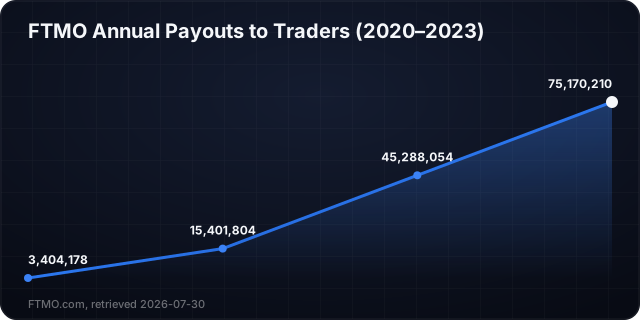
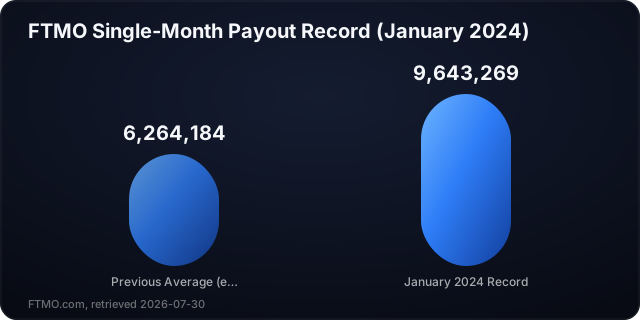
FTMO's annual payouts to traders grew from $3,404,178 in 2020 to $75,170,210 in 2023, a 22-fold increase, with a single-month record of $9,643,269 sent to traders in January 2024, according to FTMO's own blog (FTMO.com, retrieved 2026-07-30). Those are firm-published figures about the real-money side, and they are the reason "simulated" and "unpaid" are not synonyms.
The chart below plots FTMO's own reported payout growth.
The chart below shows the single-month record inside that growth curve.
Why simulated trading capital and real payouts are not a contradiction
Topstep says it directly: on its Express Funded Account you are still trading in simulated markets, but you trade the firm's money and work toward real payouts (Topstep.com, retrieved 2026-07-30). The payout is a contractual obligation triggered by simulated performance. What that obligation looks like in practice, documents, timing, thresholds, is covered in how a funded-account withdrawal actually works, and the payout math itself is explained in how profit split works in forex prop firms.
The disclosure spectrum: what four firms say in their own words
FTMO: simulated demo account, fictitious capital, in writing
FTMO's phrasing is the clearest in the category: access only to a simulated demo account with fictitious capital, stated for the funded stage specifically (FTMO.com, retrieved 2026-07-30).
FundedNext: simulated execution, in the help centre
FundedNext's help centre answers the environment question directly for both its Challenge and its FundedNext Account: orders execute in a simulated real market environment, with quotes using FundedNext's liquidity providers (FundedNext Help Center, retrieved 2026-07-30). The firm describes the environment; it does not, on that page, say where its own capital sits.
Topstep: simulated Express Funded versus live-market Live Funded
Topstep is the only firm here that draws the line inside its own funnel. The Express Funded Account is simulated with real payouts (Topstep.com, retrieved 2026-07-30), and after showing long-term consistency a trader earns access to a Live Funded Account, where trades are placed in live markets using Topstep's money and payouts are based on performance (Topstep.com, retrieved 2026-07-30).
Maven Trading and Take Profit Trader: two CEOs on the record
Hunter's "not actually real money 99 percent of the time" and Sixsmith's B-book comparison came from a named journalist's feature, Boaz Sobrado writing in Forbes, not from either firm's help centre (Forbes, retrieved 2026-07-30). Keep that distinction: a statement in a firm's own docs is something you can hold the firm to.
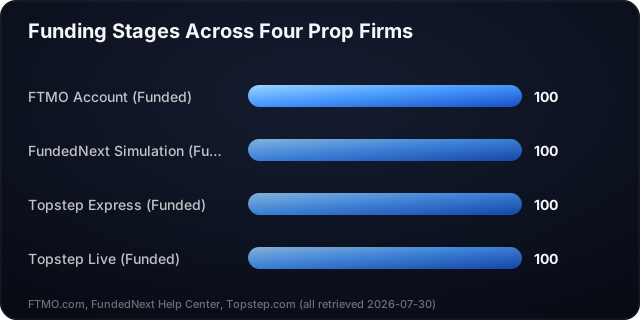
The chart below lines up the funding stages across all four firms.
Comparison table: how each firm describes its own funded stage
The table below lines up each firm's own wording on environment and capital, side by side, so you can compare precision rather than tone.
| Firm | Funded stage as the firm names it | Firm's own wording for the environment | Where the firm's own capital is stated to sit | Source type | Retrieved |
|---|---|---|---|---|---|
| FTMO | FTMO Account | "a simulated demo account with fictitious capital" (FTMO.com) | FTMO trades "on its own account with its own capital," using data from clients' simulated trades (FTMO.com) | Firm's own page | 30 July 2026 |
| FundedNext | FundedNext Account | "simulated real market environment, with quotes using FundedNext's liquidity providers" (FundedNext Help Center) | Not stated in the cited page | Firm's own help centre | 30 July 2026 |
| Topstep | Express Funded Account | "still trading in simulated markets" with "real payouts" (Topstep.com) | Not stated for this stage | Firm's own page | 30 July 2026 |
| Topstep | Live Funded Account | "trades are placed in live markets using Topstep's money" (Topstep.com) | Topstep's money, in live markets | Firm's own page | 30 July 2026 |
| Maven Trading | Funded account | balance "is not actually real money 99% of the time" (CEO Chris Hunter, Forbes) | Not stated | On-record trade press | 30 July 2026 |
| Take Profit Trader | Funded account | "a B book is basically a simulated" flow (CEO James Sixsmith, Forbes) | Not stated | On-record trade press | 30 July 2026 |
Reading the table without over-reading it
"Not stated" means not stated in the pages cited here, not proof of anything hidden. And nothing in this table tells you a firm is good or bad. It tells you how precisely each one describes its own product, which is a different and more useful signal.
Why the industry standardized on simulation instead of live accounts
The firms' stated reason: measure the trader before exposing capital
FTMO puts its rationale in writing: the process exists to identify and validate traders' skills without the risk of financial loss on the part of clients, which is why the assessment runs on simulated trading rather than a live account (FTMO.com, retrieved 2026-07-30).
The structural reason a B book makes sense to the firm
Sixsmith's own comparison, a B book where trades look live but are not going to the exchange, describes the structure plainly (Forbes, retrieved 2026-07-30). Structurally, a simulated environment lets a firm onboard thousands of traders without routing thousands of orders, and lets it decide which flow, if any, it wants real exposure to.
Where the firm's own capital actually sits at risk
FTMO answers this about itself: the firm trades on its own account with its own capital, using, among other things, data from simulated trades executed by selected FTMO clients (FTMO.com, retrieved 2026-07-30). So the firm's exposure is real. It just is not sitting inside your account.
How simulated pricing tracks the live market, and where it can diverge
Liquidity-provider quotes in a simulated environment
Simulated does not mean invented. FundedNext states that orders on its platform execute in a simulated real market environment, with quotes using FundedNext's liquidity providers (FundedNext Help Center, retrieved 2026-07-30). The price feed comes from the market; the fill is booked internally.
What execution quality still means when the fill is simulated
Spread, slippage, and fill timing still shape your equity curve, because the rule engine measures your simulated account with real costs applied. The mechanics live in slippage explained.
Use it as a transparency test before you pay a fee
Four questions the firm's own site should already answer
Before the fee: does the firm say, in its own docs, whether the funded stage is simulated? Does it name the environment, or only imply it? Does it state where its own capital sits? Does it describe payouts as an obligation with conditions you can read? FTMO, FundedNext, and Topstep each answer at least the first two questions in writing on their own hosts. Running that test across a shortlist is easier with a side-by-side view like prop firm comparison 2026, and the mistakes that skip this step entirely are in prop firm selection mistakes to avoid.
Red flag: language that implies a live brokerage account
Marketing that suggests your capital sits in a brokerage account, while the terms describe a demo environment, is a mismatch you should read as a warning. Note also Hunter's on-record point that a prop firm does not have regulations in the formal sense, which is his characterisation of the category, not a legal conclusion of ours (Forbes, retrieved 2026-07-30).
What ITAfx states about its own accounts
ITAfx is an instant-funding firm on simulated capital: account sizes from $50K to $400K in simulated capital, no evaluation time limit, and challenge fees that pay for access to evaluation environments rather than investments or deposits, as stated in the risk disclaimer published site-wide on itafx.com (itafx.com/llms.txt, retrieved 2026-07-30). The rule set that governs those accounts is covered in the funded-account rules guide, and the instant-funding format itself in instant funded accounts. If you now want to compare specific firms, start with FTMO alternatives.
Disclaimers
Ready to get funded?
50% off instant accounts with code 50CRYPTO.
Get Funded →Frequently Asked Questions
Is my funded prop firm account real money?
Usually not. FTMO states that even at the FTMO Account stage the trader has access only to a simulated demo account with fictitious capital (FTMO.com, retrieved 2026-07-30). Maven Trading's CEO Chris Hunter put it at not actually real money 99 percent of the time in Forbes on 22 July 2026 (Forbes, retrieved 2026-07-30).
Do any prop firms give you a live account?
Some describe one as a later stage. Topstep says that after showing long-term consistency a trader earns access to a Live Funded Account, where trades are placed in live markets using Topstep's money and payouts are based on performance (Topstep.com, retrieved 2026-07-30). Its earlier Express Funded stage remains simulated (Topstep.com, retrieved 2026-07-30).
If it is simulated, are the payouts real?
The payouts are cash. FTMO's own blog reports annual payouts rising from $3,404,178 in 2020 to $75,170,210 in 2023, with $9,643,269 sent in January 2024 alone (FTMO.com, retrieved 2026-07-30). Topstep frames its Express Funded stage as simulated markets with real payouts (Topstep.com, retrieved 2026-07-30).
Does simulated capital mean my results do not count?
They count for the purpose the firm defines. FundedNext calls its Simulation Funded phase a paid internship and a preparation tool for building discipline and risk control before exposure to live capital, according to FundedNext's own blog.
Is a simulated funded account legal or regulated?
Maven Trading CEO Chris Hunter told Forbes that a prop firm does not have regulations and that, given the nature of the model, it is essentially a game (Forbes, retrieved 2026-07-30). That is his on-record characterisation of the category, published 22 July 2026, and not legal advice. Check each firm's own terms and jurisdiction.
What does ITAfx say about its own simulated capital?
ITAfx states that its account sizes from $50K to $400K are simulated capital, with challenge fees paying for access to evaluation environments rather than investments or deposits (itafx.com/llms.txt, retrieved 2026-07-30).
Ready to get funded?
Instant accounts, simulated capital, rules published before you pay. 50% off with code 50CRYPTO.
Get Funded →