 ITA
ITAProp Firm Slippage Disputes: What Firm Policies Actually Allow
What FTMO's and FundedNext's own execution policies disclose about slippage and stop fills, and the independent channel where you can escalate a disputed fill.

How this article is verified: Every number and claim above is checked against a primary source, ITAfx's own Terms of Service, official product pages, or the trading platform itself, before publication, then re-verified again immediately before this page goes live. Fact-checked and published on July 30, 2026 by Adrian Caldwell.
Your stop was hit and the chart says it shouldn't have been
Three fears sit underneath every slippage complaint, and they are worth naming in order.
The first is that the fill was manufactured: that the firm moved price against you because your account was close to a payout. The second is that a rule you never read will be used against you: some clause, buried in a help-centre article, that turns your evidence into nothing. The third is the quietest and the heaviest: that nobody above the firm will ever hear you, because there is no above.
The answer to all three has the same shape, and it is not reassurance. First, read the policy language, because the firms have published more than traders realise about how their fills work. Second, know the escalation door, because as of July 2026 there is a named one that did not exist before.
What a stop-loss order actually promises (and what it doesn't)
Why a stop is a trigger, not a price guarantee
A stop-loss order is an instruction to send an order once price touches a level. It is not a contract to transact at that level. FTMO's own execution policy states that a Stop Loss order does not guarantee a fill at the predefined price level, because widened spreads can cause slippage (FTMO, retrieved 2026-07-30).
The underlying mechanics of slippage, why it happens, and what it costs per trade are covered in detail in our guide to forex slippage. What matters for a dispute is narrower: the level you typed is the trigger, and the price you receive is whatever the execution model produces at the moment the trigger fires.
Spread widening vs. a bad fill: the distinction that decides your dispute
These are two different claims, and firms treat them differently.
Spread widening is a market-condition event. The bid and ask separate, your stop sits inside the new spread, and the order triggers. Nothing failed. A bad fill, in the sense a policy might review, is closer to an execution defect: the order did not process as the model describes.
Traders usually file the first and describe it as the second. If your stop sat two pips from price ahead of a release, the widening explanation is the likely one, and it is the one the policy already discloses. Volatility-aware placement, covered in our ATR stop-loss guide, removes more of these than any ticket ever will. Traders who move a stop after the fact instead of before it tend to run into the same wall from a different direction, a pattern examined in why funded traders move their stop loss.
What FTMO and FundedNext disclose about how your orders are filled
FTMO: filled at the best price available at the moment of processing
FTMO states that orders in its Challenge, Verification, and FTMO Account are not guaranteed to receive a fill at the requested price, describing execution as modelled after the live-market execution model rather than a guaranteed-fill instant model (FTMO, retrieved 2026-07-30).
Read that clause twice, because it does most of the work. "Not guaranteed to receive a fill at the requested price" is disclosed variance. A fill that differs from your requested level is, on the firm's own published description, expected behaviour under the model, not an anomaly requiring explanation.
FundedNext: simulated real-market environment routed through its own liquidity providers
FundedNext states that orders on its platform execute in a simulated real-market environment, with quotes routed through FundedNext's own liquidity providers (FundedNext Help Center, retrieved 2026-07-30).
Two things follow from that sentence, and only two. The environment is simulated, so your comparison chart from a different broker's feed is not the feed you traded. And the quotes come from that firm's liquidity providers, so a price difference against a third-party chart is a difference between two data sources, not proof of manipulation.
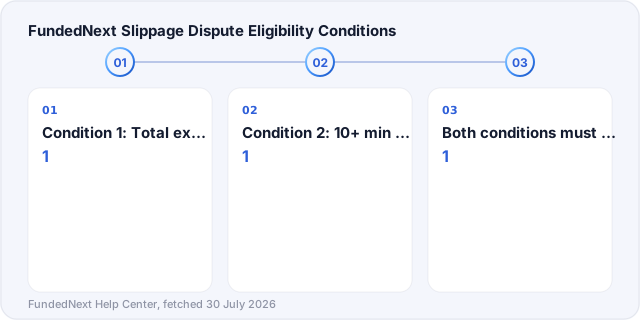
Neither firm describes a guaranteed-price instant fill. Both describe a live-market-modelled one. That is the disclosed baseline your dispute has to argue against. The eligibility conditions FundedNext applies to a slippage dispute, including its news-window rule, are set out below.
The review standard that quietly ends most disputes
Read the standard your firm publishes, not the one you assume
Here is the clause that decides most tickets, and it is not hidden, it is published on the firm's own help pages.
Firms set their own threshold for what a slippage claim gets reviewed against, and some set conditions around high-impact news releases. Those thresholds are firm-specific: they are not an industry norm, they change, and we will not restate a figure here that we could not confirm on the firm's primary document on the day of writing. Open the firm's execution and slippage pages and read the standard as it stands today.
If you trade releases at all, the interaction between the calendar and firm rules deserves a read before the next print: see the economic calendar and prop firm trading.
Why 'my fill was bad' and 'my order failed entirely' are not the same claim
A bad fill means you transacted at a worse price than you wanted. A total execution failure means the order did not process. The first is a pricing outcome. The second is a system outcome.
Policies that review only the second will read a ticket about the first and close it as within policy. That is not a firm dodging you. It is the standard, published in advance, doing exactly what it says.
Firm-policy comparison: what each one puts in writing
The table below lays out, side by side, exactly what FTMO and FundedNext each disclose in writing.
| Firm | Stated execution model | Stop-loss price guarantee stated? | Threshold for reviewing a slippage claim | News-window condition | Source, date fetched |
|---|---|---|---|---|---|
| FTMO | Live-market execution model; fills not guaranteed at requested price | No; policy states a Stop Loss does not guarantee a fill at the predefined level | Not stated on the cited pages | Not stated on the cited pages | ftmo.com/en/trading-according-to-the-real-market/, fetched 30 July 2026 |
| FundedNext | Simulated real-market environment, quotes via FundedNext's own liquidity providers | Not stated on the cited page | Not verified on the cited page at time of writing | Not verified on the cited page at time of writing | help.fundednext.com/en/articles/8662544, fetched 30 July 2026 |
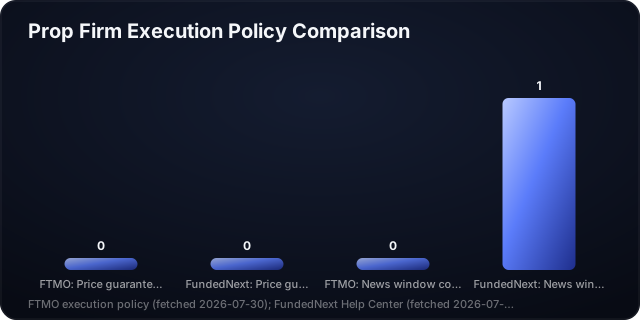
Empty cells are deliberate. "Not stated on the cited page" and "not verified on the cited page at time of writing" mean we did not confirm that position on the firm's own document, and we will not infer a firm's stance from silence. Note especially that "total execution failure only" and "any adverse fill" are different standards wherever a firm publishes one of them. Reading them as equivalent is how traders file claims that were never eligible.
Where you can escalate beyond the firm
The Financial Commission's Prop Firm Certification, launched July 22, 2026
Until recently, the honest answer to "who is above the firm?" was usually nobody. That changed, partially, in the last week of July 2026.
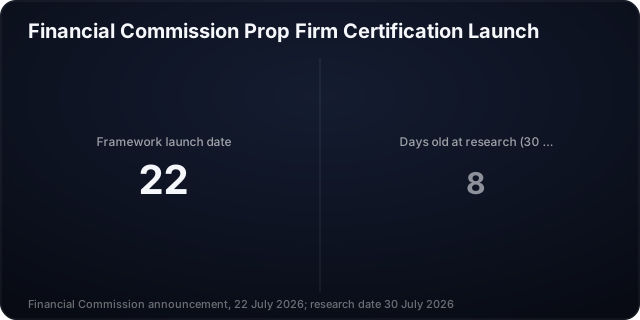
The Financial Commission, an independent industry self-regulatory body, launched Prop Firm Certification on 22 July 2026, describing it as the first self-regulatory framework built specifically for proprietary trading firms (Financial Commission, retrieved 2026-07-30).
What the code of conduct commits a certified firm to
The Financial Commission's Prop Firm Certification assesses firms against standards covering trading rules, payouts, risk management and dispute handling, and the programme extends the organisation's external dispute resolution services to the proprietary trading sector (Finance Magnates, retrieved 2026-07-30).
That is the line that matters for a disputed fill: a named channel outside the firm where a submission can be made. Finance Magnates, reporting on the 22 July 2026 launch, quoted Financial Commission COO Nikolai Isayev describing the certification's goal for the prop-firm sector as bringing "transparent rules, fair enforcement and clear payouts" (Finance Magnates, retrieved 2026-07-30).
What certification does not do for you
Three honest limits, stated plainly.
It is voluntary. The programme is reported as a voluntary certification programme for proprietary trading firms (Finance Magnates, retrieved 2026-07-30), which means a firm chooses whether to be bound by it.
It covers certified firms. If the firm that filled your stop is not certified, the dispute-submission process is not a door you can walk through on that account.
And it is new. At the time this article was researched, on 30 July 2026, the framework was eight days old. Eight days is not a track record. Treat it as a channel that now exists and is worth checking for your firm, not as a guaranteed remedy with a known success rate. Nobody has that data yet, and anyone quoting one to you is inventing it.
How to file a dispute that can actually be reviewed
Evidence to capture before the ticket: timestamps, order type, requested vs filled price
Capture this from your own platform, before you write anything: the exact server timestamp of the trigger, the order type, the requested level, the filled price, the instrument, and the spread at the moment of the fill if your platform records it. A screenshot of a candle from a different data source is the weakest artefact you can submit, because FundedNext has already disclosed that its quotes come from its own liquidity providers (FundedNext Help Center, retrieved 2026-07-30).
Check the policy clause first, then match your claim to it
Then do the step almost everyone skips. Open the firm's execution and slippage pages and find the clause that governs your situation. Ask one question: does the standard published there cover what happened to me?
If the policy reviews total execution failures only, and your order executed at a price you dislike, you do not have a claim under that clause as written. If the policy is silent, say so in your ticket and ask which standard applies, rather than asserting one that is not published.
When the answer is 'this fill was within policy'
Sometimes that answer is correct, and it is not a good feeling. A stop that triggered inside a widened spread during a release, on a model whose own documentation says orders are not guaranteed to receive a fill at the requested price (FTMO, retrieved 2026-07-30), is a cost of doing business, not a wrong to be righted.
The mature response is to change your inputs: wider stops relative to volatility, no fresh entries inside a release window, position sizes that survive a bad fill. The pattern shows up repeatedly in our breakdown of common mistakes in prop firm challenges. And if your dispute is really about a payout rather than a fill, the process itself is worth understanding first: see why prop firms deny payouts.
Choosing a firm by what its execution policy says out loud
The right time to read an execution and dispute policy is before you pay for an evaluation, not after your stop-out. Two questions answer most of it: what does the firm say its fill model is, and what standard will it review a slippage claim against? A firm that publishes both, as FTMO and FundedNext do, has given you something to plan around. A firm that publishes neither has told you something too.
If you are working through the whole rule set rather than one clause, start with prop firm drawdown rules explained, and if you are comparing firms directly, our 2026 prop firm comparison covers the field.
ITAfx sells access to simulated evaluation accounts on simulated capital, with account (simulated capital) sizes from $50K to $400K and no evaluation time limit under its instant-funding model; the current account and payout specifics are published on itafx.com rather than restated here.
Ready to get funded?
50% off instant accounts with code 50CRYPTO.
Get Funded →Frequently Asked Questions
Can a prop firm move price against my stop?
Neither cited policy describes that, and there is no evidence of it. What both firms do describe is a live-market-modelled fill: FTMO says orders are not guaranteed to receive a fill at the requested price under its live-market execution model (FTMO, retrieved 2026-07-30), and FundedNext says orders execute in a simulated real-market environment using its own liquidity providers (FundedNext Help Center, retrieved 2026-07-30). Price variance from your requested level is disclosed behaviour under both descriptions.
Why does my stop fill differ from the chart I use?
Because it may not be the same feed. FundedNext's quotes come from FundedNext's own liquidity providers (FundedNext Help Center, retrieved 2026-07-30), so a third-party chart is a second data source, not a reference price for your fill.
Is slippage during news releases disputable?
Under FundedNext's stated policy, only in narrow circumstances: slippage during high-impact news releases will not be addressed unless there is a total execution failure, and adjustments are considered only for trades placed more than 10 minutes after the news publication (FundedNext Help Center, retrieved 2026-07-30).
Is there anywhere to escalate above the firm?
As of 22 July 2026, the Financial Commission runs Prop Firm Certification, a voluntary self-regulatory framework for proprietary trading firms (Financial Commission, retrieved 2026-07-30), whose code of conduct commits certified firms to five principles, including access to the Financial Commission's independent dispute-submission process.
Does a stop-loss guarantee my exit price?
No. FTMO's own policy states that a Stop Loss does not guarantee a fill at the predefined price level because widened spreads can cause slippage (FTMO, retrieved 2026-07-30).
Ready to get funded?
Instant accounts, simulated capital, rules published before you pay. 50% off with code 50CRYPTO.
Get Funded →