 ITA
ITALoss Aversion: Why Funded Traders Move Their Stop Loss (And How to Fix It)
Discover the psychological trap of loss aversion in funded trading. Learn why traders move their stop loss and implement research-backed fixes to protect.
Short answer
Funded traders move their stop loss because losses feel roughly twice as painful as equivalent gains feel good, so the brain looks for any way to avoid locking in a loss, even a mechanical one already placed for a reason. In a prop firm context this still sits under simulated-capital rules: fees buy access to the evaluation or funded environment, not a deposit of trading capital.
Simulated capital: prop firm evaluation and funded stages discussed here typically run on simulated accounts. Challenge fees pay for access to that environment; they are not a deposit of trading capital. ITAfx accounts are simulated capital.


The Psychological Trap: Why Moving Your Stop Loss Feels Right (But Is Wrong)
You're watching EUR/USD tick closer to your stop. 15 pips away. 10 pips. 5 pips. Your cursor hovers over the order modification button. Just 10 more pips of room, your brain whispers. The trade could still work.
This moment, this exact psychological trap, is why many traders fail funded challenges or lose accounts. Not because they can't analyse charts. Not because they lack a strategy. But because when price approaches their stop loss, their brain chemistry overrides their trading plan.
The conventional wisdom says traders move stops because they're undisciplined or emotional. Set better stops, the advice goes. Have more willpower. But this misses something fundamental: your brain is literally wired to make you move that stop. According to Kahneman & Tversky's foundational research, losses feel approximately twice as painful as equivalent gains feel pleasurable. This isn't weakness, it's neurology.
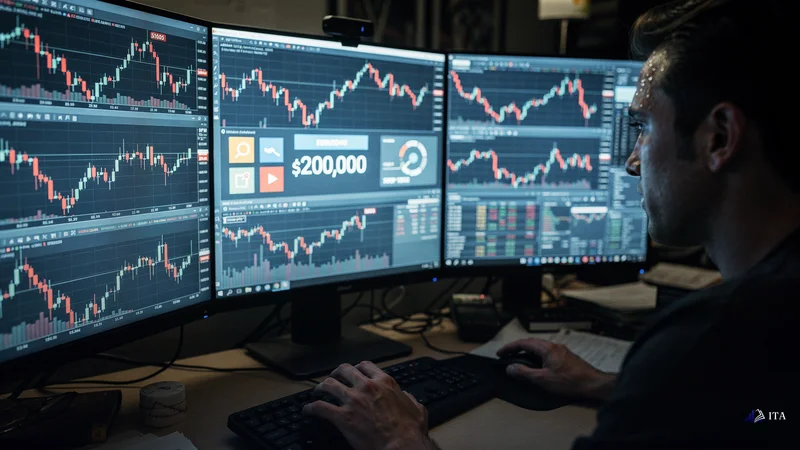
In funded trading, this biological response becomes catastrophic. When you're trading a $200,000 funded account with a 3% daily drawdown limit, every loss doesn't just hurt your P&L, it threatens your entire access to capital. The stakes transform from "I lost $600" to "I'm one trade away from losing my funding."
The Science Behind It: Prospect Theory, Disposition Effect, and Myopic Loss Aversion
But here's what changes everything: professional traders who use pre-committed, mechanical stop-loss rules perform significantly better than those using discretionary stops, according to Trades Viz analysis. The solution isn't fighting your psychology, it's removing the decision entirely.
The science behind this behaviour reveals three interconnected biases that create a perfect storm in your trading brain. Prospect theory shows that once you're in a losing position, you become risk-seeking rather than risk-averse, the opposite of your behaviour in winning trades. This explains why traders are approximately 50% more likely to sell a winning position than a losing one, a pattern known as the disposition effect.
Add myopic loss aversion, the tendency to evaluate performance over extremely short timeframes, and you get traders who can't tolerate even temporary drawdowns. Research in behavioral finance suggests that potential losses tend to trigger stronger emotional responses in the brain than equivalent gains, creating genuine physical discomfort. Your brain interprets an approaching stop loss as a threat requiring immediate action. Our guide on Anchoring Bias in Trading covers this in more depth.
In prop firms, these biases intensify. Daily drawdown limits around 4-5% mean you're always just two or three trades from a violation. The one-strike termination rules transform every loss from a learning experience into an existential threat. As ITAfx analysis notes, these hard limits create a psychological pressure cooker where loss aversion reaches extreme levels.
A Funded Account Scenario: The Price Tick, The Panic, The Move
Prop firm rules create psychological pressure that amplifies natural loss aversion and triggers panic responses in funded traders. The daily drawdown limit becomes a mental countdown timer, and the maximum loss threshold transforms routine market volatility into account-threatening scenarios. These protective mechanisms, whilst safeguarding capital, inadvertently activate the exact emotional responses that destroy trading performance.
Picture this scenario. You're trading a $200,000 funded account. You enter long on GBP/USD with a 30-pip stop, risking 0.3% of your account ($600). Price immediately moves against you. At -20 pips, you're down $400. Your daily drawdown sits at -2.2% from earlier trades. One more full loss puts you dangerously close to the 3% limit.
Your rational mind knows the probabilities haven't changed. The trade is either valid or it isn't. But your emotional brain screams that this specific loss will cascade into account termination. You widen the stop to 50 pips. "Just this once," you tell yourself. "The level needs more room."
Price continues falling. Now you're down 50 pips, $1,000 instead of the planned $600. Your daily drawdown hits -2.7%. Panic sets in. You can't take another loss today, so you remove the stop entirely. "I'll watch it manually," you promise. The timeline below traces exactly how a single 30-pip stop stretches to 50 pips and then disappears entirely as the drawdown clock keeps running.

Research-Backed Fixes: Practical Protocols to Prevent Stop Loss Tampering
This is where loss aversion meets funded trading reality. That -2.7% drawdown feels like standing on the edge of a cliff. Your identity as a funded trader, your future income potential, your proof that you can succeed, it all hangs on this moment. The psychological weight transforms a routine stop loss into an existential crisis.
The research-backed solution isn't what most traders expect. It's not about better analysis or tighter stops. It's about removing yourself from the decision entirely through three mechanical protocols.
First, implement pre-committed mechanical stops that execute without your intervention. Earn2Trade recommends using OCO (one-cancels-other) orders where your stop loss and take profit are submitted simultaneously with your entry. Once submitted, make it a rule: no modifications allowed. Period. This isn't about discipline, it's about acknowledging that your brain chemistry will betray you at the critical moment.
Second, reduce your risk per trade to levels that don't trigger your threat-detection systems. While many sources suggest 1-2% risk, funded traders need to go lower. Successful funded traders often risk just 0.25-0.5% per trade. At these levels, a loss feels manageable rather than catastrophic. Your amygdala doesn't sound the alarm bells. The graphic below lines up the three protocols, pre-committed OCO stops, lower per-trade risk, and a no-modification rule, side by side.
Daily Practice: Building Psychological Resilience Against Loss Aversion
Psychological resilience against loss aversion requires systematic daily practices that override emotional decision-making during drawdown periods. Rule-based break protocols prevent desperation psychology by removing discretionary choices when approaching limits. If you hit 50% of your daily drawdown limit, you stop trading immediately with no exceptions, ensuring the rule makes the decision before loss aversion can interfere with judgment.
Here's the bridge most traders miss: these protocols work because they target the root cause, the moment of decision when your loss-averse brain hijacks your plan.
Building psychological resilience against loss aversion requires daily practices that rewire your relationship with losses. Start with emotional state journaling, but not the generic "how do I feel" variety. Track specific moments: what were you thinking 30 seconds before moving a stop? What physical sensations appeared? Did your breathing change? This granular awareness helps you recognise the warning signs before you act on them.
Quantify your interference patterns by tracking Maximum Favourable Excursion (MFE) and Maximum Adverse Excursion (MAE) for every trade. How often do trades that hit your original stop later recover? How much extra loss do you take when you widen stops? Most traders discover their interference consistently makes results worse, seeing this data repeatedly helps break the pattern. The chart below shows what an MFE/MAE log looks like once you start tracking interference trade by trade.

Conclusion: Master Your Mind, Master Your Stops, Master Your Funded Account
Master your mind by removing the decisions that your mind can't handle. Master your stops by making them non-negotiable. Master your funded account by accepting that the enemy isn't the market, it's the moment your cursor hovers over that modify button. The traders who succeed are the ones who never give themselves the chance to fail.
Ready to get funded?
50% off instant accounts with code 50CRYPTO.
Get Funded →Frequently Asked Questions
Why do funded traders move their stop loss when price approaches it?
Loss aversion causes traders to experience losses as twice as painful as equivalent gains feel pleasurable. When price nears a stop loss, the brain triggers a threat response, making traders widen or remove stops to avoid the immediate pain of realizing a loss, even though this typically increases long-term damage.
How do prop firm rules amplify loss aversion in funded accounts?
Daily drawdown limits around 4-5% and one-strike termination rules transform routine losses into existential threats. Each loss doesn't just hurt P&L, it threatens the trader's entire access to capital, future income, and identity as a funded trader, intensifying the psychological pressure to avoid stops.
What is the disposition effect and how does it relate to moving stops?
The disposition effect is the tendency to hold losing positions too long while cutting winners too early. This behavioural bias directly explains why traders move or cancel stop losses, they become risk-seeking in losses, trying to avoid the pain of crystallizing a loss.
Are pre-committed mechanical stops more effective than discretionary ones?
Many experienced traders find that pre-committed, rule-driven stop-losses help them perform better than relying on discretionary stops. Mechanical stops remove emotional decision-making at the critical moment when loss aversion peaks, preventing traders from sabotaging their own plans.
How much should funded traders risk per trade to reduce stop-moving pressure?
Successful funded traders typically risk just 0.25-0.5% per trade, much lower than the common 1-2% recommendation. At these smaller levels, individual losses feel manageable rather than catastrophic, preventing the amygdala from triggering threat responses that lead to stop tampering.
Key Takeaways
- Implement pre-committed mechanical stops using OCO orders that execute without intervention, removing the decision from your loss-averse brain entirely.
- Reduce position sizes to 0.25-0.5% risk per trade in funded accounts to prevent threat-detection systems from triggering panic responses.
- Use the STOP protocol when tempted to move stops: Stop, Take three breaths, Observe sensations, Proceed with original plan.
- Track Maximum Adverse Excursion data to prove that stop interference consistently worsens results, let the numbers break the pattern.
- Implement mandatory break protocols at 50% of daily drawdown limit with zero exceptions to prevent desperation psychology from taking control.
- Accept that losses feel twice as painful as gains feel good, build mechanical rules that protect you from this neurological reality.
- Focus on equity curve stability over explosive returns, prop firms value consistent performance more than dramatic profit spikes.
Start Your Trading Evaluation
Simulated funded accounts up to $400K. Up to 95% profit split.
Get Funded