 ITA
ITAProp Firm Minimum Trading Days: What Actually Counts as a Day
FTMO, FundedNext and Topstep define a "trading day" differently. Firm-doc-sourced comparison of day floors for passing and for payouts.

How this article is verified: Every number and claim above is checked against a primary source, ITAfx's own Terms of Service, official product pages, or the trading platform itself, before publication, then re-verified again immediately before this page goes live. Fact-checked and published on July 31, 2026 by Adrian Caldwell.
What a "trading day" actually means, firm by firm
Read the definition before the number. The definition is what decides whether the trade you opened at 11:40 PM last night counted at all.
FTMO: a CE(S)T calendar day in which at least one position is opened
FTMO defines a Trading Day as any day, measured from 00:00:00 to 23:59:59 CE(S)T, during which at least one position is opened; the day is calendar-bounded in FTMO's timezone and only opening a position makes it count (FTMO.com, retrieved 2026-07-30).
Two consequences follow. First, the boundary is midnight in Prague, not midnight where you live. If you trade the New York close from Los Angeles, your Tuesday evening is already Wednesday on FTMO's clock. Second, opening is the trigger. A position you opened yesterday and closed today does not add today to the count.
FundedNext: the day counts only if a trade is opened on it
FundedNext counts a trading day only if a trade is opened on that day; two trades on the same day count as one trading day, and one trade on Monday plus one on Wednesday count as two (FundedNext Help Center, retrieved 2026-07-30). Volume is irrelevant. Twelve trades in one session buys you exactly one day of credit. If volume itself, not just day count, is the concern, see the separate question of how many trades per day starts to count as overtrading.
Topstep: an exchange session from 5:00 PM CT to 3:10 PM CT, not a calendar day
This is the definition that surprises people most. Topstep's trading day is an exchange session, not a calendar day: it runs from 5:00 PM CT through 3:10 PM CT the next calendar day (Topstep Help Center, retrieved 2026-07-30).
So a trade placed at 6:00 PM CT on Monday belongs to Tuesday's session. Trade the Asian open on Monday evening and the London open on Tuesday morning, and you have filled one Topstep day, not two, even though your own calendar shows two dates.
Why the same "5 days" is not the same requirement at two firms
Put the three definitions side by side and the ranking pages fall apart. At FTMO, a day is a block of clock time in Central European time. At FundedNext, a day is a calendar date on which you opened something. At Topstep, a day is a futures session that straddles two dates. Five days of a session-based clock demands a different weekly schedule than five days of a calendar clock, especially if you trade outside European hours. The day floor is one item inside a wider rule set, and the rest of that set is worth reading in the same sitting, starting with the full prop firm challenge rules and requirements.
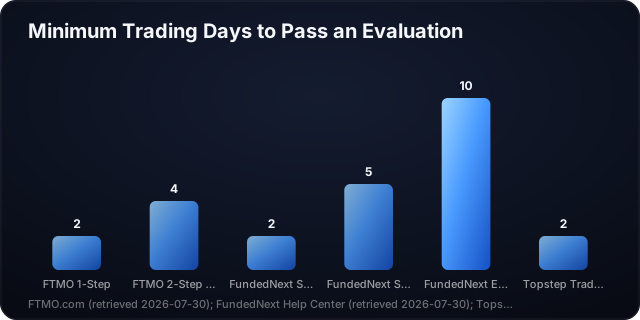
Minimum trading day floors to pass an evaluation
Here is the published floor for each program, with the unit each firm actually counts.
| Firm | Program | Published day floor | Unit the firm counts | Source |
|---|---|---|---|---|
| FTMO | 2-Step (per phase) | 4 Trading Days | Calendar day 00:00:00 to 23:59:59 CE(S)T with a position opened | FTMO Trading Objectives (retrieved 2026-07-30) |
| FundedNext | Stellar 1-Step | Trades on 2 separate calendar days | Day counts only if a trade is opened on it | FundedNext Help Center (retrieved 2026-07-30) |
| FundedNext | Stellar Lite, Stellar 2-Step (and legacy Evaluation) | 5 trading days | Day counts only if a trade is opened on it | FundedNext Help Center (retrieved 2026-07-30) |
| FundedNext | Express (closed to new clients since 18 Mar 2025) | 10 trading days, challenge and funded stage | Day counts only if a trade is opened on it | FundedNext Help Center (retrieved 2026-07-30) |
| Topstep | Trading Combine | Passable in as few as two days | Exchange session, 5:00 PM CT to 3:10 PM CT | Topstep Help Center (retrieved 2026-07-30) |
FTMO 2-Step: 4 Trading Days per phase
FTMO's 2-Step evaluation requires the trader to achieve at least 4 Trading Days as a Trading Objective (FTMO.com, retrieved 2026-07-30). That floor applies per phase, which is why the total for the 2-Step route is double the phase figure.
FundedNext: 2, 5, or 10, depending on the model
FundedNext's Stellar 1-Step Challenge requires trades placed on 2 separate calendar days as its minimum trading days rule (FundedNext Help Center, retrieved 2026-07-30). FundedNext's Evaluation, Stellar Lite, and Stellar 2-Step Challenges each require a minimum of 5 trading days (FundedNext Help Center, retrieved 2026-07-30). FundedNext's Express model carries the firm's highest published floor, a minimum trading day requirement of 10 trading days, applied to both the challenge account and the funded account; FundedNext also states that, effective 18 March 2025, the Express/Evaluation model is no longer offered to new clients, with existing clients keeping access (FundedNext Help Center, retrieved 2026-07-30).
Same brand, a five-fold spread in the day floor. The name of the product on your checkout page decides which number you live under.
Topstep Trading Combine: two days, with a single-day cap attached
Topstep states the Trading Combine can be passed in as few as two days, provided the best single day stays below 50% of the Profit Target (Topstep Help Center, retrieved 2026-07-30). Note the structure: the day floor and a distribution rule are bolted together. Two days is available only if neither day carries too much of the result. Consistency rules and speed pull against each other by design, the same tension covered in how the consistency rule works in funded account payouts.
Do any firms have no minimum trading days?
The query "prop firms with no minimum trading days" gets answered with logos. It deserves a definition instead.
Where the floor genuinely disappears: FundedNext's funded stage
FundedNext applies no minimum trading day requirement in the funded stage (the FundedNext Account) for its Evaluation, Stellar Lite, Stellar 1-Step, and Stellar 2-Step models; the floor exists only in the challenge phases (FundedNext Help Center, retrieved 2026-07-30). So the honest version of "no minimum trading days" at FundedNext is: not in the challenge, only after it.
Where "no minimum" is really "a low minimum"
A two-day floor is marketed as effectively no floor. It is not the same thing. FundedNext's Stellar 1-Step still needs trades on 2 separate calendar days (FundedNext Help Center, retrieved 2026-07-30), and Topstep's two-day route carries the 50% single-day cap (Topstep Help Center, retrieved 2026-07-30). Both are floors. Both can fail you on a day you did not open anything.
What the marketed differentiator does and does not buy you
A low day floor buys schedule freedom, nothing else. It does not loosen the drawdown threshold, and a drawdown breach can end an evaluation before any day count is ever reached, as covered in how to avoid breaching prop firm drawdown limits. ITAfx runs instant-funding simulated evaluations with no evaluation time limit (itafx.com, retrieved 2026-07-30), which removes the deadline question rather than the day-count question, and the day-floor question is only useful next to the drawdown question.
Payout day floors are a different clock
Here is the distinction no ranking page draws. The days you need to pass an evaluation and the days you need to get paid are counted by different rules, and at Topstep they are not even the same kind of day.
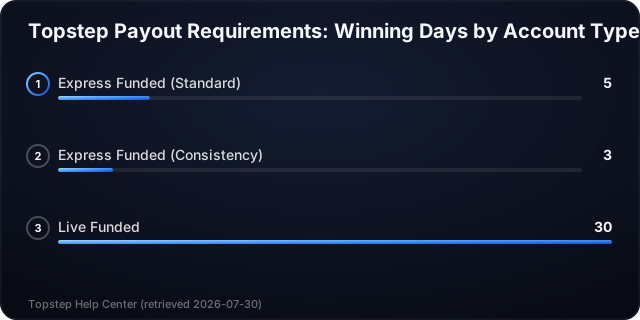
- Topstep Express Funded, standard path. To request a standard payout from a Topstep Express Funded Account, a trader needs 5 winning days of $150 or more in Net P&L; the days do not need to be consecutive, and a day locks in at 4:00 PM CT (Topstep Help Center, retrieved 2026-07-30). A losing day, or a day of plus $90, is not a step toward this number. It is nothing.
- Topstep Express Funded, Consistency path. Topstep's alternative Consistency payout path on the Express Funded Account requires 3 trading days with at least 1 trade per day while staying at or below the 40% consistency target, instead of 5 winning days (Topstep Help Center, retrieved 2026-07-30). Fewer days, a tighter distribution rule.
- Topstep Live Funded. In Topstep's Live Funded Account, daily payouts unlock only after the trader has earned $150 or more in Net P&L on 30 non-consecutive days, with a minimum payout of $125 once per day (Topstep Help Center, retrieved 2026-07-30). Thirty qualifying days is a different order of commitment than two.
- FundedNext funded stage. No minimum trading day requirement applies in the funded stage for Evaluation, Stellar Lite, Stellar 1-Step, and Stellar 2-Step (FundedNext Help Center, retrieved 2026-07-30), so the day count is not what gates you there. The withdrawal cycle is a separate mechanism, and worth reading separately from any day rule, alongside general guidance on how profit split works in forex prop firms.
The practical read: a "winning day" floor is a profit-quality filter wearing a calendar's clothes. How long five winning days takes is set by your results, not by the calendar, and nothing in the rule caps it. ITAfx pays out typically within 24 hours (itafx.com, retrieved 2026-07-30) on simulated evaluation accounts, which is a timing statement about the request, not a substitute for reading whatever day floor sits in front of it.
"No time limit" is not "no clock"
This is the hidden rule most traders miss, and it lives in the same help centre as the promise that contradicts it.
FTMO: no maximum time limit, since July 2023
FTMO states there is no maximum time limit to complete the FTMO Challenge, for both the 1-Step and 2-Step evaluations (FTMO.com, retrieved 2026-07-30). That is not a recent marketing line. In July 2023 FTMO removed the 30- and 60-calendar-day time limits from its Evaluation Process, which also made free repeats and 14-day extensions unnecessary (FTMO.com, retrieved 2026-07-30). The upper deadline is gone; the 4-Trading-Day lower floor per phase stayed (FTMO.com, retrieved 2026-07-30).
FundedNext: no time restriction to finish the challenge
FundedNext states there is no time restriction to complete the Stellar 1-Step Challenge: whether it takes 2 days or 2 months is up to the trader (FundedNext Help Center, retrieved 2026-07-30).
That covers the deadline to finish. It says nothing about how long an account may sit untouched, which is a separate clause in a separate document at most firms, and the one to go looking for before you buy.
The hidden rule to read for: inactivity expiry, not deadline
When a page says "no time limit," search the same documentation for the word "inactivity" before you buy. The clause that kills a dormant account is almost never on the objectives page. It is in a separate help article, in a different section, written for a different question. If you want the general timeline picture of getting from signup to funded, see how long it takes to get funded in a prop firm.
The fastest a pass is actually possible
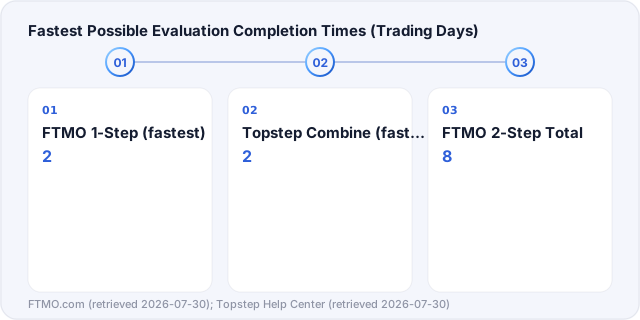
- FTMO 1-Step. FTMO states that, due to its Best Day Rule, the 1-Step evaluation can be completed in as few as 2 trading days, provided exactly 50% of the total profit target is achieved on each of two separate trading days (FTMO.com, retrieved 2026-07-30).
- FTMO 2-Step. On FTMO's 2-Step evaluation, the fastest route to an FTMO Account is 8 Trading Days in total, 4 in the Challenge phase plus 4 in the Verification phase (FTMO.com, retrieved 2026-07-30).
- Topstep Combine. Two days, if the best day stays below 50% of the Profit Target (Topstep Help Center, retrieved 2026-07-30).
Why speed records are ceilings, not plans
Every one of those figures is a floor on days, not a forecast of your outcome. Hitting the profit target in two sessions usually means concentrating the result into one day, which is exactly what the distribution rules are built to reject: Topstep's two-day route only exists under the 50% single-day cap (Topstep Help Center, retrieved 2026-07-30). Consistency rules and fast passes interact directly, and the mechanics of that interaction are their own topic. Which sessions you choose to spend as counted days is a scheduling decision too, not just a market one, and the general first-attempt tactics in how to pass a prop firm challenge on the first try apply on top of whatever day floor governs the account.
How to read your own firm's day rule before you buy
The four questions to answer from the firm's own docs
- What is a day here? Calendar day in which timezone, or exchange session with what start and end time?
- What makes a day count? Opening a position, closing one, or reaching a Net P&L threshold?
- Does the floor apply per phase or per evaluation? FTMO's 4 Trading Days is a per-phase objective, which is why the 2-Step total is 8 (FTMO.com, retrieved 2026-07-30).
- Is there a separate day floor for payouts? At Topstep there is, and it is counted in winning days of $150 or more in Net P&L, not in active days (Topstep Help Center, retrieved 2026-07-30).
Where firms publish it: objectives pages, help centres, payout policies
The evaluation floor sits on the trading objectives page. The definition of a day sits in the help centre, often in an article answering a different question. The payout day floor sits in the payout policy, a document most traders read only after they pass. Read all three before you pay for anything, and use the checklist in how to know if a prop firm pays as a companion to the day-floor questions above. ITAfx publishes its instant-funding simulated evaluation terms on itafx.com, and the same four questions are the right ones to put to us.
Ready to get funded?
50% off instant accounts with code 50CRYPTO.
Get Funded →Frequently Asked Questions
What counts as a trading day at a prop firm?
It depends on the firm's own definition. FTMO uses a calendar day from 00:00:00 to 23:59:59 CE(S)T in which at least one position is opened (FTMO.com, retrieved 2026-07-30). FundedNext counts a day only if a trade is opened on it (FundedNext Help Center, retrieved 2026-07-30). Topstep uses an exchange session from 5:00 PM CT to 3:10 PM CT the next calendar day (Topstep Help Center, retrieved 2026-07-30).
What is FTMO's minimum trading days requirement?
At least 4 Trading Days, as a Trading Objective of the 2-Step evaluation (FTMO.com, retrieved 2026-07-30).
Are there prop firms with no minimum trading days?
Among the firms documented here, the floor disappears only after the challenge: FundedNext applies no minimum trading day requirement in the funded stage for its Evaluation, Stellar Lite, Stellar 1-Step, and Stellar 2-Step models (FundedNext Help Center, retrieved 2026-07-30).
How many winning days does Topstep need before a payout?
5 winning days of $150 or more in Net P&L on an Express Funded Account, non-consecutive, each locking in at 4:00 PM CT (Topstep Help Center, retrieved 2026-07-30), or 3 trading days with at least 1 trade per day under the 40% consistency target via the alternative Consistency path (Topstep Help Center, retrieved 2026-07-30).
Does "no time limit" mean my account never expires?
No. FundedNext has no time restriction to complete the Stellar 1-Step Challenge (FundedNext Help Center, retrieved 2026-07-30), and separately, FundedNext accounts expire after 30 days of inactivity (FundedNext Help Center, retrieved 2026-07-30).
What is the fastest anyone can pass an evaluation?
FTMO says its 1-Step can be completed in as few as 2 trading days (FTMO.com, retrieved 2026-07-30) and its 2-Step route reaches an FTMO Account after as few as 8 Trading Days (FTMO.com, retrieved 2026-07-30). Topstep says the Combine can be passed in as few as two days if the best day stays below 50% of the Profit Target (Topstep Help Center, retrieved 2026-07-30).
Ready to get funded?
Instant accounts, simulated capital, rules published before you pay. 50% off with code 50CRYPTO.
Get Funded →