 ITA
ITAOvertrading in Funded Accounts: How Many Trades Per Day Is Too Many?
Academic research defines overtrading as the point where more trades correlate with worse returns.
Short answer
Academic research defines overtrading as the point where more trades correlate with worse returns. In a prop firm context this still sits under simulated-capital rules: fees buy access to the evaluation or funded environment, not a deposit of trading capital.
Simulated capital: prop firm evaluation and funded stages discussed here typically run on simulated accounts. Challenge fees pay for access to that environment; they are not a deposit of trading capital. ITAfx accounts are simulated capital.

What Is Overtrading? The Academic Definition
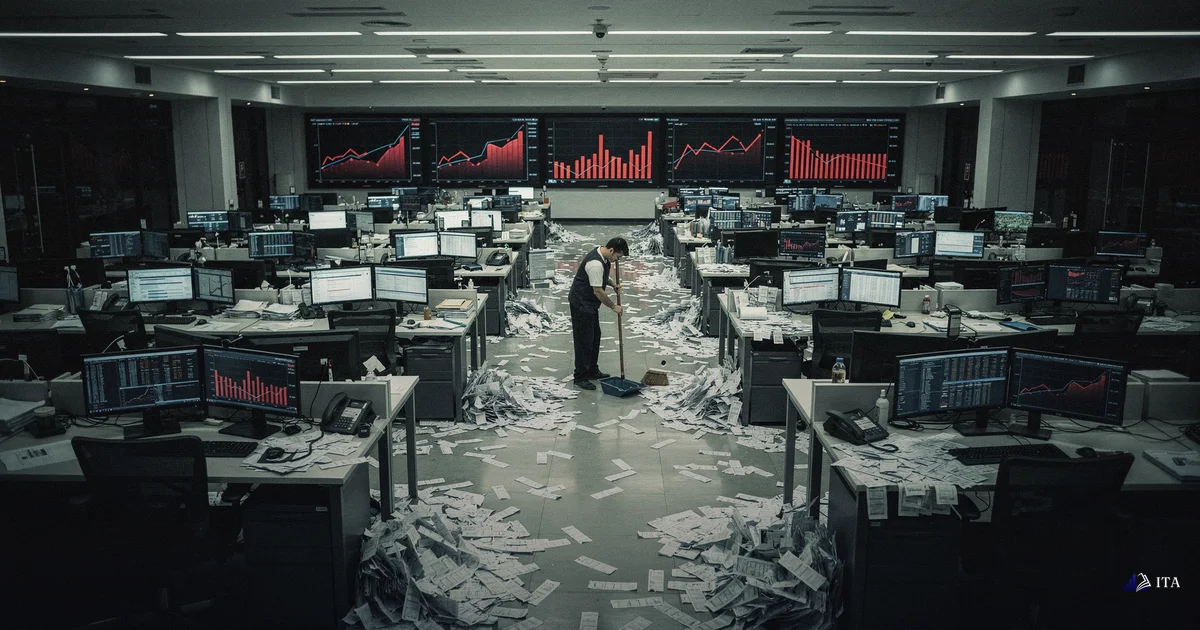
Overtrading is the excessive frequency of transactions that reduces profitability through increased costs and emotional decision-making. Clinical research defines it as trading beyond optimal frequency for one's capital base, risk tolerance, and market edge. When you've taken twelve trades today, eight yesterday, and fifteen the day before whilst telling yourself the market was "moving well", you're experiencing this documented psychological pattern that destroys more accounts than poor technical analysis.
Overtrading, according to academic research, occurs when there's a negative relationship between trading volume and investment returns. In simpler terms: when taking more trades correlates with making less money, you're overtrading. It's not about hitting some arbitrary daily limit, it's about the mathematical reality that beyond a certain point, each additional trade actively harms your performance.
The evidence is stark. Analysis of trader evaluation data shows that overtrading increases monthly losses by about 23%. But in a simulated evaluation environment with strict drawdown limits, those extra trades don't just reduce profits, they exponentially increase your probability of account termination.
What transforms a disciplined trader into an overtrader isn't greed or incompetence. It's something far more subtle and universal.
The Psychology Behind Overtrading: Why Traders Can't Stop
The Dopamine Trap
Every time you enter a trade, your brain releases dopamine, not when you win, but at the moment you click "buy" or "sell". This neurochemical response evolved to reward action-taking in uncertain environments. In trading, it creates a feedback loop where the act of trading itself becomes the reward, separate from the financial outcome.
This explains why you might find yourself taking "one more quick scalp" even after hitting your daily target. Your rational mind knows the probabilities, but your dopamine system demands another hit. The market becomes a sophisticated slot machine, and you're pulling the lever not for money, but for the neurochemical rush of participation.
FOMO and Market Noise
Fear of missing out operates on a different psychological circuit, the same one that made our ancestors hyper-aware of resources in scarcity. When you see price moving without you, your brain interprets it as lost resources. Modern trading platforms amplify this with real-time tickers, flashing numbers, and notification sounds designed to create urgency.
The result? You start seeing patterns that aren't there. Every minor pullback looks like an entry opportunity. Every momentum burst feels like the start of a trend you must catch. Your pattern recognition system, overwhelmed by stimuli, begins manufacturing signals to justify what your FOMO demands: more trades.
The Overconfidence Bias
After a winning streak, something dangerous happens to your risk perception. Research by Barber and Odean found that men traded 45% more than women, and this excessive trading reduced their net annual returns by 2.65 percentage points. The culprit? Overconfidence bias, the tendency to overestimate our skill after recent success.
In funded trading evaluations, this bias is particularly lethal. A few winning trades convince you that you've "figured out" the market. Your trade frequency increases. Your selectivity decreases. The very success that should make you more cautious makes you more reckless. This is where the data becomes revealing.
Evidence-Based Daily Trade Limits for Funded Accounts
For Discretionary Day Traders: 3-5 Trades Maximum
The convergence of evidence is striking. Multiple sources now point to the same range: day traders should generally limit themselves to 3-5 trades per day, focusing on only "A-quality" setups. But here's the crucial detail most miss, this isn't about the number itself, but what happens to trade quality beyond this threshold.
Analysis shows that trades beyond the third trade of the day often have a negative expected value. Think about that: your fourth trade of the day is statistically likely to lose money, even before accounting for commissions and spread. The reason isn't mysterious, by trade four, you're likely forcing setups that don't meet your original criteria.
For Scalpers: 10-30 Trades (Strategy-Dependent)
Scalping operates on different mechanics. Pattern-based day traders typically generate 2-8 valid setups per day, while scalpers may legitimately take 10-30 trades per session. The key word here is "legitimately", these aren't forced trades but executions of a systematic strategy with positive expectancy across high frequency.
If your scalping strategy historically generates twenty signals per day and you're taking twenty trades, you're not overtrading. If you're taking forty because you're "feeling it", you've crossed the line. The threshold isn't the number, it's the deviation from your strategy's natural signal generation.
For Swing Traders: 2-5 Trades Per Week
Swing traders face a different challenge. With fewer opportunities, the temptation to "day trade while waiting" becomes intense. But mixing timeframes is where overtrading takes its most expensive form. A swing trader taking daily scalps isn't diversifying, they're diluting their edge with trades outside their proven competency. Our guide on Risk management guide for funded trading accounts covers this in more depth.
The math is unforgiving: if your swing strategy has a 65% win rate but your improvised day trades win only 45% of the time, every "bonus" trade actively degrades your overall performance. This mathematical reality brings us to the hidden costs most traders never calculate.

The Hidden Costs of Overtrading to Your Performance
Transaction Cost Erosion
In a funded account evaluation, every trade carries a cost burden that compounds invisibly. Suppose you're trading a standard forex lot with a 1-pip spread. At $10 per pip, that's $10 in cost per round trip. Take twenty trades instead of five, and you've added $150 in unnecessary friction. On a $100,000 account targeting 6% for evaluation pass, that's 2.5% of your profit target consumed by excess transaction costs alone.
But spreads are just the visible cost. Slippage during high-frequency sessions, wider spreads during news events, and the market impact of your own orders all compound. High-frequency retail traders often discover that their "profitable" strategy becomes breakeven or negative once true transaction costs are accurately measured.
Reduced Trade Quality
The quality degradation is measurable. Track any trader's results by trade sequence, and a pattern emerges: early trades outperform late trades. This isn't coincidence, it's cognitive fatigue meeting diminishing opportunity quality. Your best setups appear sporadically. Once you've taken them, what remains are increasingly marginal opportunities that your tired brain rationalises as valid.
In funded evaluations, this quality decay is catastrophic. You need perhaps 60 high-quality trades to pass an evaluation. If half your trades are low-quality fillers taken after your edge is exhausted, you've doubled the timeline and risk exposure needed to reach your target.
Emotional Exhaustion
Decision fatigue is real and measurable. Each trade requires multiple decisions: entry, position size, stop placement, target setting, and eventual exit. A five-trade day might involve twenty-five significant decisions. A twenty-trade day involves a hundred. By the afternoon, you're not making decisions, you're following impulses dressed up as analysis. Our guide on Anchoring Bias in Stop Loss Placement covers this in more depth.
This exhaustion compounds day after day. Overtraders don't just have bad days, they have bad weeks that spiral into blown evaluations. The psychological weight of managing too many positions simultaneously degrades every aspect of performance. Which brings us to the question: how do you identify your personal breaking point?

How to Identify Your Personal Overtrading Threshold
Track Your Trade Quality Score
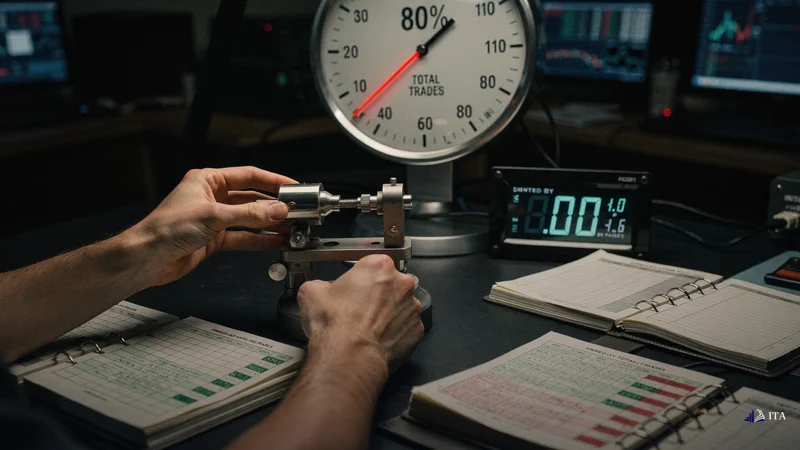
Here's a metric that will transform your trading: Trade Quality Score = (Planned Trades ÷ Total Trades) × 100. A planned trade is one that met all your pre-defined criteria before entry. Everything else, the "quick scalps", the "obvious moves", the revenge trades, counts against you.
Funded traders maintaining scores above 80% show dramatically better evaluation outcomes. Below 60%, account failure becomes nearly inevitable. The beauty of this metric is its objectivity. You can't lie to it or rationalise around it. Either the trade was in your plan or it wasn't.
Monitor Performance by Trade Number
Create a simple spreadsheet tracking each trade's sequence number and result. After thirty days, calculate average profit/loss by trade number. What you'll likely find mirrors the research: steady results for trades 1-3, declining performance thereafter. Your personal overtrading threshold is where the expected value turns negative.
This isn't about win rate, it's about expectancy. Trade #5 might win sometimes, but if its average result is negative, taking it is mathematically irrational. The data doesn't care about your feelings or hunches. It reveals the truth your P&L already knows.
The One-Trade Experiment
Here's an experiment that terrifies overtraders: limit yourself to one trade per day for five days. Not your best trade, your only trade. This forces a level of selectivity that reveals how many marginal setups you've been taking. Most traders find their results improve dramatically, not despite the limitation but because of it.
The experiment works because it breaks the action-reward loop. When you can only take one trade, you wait for quality. When you wait for quality, you remember what your actual edge looks like. When you trade only your edge, your results align with your backtested expectations. The revelation leads directly to systematic solutions.
Systematic Solutions to Prevent Overtrading in Funded Accounts
Hard Daily Limits
The simplest solution is often the most effective: set a maximum trade count and enforce it mechanically. If your data shows performance degradation after trade three, your daily limit is three. Period. No exceptions for "great markets" or "feeling good". The limit exists precisely because your judgment degrades when you need it most.
Implement this through platform controls when possible. Some platforms allow daily trade limits. Others require manual discipline. Either way, the rule must be inviolable. Think of it like a professional athlete's rep count, beyond a certain point, additional reps don't build strength, they risk injury.
Mandatory Cooling-Off Periods
After each trade closes, implement a mandatory waiting period before the next entry. Start with fifteen minutes. This breaks the dopamine-seeking pattern of rapid-fire trading and forces conscious reflection between decisions. During the cooling period, document why you want to take another trade. Often, the act of writing exposes the emotional reasoning.
For losing trades, double the cooling period. Revenge trading thrives on immediacy. By forcing delay, you allow your prefrontal cortex to reassert control over your limbic system. The market will still be there in thirty minutes. Your blown evaluation won't be recoverable.
Pre-Session Checklists
Before your session starts, document exactly which setups you're hunting. Include specific criteria: the pattern, the timeframe, the minimum risk-reward, the maximum position size. This isn't a wishlist, it's a contract with yourself. If a trade doesn't match the pre-session criteria, it doesn't get taken.
The checklist serves as your external prefrontal cortex. When market action triggers your emotional trading systems, the checklist remains rational. It doesn't get excited by momentum or fearful of missing out. It simply asks: does this match what we planned to trade today?
Position Sizing Rules
Here's a counterintuitive approach: reduce position size for trades beyond your quality threshold. If your data shows trades 1-3 are solid but 4-6 are marginal, trade full size on the first three and half size thereafter. This acknowledges human nature while limiting damage. You can scratch the trading itch without full exposure to its costs. Our guide on Trade Management Rules for Forex covers this in more depth.
This graduated sizing acts as a natural brake on overtrading. When additional trades carry less profit potential, the risk-reward calculation shifts. Your brain becomes less interested in marginal setups when they can only produce marginal gains. But certain conditions can override even the best systematic controls.
Market Conditions That Increase Overtrading Risk
High-Volatility News Events
Non-Farm Payrolls Friday. FOMC announcement days. Unexpected geopolitical shocks. These events flood the market with movement and your brain with stimulation. Price swings that normally take hours happen in minutes. Every tick feels like an opportunity. Your carefully constructed trading rules evaporate in the face of extraordinary volatility.
The solution isn't to avoid these events entirely, it's to acknowledge their psychological impact. Cut your normal trade limit in half during high-impact news. If you typically take four trades, limit yourself to two on NFP day. The market movement might be double, but your edge isn't. In fact, wider spreads and increased slippage often make your edge negative during peak volatility.
Sideways Markets
Paradoxically, low volatility triggers overtrading as aggressively as high volatility. When price enters a tight range, traders manufacture opportunities from noise. That minor support becomes a major level. That two-pip bounce becomes a reversal signal. Boredom drives pattern-seeking behaviour, and pattern-seeking drives overtrading.
Recognise sideways markets for what they are: periods where your edge temporarily disappears. The market doesn't owe you opportunities every day. Professional traders understand this. Retail traders fight it, usually to their detriment. Sometimes the best trade is no trade.
Winning Streaks
Nothing triggers overtrading quite like success. Five winning trades in a row convince you that you've synced with market rhythm. Your position size creeps up. Your trade frequency doubles. Your criteria loosens because everything seems to be working. This is exactly when the market humbles overconfident traders.
Winning streaks require more discipline, not less. They're when you should tighten criteria and reduce frequency, preserving gains rather than giving them back through overactivity. The market's mathematical reality doesn't change because you've had a good run. If anything, regression to mean suggests caution, not acceleration. This mathematical framework reveals why less truly can be more.

The Mathematics of Trade Frequency: Why Less Can Be More
Why More Isn't Better
The relationship between trade frequency and returns follows a curve, not a line. Up to your optimal frequency, typically 3-5 trades for day traders, more trades mean more opportunities to capture edge. Beyond that point, the curve inverts. Each additional trade subtracts value through costs, fatigue, and quality degradation.
Consider the math: if your edge is 2% per trade on high-quality setups but drops to -0.5% on forced trades, taking ten trades (five quality, five forced) yields less than taking five quality trades. (5 × 2%) + (5 × -0.5%) = 7.5%, versus 5 × 2% = 10%. By trading less, you literally earn more.
The Compound Effect
In funded account evaluations, this mathematical reality compounds dangerously. Each unnecessary loss doesn't just reduce your balance, it increases the required return to reach your profit target. Lose 2% on forced trades, and your 6% target becomes 8.2% on remaining capital. The evaluation that was mathematically probable becomes statistically unlikely.
It is commonly observed that more active traders tend to underperform market returns. In funded evaluations with limited time and strict rules, this performance gap transforms from expensive to fatal.
The mathematics are clear, the psychology is understood, and the solutions are proven. What remains is implementation. At Institutional Trading Academy, we've built our evaluation framework around these realities. Our traders learn to recognise their personal overtrading thresholds before they become expensive lessons. Because in funded trading, the edge isn't in doing more, it's in doing less, better.
The next time you feel the urge to take "just one more trade", remember: your overtrading threshold isn't a suggestion. It's the mathematical boundary between profit and loss, between funded success and evaluation failure. Respect it, and the market respects you back.
Ready to get funded?
50% off instant accounts with code 50CRYPTO.
Get Funded →Frequently Asked Questions
How many trades per day is considered overtrading?
Overtrading isn't defined by a fixed number but by taking more trades than your strategy justifies. Many traders find that trades beyond the first few of the day often have weaker expected value. Most discretionary day traders benefit from limiting themselves to 3-5 high-quality trades per day.
What are the psychological triggers that lead to overtrading?
The main psychological triggers include FOMO (fear of missing out), dopamine addiction from trade execution, overconfidence bias after winning streaks, and boredom during sideways markets. These triggers cause traders to manufacture opportunities from market noise and take trades outside their proven strategy.
How does overtrading affect trading performance and account balance?
Overtrading increases monthly losses by approximately 23% according to trader evaluation data. It erodes performance through increased transaction costs, reduced trade quality due to cognitive fatigue, and emotional exhaustion that leads to poor decision-making throughout the trading session.
How can I identify my personal overtrading threshold?
Calculate your Trade Quality Score: (Planned Trades ÷ Total Trades) × 100. Traders maintaining scores above 80% show better results. Also track performance by trade sequence number - when your expected value turns negative, you've found your threshold.
What systematic solutions help prevent overtrading in funded accounts?
Implement hard daily trade limits based on your data, mandatory 15-minute cooling periods between trades, pre-session checklists defining exact setups to hunt, and graduated position sizing for trades beyond your quality threshold. These mechanical controls override emotional impulses during market sessions.
Key Takeaways
- Limit discretionary day trades to 3-5 maximum, beyond this threshold, expected value turns negative even before transaction costs.
- Track your Trade Quality Score: planned trades divided by total trades, multiplied by 100, maintain above 80% for evaluation success.
- Implement mandatory 15-minute cooling periods between trades to break dopamine-seeking patterns and force conscious reflection between decisions.
- Use graduated position sizing: full size for trades 1-3, half size for marginal trades 4-6 to acknowledge human nature while limiting damage.
- Monitor performance by trade sequence number, most traders show declining results after their third trade of the day.
- Set hard daily limits based on your data: if trade four historically loses money, your maximum is three trades regardless of market conditions.
- Calculate the hidden cost: twenty trades instead of five adds $150 in unnecessary friction on a standard forex account, that's 2.5% of your profit target consumed by excess transactions alone.
Ready to get funded?
Instant accounts, simulated capital, rules published before you pay. 50% off with code 50CRYPTO.
Get Funded →