 ITA
ITAHow the Consistency Rule Works in Funded Account Payouts (2026)
Understand the Consistency Rule in funded trading accounts. Learn how best-day profit limits affect payouts and strategies to ensure compliance.
Short answer
Understand the Consistency Rule in funded trading accounts. Learn how best-day profit limits affect payouts and strategies to ensure compliance. In a prop firm context this still sits under simulated-capital rules: fees buy access to the evaluation or funded environment, not a deposit of trading capital.
Simulated capital: prop firm evaluation and funded stages discussed here typically run on simulated accounts. Challenge fees pay for access to that environment; they are not a deposit of trading capital. ITAfx accounts are simulated capital.

Key Takeaways
- Limit single-day profits to 30-50% of total gains to avoid consistency rule violations that freeze payouts indefinitely.
- Use profit distribution targeting: divide your target by three, then size positions to stay under daily limits.
- Track your best day's percentage in real-time using the formula: (best day profit ÷ total profit) × 100.
- Stop trading after exceptional days that approach the consistency threshold to preserve payout eligibility and timeline.
- Choose firms with progressive thresholds like Funded Futures Family's progressive threshold schedule (40% to 50%) rather than fixed caps.
- Adopt institutional trading patterns with multiple small edges rather than hunting for single massive wins.
- Understand that consistency violations don't terminate accounts but delay payouts until profit distribution rebalances naturally.
Understanding the Consistency Rule: Why Prop Firms Implement It
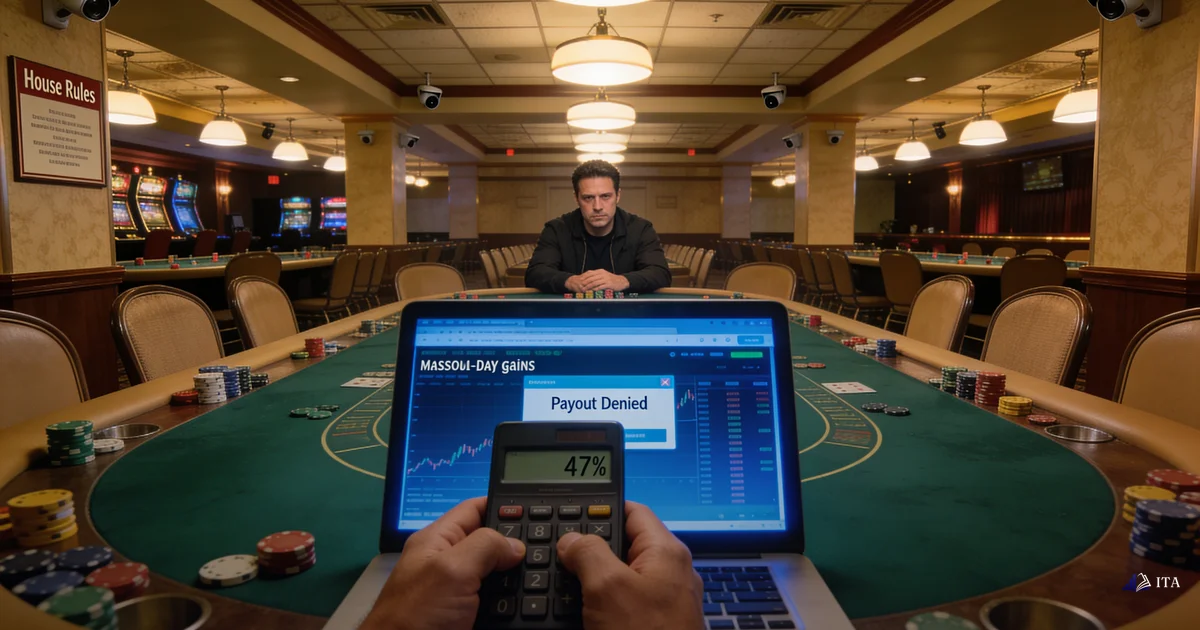
Prop firms implement the consistency rule to distinguish between skilled traders and gamblers who hit lucky streaks. Unlike drawdown violations that terminate your account, consistency breaches freeze your funded account whilst allowing you to continue trading until your profit distribution meets the required percentage threshold.
Most traders discover this rule the hard way, after months of disciplined trading. They assume that avoiding drawdown and hitting targets guarantees payment. The prop firms have built a mathematical gate that filters not just for profitability, but for profit distribution.
The standard calculation works like this: take your best day's profit, divide it by your total profit, multiply by 100. If that percentage exceeds the firm's threshold, typically 30% to 50% across the industry, your payout is blocked. No exceptions, no appeals, just pure mathematics.
But here's what changes everything: the consistency rule isn't actually about filtering lucky traders.
Think about how institutional traders operate. They don't hunt for single massive wins. They build positions over days or weeks, accumulating profits through multiple entries and exits. Their P&L curves look like steady climbs, not violent spikes. The consistency rule, whether by design or accident, forces retail traders to adopt this institutional approach.
How Consistency is Calculated: Formulas and Thresholds in 2026
The consistency rule calculates your largest single-day profit as a percentage of total profits, blocking payouts if that percentage exceeds the firm's threshold, typically 30-50%, which means a $5,000 best day on $10,000 total profit equals 50% concentration and triggers the rule. The rule rewards traders for operating like fund managers rather than gamblers, as it prevents payouts from accounts where most profits derive from one exceptional trading session.
Let's dissect exactly how this works across different firms, because the devil is in the implementation details.
Funded Futures Family uses a progressive system that actually becomes more lenient as you prove yourself: 40% for your first three payouts, 45% for payouts four and five, then 50% from payout six onwards. This isn't random generosity, it's recognition that experienced funded traders naturally develop more balanced profit distribution over time.
Contrast this with Funded Next's approach, which recalculates your profit target upward if you breach the 40% cap. Suppose you need $4,000 profit for payout, but your best day generated $2,000. That's 50% concentration, so Funded Next recalculates: $2,000 ÷ 0.40 = $5,000 new target. You now need an extra $1,000 profit, distributed across other days, before you can withdraw. Our guide on Prop Firm Challenge Requirements covers this in more depth.
The math reveals something profound: the consistency rule effectively creates a minimum number of profitable days required for payout. At a 40% cap, you need at least three winning days. At 20% (like Tradeify's Lightning accounts), you need at least five. This isn't about luck, it's about pattern repetition.

Consistency Rule by Prop Firm: A Comparative Analysis
This leads to something most traders miss: the consistency rule fundamentally changes optimal position sizing.
Traditional risk management says to risk 1-2% per trade, allowing for larger position sizes when high-conviction setups appear. But under consistency rules, that approach backfires. A single 5R winner (5 times your risk in profit) could lock your account for weeks.
Instead, funded traders who consistently receive payouts use what I call "profit distribution targeting." They reverse-engineer from the consistency threshold to determine maximum acceptable daily profits. If you're targeting $10,000 profit with a 40% cap, your maximum daily profit should stay under $4,000. This means capping position sizes not just by risk, but by potential reward.
Here's a practical framework: divide your profit target by three (for 33% distribution), then divide by your expected R-multiple. If you're targeting $9,000 profit and typically achieve 2R wins, each winning trade should capture no more than $9,000 ÷ 3 ÷ 2 = $1,500. Working backwards, if you risk 0.5% per trade on a $100,000 account ($500 risk), your 2R winner would yield $1,000, safely under the distribution limit.
This approach seems to limit upside, but the data suggests otherwise. Traders who implement profit distribution targeting report more consistent payouts and, surprisingly, higher total earnings. Why? Because they're no longer hunting for home runs that trigger consistency violations. They're building wealth through base hits.

Avoiding Consistency Rule Violations: Strategies for Traders
To avoid consistency violations, cap your daily profits at one-third of your target payout amount, if targeting $9,000, keep any single day under $3,000, and size positions based on both risk and maximum reward to ensure profit distribution across multiple trading days. Hedge funds generate returns from hundreds of calculated positions compounded over time, and the consistency rule forces retail traders to mirror this professional methodology.
But what happens when you do breach the rule?
Firm policies diverge significantly. At Funded Futures Family, breaching doesn't terminate your account, it simply delays your payout. You keep trading until your profit distribution naturally balances out. This creates an interesting dynamic: your best day's profit becomes a fixed numerator, while your total profit (denominator) keeps growing. Eventually, mathematics ensures compliance.
Other firms are less forgiving. Some reset your profit tracking entirely, forcing you to start fresh. Others maintain the breach flag indefinitely, requiring manual review for any future payout attempt. The key is knowing your firm's specific policy before you trade, not after you breach.
The most successful funded traders I've observed use a technique called "profit smoothing." When they have an exceptional day approaching the consistency threshold, they actively close their platforms and stop trading. Not from fear or superstition, but from mathematical necessity. They'll return the next day to distribute future profits across multiple sessions.

What Happens When You Breach the Consistency Rule?
Traders who earn most profits from single exceptional days must continue trading to rebalance their profit distribution Stopping after big wins preserves payout timelines instead of extending them indefinitely through continued exceptional-day requirements.
The real revelation comes when you compare firms with no consistency rule at all against firms with a lenient one, like My Funded Futures' 50% threshold specifically for payouts.
These firms see different trading patterns entirely. Traders take more concentrated risks, hold positions longer, and show higher variance in daily returns. The absence of consistency requirements doesn't make trading easier, it reveals how much the rule shapes behavior at other firms. It's like removing a speed limit and watching traffic patterns change.
This brings us to a crucial insight: the consistency rule isn't just about risk management or filtering lucky traders. It's about creating a specific type of trader, one who thinks in campaigns rather than battles, who builds positions rather than hunting for kills.
At ITAfx, we've observed this transformation repeatedly. Traders who initially resent the consistency rule often become its biggest advocates once they understand its effect on their trading psychology. They report feeling less pressure on individual trades, more patience with position building, and ironically, more consistent profits overall.

The ITAfx Perspective: Funding Discipline, Not Just Profit
Traders who embrace profit distribution targeting from day one tend to request payouts more frequently than those who trade without considering consistency. They're not making less money, they're making it in a way that ensures they can actually withdraw it.
The key is to stop viewing the consistency rule as a restriction and start seeing it as a framework. Just as position sizing rules prevent catastrophic losses, consistency rules prevent profit concentration that signals unsustainable trading. The firms aren't trying to avoid paying you, they're trying to ensure you'll still be profitable next month.
For traders starting their funded journey, First, know your firm's exact consistency threshold and calculation method. Second, reverse-engineer your maximum daily profit from your payout target. Third, size your positions to respect both risk and reward limits. Fourth, track your daily P&L against the consistency threshold in real-time. Finally, be willing to stop trading after exceptional days.
The traders who struggle with consistency rules are often the same ones who would struggle with institutional risk mandates. They're hunting for the big score instead of building sustainable returns. The consistency rule simply makes this tendency visible through mathematics. Our guide on Prop Firm Challenge Rules and Requirements covers this in more depth.
As we move further into 2026, expect consistency rules to evolve. Some firms are experimenting with weekly or monthly calculations instead of daily. Others are adding graduated thresholds that relax as account sizes grow. The trend is toward more sophisticated distribution requirements that better mirror institutional trading patterns.

Ready to get funded?
50% off instant accounts with code 50CRYPTO.
Get Funded →Frequently Asked Questions
How exactly is the consistency percentage calculated for a funded account payout cycle?
The consistency percentage is calculated using the formula: (Best Day Profit ÷ Total Profit) × 100. If you made $10,000 total profit and your best day generated $4,000, your consistency percentage would be 40%. This percentage must stay below your prop firm's threshold to qualify for payouts.
What are the typical consistency thresholds for major prop firms in 2026?
Most prop firms in 2026 use consistency thresholds between 30% and 50%. Funded Futures Family uses 40-50% depending on payout stage, Funded Next enforces 40%, Tradeify uses 35% for Advanced accounts and 20% for Lightning accounts, whilst some strict instant-funding programs require as low as 15%.
Does breaching the consistency rule terminate your funded account?
No, breaching the consistency rule typically doesn't terminate your account. At most firms like Funded Futures Family, it simply delays your payout until you continue trading and your profit distribution naturally rebalances. You keep trading until your best day represents a smaller percentage of total profits.
How can I structure my position sizing to avoid consistency rule violations?
Implement profit distribution targeting by dividing your profit target by three, then dividing by your expected R-multiple. For a $9,000 target with 2R wins, each trade should capture no more than $1,500. This ensures no single day dominates your profit distribution whilst maintaining consistent returns.
Why do prop firms use consistency rules instead of just drawdown limits?
Consistency rules filter traders who rely on lucky streaks versus those with repeatable methodology. They force retail traders to adopt institutional patterns where profits accumulate through multiple calculated positions over time, rather than hunting for single massive wins that indicate unsustainable trading behaviour.
Start Your Trading Evaluation
Simulated funded accounts up to $400K. Up to 95% profit split.
Get Funded