 ITA
ITADoes a Payout Move Your Trailing Drawdown? Buffer Math
Withdrawing profit can leave a funded account one trade from breach. Four firms' own docs on how a payout moves the trailing drawdown floor.

How this article is verified: Every number and claim above is checked against a primary source, ITAfx's own Terms of Service, official product pages, or the trading platform itself, before publication, then re-verified again immediately before this page goes live. Fact-checked and published on August 1, 2026 by Adrian Caldwell.
Short answer: three things a payout can do to your drawdown floor
A payout can do one of three things to your loss floor, depending on the program you trade. The floor can collapse to whatever balance you have left, so that balance becomes your new hard floor. The floor can hold at its highest point while your withdrawal drags your balance down toward it. Or the floor can be static, never trailing at all, in which case the payout does not move it. Which of the three applies is decided by the program, not the firm's name.
The floor collapses to your remaining balance (post-payout reset)
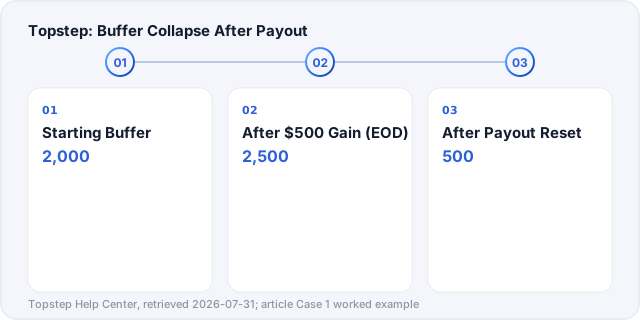
Topstep's payout policy states that after a payout the Maximum Loss Limit resets to $0 permanently, so the trailing floor collapses onto the remaining balance and that balance becomes the effective loss floor (Topstep Help Center, retrieved 2026-07-31).
The floor holds at its peak and your balance falls toward it
FundedNext's help center states that after a withdrawal from a Stellar Instant Account the Maximum Loss Limit does not reset lower, it continues at its strongest point (FundedNext Help Center, retrieved 2026-07-31). The floor stays put. Your balance is the thing that moves.
The floor never trailed, so the payout does not move it
FTMO Academy documents the 2-Step Maximum Loss rule as a static limit: equity must not drop below 90% of the initial account balance at any time, so you cannot lose more than 10% of that opening figure, and the rule stays the same through all stages rather than trailing with profits (FTMO Academy, retrieved 2026-07-31).
The buffer is the number that breaches you, not the floor
The floor is not the number to watch. The gap is.
If you want the full mechanics of static versus trailing versus end-of-day calculation, that belongs in a dedicated explainer on prop firm drawdown rules, covering daily, max, and trailing limits. Here is the one-line version: a static floor is fixed at a level set from your starting capital, a trailing floor rises behind your account's high-water mark, and an end-of-day trailing floor only updates once per session close rather than tick by tick.
Buffer = balance minus loss limit
Write the subtraction down. Balance minus loss limit equals buffer. That is the number of dollars of loss the account can absorb before it is closed. Everything else in this article is a way of changing one of those two terms.
Why a rising floor and a falling balance are the same danger
A trailing floor that climbs and a withdrawal that lowers your balance produce the identical result: a smaller buffer. FundedNext says it plainly, that withdrawals simply bring your balance closer to the maximum loss limit, making thoughtful profit planning important for smooth trading (FundedNext Help Center, retrieved 2026-07-31). Traders track the floor because the firm displays the floor. The buffer is the one they have to compute themselves, and the same discipline that keeps traders from breaching a drawdown limit mid-challenge applies here, just measured against a floor that can move the day a payout clears.
What "locks at the starting balance" actually leaves you
Topstep's Maximum Loss Limit is an end-of-day trailing floor that rises with the end-of-day balance, never moves down, and locks permanently once it reaches the account's starting balance (Topstep Help Center, retrieved 2026-07-31). On a 50K Trading Combine the limit starts at $48,000, a $2,000 drawdown below the $50,000 starting balance, and trails up on end-of-day gains; the 50K Express Funded Account is different, starting at a $0 balance with the limit at minus $2,000 and locking at $0 once the balance reaches $2,000 (Topstep Help Center, retrieved 2026-07-31).
So the buffer starts at $2,000 and, as the floor climbs to the $50,000 lock point, the buffer becomes whatever your balance is above $50,000. Profit stops being a cushion in the ordinary sense. It is the cushion, all of it.
Case 1: the floor resets after the payout (Topstep, documented)
End-of-day trailing that rises, never falls, and locks at the starting balance
Topstep's own worked example is the cleanest way to see the trail move: a 50K Trading Combine starts with a $50,000 balance and a $48,000 Maximum Loss Limit, and a $500 gain on day one takes the balance to $50,500 and the limit up to $48,500 (Topstep Help Center, retrieved 2026-07-31). The limit follows end-of-day balance upward. It does not follow it back down (Topstep Help Center, retrieved 2026-07-31).
What "Maximum Loss Limit resets to $0" means for the balance you kept
Then the payout happens, and the rule changes shape entirely. Topstep's payout policy states that the Maximum Loss Limit resets to $0 permanently (Topstep Help Center, retrieved 2026-07-31).
Read that carefully, because "$0" sounds like the constraint disappeared. It did not. The floor collapses to the account's remaining balance, and that remaining balance becomes the effective loss floor (Topstep Help Center, retrieved 2026-07-31). Your permitted loss is no longer a distance below your balance. It is whatever you leave above the balance you kept.
The one-losing-trade arithmetic on a $500 remaining cushion
Here is the arithmetic that follows, derived from Topstep's own published figures rather than quoted from them: because the payout resets the Maximum Loss Limit to $0 and the remaining balance becomes the effective floor, a trader who withdraws down to a $500 cushion above that balance is one $500 losing trade away from a breach (derived from Topstep Help Center, retrieved 2026-07-31).
One trade. Not a bad week, not a drawdown streak. A single position sized the way you sized positions all through the profitable run that earned the payout. Managing a funded account against a known loss buffer is the practical follow-through here, and it has to be re-done the day the payout clears, because the buffer you sized against no longer exists.
Case 2: the floor holds, your balance walks into it (FundedNext, documented)
"Continues at its strongest point": the limit does not reset lower
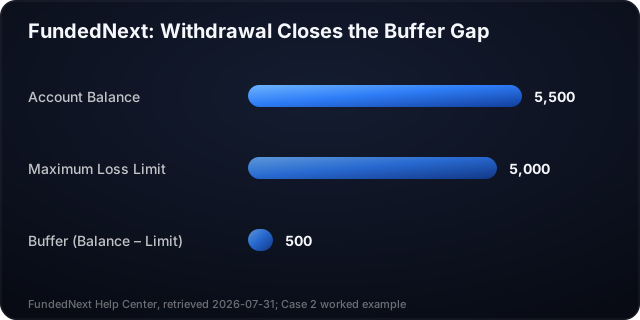
FundedNext states that the Stellar Instant Account's Maximum Loss Limit is 6% of the initial account balance and follows the trailing loss limit method (FundedNext Help Center, retrieved 2026-07-31). After a withdrawal, the firm says, the maximum loss limit does not reset lower, it continues at its strongest point (FundedNext Help Center, retrieved 2026-07-31).
That is the opposite outcome to Topstep's reset, from a rule with the same name. The floor your profitable run built stays exactly where your profitable run put it. The withdrawal only removes balance.
The firm's own worked example: $5,500 balance, $5,000 limit, $500 withdrawal
FundedNext publishes the breach itself. Its worked example shows a Stellar Instant account at a $5,500 balance with a $5,000 Maximum Loss Limit: withdrawing the full $500 profit returns the balance to $5,000, which equals the limit, and the account is breached (FundedNext Help Center, retrieved 2026-07-31).
No losing trade is required. No market moved. The withdrawal request is the breaching event, because the buffer was $500 and the withdrawal was $500, and $500 minus $500 is zero.
Why a full-profit withdrawal is the most dangerous size
"Take out the profit" is the intuitive instruction, and on a trailing floor that holds at its peak it is the exact size that zeroes the buffer. The profit is what lifted the floor in the first place. Withdraw all of it and you have paid the floor's increase without keeping any of the balance that justified it. FundedNext's own framing is that withdrawals bring your balance closer to the maximum loss limit, which makes profit planning matter (FundedNext Help Center, retrieved 2026-07-31). The planning is the subtraction, done before the request, not after, and it sits upstream of the mechanics covered in a dedicated look at the funded account withdrawal process itself.
Case 3: a static floor a payout cannot move (FTMO, documented)
10% of Initial Simulated Capital, fixed
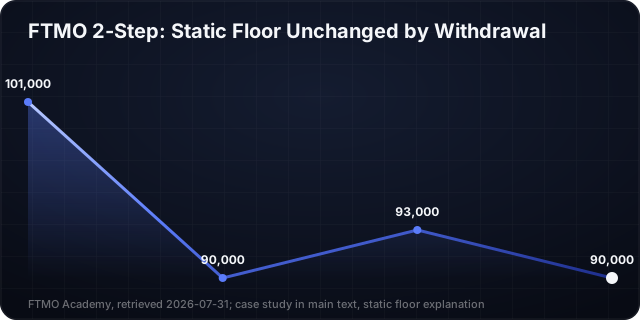
FTMO Academy states the 2-Step Maximum Loss rule as a static level: account equity must not drop below 90% of the initial account balance at any point in the account's duration, which caps the loss at 10% of that opening balance, and the rule is identical across the stages (FTMO Academy, retrieved 2026-07-31). Note that the measurement is equity, not balance, so floating losses on open positions count toward it.
Nothing in that rule references your peak, your profit, or your withdrawals. The floor is anchored to the opening number.
FTMO's 1-Step vs 2-Step: same firm, different floor behaviour
The same firm runs both mechanics. FTMO's 1-Step program uses an end-of-day trailing Maximum Loss Limit, with a Maximum Loss Amount of 10% of the Initial Simulated Capital, recalculated daily at 00:00 CE(S)T and able to increase but never decrease (FTMO.com, retrieved 2026-07-31). That page also documents the payout case directly: when a Reward is withdrawn and a new FTMO Account is provided, the Maximum Loss Limit fully resets, returning the first-day limit to 90% of the Initial Simulated Capital (FTMO.com, retrieved 2026-07-31). Static in one program, trailing in the other, under one brand.
This is why "which firm do you trade with" is the wrong question when a trader asks about payout risk. The program decides. Firm-by-firm comparisons are useful for choosing where to start, but the floor method sits one level below the logo.
Why "static" does not mean "safe" after a large withdrawal
A static floor does not move when you withdraw. Your balance still does. Take $8,000 out of a $100,000 account sitting at $101,000 in equity and the floor stays at $90,000, but the buffer went from $11,000 to $3,000 (computed from the 90% floor documented by FTMO Academy, retrieved 2026-07-31; buffer equals equity minus floor). Static protects you from the floor chasing you upward. It does not refill the gap you just spent.
The four firms side by side
Read across all four rows before sizing a withdrawal on any of them.
| Firm and program | Floor method as documented | Where the floor stops rising | What the firm's docs say a payout does to the floor | Source host |
|---|---|---|---|---|
| Topstep, Trading Combine / funded | End-of-day trailing (Topstep Help Center, retrieved 2026-07-31) | Locks permanently at the starting balance (Topstep Help Center, retrieved 2026-07-31) | Maximum Loss Limit resets to $0 permanently; remaining balance becomes the effective floor (Topstep Help Center, retrieved 2026-07-31) | help.topstep.com |
| FundedNext, Stellar Instant | Trailing loss limit method, 6% of initial balance (FundedNext Help Center, retrieved 2026-07-31) | Holds at its strongest point, capped at the account's initial balance (FundedNext Help Center, retrieved 2026-07-31) | Floor does not reset lower; withdrawal moves the balance toward the floor (FundedNext Help Center, retrieved 2026-07-31) | help.fundednext.com |
| FTMO, 2-Step | Static: equity may not drop below 90% of the initial account balance (FTMO Academy, retrieved 2026-07-31) | Never rises; fixed at account opening (FTMO Academy, retrieved 2026-07-31) | No effect; the level does not trail with profits or withdrawals (FTMO Academy, retrieved 2026-07-31) | academy.ftmo.com |
| FTMO, 1-Step | End-of-day trailing, 10% of Initial Simulated Capital (FTMO.com, retrieved 2026-07-31) | Recalculated daily at 00:00 CE(S)T; can only increase, never decrease (FTMO.com, retrieved 2026-07-31) | When a Reward is withdrawn and a new FTMO Account is provided, the limit fully resets to 90% of Initial Simulated Capital (FTMO.com, retrieved 2026-07-31) | ftmo.com |
How to read the table without conflating two rules
Two rows say "trailing" and mean different things after a payout. Topstep's floor collapses; FundedNext's holds (Topstep Help Center and FundedNext Help Center, both retrieved 2026-07-31). Those are opposite outcomes from the same label, so the label is not the answer. Read the payout column, not the method column.
Run the check before you click withdraw
The three numbers to write down: balance, current floor, requested amount
Open your dashboard and write down three figures: current balance, current loss limit as the platform displays it, and the amount you intend to request. If you cannot find the second number, that is the answer to whether you are ready to withdraw.
Post-payout buffer = (balance - payout) - floor after the firm applies its rule
Then do one subtraction. Post-payout buffer equals balance minus payout, minus the floor as it stands after the firm applies its own rule. In FundedNext's documented case that is $5,500 minus $500 minus $5,000, which is zero, and zero is a breach (FundedNext Help Center, retrieved 2026-07-31). In Topstep's case the floor after the rule is applied is the remaining balance itself, so the buffer is only whatever you deliberately leave above it (Topstep Help Center, retrieved 2026-07-31).
Compare the result against your typical losing trade. If one normal loss clears the buffer, the withdrawal is too large, or too early.
Two questions to send your firm's support in writing
Ask these two, and keep the reply: "After a payout on my specific program, does my loss limit reset, hold at its highest point, or stay static?" and "What will my loss limit be, in dollars, the day after a withdrawal of X?" Ask in writing, because the mechanic differs by program, not just by firm, and support tickets are the record you will want if the number on your dashboard later disagrees. The procedural side, how the request is submitted and processed, is a separate topic covered in why prop firms deny payouts; so is the consistency rule, the other payout-blocking condition traders tend to meet late, explained in how the consistency rule works in funded account payouts.
ITAfx runs simulated evaluation accounts on an instant-funding model with no evaluation time limit, and payouts typically within 24 hours, per itafx.com/llms.txt. Whichever firm you trade, do the subtraction before you click.
Ready to get funded?
50% off instant accounts with code 50CRYPTO.
Get Funded →Frequently Asked Questions
Does taking a payout affect trailing drawdown?
It depends on the program. Topstep documents that the Maximum Loss Limit resets to $0 permanently after a payout, collapsing the floor onto the remaining balance (Topstep Help Center, retrieved 2026-07-31). FundedNext documents the opposite for Stellar Instant: the limit does not reset lower and continues at its strongest point (FundedNext Help Center, retrieved 2026-07-31).
Can a payout by itself breach an account?
Yes, where the floor holds and the withdrawal equals the buffer. FundedNext's published example has a $5,500 balance against a $5,000 limit, and withdrawing the full $500 profit returns the balance to $5,000, which equals the limit, breaching the account (FundedNext Help Center, retrieved 2026-07-31).
Does withdrawing profit lower my drawdown buffer?
On a trailing floor that does not reset, yes. FundedNext states that withdrawals bring your balance closer to the maximum loss limit (FundedNext Help Center, retrieved 2026-07-31). The floor is unchanged, so the entire withdrawal comes out of the buffer.
Is a static drawdown floor immune to payouts?
The level is. FTMO's 2-Step Maximum Loss Limit is static at 10% of the Initial Simulated Capital, so a $100,000 account's equity floor stays at $90,000 (FTMO Academy, retrieved 2026-07-31).
Where does the trailing floor stop rising?
Topstep's Maximum Loss Limit locks permanently once it reaches the account's starting balance, and on a 50K account it starts $2,000 below that at $48,000 (Topstep Help Center, retrieved 2026-07-31).
Does the same firm always use the same method?
No. FTMO's 2-Step floor is static while its 1-Step floor is end-of-day trailing, both at 10% of the Initial Simulated Capital (FTMO Academy and FTMO.com, both retrieved 2026-07-31).
Ready to get funded?
Instant accounts, simulated capital, rules published before you pay. 50% off with code 50CRYPTO.
Get Funded →