 ITA
ITAStatic vs Trailing Drawdown at Prop Firms, Compared
Static vs trailing drawdown, with FTMO, Topstep, Apex and FundedNext's own numbers, plus how to tell which model a firm enforces before you pay.

How this article is verified: Every number and claim above is checked against a primary source, ITAfx's own Terms of Service, official product pages, or the trading platform itself, before publication, then re-verified again immediately before this page goes live. Fact-checked and published on July 31, 2026 by Adrian Caldwell.
Static vs Trailing Drawdown at Prop Firms, Compared
You paid for an evaluation, hit a good day, then watched the platform close your position at a number you did not recognise. That number was your drawdown floor, and whether it sat where it did on day one or moved up behind your best trade is the single most consequential rule in the account.
Maximum drawdown at a prop firm is either static, a fixed loss allowance measured from the account's initial balance, or trailing, a stop-out level that rises behind the account's balance or equity peak and never moves back down. ITA provides simulated trading evaluation services, and challenge fees pay for access to evaluation environments, not investments or deposits, so every number in this article describes a simulated account, never real deposited capital. That is true of ITAfx and of every firm named below: the arithmetic in this article describes simulated evaluation accounts, and the rules are quoted from each firm's own live documentation.
This is not a verdict on which model is better. It is two questions and a procedure for answering them about any firm before you pay. If you want the full rulebook context around this one rule, the complete guide to daily, max and trailing drawdown rules is the broader reference this article zooms in from.
The two questions that decide everything: does the floor move, and what moves it?
Every maximum-drawdown rule at every firm reduces to two questions.
Question one: does the floor move when I profit? If it does not, you have a static model. If it does, you have a trailing model.
Question two: if it moves, what moves it, my end-of-day balance or my intraday peak equity? Two firms can both call their rule "trailing" and enforce two rules that behave nothing alike. Most comparison guides collapse those into one word. That collapse is the difference between an open winner being safe and an open winner permanently raising a floor you never saw on screen.
Static (absolute) drawdown: a fixed loss allowance measured from initial balance
The5ers' drawdown guide defines absolute (static) drawdown as a fixed amount of money the trader is allowed to lose, calculated from the initial account balance (The5ers, retrieved 2026-07-31). The reference point is the balance the account started with, and it does not change. The floor is a constant. Your distance to it is whatever your equity happens to be, minus that constant.
Trailing (relative) drawdown: a stop-out that is recalculated at a new high
The5ers define relative (trailing) drawdown as a stop-out level that trails as the account grows, recalculated every time a new highest equity point is reached (The5ers, retrieved 2026-07-31). The reference point is not the starting balance. It is the best point the account has ever reached, and it ratchets: it goes up, it does not come back down. For the mechanics of that ratchet in isolation, see the dedicated explainer on trailing drawdown.
Why "trailing" is two rules, not one: end-of-day balance vs intraday peak equity
The phrase "new highest point" hides the fork. A firm can measure that high on the balance recorded when the session closes, or on the equity ticking on your screen while a trade is still open.
Under the first, an intraday spike you give back before the close leaves no trace on the floor. Under the second, the spike is the new high, and the floor rises to sit behind a profit you never banked. Same word on the marketing page, different rule in the account. The rest of this article does the arithmetic on both, with each firm's published numbers.
If you are still untangling maximum drawdown from the separate daily loss limit, start with the guide to how drawdown is calculated on funded accounts.
Static drawdown, worked with FTMO's published numbers
The floor: 90% of initial balance, unchanged across stages
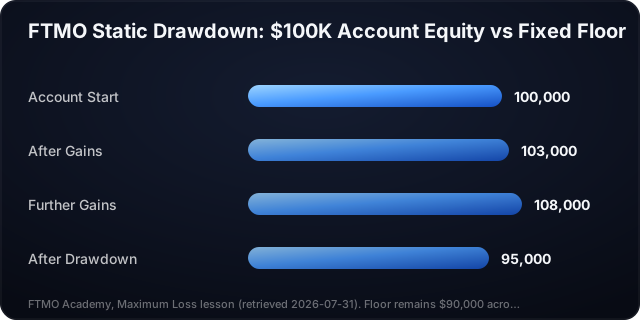
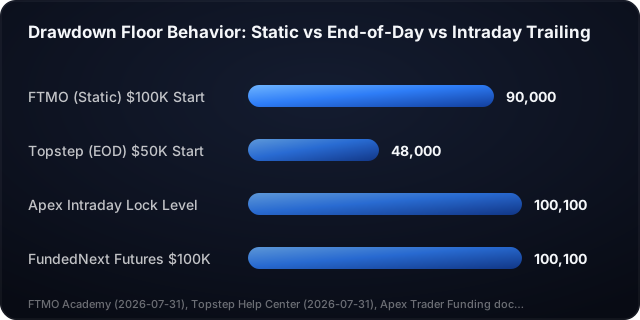
FTMO's Maximum Loss rule is static: account equity must not drop below 90% of the initial account balance at any time, meaning a trader cannot lose more than 10% of the initial balance, and the floor does not rise as the account profits (FTMO Academy, retrieved 2026-07-31). FTMO states that on a $100,000 account the Maximum Loss floor stays fixed at $90,000 across all stages, illustrating a static floor that does not move as the account gains (FTMO Academy, retrieved 2026-07-31).
One number, set on day one, valid until the account ends.
What a $100,000 account actually gives you at every equity level
Run the same account up and the arithmetic is boring, which is the point.
| Equity | Floor | Distance to floor |
|---|---|---|
| $100,000 (start) | $90,000 | $10,000 |
| $103,000 | $90,000 | $13,000 |
| $108,000 | $90,000 | $18,000 |
| $95,000 | $90,000 | $5,000 |
Floor column: $90,000 at every row, per FTMO's own Maximum Loss lesson (FTMO Academy, retrieved 2026-07-31).
Every dollar of profit is a dollar of extra room. Three good days and you are risking house money in the literal sense: the loss you can absorb before the account closes has grown by exactly your gain, and nothing you do can shrink it back below the original $10,000 allowance.
Which trading styles this favors, and the trap it hides
A static floor rewards getting ahead early. Build a cushion in week one and every subsequent trade is taken from a wider stance. Strategies with occasional large winners benefit most, because a single good run buys permanent room that a trailing model would immediately claw back.
The trap runs the other direction, and traders misjudge it constantly. The floor never gets easier either. A trader who runs $100,000 to $108,000 and then bleeds slowly is not protected by having been up 8%. The stop-out is still $90,000, so the bleed has $18,000 of rope to play out over, long enough to feel survivable at every single step and long enough to erase the entire run before the rule intervenes. Static models fail people slowly, and the pattern behind that slow bleed is documented in the guide on how to avoid breaching prop firm drawdown limits.
Trailing drawdown, worked with Topstep, Apex and FundedNext's published numbers
Topstep: trails on end-of-day balance, monitored in real time, locks at the starting balance
Topstep's Maximum Loss Limit is a trailing floor that rises as the end-of-day balance grows, never moves down, and locks permanently once it reaches the starting balance (Topstep Help Center, retrieved 2026-07-31). On a Topstep $50,000 Trading Combine the Maximum Loss Limit starts $2,000 below the balance, at $48,000 (Topstep Help Center, retrieved 2026-07-31). The Express Funded Account works from a different base: its balance starts at $0 and the limit starts at minus $2,000, trailing up until it locks at $0 (Topstep Help Center, retrieved 2026-07-31).
Now the detail that most summaries drop. Topstep's Maximum Loss Limit updates at the end of each trading day but is monitored in real time during the session, with both realized and unrealized P&L counting toward it (Topstep Help Center, retrieved 2026-07-31). Two separate mechanisms: the level is recalculated on the close, and the existing level is enforced tick by tick. An open loser can breach today's limit at 10:00. An open winner does not raise that limit until the day is over.
And it stops. Once the limit reaches the starting balance it locks permanently, so on the $50,000 Trading Combine the floor climbs from $48,000 to $50,000 and then stays there for good (Topstep Help Center, retrieved 2026-07-31). Every dollar of profit past that point is genuinely additional room, exactly like the static model. Read the lock level for your own program rather than the brand: on the Express Funded Account the limit locks at $0, and after a first payout it is set to $0 regardless of where it stood before (Topstep Help Center, retrieved 2026-07-31).
Apex: follows intraday peak balance including unrealized PnL, locks at Starting Balance + $100
Apex Trader Funding's intraday trailing threshold follows the account's highest intraday peak balance, including unrealized PnL, in real time, and never decreases even if the balance later declines (Apex Trader Funding Help Center, "Intraday Trailing Drawdown Explained," retrieved 2026-07-31). On Performance Accounts, the threshold stops increasing once it reaches Starting Balance + $100; Rithmic and Wealthcharts Evaluations instead lock when the threshold reaches the Target Profit balance, and Tradovate Evaluations keep trailing the peak indefinitely, with no fixed lock level (Apex Trader Funding Help Center, retrieved 2026-07-31).
The words "including unrealized PnL" are the whole difference. The peak that sets your floor is not a peak you ever withdrew or even closed. It is the best number your open position touched. Give it back and the floor stays where the peak put it.
On a Performance Account, the lock is the same shape as Topstep's, one increment higher: the threshold stops rising at Starting Balance + $100, after which further profit widens the gap permanently.
FundedNext Futures Flex: balance-based trailing that stops at $50,100 / $100,100 / $150,100
FundedNext's Futures Flex Challenge uses a trailing drawdown calculated on account balance that eventually locks in at $50,100, $100,100, or $150,100 depending on account size, after which it stops trailing (FundedNext Futures Help Center, retrieved 2026-07-31). Balance-based, per the firm's own wording, and with the same lock-at-roughly-the-starting-balance structure. Note what that lock table tells you: the model is defined per program, at a specific account size, not brand-wide.
The "give back your open profit" scenario, step by step
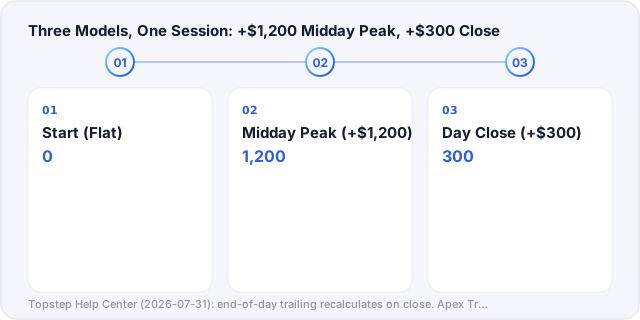
One profit path, three floor calculations. A trader opens the session flat, runs an open position to plus $1,200 by midday, then closes the day at plus $300.
- Static (FTMO-style). The floor was 90% of initial balance before the trade and it is 90% of initial balance after (FTMO Academy, retrieved 2026-07-31). The $1,200 peak is irrelevant to the floor; only the closing equity matters, and it matters only as distance.
- End-of-day trailing (Topstep-style). The recalculation happens on the close, so the level moves on the plus $300, not the plus $1,200 (Topstep Help Center, retrieved 2026-07-31). But the pre-existing limit was live all midday against unrealized P&L, so the trade could still have breached it on the way (Topstep Help Center, retrieved 2026-07-31).
- Intraday peak trailing (Apex-style). The plus $1,200 is the new peak, unrealized or not, and the threshold moves up behind it and never comes back down (Apex Trader Funding Help Center, retrieved 2026-07-31).
That last line is the one traders learn by losing an account. Under an intraday model, an unrealized peak is a decision: taking the profit and letting it go both cost you the same floor.
Side-by-side: how each firm's floor is set, moved and locked
| Firm | Model as the firm names it | What the floor is measured from | What triggers a recalculation | Does it stop trailing, and at what level | Source doc |
|---|---|---|---|---|---|
| FTMO | Maximum Loss | Initial account balance | Nothing; fixed at 90% of initial balance (FTMO Academy, retrieved 2026-07-31) | Not applicable, floor never moves (FTMO Academy, retrieved 2026-07-31) | academy.ftmo.com, Maximum Loss lesson |
| Topstep (Trading Combine) | Maximum Loss Limit (MLL) | Starting balance, minus $2,000 on a $50,000 Trading Combine (Topstep Help Center, retrieved 2026-07-31) | End-of-day balance; existing limit monitored in real time against realized and unrealized P&L (Topstep Help Center, retrieved 2026-07-31) | Yes, locks permanently at the starting balance; the Express Funded Account locks at $0 instead (Topstep Help Center, retrieved 2026-07-31) | help.topstep.com, What is the Maximum Loss Limit? |
| Apex Trader Funding | Intraday Trailing Threshold | Highest intraday peak balance, including unrealized PnL (Apex Trader Funding Help Center, retrieved 2026-07-31) | Any new intraday peak balance, in real time (Apex Trader Funding Help Center, retrieved 2026-07-31) | On Performance Accounts, yes, stops trailing at Starting Balance + $100; Rithmic and Wealthcharts Evaluations lock at the Target Profit balance; Tradovate Evaluations trail indefinitely with no fixed lock (Apex Trader Funding Help Center, retrieved 2026-07-31) | apextraderfunding.com, Intraday Trailing Drawdown Explained |
| FundedNext (Futures Flex) | Trailing drawdown, maximum loss limit | Account balance (FundedNext Futures Help Center, retrieved 2026-07-31) | Account balance; intraday vs end-of-day trigger not stated in firm docs | Yes, locks at $50,100 / $100,100 / $150,100 by account size (FundedNext Futures Help Center, retrieved 2026-07-31) | helpfutures.fundednext.com, Futures Flex Challenge |
| The5ers (vocabulary) | Absolute vs relative drawdown | Initial balance (absolute) or highest equity point (relative) (The5ers, retrieved 2026-07-31) | New highest equity point, for relative (The5ers, retrieved 2026-07-31) | Not stated in firm docs | the5ers.com, drawdown on a funded account |
Where a cell says "not stated in firm docs", that is deliberate. Inferring a trigger from a phrase like "balance-based" is how readers end up surprised, and the point of the next section is that you should ask rather than assume.
Which model suits which style
No new numbers here, and no universal winner. The better model is the one whose recalculation trigger matches how your equity actually moves during a session.
Scalpers and intraday traders holding unrealized peaks
If your method routinely lets a position run into large unrealized profit and then gives part of it back, an intraday-peak trigger is measuring you at your best moment and charging you for it. An end-of-day trigger is far kinder to the same behaviour, though the existing limit is still live against your open losers all session (Topstep Help Center, retrieved 2026-07-31). Reading your own history against this pattern, alongside the discipline covered in how to manage a funded trading account, will tell you which of the two your trading is exposed to, because the answer is in your data, not your self-image.
Swing and multi-day holders
Hold overnight and the end-of-day snapshot stops being a formality: it is the moment the floor is set, taken mid-position. A static floor is the most predictable environment for multi-day work, because the number you plan around on Monday is the same number on Friday (FTMO Academy, retrieved 2026-07-31). The separate question of whether a firm even permits holding through the weekend is covered in the prop firm weekend holding rules guide.
Why the model matters more than the headline drawdown percentage
Two accounts can advertise the same allowance and behave differently, because the percentage says how far the floor is and the model says where it will be. A trailing model that locks early converges toward static behaviour once locked (Topstep Help Center, retrieved 2026-07-31). One that follows intraday peaks does not, until it locks. Compare the mechanism, then compare fees; the FTMO alternatives comparison is the right place to weigh fees and rule flexibility once the drawdown model itself is understood.
How to tell which model a firm enforces before you pay
The four phrases to search for in a firm's own knowledge base
Search the firm's help centre, not the sales page, for these:
- "trailing" and "trails", to establish whether the floor moves at all (Topstep Help Center, retrieved 2026-07-31).
- "end-of-day" or "end of day balance", the marker of a close-based trigger (Topstep Help Center, retrieved 2026-07-31).
- "intraday" and "peak balance", the marker of a peak-based trigger (Topstep Help Center, retrieved 2026-07-31).
- "unrealized", the single word that decides whether open trades move or breach the floor (Topstep Help Center, retrieved 2026-07-31).
If all four turn up nothing, the firm has not documented the rule you are about to be judged by, and that is itself the answer. The same "check the firm's own docs, not the marketing" discipline is the whole method behind how to know if a prop firm pays.
Read the dashboard field, not the marketing page
Documentation tells you the rule; the platform tells you the current number. Find the field that names your floor, Topstep calls it the Maximum Loss Limit (Topstep Help Center, retrieved 2026-07-31), Apex calls it the Intraday Trailing Threshold (Apex Trader Funding Help Center, retrieved 2026-07-31), and watch it across one profitable session.
Why one firm can run different models across programs
FundedNext publishes its trailing configuration and its lock levels for the Futures Flex Challenge specifically, by account size (FundedNext Futures Help Center, retrieved 2026-07-31). The model belongs to the program, not the brand. Check per account type, on the firm's own docs, before the evaluation fee leaves your card. The same discipline applies to instant-funding programs too, where the static-vs-trailing question is worked through in instant account drawdown rules: static vs trailing.
For context on what ITAfx itself offers: ITA provides simulated trading evaluation services, challenge fees pay for access to evaluation environments, not investments or deposits, and the instant-funding model carries no evaluation time limit, with simulated capital sizes from $50K to $400K (itafx.com/llms.txt, retrieved 2026-07-31). ITAfx's own drawdown numbers are deliberately absent from this article: they are not yet published in a document you could check for yourself, and a rule you cannot read is a rule this article will not quote, from us or from anyone else. When they are published on itafx.com, they will be quotable on the same terms as every firm named above.
Common mistakes traders make reading a drawdown rule
Confusing daily loss limit with maximum drawdown
They are separate rules with separate resets, and breaching either can end the account. This article is about the maximum floor only; the complete guide to how drawdown works in trading covers the daily limit alongside it.
Assuming the floor unlocks after payout
Trailing floors ratchet. Topstep's Maximum Loss Limit rises as the end-of-day balance grows and never moves down, even if the balance later declines (Topstep Help Center, retrieved 2026-07-31). Apex's Intraday Trailing Threshold works the same way: it never decreases even if the balance later declines (Apex Trader Funding Help Center, retrieved 2026-07-31).
Assuming "balance-based" excludes open trades
"Balance-based" describes what sets the floor, not what is measured against it. Topstep counts both realized and unrealized P&L toward the limit while recalculating it on end-of-day balance (Topstep Help Center, retrieved 2026-07-31). Apex's peak balance includes unrealized PnL too, but there the level itself, not just the monitoring, moves in real time on an intraday peak (Apex Trader Funding Help Center, retrieved 2026-07-31). So a balance-based label tells you nothing about whether your open trades can breach the floor today. Several of the other misreadings that end evaluations, drawdown and otherwise, are collected in the institutional guide to prop firm drawdown survival.
Ready to get funded?
50% off instant accounts with code 50CRYPTO.
Get Funded →Frequently Asked Questions
Is static or trailing drawdown better?
Neither, in the abstract. Static gives a fixed floor that widens as you profit (FTMO Academy, retrieved 2026-07-31). Trailing moves the floor up behind your gains, and how it moves, on the close or on intraday peaks, matters more than the headline percentage (The5ers, retrieved 2026-07-31).
Does trailing drawdown ever stop?
At the firms documented here, yes. Topstep's Maximum Loss Limit locks permanently at the starting balance (Topstep Help Center, retrieved 2026-07-31). FundedNext's Futures Flex trailing drawdown locks in at $50,100, $100,100, or $150,100 depending on account size (FundedNext Futures Help Center, retrieved 2026-07-31).
Do unrealized profits raise my drawdown floor?
Only under an intraday-peak model. Topstep's Maximum Loss Limit counts both realized and unrealized P&L toward the existing limit, while the level itself only recalculates on end-of-day balance (Topstep Help Center, retrieved 2026-07-31).
What is the floor on a $100,000 FTMO account?
$90,000, unchanged across all three stages (FTMO Academy, retrieved 2026-07-31).
How do I check a firm's model before paying?
Search the firm's help centre for "trailing", "end-of-day", "intraday peak balance" and "unrealized", per program rather than per brand, then verify against the live dashboard field during one profitable session.
Ready to get funded?
Instant accounts, simulated capital, rules published before you pay. 50% off with code 50CRYPTO.
Get Funded →