 ITA
ITAProp Firm News-Trading Rules Compared: Windows and Penalties
FTMO, FundedNext and Topstep news-trading rules quoted verbatim: exact windows, which phase they bind, and what a violation costs.

How this article is verified: Every number and claim above is checked against a primary source, ITAfx's own Terms of Service, official product pages, or the trading platform itself, before publication, then re-verified again immediately before this page goes live. Fact-checked and published on July 30, 2026 by Adrian Caldwell.
The rule that breaks accounts passively: when a stop loss triggers inside the window
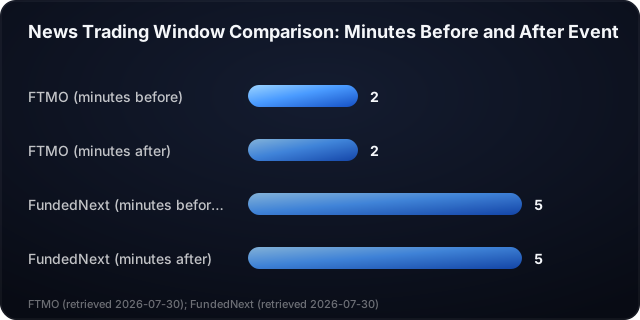
FTMO's window is short and symmetric, and it applies to Standard accounts only (FTMO, retrieved 2026-07-30). On FTMO Standard Accounts, it is not permitted to open or close any trades, including pending orders such as Stop Loss or Take Profit, on targeted instruments within a window starting 2 minutes before and ending 2 minutes after the release of selected news announcements (FTMO, retrieved 2026-07-30).
Read the verb list again: open or close. Almost every summary of this rule online treats it as an entry ban, as though the risk were clicking buy during Non-Farm Payrolls. The closing half is where accounts die. A Stop Loss is an instruction to close. A Take Profit is an instruction to close. If price reaches either level in that four-minute band, the platform executes a closing trade on your behalf, and at FTMO a Stop Loss or Take Profit triggered inside the restricted window is itself considered a breach of the FTMO Account Agreement even though the order was placed earlier (FTMO, retrieved 2026-07-30).
So the failure mode is passive. You do nothing wrong at the moment of the violation, because you do nothing at all. A EUR/USD position carried overnight with a protective stop 30 pips away, a stop that has done exactly its job for two days, becomes the instrument of the breach if a restricted release drags price into it at 13:30:45 rather than 13:33.
The defensive habit that follows is not sophisticated. Before a restricted event on an instrument you hold, you either close the position more than 2 minutes early, or you widen or remove the pending orders and accept naked exposure through the print, or you avoid holding that instrument into that release at all. Each of those is a real cost. Pretending the rule is only about entries is what makes it a surprise cost. Reading how to prepare for NFP releases before the print is where that habit gets built, not during it.
Three enforcement models, not one rule
The comparison only becomes readable once you stop looking for a single rule and start sorting by enforcement mechanism. There are three, and they are not variations of each other.
Hard window: opening and closing both blocked
FTMO's is a prohibition. Inside the window, the action is not permitted, and the consequence sits in contract law: breach of the FTMO Account Agreement (FTMO, retrieved 2026-07-30). Nothing about the trade's profitability enters into it. A losing trade closed inside the window is as much a breach as a winning one.
Profit adjustment: the trade is allowed, the reward is not
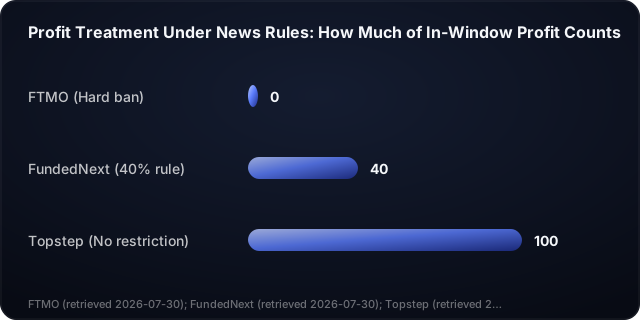
FundedNext permits traders to trade during news events in both the Challenge Phase and the FundedNext Account; its restriction works through profit adjustment rather than a trade ban (FundedNext, retrieved 2026-07-30). On funded Stellar 1-Step, Stellar 2-Step, and Stellar Lite FundedNext Accounts, trades executed within 5 minutes before to 5 minutes after a listed high-impact news event fall under the News Reward Share Rule: only 40% of the profit from those trades is counted toward the account balance (FundedNext, retrieved 2026-07-30).
Nobody flattens anything. Nobody breaches anything. The trade stands, and the accounting shaves it.
No restriction, no exception: the futures-firm contrast
Topstep does not require traders to flatten positions during economic releases in either SIM (evaluation) or Funded Accounts, though it recommends caution or stepping aside around releases affecting the traded product (Topstep, retrieved 2026-07-30). That is the permissive end of the range. It is also the end with the least recourse, which the consequence section below makes concrete.
The comparison table: window, phase, scope, consequence
Each cell keeps the firm's own unit. FTMO's minutes are a trade-ban window, FundedNext's are a reward window, and Topstep's clock is not a window at all. They are not interchangeable.
| Firm | Window (and what it blocks) | Phase bound | What counts as news | Stated consequence |
|---|---|---|---|---|
| FTMO | 2 minutes before to 2 minutes after a selected release, on targeted instruments; blocks both opening and closing, including Stop Loss and Take Profit triggers (FTMO, retrieved 2026-07-30) | Standard account type only, and only once trading on a funded FTMO Account; it does not apply during the Evaluation Process, that is FTMO Challenge and Verification (FTMO, retrieved 2026-07-30) | Events FTMO marks in its own Economic Calendar with the note "Restricted event" (FTMO, retrieved 2026-07-30) | Breach of the FTMO Account Agreement, including when the closing order triggers itself (FTMO, retrieved 2026-07-30) |
| FundedNext | 5 minutes before to 5 minutes after a listed high-impact event; blocks nothing, but flags trades executed inside it (FundedNext, retrieved 2026-07-30) | News trading allowed in both the Challenge Phase and the FundedNext Account; the reward rule applies on funded Stellar 1-Step, Stellar 2-Step and Stellar Lite (FundedNext, retrieved 2026-07-30) | Only listed high-impact events that directly correlate with the traded pair (FundedNext, retrieved 2026-07-30) | Only 40% of the profit from those trades counts toward the balance; losses in the same window remain fully the trader's and are not removed (FundedNext, retrieved 2026-07-30) |
| Topstep | No flatten requirement and no news window; caution recommended around releases affecting the traded product (Topstep, retrieved 2026-07-30) | Same stance in SIM (evaluation) and Funded Accounts (Topstep, retrieved 2026-07-30) | Only one named case: purposefully trading the full Maximum Position Size directly into a scheduled major news event (Topstep, retrieved 2026-07-30) | That max-size entry is a Prohibited Trading Strategy; separately, trades impacted by economic releases are not eligible for exceptions or Reset credits (Topstep, retrieved 2026-07-30) |
FTMO turns a violation into a contract breach, FundedNext turns it into a smaller number, and Topstep does nothing at all: three very different costs for the same action.
Which phase does the rule actually bind?
This is where traders get hurt, because the two forex firms are arranged in opposite ways.
At FTMO the restriction applies to the Standard account type and only once a trader is on a funded FTMO Account; it does not apply during the Evaluation Process, that is FTMO Challenge and Verification (FTMO, retrieved 2026-07-30). Sit with the incentive that creates. A trader can pass a Challenge by trading Non-Farm Payrolls releases, pass Verification the same way, learn nothing about the rule because it never once bound, and then breach the Account Agreement in the first week of funding with the identical strategy. The evaluation does not teach the rule it later enforces, which is one more reason how long it takes to get funded in a prop firm is only half the story: the rules that matter can start on day one of funding, not before.
At FundedNext the direction reverses. News trading is permitted in both the Challenge Phase and the funded FundedNext Account (FundedNext, retrieved 2026-07-30), so nothing is forbidden at any stage; what changes on the funded Stellar accounts is the arithmetic, with only 40% of profit from in-window trades counted toward the balance (FundedNext, retrieved 2026-07-30). A strategy that clears a Challenge target on news spikes will clear a funded target far more slowly, and the trader who has not read the rule will experience that as a platform error rather than a policy.
Topstep is the only one of the three with a single consistent stance across phases: no flatten requirement in SIM or Funded Accounts (Topstep, retrieved 2026-07-30). If you are choosing a firm partly to avoid phase-dependent surprises, that consistency is the feature. The broader funded-account rulebook is worth reading in one sitting before you pick, alongside how the consistency rule works in funded account payouts, since the two rule families interact at payout time.
What counts as "news" at each firm
"High-impact" sounds like a shared standard. It is not. Each firm defines the trigger list itself, and the three definitions have different shapes.
FTMO publishes the list. Restricted releases are marked in FTMO's own Economic Calendar with the note "Restricted event", so the trader does not have to guess what qualifies as news (FTMO, retrieved 2026-07-30). That is the most operationally usable definition of the three, because it is a lookup rather than a judgement, and it is why reading forex economic news releases against your firm's rules matters more than reading it for volatility.
FundedNext narrows by relevance instead of by list alone: only listed high-impact news events that directly correlate with the traded pair trigger the rule, so a USD or EUR release affects a EUR/USD trade while an unrelated currency's release does not (FundedNext, retrieved 2026-07-30). A trader long GBP/JPY through a Canadian release is outside the rule's scope by construction, though a currency correlation analysis is what turns that construction into a checkable fact rather than an assumption.
Topstep does not maintain a restricted-event list for this purpose at all, because it has no window to enforce. Its single named prohibition is behavioural: purposefully trading the full Maximum Position Size directly into a scheduled major news event (Topstep, retrieved 2026-07-30). The offence is the sizing, not the timing, which is why position sizing into scheduled events is the discipline that keeps you inside that rule.
What a violation actually costs
Three penalties, three different categories. Lining them up as "consequences" flattens a distinction that decides how much a mistake costs you.
FTMO: a contract breach. A trade opened or closed inside the window, including a Stop Loss or Take Profit that triggers there, is a breach of the FTMO Account Agreement (FTMO, retrieved 2026-07-30). It is a status event, not a fee. The size of the trade does not scale the penalty.
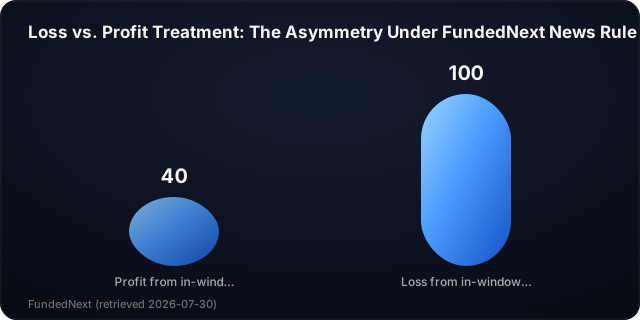
FundedNext: an asymmetric deduction. Only 40% of the profit from in-window trades is counted toward the account balance (FundedNext, retrieved 2026-07-30), and the asymmetry is explicit in the firm's own wording: any losses incurred during this period remain the trader's responsibility and will not be removed (FundedNext, retrieved 2026-07-30). Upside is cut by more than half, downside is untouched. Anyone modelling expectancy on a news strategy at FundedNext has to run it with the profit leg at 40% and the loss leg at 100%.
Topstep: no recourse. Trades impacted by economic releases are not eligible for exceptions or Reset credits (Topstep, retrieved 2026-07-30). Nothing was violated, so nothing is confiscated, but the loss stands exactly as taken and cannot be argued back. And a news-driven loss does not sit in isolation: it feeds straight into the drawdown math that decides whether the account survives, the same math covered in how to avoid breaching prop firm drawdown limits.
Name the pattern plainly. In the hard-ban model, in the profit-adjustment model, and in the permissive model, the trader keeps the full loss in every case. Only the upside changes shape.
The escape hatches the firms publish themselves
These are documented in the rulebooks, not workarounds around them.
FTMO Swing accounts. The Swing account type has no restrictions on trading during news releases (FTMO, retrieved 2026-07-30). For a trader whose edge is genuinely event-driven, that is FTMO's own answer to its own rule, chosen at account level rather than negotiated later.
Holding through, rather than trading into. FTMO allows holding open positions on the targeted instruments if they were opened more than 2 minutes before the restricted event (FTMO, retrieved 2026-07-30). Exposure through the release is permitted; the actions of opening and closing inside the window are not. The practical consequence, again, is the pending orders: the position may stay, but a Stop Loss that fires inside the window still breaches (FTMO, retrieved 2026-07-30).
The gap between "allowed" and "protected". FundedNext lets you trade the release, but its slippage policy states that slippage during a high-impact news release will only be addressed if there is a total execution failure, and adjustments will only be considered for trades placed more than 10 minutes after the news publication (FundedNext, retrieved 2026-07-30). So the window where the rule permits trading and the window where execution complaints are entertained do not overlap. If you take the 13:30 print and get filled 14 pips away from your intended price, that is yours. Understanding how slippage arises is the difference between planning for that and disputing it, the same discipline that staying focused during high-volatility news events is built around.
Reading your own firm's rulebook before the next NFP
Four checks, in this order, on whatever firm you are trading. Each one comes from a place where the three firms above actually diverge, so a generic summary will not answer them.
- Does the window ban closing as well as opening? If yes, every pending order you carry into a restricted event is a live liability, not a protection. FTMO's does (FTMO, retrieved 2026-07-30).
- Which phase binds? Evaluation-only, funded-only, or both. FTMO's binds on Standard accounts, and only once funded (FTMO, retrieved 2026-07-30); FundedNext permits news trading in both phases and adjusts funded profit (FundedNext, retrieved 2026-07-30); Topstep's stance is the same in SIM and Funded (Topstep, retrieved 2026-07-30).
- Who defines the event list? A calendar you can look up, like FTMO's "Restricted event" marking (FTMO, retrieved 2026-07-30), is very different from a correlation test you have to apply yourself (FundedNext, retrieved 2026-07-30).
- Is a violation a breach or a deduction? A breach ends an account. A deduction slows it. Plan capital and expectancy differently for each, and weigh that against the general economic calendar impact on prop firm trading before committing to a firm.
If your conclusion is that the news rule is the dealbreaker, that is a legitimate firm-selection criterion and worth comparing at firm level rather than rule level, alongside the broader question of how to choose the right prop firm for forex trading. Whatever firm you land on, ITAfx included, read the published rulebook for its own news-window wording before you trade a release, and read the adjacent rule families, consistency rules among them, with the same line-by-line attention you just gave this one.
Ready to get funded?
50% off instant accounts with code 50CRYPTO.
Get Funded →Frequently Asked Questions
Can you trade news on a funded account?
It depends entirely on the firm and often on the phase. At FTMO the news restriction applies only once you are on a funded FTMO Account, and during FTMO Challenge and Verification it does not apply regardless of account type (FTMO, retrieved 2026-07-30). At FundedNext, news trading is allowed in both the Challenge Phase and the funded FundedNext Account, with a profit adjustment rather than a ban (FundedNext, retrieved 2026-07-30). At Topstep there is no requirement to flatten positions during economic releases in SIM or Funded Accounts (Topstep, retrieved 2026-07-30).
What exactly is FTMO's 2-minute news rule?
On FTMO Accounts it is not permitted to open or close any trades, including pending orders such as Stop Loss or Take Profit, on targeted instruments within a window starting 2 minutes before and ending 2 minutes after the release of selected news announcements (FTMO, retrieved 2026-07-30).
Can a stop loss triggering during news break the rule?
Yes. If a Stop Loss or Take Profit is triggered inside the restricted window, that is itself considered a breach of the FTMO Account Agreement, even though the order was placed earlier (FTMO, retrieved 2026-07-30).
Can I hold a position through a restricted FTMO event?
Yes, if it was opened more than 2 minutes before the restricted event (FTMO, retrieved 2026-07-30). The ban covers opening and closing inside the window, not exposure through it. FTMO's Swing account type has no restrictions on trading during news releases at all (FTMO, retrieved 2026-07-30).
How much profit does FundedNext's news rule cost?
On funded Stellar 1-Step, Stellar 2-Step and Stellar Lite accounts, trades executed within 5 minutes before to 5 minutes after a listed high-impact news event fall under the News Reward Share Rule, and only 40% of the profit from those trades is counted toward the account balance (FundedNext, retrieved 2026-07-30). Losses in that period remain the trader's responsibility and are not removed (FundedNext, retrieved 2026-07-30).
Does Topstep penalise news trading?
It imposes no flatten requirement (Topstep, retrieved 2026-07-30), but trades impacted by economic releases are not eligible for exceptions or Reset credits (Topstep, retrieved 2026-07-30), and purposefully trading your full Maximum Position Size directly into a scheduled major news event is listed as a Prohibited Trading Strategy (Topstep, retrieved 2026-07-30).
Will a firm compensate me for news slippage?
FundedNext publishes the narrowest version of this: slippage during high-impact news releases will only be addressed in the case of a total execution failure, and adjustments will only be considered for trades placed more than 10 minutes after the news publication (FundedNext, retrieved 2026-07-30).
Ready to get funded?
Instant accounts, simulated capital, rules published before you pay. 50% off with code 50CRYPTO.
Get Funded →