 ITA
ITAGold Futures Trading Psychology for Prop Firms: Master Your Mindset for Payouts
Master gold futures trading psychology in prop firms. Learn to control emotions, avoid common pitfalls, and build the mental resilience for consistent.
Short answer
Master gold futures trading psychology in prop firms. Learn to control emotions, avoid common pitfalls, and build the mental resilience for consistent. In a prop firm context this still sits under simulated-capital rules: fees buy access to the evaluation or funded environment, not a deposit of trading capital.
Simulated capital: prop firm evaluation and funded stages discussed here typically run on simulated accounts. Challenge fees pay for access to that environment; they are not a deposit of trading capital. ITAfx accounts are simulated capital.
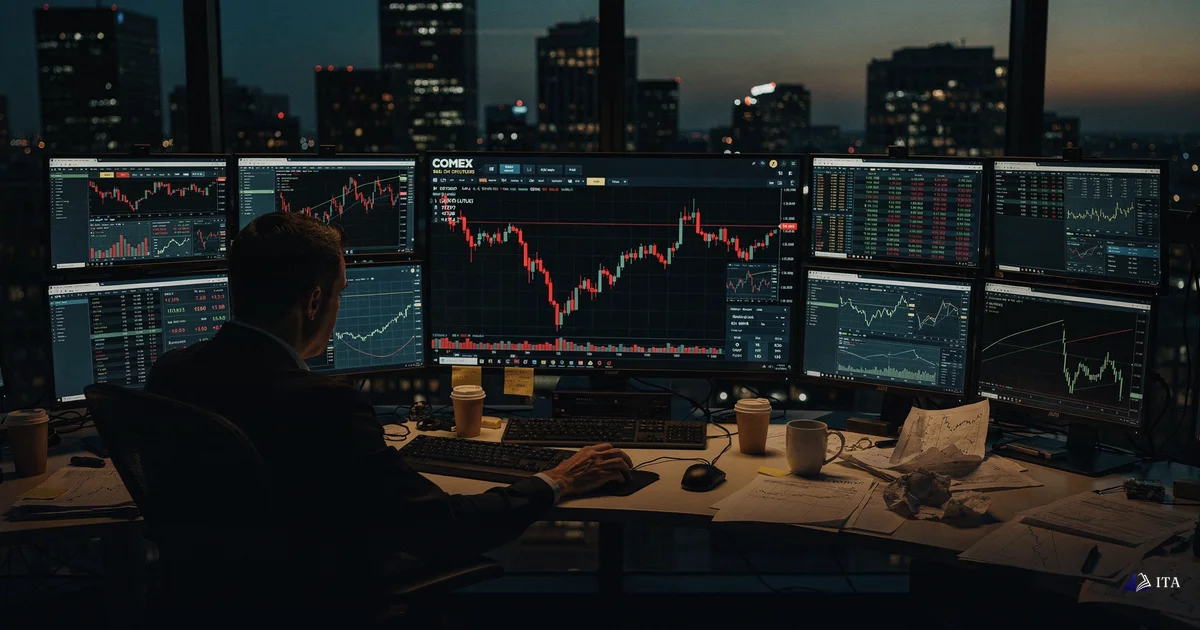

Understanding Gold Futures Trading in Prop Firms: The Mental Edge
Gold futures trading in prop firms requires understanding contract mechanics and psychological pressure that traditional risk management doesn't address. Gold's specific contract mechanics, combined with prop firm drawdown rules, create a psychological environment where the 1-2% rule breaks down. By the time you've identified an entry, calculated your size, and placed your order, the market has moved 5 ticks, widening your stop and increasing your risk while your mind races. The CFTC's Commitments of Traders data shows that non-commercial traders account for roughly 70-80% of open interest in COMEX gold futures. These are speculators, not hedgers. They're trading for profit, not protection. And in the prop firm context, they're trading with strict daily and maximum drawdown limits that transform every tick into a psychological event. Here's what actually works: backward position sizing from daily drawdown limits. The funded traders who consistently profit from gold futures don't start with "what's my setup?" They start with "what's my maximum acceptable loss today?" In a $100,000 account with a 3% daily limit, that's $3,000. Not $3,000 per trade, $3,000 total, including all losses, commissions, and slippage. From there, they work backwards:
- Daily loss limit: $3,000
- Maximum trades planned: 3
- Maximum loss per trade: $900 (leaving $300 buffer)
- Typical stop in gold: 50 ticks ($500 on GC)
- Maximum contracts: 1.8, round down to 1.
Our guide on How to trade gold with prop firm covers this in more depth. This isn't risk management. This is pre-trade cognitive load reduction. Before the market opens, before the charts load, before any emotion can interfere, the position size is fixed. The calculator is closed. The decision is made.
Common Psychological Traps in Gold Futures Trading (and How to Avoid Them)
But the framework goes deeper than position sizing. Gold futures have a personality. They move in violent spurts during specific windows. The US morning session from 08:20 ET to 11:00 ET sees the cleanest price action and highest volume. News events like Non-Farm Payrolls can trigger 100-tick moves in seconds. The London fix at 10:30 AM and 3:00 PM London time creates predictable volatility. Successful prop firm gold traders build session-specific playbooks that match these rhythms: Morning Session Playbook (08:20-11:00 ET):
- Check overnight range on both GC and spot XAU/USD
- Note any economic releases in the next 3 hours
- Maximum 2 trades, maximum 1 contract each
- Setup types: range fade or trend continuation only
- If no clear setup by 10:00 ET, no trades.
This isn't a suggestion. It's a pre-written contract with themselves. The playbook exists because willpower doesn't. When gold drops 30 ticks in 5 minutes and every cell in your body screams "catch the knife," the playbook says "setup types: range fade or trend continuation only." No knife-catching is listed. So no knife-catching happens. The psychological traps in gold futures are predictable and preventable.

Building a Resilient Gold Futures Trading Mindset: Practical Strategies
FOMO in gold manifests differently than in forex. In EUR/USD, fear of missing out might cost you 10-20 pips. In gold, FOMO after a news spike can cost you 100 ticks, $1,000 per contract, in minutes. The prevention isn't emotional control. It's mechanical restriction. Many funded gold traders literally close their platform during high-impact news unless they have a specific news-trading setup prepared.
Revenge trading after a gold loss follows a pattern. The loss stings more because the moves are larger. A 50-tick stop in gold is $500, not $50. The urge to "make it back" scales with the dollar amount. The prevention: a hard daily loss limit that, when hit, triggers an automatic platform lockout. Some traders use third-party risk management tools that forcibly close the platform after a preset loss. Others give their account password to a accountability partner with instructions: "If I text you 'red day,' change my password until tomorrow."
Evaluation anxiety in prop firm challenges intensifies with gold because the profit targets feel both closer and further away. A single good gold trade can make 1-2% easily. A single bad gold trade can end your evaluation. The mental math becomes toxic: "I need 4% more to pass... that's just 40 ticks on 10 contracts..." This is where accounts die. The prevention: tracking progress in days remaining, not dollars needed. "I have 25 days to make 4%" creates patience. "I need $4,000 by Friday" creates desperation.
The session-specific approach changes everything.
Instead of treating gold futures as a 23-hour market, successful prop traders divide it into distinct sessions with different playbooks:. Our guide on Gold Trading Strategy covers this in more depth.
Asian Session (18:00-02:00 ET): Typically quiet, range-bound. Playbook: No trades unless inside-day setup with 20-tick stop maximum.

Optimizing Your Trading Session: Timing and Focus for Gold Futures
London Session (02:00-08:00 ET): Volatile, news-driven. Playbook: Reduced size (micro contracts only), wider stops, or no trades.
US Session (08:00-17:00 ET): Highest volume, cleanest moves. Playbook: Full size allowed, but maximum 3 trades, specific setups only.
Each session has its own mental state. Asian session requires patience. London session requires caution. US session requires precision. By matching their psychology to the market's rhythm, traders stop fighting the market and start flowing with it.
This is where position sizing meets market timing meets mental state.
A trader checking their funded account at 3 AM, seeing an "obvious" setup in thin Asian liquidity, calculating position size while half-asleep, this trader has already lost. Not because the setup is wrong, but because they're operating outside their optimal conditions. The session playbook would have prevented the trade entirely: "Asian Session: No trades unless inside-day setup."
The magic isn't in the rules. It's in the pre-commitment. Every decision made in advance is a decision that can't be corrupted by emotion. Every parameter defined before the market opens is a parameter that can't be adjusted in the heat of battle.

Transforming Your Gold Trading Psychology with ITA
At ITAfx, this systematic approach to psychology is embedded in the methodology.
While other prop firms focus on teaching technical analysis and hoping traders figure out the mental game, ITAfx's institutional methodology treats psychology as a mechanical system. The same precision applied to trade entries applies to mental preparation. The same backtesting used for strategies applies to behavioral patterns.
This shows up in the results. When traders approach gold futures with pre-defined session playbooks and backward position sizing, the psychological battles disappear. Not because the traders became emotionally stronger, but because they engineered an environment where emotional trading is mechanically impossible.
The framework extends beyond gold. Whether trading forex pairs, indices, or commodities, the principle remains: psychology isn't about feeling better. It's about building better systems. But gold futures, with their unique combination of leverage, volatility, and tick value, demonstrate this principle most clearly.
The transformation happens when traders stop trying to control their emotions and start controlling their environment.
Conclusion: Master Your Psychology, Master Gold Futures in Prop Firms
The next time you open your gold futures chart, ask yourself: am I about to trade my emotions, or my system? If you don't have a system, you already know the answer. And now you know what to build.
Ready to get funded?
50% off instant accounts with code 50CRYPTO.
Get Funded →Frequently Asked Questions
What is the best gold futures contract for prop firm traders: GC or MGC?
Micro gold (MGC) is generally better for prop firm traders starting out. Each MGC tick is worth $1 versus $10 for standard GC contracts, reducing emotional pressure and allowing better position sizing within daily drawdown limits. Most funded traders graduate to GC after proving consistency with MGC.
How do prop firm drawdown rules affect trading psychology?
Prop firm drawdown limits create psychological pressure that doesn't exist in personal accounts. A 3% daily loss limit on a $100,000 account means just $3,000 total losses before lockout. This transforms every gold tick into a psychological event, requiring backward position sizing from drawdown limits rather than traditional risk management.
Why is gold harder psychologically to trade than indices or forex?
Gold futures move in larger dollar increments per tick. A 50-tick stop in GC costs $500 versus $50 in many forex pairs. When XAU/USD moves 0.99% in a session, a single GC contract swings $4,100 in value. The larger dollar swings amplify emotional responses like FOMO and revenge trading.
What is the best time of day to trade gold futures?
The US morning session from 08:20 ET to 11:00 ET offers the cleanest price action and highest volume in gold futures. This window sees institutional participation and clear directional moves. Asian sessions are typically range-bound, while London sessions can be volatile but less predictable.
How can a trader stop revenge trading in a funded account?
Use mechanical restrictions rather than willpower. Set a hard daily loss limit that triggers automatic platform lockout when hit. Some traders give their account password to an accountability partner with instructions to change it after losses. Pre-written session playbooks prevent impulsive decisions during emotional states.
Key Takeaways
- Calculate position size backwards from daily drawdown limits, start with maximum loss, work to contract size, never exceed preset boundaries.
- Use session-specific playbooks for gold futures, Asian (range only), London (micro contracts), US (full size, maximum 3 trades).
- Set mechanical lockouts at daily loss limits, when hit, platform closes automatically, removing emotional override temptation completely.
- Gold futures require 50-tick stops minimum due to volatility, factor $500 per contract into risk calculations before entry.
- Pre-commit all trading decisions before market opens, position size, session rules, maximum trades eliminate real-time emotional interference.
- Track evaluation progress in days remaining, not dollars needed, 'I have 25 days for 4%' creates patience versus desperation.
- Engineer your trading environment to make bad decisions mechanically impossible rather than relying on willpower under pressure.
Start Your Trading Evaluation
Simulated funded accounts up to $400K. Up to 95% profit split.
Get Funded