 ITA
ITASame Strategy, Multiple Prop Firm Accounts: What's Allowed
Running one strategy across several prop firm accounts is usually allowed, until a capital cap kicks in. FTMO's own rule, and how to check yours.

How this article is verified: Every number and claim above is checked against a primary source, ITAfx's own Terms of Service, official product pages, or the trading platform itself, before publication, then re-verified again immediately before this page goes live. Fact-checked and published on July 30, 2026 by Adrian Caldwell.
The short answer: account count is rarely the rule that gets you suspended
Running the same strategy across several accounts at one firm is generally permitted. What gets capped is the total capital allocated to you, or to that strategy, across all of your accounts. FTMO states on its own site that there is no limit to the number of accounts a trader may have (FTMO FAQ, retrieved 2026-07-30). The limit sits somewhere else entirely.
That is one firm's published policy, on one FAQ page, on one date. It is not a market standard and you should not assume your firm copied it.
What "no limit on accounts" actually means
It means the count itself is not the trigger. FTMO's FAQ answer to the question "How many accounts can I have?" is that there is no limit to the number of accounts you may have (FTMO FAQ, retrieved 2026-07-30). Read only that line and you would conclude the door is wide open. Read the next line and the door has a frame.
Why the question traders ask is not the question the rulebook answers
Traders count accounts because accounts are what they buy. Firms count exposure, because exposure is what they carry. So the trader asks "how many?" and the rulebook answers "how much, in total, and traded how similarly?" Those are different questions, and only one of them is enforced.
If you are still assembling the basic rulebook, start with the broader rules a first-time funded trader needs to read before opening a second anything.
Do they actually enforce it? FTMO's published capital-allocation rule, read closely
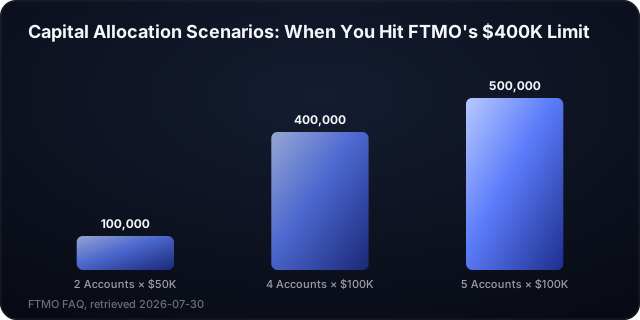
Yes, and the firm says so in writing rather than leaving it to discretion. On the same FAQ page, FTMO caps the total capital allocation across all of one trader's accounts at $400,000 per trader or strategy, before any scaling (FTMO FAQ, retrieved 2026-07-30).
Treat that figure as volatile. It is a number on a page that FTMO can change without notice, retrieved 30 July 2026. Check the live page before you act on it: FTMO's own FAQ, "How many accounts can I have?"
The $400,000 aggregate cap, per trader or per strategy
The wording FTMO publishes is "per trader or strategy." Two ceilings, either of which can bind first. Four accounts of $100,000 each reach the cap even if you never touch a fifth. And if you and a friend run one identical strategy across separate logins, the "per strategy" half of the clause is the one that reads on you.
"Before scaling" means the cap is a floor, not a ceiling
The published limit applies prior to any scaling (FTMO FAQ, retrieved 2026-07-30). Scaling programs at prop firms increase allocated simulated capital after a track record, so the pre-scaling number is the starting constraint, not the lifetime maximum. It also means the aggregate you compute today is not the aggregate the firm sees in six months. Recompute it every time you add an account or take a scale-up.
What "identically traded strategies" means when they audit
What the FAQ page publishes, on the date we retrieved it, is the $400,000 aggregate ceiling per trader or strategy (FTMO FAQ, retrieved 2026-07-30). It does not spell out on that page how strategy similarity is assessed, so treat the mechanics as unpublished rather than known. What is worth understanding is why a similarity test would be easy for any firm to run: same instrument, same direction, same timestamps, same size ratio is trivial to detect from server-side trade logs.
The hidden rule: copy trading is fine until your capital aggregates
Here is the sentence most traders read half of. FTMO's published answer says there is no limit on account count and that a maximum capital allocation limit applies on top of it (FTMO FAQ, retrieved 2026-07-30). The permission and the ceiling are in the same breath.
Half a clause is worse than none. The trader who reads only "identical strategies get suspended" stops doing something that was allowed. The trader who reads only "no limit on accounts" walks straight into the aggregate (FTMO FAQ, retrieved 2026-07-30).
Two conditions, one clause: identical strategy AND capital above the cap
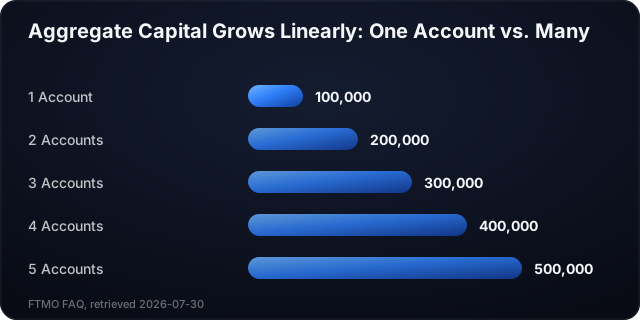
Copy the strategy across two $50,000 accounts and the aggregate is $100,000, which is under FTMO's published $400,000 figure (FTMO FAQ, retrieved 2026-07-30). Copy it across five $100,000 accounts and the aggregate is $500,000, which is over the published ceiling. The mirroring did not change. The total did.
Copier, EA, or manual mirroring: the mechanism is not the issue
FTMO's published ceiling is written "per trader or strategy," not per tool (FTMO FAQ, retrieved 2026-07-30). A strategy basis reads on what your trades look like, not on what produced them, so do not assume manual execution is a workaround. Assume the log is read for what it shows.
Where traders self-report getting caught, and why that is anecdote
Community threads are full of accounts of suspensions after copying across accounts. Treat every one of them as anecdote, not evidence. None of it is a source you can hold a firm to, and none of it appears in this article as a number. The only thing worth acting on is the clause on the firm's own page, which is why the whole worked example above sits on one primary document. If a firm's allocation cap is the binding constraint on how you want to trade, the honest response is to compare firms rather than to guess at the enforcement threshold.
How to find your own firm's version of this clause in under ten minutes
FTMO's number is FTMO's. Your firm's clause may sit at a different figure, on a different basis, or may not exist. Here is how to locate it yourself, which also keeps this useful when the figure above changes.
The four phrases to search in a terms-of-use page
Open the firm's terms of use, FAQ, and any separate trading-rules page. Press Ctrl+F and search for:
- "capital allocation" and "maximum allocation"
- "multiple accounts" and "related accounts"
- "identical" and "copy"
- "aggregate" and "across all accounts"
If none of the four returns anything, the rule is not published, and an unpublished rule is a rule you cannot plan around.
"Per trader" vs "per account" vs "per strategy": the distinction that decides everything
Three prepositions, three completely different constraints. "Per account" caps each account separately and puts no ceiling on your total. "Per trader" aggregates everything under your identity, including accounts you opened years apart. "Per strategy" can reach across identities, which is the version that catches groups running one system on separate logins. FTMO's published wording is "per trader or strategy" (FTMO FAQ, retrieved 2026-07-30). Find out which of the three your firm wrote before you fund the second account.
| Basis written in the terms | What it aggregates | Example scenario it catches |
|---|---|---|
| Per account | Nothing beyond that single account | None; each account stands alone |
| Per trader | Every account under one trader's identity | Same person opening accounts years apart |
| Per strategy | Every account running one identical strategy, regardless of who holds it | A group running one system on separate logins |
Whichever basis your firm uses changes who the cap applies to, so confirm it before you open a second account.
Get it in writing from support, and keep the reply
Ask one specific question: "What is the maximum total simulated capital allocated to one trader across all accounts, and is the limit per trader, per account, or per strategy?" Ask in the ticketing system, not on a live chat that disappears. Save the reply with the date. A dated written answer is the only thing that is worth anything if a payout is ever questioned, and it takes four minutes.
Why the cap exists at all: what the firm is actually protecting against
The cap looks like it exists to stop you from earning. It exists because of what identical positions do to the firm's own exposure.
Identical positions are one position, from the firm's side
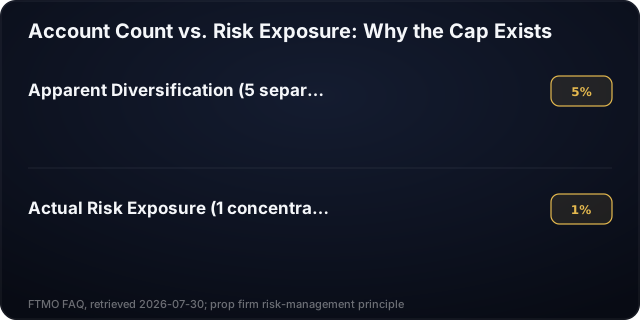
Five accounts running the same system long the same pair at the same moment are not five diversified traders. They are one position, five times the size, with one exit. Whatever obligation the firm carries when that trade wins, it carries all at once. Diversification that is only apparent, rather than real, is exactly the situation covered by understanding how correlated and identical positions concentrate risk instead of spreading it.
Why this looks like a penalty and is really an exposure limit
Every risk desk in finance caps concentrated exposure to a single strategy. A prop firm capping aggregate allocation per trader or strategy is doing the ordinary version of that, and it is doing it in public, on an FAQ page, where you can read it before you buy (FTMO FAQ, retrieved 2026-07-30). The unfair version is the firm that has the same limit and does not publish it. Once your exposure is aggregated across accounts, your own sizing has to be recomputed on the total, which is a risk-management problem before it is a rules problem. It is also worth asking whether scaling one account gets you to the same allocation with one set of rules instead of five.
Before you open the second account: a five-question checklist
- What is my aggregate simulated capital if I add this account? Add every open account, including ones you forgot.
- Is the cap written per trader, per account, or per strategy? Quote the exact phrase from the terms page.
- Must I disclose a copier or EA? Some firms require declaration; find out before, not after.
- Must I declare related accounts? Accounts under a family member's name, or a shared strategy, may be treated as related.
- What happens to pending payouts if one related account breaches? This is the answer that costs the most to learn late.
ITAfx's own position: accounts are simulated evaluation accounts, operated by Institutional Trading Academy Ltd., with the rules published up front rather than discovered after a breach. If you are unsure what simulated evaluation capital is and is not, that distinction is worth ten minutes before you buy anything. Rules that only surface after they are broken are a category of their own, and the consistency rule is the other one traders meet that way.
Ready to get funded?
50% off instant accounts with code 50CRYPTO.
Get Funded →Frequently Asked Questions
Can I run the same strategy on two prop firm accounts?
At FTMO, account count itself is not limited (FTMO FAQ, retrieved 2026-07-30). The published constraint is on total capital allocation, capped at $400,000 per trader or strategy prior to scaling (FTMO FAQ, retrieved 2026-07-30). Other firms write their own clause, so check the terms page of the firm you actually use.
Is copy trading between my own accounts against the rules?
Not by itself, on FTMO's published wording. The suspension right applies where identically traded strategies are detected across multiple accounts and total fictitious capital exceeds the allocation limit.
Does it matter whether I use a copier, an EA, or place the trades by hand?
The published clause describes the pattern, "identically traded strategies," not the tool.
What is the $400,000 figure, exactly?
It is FTMO's stated total capital allocation limit across all of one trader's accounts, per trader or strategy, prior to any scaling, retrieved from its FAQ on 30 July 2026 (FTMO FAQ, retrieved 2026-07-30). It is not an industry standard and it can change without notice.
How do I find the equivalent rule at my firm?
Search the terms of use for "capital allocation," "multiple accounts," "identical," and "aggregate." If nothing appears, ask support in writing and keep the dated reply.
Ready to get funded?
Instant accounts, simulated capital, rules published before you pay. 50% off with code 50CRYPTO.
Get Funded →