 ITA
ITAProp Firm Retroactive Rule Changes: How to Spot the Red Flag
A prop firm changed its rules after traders passed and cut earned profits. What retroactive rule changes look like, and how to check before you pay.

How this article is verified: Every number and claim above is checked against a primary source, ITAfx's own Terms of Service, official product pages, or the trading platform itself, before publication, then re-verified again immediately before this page goes live. Fact-checked and published on July 30, 2026 by Adrian Caldwell.
What a retroactive rule change actually is (and what it is not)
The difference between new rules for new accounts and new rules for your account
Firms revise rules constantly. That by itself is normal. The question that matters is scope: does the new rule apply to accounts bought after the announcement, or does it reach backwards into accounts that already exist, including ones that already passed?
Forward-only changes leave you with the deal you bought. Retroactive changes replace it. Same announcement, completely different consequence for your balance.
The one-minute hold time, applied to trades already closed
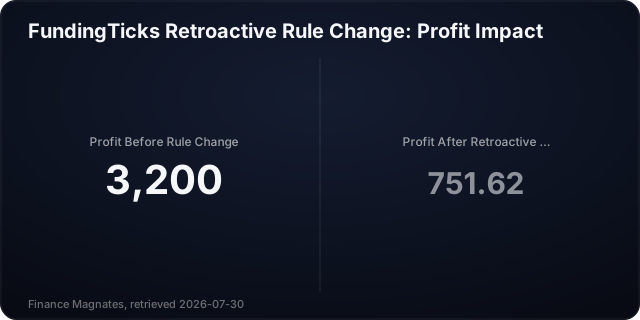
Finance Magnates reported on December 23, 2025 that futures prop trading platform FundingTicks was facing a backlash on social media after reportedly changing its trading rules retroactively the previous week, with the changes including a minimum one-minute trade hold time for scalpers. The report notes that although rule changes are common in prop trading, many traders claim FundingTicks applied them retroactively to all accounts (Finance Magnates, retrieved 2026-07-30).
Read that as a trader. A minimum hold time is not something you can retroactively comply with. If you scalped a position for forty seconds three weeks ago, that trade is in the past. A rule written today cannot be satisfied by a trade already closed, which means a retroactive hold-time rule is not really a rule. It is a filter applied to history.
Why this is not the same as a firm tightening its news-trading policy going forward
If a firm announces that from next Monday, positions may not be opened two minutes either side of a major release, you can adapt or walk. You keep agency. If you are new to how these rulesets are normally structured, our baseline explanation of standard evaluation rules covers what a conventional set contains.
The retroactive version removes agency entirely. You cannot adapt to a rule that governs a trade you already closed. That asymmetry, not the strictness of the rule, is the red flag.
The December 2025 FundingTicks case, as reported
The dated announcement and what applied to already-passed evaluations
Finance Magnates reported that traders had bought challenges on the platform and agreed to the old trading rules before the change (Finance Magnates, retrieved 2026-07-30). The firm's CEO, Khaled, pushed back publicly, writing that he had "paid out more than US$220M" while "putting my traders always first," and that FundingTicks "started as a side project" that quickly "became a giant" (Finance Magnates, retrieved 2026-07-30). This is reported by trade press, and the retroactive scope is what traders claim, not something verified independently beyond that reporting.
Why the complaint is about sequence, not strictness
The grievance in the reported backlash is not that a one-minute hold time is harsh. It is the ordering. Traders bought challenges, agreed to the rules as they stood, and traded under them. No stop was hit. No limit was breached under the ruleset that existed when the trades were placed. This is one of several hidden triggers that cause prop firms to deny payouts, and worth cross-checking against that broader list before you assume a denial was your fault.
Why a review score would not have warned you
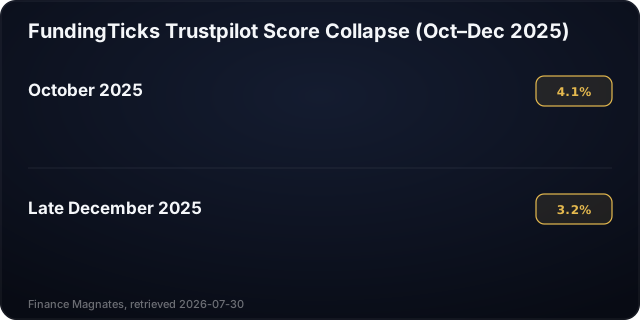
Here is the uncomfortable part about reputation signals in this pattern: they arrive after the money is gone. A review score is a lagging indicator. It tells you a firm has already failed a cohort of traders. It does not warn the cohort. Anyone checking a firm's score in the weeks before a retroactive change would have seen only the record of traders who had not yet been affected.
So use review scores as confirmation, never as your primary check. The primary check has to be something you can read before the damage exists, which means the terms document, alongside the broader diligence steps in how to verify whether a prop firm actually pays.
Why the industry itself calls this a payout trap
A competing firm's CEO on hidden, vague, and retroactively changed rules
You do not have to take this framing from us. It comes from an operator. FundedHive founder and chief executive Thomas Heinfart said of the consistency rule: "The one rule we would remove from the industry is the consistency rule, because in most cases it is not a real risk-management tool. It is a payout trap." He said FundedHive operates "zero consistency rules on any of our challenges" (remarks published by ResponsibleTrading.com, reported by Finance Magnates, retrieved 2026-07-30).
His objection is to a rule that functions as a gate on withdrawal rather than as risk control. That points at a wider diagnostic, and it is the one this article uses: sort every profit-affecting rule by whether it is hidden, vague, changed retroactively, or applied by hand. The checklist below is built from those four categories. The consistency rule itself is a separate mechanic with its own arithmetic, explained in how the consistency rule works.
Rules applied manually versus rules enforced by the platform
A rule enforced by the platform stops you in real time. You breach a daily loss limit, positions close, you know immediately. The rule is testable and the outcome is symmetric.
A rule applied by manual review at payout time is different. It is evaluated once, by a human, at the exact moment money is due to leave the firm. Same wording, opposite incentive structure. When you read terms, sort every rule into one of those two buckets. Anything sitting in the manual bucket is a rule you cannot verify you have satisfied until it is too late to change your trading.
| Platform-enforced rule | Manually-reviewed rule | |
|---|---|---|
| When it is checked | Real time, the moment the limit is hit | Once, at payout request |
| Who checks it | The trading platform itself | A human reviewer at the firm |
| Can you verify compliance in advance | Yes, the account either breaches or does not | No, the outcome is not known until reviewed |
| Outcome if wording is unchanged but enforcement is retroactive | Symmetric: the same breach means the same result for every account | Asymmetric: identical trading history can be read two different ways depending on who reviews it and when |
This is not new: the 2024 payout freeze precedent
What a pause in operations reveals about the denominator
Retroactive rule changes are one member of a family. The wider pattern is a firm's obligations exceeding what it can or will pay, and that pattern has a documented history.
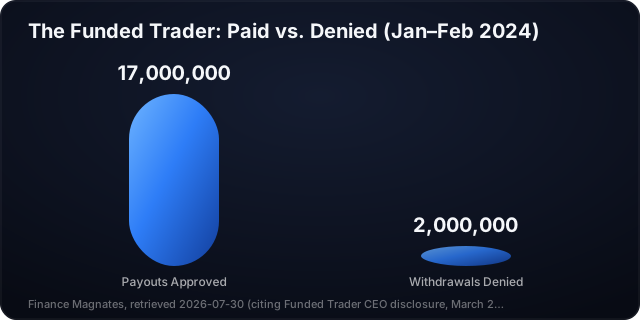
The Funded Trader, a prop trading firm that had faced an array of complaints over payout denials, temporarily paused all operations in March 2024 with promises of a relaunch, and its chief executive Angelo Ciaramello said the brand would return "but with a slightly different look and feel" (Finance Magnates, retrieved 2026-07-30).
Note what the trader could and could not see in advance. The complaints about denied payouts were public before the pause; the firm's own totals were not something a trader could audit. That is the general lesson: a headline paid-out figure says nothing about your odds if the denominator, the requests refused, is never published alongside it.
Why an operational excuse and a rule change land the same way for the trader
One firm paused operations and promised a relaunch. Another reportedly rewrote its rules. From the trader's side these are the same event: money that was earned did not arrive, and the explanation came from the party holding it.
That is why the check has to be structural, not reputational. You are not trying to judge whether a firm's management is honest. You are trying to find out what the contract lets them do if they are not. If you want to see what a normal withdrawal sequence looks like when nothing goes wrong, we walk through it in the payout request process.
The pre-signup check: five clauses to read before you pay
Open the firm's terms of service and rules page. Use your browser's find function. This takes under ten minutes and costs nothing.
| Clause to find | Exact wording to look for | What a bad answer looks like | Where to find it |
|---|---|---|---|
| Right to amend rules on open accounts | "amend", "modify", "at our sole discretion", "effective immediately" | Amendment right with no carve-out for accounts already purchased or already passed | Terms of service, usually the final sections |
| Grandfather clause | "accounts purchased prior to", "existing accounts", "rules in effect at the time of purchase" | The phrase is absent entirely, so nothing protects the ruleset you bought | Terms of service, or the rules changelog |
| Profit split fixed at purchase | "fixed for the life of the account" versus "subject to change" | Split described as current rather than contractual | Payout or profit-share section |
| Public dated changelog | A revision history with dates, or "last updated" plus prior versions | No dates, or a single "last updated" stamp with no archive of what changed | Footer, rules page, or documentation site |
| Manual review versus platform enforcement | "at our discretion", "subject to review", "may be assessed" | A profit-affecting rule that is only checked by a human at payout | Prohibited-practices and payout-eligibility sections |
Two practical notes. First, absence is an answer. A missing grandfather clause is not neutral, it means the default applies and the default is whatever the amendment clause says. Second, if a firm's rules live only in a Discord announcement or a support article rather than in the terms, treat that as the "vague" failure mode from the quote above.
This same posture, verify the documents rather than the marketing, works on people as well as firms. We apply it to educators in warning signs of a fake trading guru.
What to do if the rules change under an account you already hold
Screenshot the ruleset the day you buy
Do this before your first trade. Save the rules page, the payout terms, and the profit split as a dated PDF or full-page screenshot. It takes two minutes and it is the only version of the agreement you will control.
Without it, you are arguing from memory against a live page that has been edited. With it, you at least know precisely what changed and when.
Where the amendment clause leaves you, in plain terms
Read your own screenshot's amendment clause honestly. If it grants unilateral changes with immediate effect and no grandfather carve-out, the practical answer is that your leverage is commercial, not contractual: public complaint, review platforms, chargeback where a payment provider allows it. That is a weaker position than most traders assume when they click accept.
This is not legal advice, and nothing here promises recourse. It is a reason to read the clause before you pay rather than after.
What ITAfx fixes at purchase on its simulated evaluation accounts
For the sake of a concrete reference point, here is where ITAfx sits (itafx.com, retrieved 2026-07-30). It runs an instant-funding model with no evaluation time limit, on simulated account sizes from $50K to $400K, on the third-party platform platform, with a profit split of up to 120% on its Instant PRO accounts: a figure that exceeds 100% because it combines the 100% base split with a 20% promotional bonus, payouts typically within 24 hours, and fees that are final and non-refundable, as set out in our Return Policy. Current terms, sizes, and conditions are published at itafx.com, which is the version you should screenshot on the day you buy, exactly as you would with any other firm. If you want the wider field side by side, our comparison of FTMO alternatives handles fees and rules firm by firm.
Ready to get funded?
50% off instant accounts with code 50CRYPTO.
Get Funded →Frequently Asked Questions
What is a retroactive rule change at a prop firm?
It is a rule announced now and applied to trading activity or accounts from before the announcement. In the reported December 2025 case, new rules including a minimum one-minute hold time were applied to accounts that had already passed under the previous ruleset, resulting in flagged breaches and reduced profits (Finance Magnates, retrieved 2026-07-30).
Is my prop firm profit safe?
Your position depends on the amendment clause in the terms you agreed to, not on your trading. Check whether the firm reserves the right to modify rules affecting open accounts, whether a grandfather clause exists for accounts already purchased, and whether the profit split is fixed at purchase or subject to change.
Can a prop firm legally change rules after I pass?
That depends on the contract you accepted and the jurisdiction. Many terms documents include a broad right to amend at the firm's discretion. This article is not legal advice, so read the clause yourself before paying, and keep a dated copy of the rules as they stood on your purchase date.
Does a bad Trustpilot score warn me in advance?
Rarely. Review scores are a lagging indicator: they move only after a cohort of traders has already been affected, so a healthy score tells you about past customers rather than about the terms you are agreeing to today. Read the amendment clause instead.
Has this happened at more than one firm?
The pattern of unpaid or denied withdrawals predates 2025. The Funded Trader, which had faced an array of complaints over payout denials, temporarily paused all operations in March 2024 with promises of a relaunch (Finance Magnates, retrieved 2026-07-30).
Ready to get funded?
Instant accounts, simulated capital, rules published before you pay. 50% off with code 50CRYPTO.
Get Funded →