 ITA
ITAHow Often Prop Firms Actually Pay: First Payout vs Cycle
Two timing questions decide when your money moves: how long until the first payout, and how often after. FTMO, FundedNext and Topstep rules compared.

How this article is verified: Every number and claim above is checked against a primary source, ITAfx's own Terms of Service, official product pages, or the trading platform itself, before publication, then re-verified again immediately before this page goes live. Fact-checked and published on August 2, 2026 by Adrian Caldwell.
The two clocks nobody separates: first payout vs every payout after
Ask "how often do prop firms pay out" and you get answers like "every 14 days" or "monthly". Both answers can be true of the same firm and still leave you waiting three weeks longer than you planned, because neither says what starts the count.
Clock one runs once. It begins at some triggering event after funding, and it ends the first time you are allowed to request a withdrawal. The triggering event is not the same everywhere: it can be your first placed trade, the date you started trading on the account, or the accumulation of a number of qualifying days. If you are still mapping the road from application to a live account, how long it takes to get funded covers the stage before this one.
Clock two runs forever. It governs the gap between one payout and the next. Some firms restart a calendar counter. Some restart a performance counter. One firm effectively stops running a clock at all once you clear the first threshold.
If you only read one number, read the second one. Clock one costs you a few weeks once. Clock two shapes your income for as long as you hold the account.
How long until your first withdrawal? The eligibility window, firm by firm
Each of these is quoted from the firm's own help documentation, read on 2 August 2026.
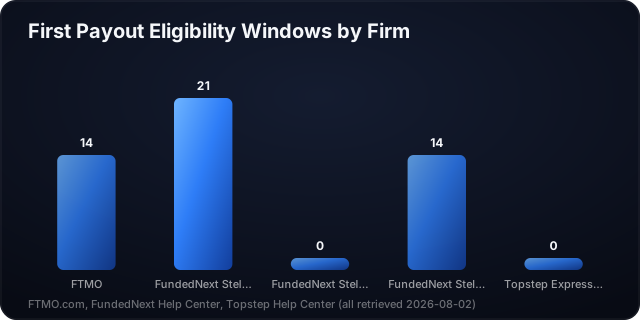
FTMO: day 14 after your first placed trade, all positions closed
FTMO ties the window to a trade, not to a signup date. FTMO traders can request a Reward claim on the 14th or any following day after the first placed trade on that specific account, with all open positions and pending orders closed at the time of the request (FTMO.com, retrieved 2026-08-02).
The practical consequence: if you sit on your hands for a week after getting the account, your day 14 is a week later than you assumed. The clock does not start when the credentials arrive. It starts when you trade.
FundedNext Stellar 2-Step: 21 days from the start of trading
FundedNext's 2-Step path uses a longer first window and a different trigger. FundedNext Stellar 2-Step traders can request their first Performance Reward 21 days after starting trading, with subsequent Performance Rewards occurring every 14 days thereafter (FundedNext Help Center, retrieved 2026-08-02).
Note the asymmetry. The first window is 21 days, the recurring one is 14. A reader who memorises "FundedNext pays every 14 days" will be a week early on the first request.
FundedNext Stellar 1-Step and Instant: the first cycle starts immediately
On Stellar 1-Step, there is no separate first-payout delay to memorise: FundedNext Stellar 1-Step traders receive Performance Rewards every 5 business days, starting from the first trading cycle (FundedNext Help Center, retrieved 2026-08-02).
Stellar Instant replaces the date with a growth threshold. A FundedNext Stellar Instant trader can request a Performance Reward once the account reaches 5% growth, with eligibility confirmed at end of day; if growth sits at least 1% but under 5%, the request becomes available 14 days after the cycle's start date, and below 1% growth no reward can be requested at all (FundedNext Help Center, retrieved 2026-08-02).
Topstep: the first payout is exempt from the standard requirement
Topstep runs on winning days rather than dates. Topstep's payout policy requires 5 winning days of $150 or more in Net P&L before a payout can be requested on an Express Funded Account, and the same 5-winning-day requirement applies per payout cycle on a Live Funded Account (Topstep Help Center, retrieved 2026-08-02).
The first one is treated differently. Topstep's payout policy states that a trader's first payout is exempt from the standard payout requirement, which separates the first withdrawal from every later payout that must fully satisfy the winning-day and consistency rules (Topstep Help Center, retrieved 2026-08-02).
After the first one: calendar cadence vs performance cadence
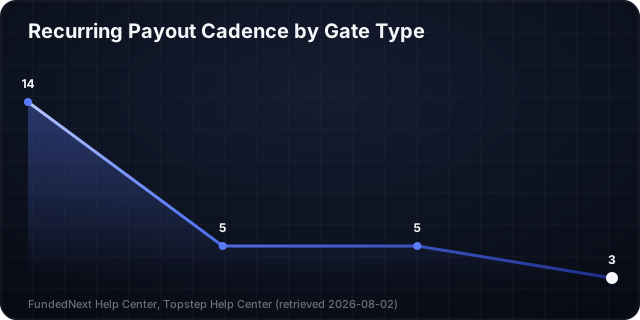
Once the first payout clears, firms fall into three groups. This is the taxonomy worth carrying around, because it predicts what your second and tenth payouts will feel like.
Calendar-gated: every 14 days, every 5 business days, on any following day
A calendar gate counts dates. It does not care how much you traded in between, only that the interval elapsed and you have profit to claim.
FundedNext's 2-Step sits here at every 14 days after the 21-day first window (FundedNext Help Center, retrieved 2026-08-02). Stellar 1-Step sits here too, on a tighter loop of every 5 business days from the first trading cycle (FundedNext Help Center, retrieved 2026-08-02).
FTMO is the loosest version of a calendar gate. FTMO's own withdrawal FAQ defines eligibility as the 14th or any following day after the first placed trade, meaning that once the 14-day mark is reached, later reward claims are not tied to a fixed calendar cycle: requests can be made on any following day rather than only on a set monthly or bi-weekly date (FTMO.com, retrieved 2026-08-02).
Performance-gated: Topstep's winning-day count that restarts after each payout
A performance gate counts your results. Topstep's cadence between payouts is gated by winning days rather than a fixed calendar cycle: after each payout the winning-day count restarts, a 5-day count on the Express Standard path and a 3-day count on the Express Consistency path, so the next payout requires meeting the winning-day requirement again (Topstep Help Center, retrieved 2026-08-02).
There is no date that guarantees your next payout. There is only a tally of days where a Topstep trader closed with $150 or more in Net P&L (Topstep Help Center, retrieved 2026-08-02). This is the same logic that sits behind consistency rules in prop firm challenges: the firm is buying repeatability, not a single good week.
Hybrid: FundedNext Instant's 5% growth on demand, or 1% at 14 days
The hybrid gate opens on whichever condition arrives first. A FundedNext Stellar Instant trader can request on demand at 5% growth with end-of-day confirmation, or wait until 14 days after the cycle start if growth is between 1% and 5% (FundedNext Help Center, retrieved 2026-08-02).
A strong week collapses your wait to a few days. A flat week hands you back to the calendar. That is the trade-off a hybrid gate makes: it pays for performance when performance shows up, and falls back to a date when it does not.
The comparison table: first window and recurring cadence side by side
| Firm / Program | First-withdrawal window (as published) | What starts the clock | Recurring cadence | Gate type | Policy read on |
|---|---|---|---|---|---|
| FTMO | 14th day, or any following day (FTMO.com, retrieved 2026-08-02) | The first placed trade on that specific account (FTMO.com, retrieved 2026-08-02) | Any following day, no fixed calendar cycle (FTMO.com, retrieved 2026-08-02) | Calendar (open-ended) | 2 August 2026 |
| FundedNext Stellar 2-Step | 21 days (FundedNext Help Center, retrieved 2026-08-02) | Starting trading on the account (FundedNext Help Center, retrieved 2026-08-02) | Every 14 days thereafter (FundedNext Help Center, retrieved 2026-08-02) | Calendar | 2 August 2026 |
| FundedNext Stellar 1-Step | First trading cycle, no separate delay (FundedNext Help Center, retrieved 2026-08-02) | The first trading cycle (FundedNext Help Center, retrieved 2026-08-02) | Every 5 business days (FundedNext Help Center, retrieved 2026-08-02) | Calendar | 2 August 2026 |
| FundedNext Stellar Instant | On demand at 5% growth, confirmed end of day; or 14 days from cycle start at 1% to 5% growth (FundedNext Help Center, retrieved 2026-08-02) | Account growth, plus the cycle start date as fallback (FundedNext Help Center, retrieved 2026-08-02) | Same dual condition each cycle (FundedNext Help Center, retrieved 2026-08-02) | Hybrid | 2 August 2026 |
| Topstep Express / Live Funded | First payout exempt from the standard requirement (Topstep Help Center, retrieved 2026-08-02) | Winning days accumulated, $150+ Net P&L each (Topstep Help Center, retrieved 2026-08-02) | 5-day count restarts after each payout, 3 days on the Express Consistency path (Topstep Help Center, retrieved 2026-08-02) | Performance | 2 August 2026 |
Read the "what starts the clock" column twice. It is the column that catches people. "First placed trade" (FTMO) and "starting trading on the account" (FundedNext) sound identical and are not necessarily the same date. "Winning days accumulated" (Topstep) is not a date at all.
What the clock is actually measuring: trading days, calendar days, or winning days
Three units, one word. Policy pages all say "days".
A calendar day passes whether or not you open a platform. FundedNext's 21-day first window and 14-day recurring cycle run on this unit, so a trader on holiday still moves toward eligibility (FundedNext Help Center, retrieved 2026-08-02). Business days are the same idea with weekends removed, which is why "every 5 business days" is a full working week, not five days (FundedNext Help Center, retrieved 2026-08-02).
A winning day is a result, not a date. Topstep requires 5 of them at $150 or more in Net P&L (Topstep Help Center, retrieved 2026-08-02). A trader who takes two setups a week and wins both reaches five winning days in under a month. A trader who takes two setups a month reaches them in a quarter, if the market cooperates. Same rule, wildly different payout dates.
Then there is the reset. After a Topstep payout, the count restarts from zero (Topstep Help Center, retrieved 2026-08-02). A calendar cycle also restarts, but a calendar restart runs itself while a performance restart requires you to trade well again. That is the whole difference between the two families.
So when you read a payout sentence, extract three things before you assume a date: the unit (calendar, business, or qualifying day), the trigger (what event sets it to zero), and whether the count resets after each payout. Miss any one and your projected payout date is a guess.
Which cadence fits your trading rhythm
None of these structures is generous or stingy on its own. They reward different behaviour, and the mismatch is what hurts.
Low-frequency swing traders and calendar cycles
If you take a handful of positions a month and hold them for days, a calendar gate is the friendlier structure. The interval elapses regardless of your activity, and FTMO's open-ended version, where any following day after the 14th qualifies, imposes almost no rhythm at all (FTMO.com, retrieved 2026-08-02).
The one thing to watch is the closing condition. FTMO requires all open positions and pending orders to be closed when you request (FTMO.com, retrieved 2026-08-02). A swing trader sitting in a three-week position has to choose between the trade and the request. Weekend and multi-day holds carry their own rules too, covered in prop firm weekend holding rules.
Active intraday traders and winning-day gates
If you trade most sessions, a performance gate can be dramatically faster than any calendar. Five winning days at $150 or more can arrive inside a single week for a Topstep trader taking daily setups (Topstep Help Center, retrieved 2026-08-02).
The cost is variance. A drawdown week does not just pause your profit, it pauses your eligibility, because the counter restarts after each payout and only qualifying days move it (Topstep Help Center, retrieved 2026-08-02). Traders who have worked through this cycle describe the shift in reaching repeat withdrawals as a change in planning, not in strategy.
Why a shorter cycle is not automatically better
Every 5 business days sounds strictly better than every 14 (FundedNext Help Center, retrieved 2026-08-02). In practice a short cycle only helps if you can reliably produce claimable profit inside it. Frequent small withdrawals also shrink the buffer between your balance and your loss limit, which is the account's real life expectancy, the same drawdown math covered in prop firm drawdown rules.
Threshold structures make the same trade-off explicit. Stellar Instant's 5% on-demand route is faster than its 14-day route only if the account actually reached 5% (FundedNext Help Center, retrieved 2026-08-02). Speed you cannot trigger is not speed.
If you are still learning the vocabulary behind these rules, start with what a prop firm challenge is, and if payout timing is only one factor in your decision, the broader firm comparison covers the rest.
Gate type and unit at a glance
| Firm / Program | Gate type | Timing unit used | Does the count reset after payout? |
|---|---|---|---|
| FTMO | Calendar (open-ended) | Calendar days (FTMO.com, retrieved 2026-08-02) | No fixed cycle to reset; any following day qualifies (FTMO.com, retrieved 2026-08-02) |
| FundedNext Stellar 2-Step | Calendar | Calendar days (FundedNext Help Center, retrieved 2026-08-02) | Yes, a fresh 14-day interval each time (FundedNext Help Center, retrieved 2026-08-02) |
| FundedNext Stellar 1-Step | Calendar | Business days (FundedNext Help Center, retrieved 2026-08-02) | Yes, a fresh 5-business-day interval each time (FundedNext Help Center, retrieved 2026-08-02) |
| FundedNext Stellar Instant | Hybrid | Growth percentage, with calendar days as fallback (FundedNext Help Center, retrieved 2026-08-02) | Yes, the same dual condition applies each cycle (FundedNext Help Center, retrieved 2026-08-02) |
| Topstep Express / Live Funded | Performance | Winning days at $150+ Net P&L (Topstep Help Center, retrieved 2026-08-02) | Yes, the winning-day count restarts after each payout (Topstep Help Center, retrieved 2026-08-02) |
Ready to get funded?
50% off instant accounts with code 50CRYPTO.
Get Funded →Frequently Asked Questions
How often do prop firms pay out?
It depends on the gate type. FundedNext's Stellar 2-Step pays every 14 days after a 21-day first window (FundedNext Help Center, retrieved 2026-08-02). Stellar 1-Step pays every 5 business days from the first trading cycle (FundedNext Help Center, retrieved 2026-08-02). FTMO allows requests on the 14th or any following day after the first placed trade, with no fixed cycle after that (FTMO.com, retrieved 2026-08-02). Topstep is not calendar-based at all.
How long before my first withdrawal from a funded account?
FTMO: the 14th day after your first placed trade (FTMO.com, retrieved 2026-08-02). FundedNext Stellar 2-Step: 21 days after starting trading (FundedNext Help Center, retrieved 2026-08-02). FundedNext Stellar Instant: on demand at 5% growth, or 14 days from cycle start at 1% or more (FundedNext Help Center, retrieved 2026-08-02). Topstep: the first payout is exempt from the standard requirement (Topstep Help Center, retrieved 2026-08-02).
What is a winning day?
At Topstep it is a day with $150 or more in Net P&L, and five of them are required before a payout on an Express Funded Account (Topstep Help Center, retrieved 2026-08-02).
Does my payout count restart after I withdraw?
At Topstep yes: the winning-day count restarts after each payout, 5 days on the Express Standard path and 3 days on the Express Consistency path (Topstep Help Center, retrieved 2026-08-02). Calendar cycles restart too, but they restart on their own.
Is a faster payout cycle always better?
No. A 5-business-day cycle only helps if you can generate claimable profit within it (FundedNext Help Center, retrieved 2026-08-02), and frequent withdrawals reduce the buffer between your balance and your loss limit.
Ready to get funded?
Instant accounts, simulated capital, rules published before you pay. 50% off with code 50CRYPTO.
Get Funded →