 ITA
ITAProp Firm Leverage by Asset Class: What Firms Publish
FTMO and FundedNext publish different leverage caps for forex, indices, metals and crypto, by account type and phase. The grid, in margin terms.

How this article is verified: Every number and claim above is checked against a primary source, ITAfx's own Terms of Service, official product pages, or the trading platform itself, before publication, then re-verified again immediately before this page goes live. Fact-checked and published on August 2, 2026 by Adrian Caldwell.
Leverage at a prop firm is a grid, not a single number
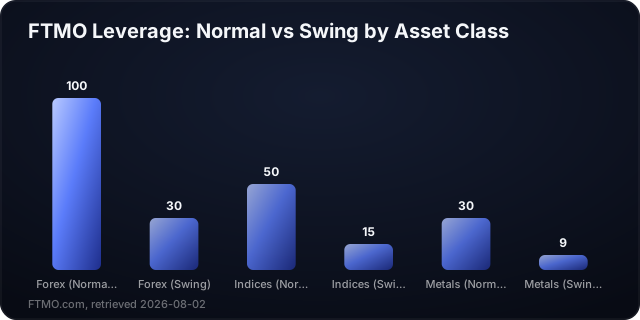
FTMO's Standard account offers leverage up to 1:100, and the firm states plainly that this cap cannot be increased (FTMO.com, retrieved 2026-08-02). That headline number is the forex line. FTMO's own per-asset-class breakdown puts forex pairs at 1:100 on Normal accounts and 1:30 on Swing accounts (FTMO.com, retrieved 2026-08-02). Its metals line sits at 1:30 on Normal and 1:9 on Swing (FTMO.com, retrieved 2026-08-02). Cryptocurrencies, equity CFDs and commodities sit at 1:3.3 on Normal and 1:1 on Swing (FTMO.com, retrieved 2026-08-02).
So the gap between the advertised cap and the cap you actually trade under can be a factor of thirty, decided entirely by which symbol you clicked. Three questions decide your real number: which asset class, which account type, and which phase you are in.
If you are new to the wider rule set an evaluation account carries, start with the beginner rules explainer, then come back to this grid.
The published caps, side by side by asset class
One table, both firms, every cell taken from the firm's own documentation.
| Firm | Account type or model | Phase | Forex | Indices | Metals or commodities | Crypto |
|---|---|---|---|---|---|---|
| FTMO | Normal (Standard) | Both | 1:100 | 1:50 (1:30 on HK50.cash, US2000.cash, SPN35.cash) | Metals 1:30; commodities 1:3.3 | 1:3.3 |
| FTMO | Swing | Both | 1:30 | 1:15 (1:9 on HK50.cash, US2000.cash, SPN35.cash) | Metals 1:9; commodities 1:1 | 1:1 |
| FundedNext | Stellar 2-Step | Challenge | 1:100 | 1:25 | Commodities 1:25 | 1:1 |
| FundedNext | Stellar 2-Step | Funded | 1:100 | 1:15 | Commodities 1:15 | 1:1 |
| FundedNext | Stellar Lite | Challenge | 1:100 | 1:25 | Commodities 1:25 | 1:1 |
| FundedNext | Stellar Lite | Funded | 1:100 | 1:15 | Commodities 1:15 | 1:1 |
| FundedNext | Stellar 1-Step | Challenge | 1:30 | 1:10 | Commodities 1:15 | 1:1 |
| FundedNext | Stellar 1-Step | Funded | 1:30 | 1:10 | Commodities 1:10 | 1:1 |
| FundedNext | Stellar Instant | All phases | 1:30 | 1:5 | Commodities 1:7.5 | 1:1 |
Two footnotes matter more than the rest of the table. First, the metals and commodities column is not one thing: FTMO publishes a separate metals line at 1:30 Normal and 1:9 Swing, distinct from its commodities line at 1:3.3 and 1:1, while FundedNext publishes a single Commodities tier. Second, FTMO carves three index symbols out at lower leverage than the rest, HK50.cash, US2000.cash and SPN35.cash, at 1:30 on Normal and 1:9 on Swing (FTMO.com, retrieved 2026-08-02).
FTMO: Normal vs Swing account types
The Swing account exists for traders who hold through news and over weekends. Its price is leverage. FTMO's Swing account type has leverage set to up to 1:30 (FTMO.com, retrieved 2026-08-02), roughly a third of the Normal cap on forex and roughly a third on metals and indices too. If your strategy needs overnight and weekend exposure, that is not a preference, it is a forced move onto a lower-leverage account type. Read the forex market hours and session overlap guide before choosing, because holding period drives the account type, and the account type drives the cap.
FundedNext: Stellar 2-Step, Lite, 1-Step and Instant
Two clusters. Stellar Instant is lower again on index exposure: FundedNext's published Stellar Instant leverage structure is 1:30 forex, 1:7.5 commodities, 1:5 indices and 1:1 crypto, identical in all phases (FundedNext Help Center, retrieved 2026-08-02). For more on how this model works end to end, see the prop firm instant account guide.
Where gold actually sits: metals tier vs commodities tier
This is the single most common mistake in leverage comparisons. FundedNext lists XAUUSD (Gold), XAGUSD (Silver) and USOUSD (US Oil) under Commodities (FundedNext, retrieved 2026-08-02). At FTMO, metals are their own published line at 1:30 Normal and 1:9 Swing (FTMO.com, retrieved 2026-08-02), while commodities sit far lower at 1:3.3 and 1:1 (FTMO.com, retrieved 2026-08-02). Same metal, two different filing cabinets. Check the firm's symbol list, not the word you assume applies. Traders who focus on this instrument should see the gold price analysis and support/resistance guide for how these levels interact with position sizing.
Why the cap drops when you move to funded (and when it doesn't)
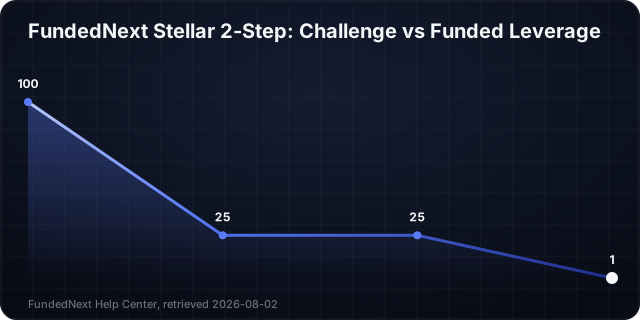
The drop is real, and it is selective. Nothing announces this in the middle of a trade. A position size that was inside your margin budget during the evaluation can sit outside it on the funded account.
Stellar Instant does not change at all, publishing the same 1:30 forex, 1:7.5 commodities, 1:5 indices and 1:1 crypto across all phases (FundedNext Help Center, retrieved 2026-08-02).
The practical reading: if you trade indices or gold, ask what the funded grid looks like before you buy the challenge, not after you pass it. If you trade forex only, at either of these firms the phase change is a non-event.
Why gold and crypto get less leverage than EURUSD
FundedNext states the reason itself, and it is worth taking at face value: higher leverage is available for more liquid assets like forex, while lower leverage is applied to high-volatility instruments like crypto (FundedNext Help Center, retrieved 2026-08-02).
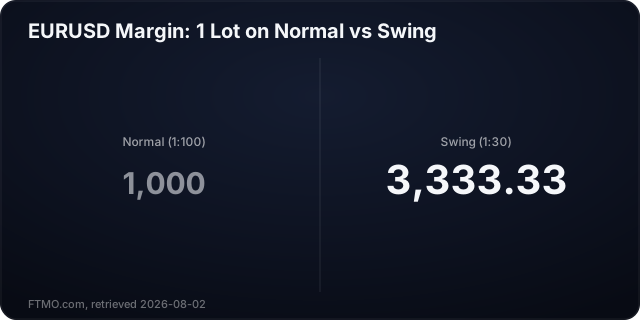
Read that as risk transfer, because that is what it is. A leverage cap is not a judgement about your skill. It is a governor on how fast a position can travel toward a drawdown limit. On a volatile instrument, a given lot size moves the equity curve further per minute, so the firm caps the lot size indirectly by capping margin efficiency. The lower the liquidity and the higher the volatility, the harder the governor bites. Crypto at 1:1 across every model in the table above is the extreme end of that logic: you can trade it, but only with the full notional value tied up.
Understanding what the cap protects means understanding the drawdown rule it protects, so read the drawdown limits guide alongside this.
What each cap means in margin: the firms' own worked examples
Ratios are abstract. Money is not. Both firms publish a worked example, and those two examples say everything.
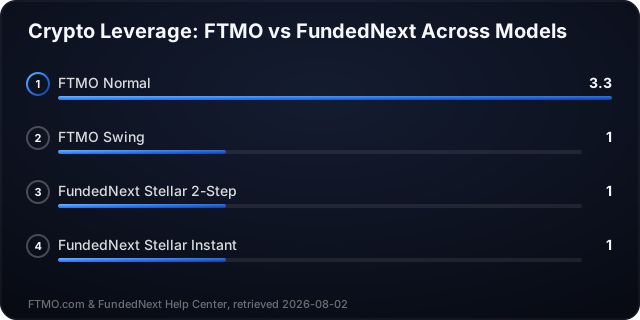
One EURUSD lot: EUR 1,000 at 1:100 vs EUR 3,333.33 at 1:30
FTMO's own example: opening one lot of EURUSD requires EUR 1,000 of margin on the Normal account type at 1:100, versus EUR 3,333.33 on the Swing account at 1:30 (FTMO.com, retrieved 2026-08-02). Same trade, same pair, same stop distance, same risk in currency terms. Only the capital locked up changes, and it more than triples.
Five lots on a 6K account: 90.86% of the balance in margin
FundedNext's overleveraging example is the one to keep. On a 6K Stellar 2-Step account at 1:100 leverage, opening 5 lots of EURUSD requires $5,451.65 of margin, which is 90.86% of the trader's total available balance (FundedNext Help Center, retrieved 2026-08-02).
Sit with that number. This is the highest leverage tier either firm publishes, on the most liquid pair in the world, and five lots still consumes more than nine tenths of the account. That is the trap in one line: high leverage does not raise your risk budget. Your drawdown limit is fixed in currency, and a bigger cap simply lets you reach it faster with fewer clicks. Leverage buys speed, not room.
How to size positions inside the cap you actually have
Margin used vs risk per trade: two different limits
These get confused constantly. Margin used is how much of the balance a position ties up. Risk per trade is how much you lose if the stop is hit. You can breach the second while sitting comfortably inside the first, and you can be blocked by the first while risking almost nothing. Both need a number before you open.
FundedNext's stated guidance in its own leverage article is that successful traders typically risk no more than 1% at a time and use only 20% to 30% of their total margin (FundedNext Help Center, retrieved 2026-08-02). Treat that as one firm's published guidance, not a universal law. Against the 90.86% example above, though, the contrast is instructive: the same firm that permits 1:100 recommends operating at roughly a quarter of the margin that cap makes available. For the sizing method itself, see the broader leverage explained for funded accounts guide rather than reverse-engineering it here, and factor slippage into large-margin positions.
A checklist before you pick an account type
- Which asset class do you actually trade? If it is gold, indices or crypto, the forex headline cap is irrelevant to you. Look up your symbol's tier.
- Does the model change leverage at funding? On Stellar Instant, nothing changes (FundedNext Help Center, retrieved 2026-08-02).
- Do you hold overnight or over weekends? At FTMO that points to the Swing account, which is capped at up to 1:30 (FTMO.com, retrieved 2026-08-02).
- Is your symbol carved out? HK50.cash, US2000.cash and SPN35.cash trade below the general FTMO indices line (FTMO.com, retrieved 2026-08-02).
- Run the margin number on your normal position size before you pay a fee, not after.
If you are still choosing between firms rather than between account types, the FundedNext vs ITAfx comparison covers more than leverage.
How ITAfx handles leverage on simulated accounts
ITA provides simulated trading evaluation services. Challenge fees pay for access to evaluation environments, not investments or deposits, and all trading in evaluation environments is simulated (source: risk disclaimer published site-wide on itafx.com). The margin arithmetic in this article behaves identically on a simulated balance: a position that consumes 90% of the balance in margin consumes 90% whether the capital is simulated or not, and the drawdown limit it approaches is just as binding. For current ITAfx account specifications, including any per-asset conditions, check itafx.com directly rather than a third-party summary.
Ready to get funded?
50% off instant accounts with code 50CRYPTO.
Get Funded →Frequently Asked Questions
Does FTMO let you increase leverage above 1:100?
No. FTMO states that the leverage offered on the Standard account type is up to 1:100 and cannot be increased (FTMO.com, retrieved 2026-08-02). There is no upgrade path or paid add-on for a higher cap. The Swing account type moves in the other direction, capped at up to 1:30 (FTMO.com, retrieved 2026-08-02), which is the trade-off for holding through news and weekends.
What leverage does FundedNext give on gold?
Gold takes the commodities cap, because FundedNext files XAUUSD (Gold), XAGUSD (Silver) and USOUSD (US Oil) under Commodities rather than a separate metals tier (FundedNext, retrieved 2026-08-02).
Does leverage change between challenge and funded?
On some models, yes. Stellar Instant publishes the same structure in all phases (FundedNext Help Center, retrieved 2026-08-02).
Is higher leverage better for passing an evaluation?
Higher leverage frees margin, it does not enlarge your loss limit. FundedNext's own example shows 5 lots of EURUSD at 1:100 on a 6K account consuming $5,451.65, or 90.86% of the balance (FundedNext Help Center, retrieved 2026-08-02), while the same firm's guidance is to use 20% to 30% of total margin and risk no more than 1% per trade (FundedNext Help Center, retrieved 2026-08-02).
Why does gold get a different leverage cap at FTMO than at FundedNext?
Because the two firms classify the same instrument differently: FTMO gives metals their own published tier at 1:30 Normal and 1:9 Swing (FTMO.com, retrieved 2026-08-02), while FundedNext folds gold into a general Commodities tier alongside silver and oil (FundedNext, retrieved 2026-08-02).
What is the highest leverage either firm publishes, and where?
The highest published figure in either grid is 1:100, offered by FTMO on Normal (Standard) accounts for forex (FTMO.com, retrieved 2026-08-02) and by FundedNext on Stellar 2-Step and Stellar Lite forex during both challenge and funded phases.
Ready to get funded?
Instant accounts, simulated capital, rules published before you pay. 50% off with code 50CRYPTO.
Get Funded →