 ITA
ITAProp Firm Hidden Costs: The Real 12-Month Cost of a Funded Account
Challenge fee is only part of it. Add data feeds, platform, activation and resets to get your true 12-month prop firm cost, with a worksheet.

How this article is verified: Every number and claim above is checked against a primary source, ITAfx's own Terms of Service, official product pages, or the trading platform itself, before publication, then re-verified again immediately before this page goes live. Fact-checked and published on August 1, 2026 by Adrian Caldwell.
The sticker price is one line on a 12-month bill
The challenge fee is the price of entry. It is not the price of the year. Understanding how long it typically takes to get funded helps frame how many months that entry fee is meant to cover before these ongoing costs even start.
There are seven buckets that can sit on top of it. Market-data fees charged by the exchange and passed through by your platform. The platform subscription itself. A one-time activation fee when a passed account goes live. Resets after a breach. Withdrawal processing. Currency conversion, if you are billed in a currency you do not hold. And inactivity charges on free-tier plans.
Not every model carries all seven. That is the honest part of this, and we get to it below. But three of them, market data, platform subscription and activation, are documented in published price lists you can open right now, and those three are where most of the money is.
Here is what this article can prove with a primary source, and what it cannot. It can prove market data, platform subscription and activation, because Tradovate, Kinetick and Topstep publish those numbers on their own pages. It cannot give you a universal figure for inactivity fees, resets, withdrawal processing or currency conversion, because those vary by firm and by your bank, and no published number covers everyone. Where a figure would be invented, this article leaves a blank in the worksheet for you to fill from your own firm's terms.
Do these fees ever stop you getting paid? The three questions to ask before you buy
The fear underneath "hidden costs" is not really about money. It is about finding out, at the moment you finally pass, that getting paid requires another payment you did not plan for. Three questions kill that surprise before you buy.
Is the fee charged before or after you pass?
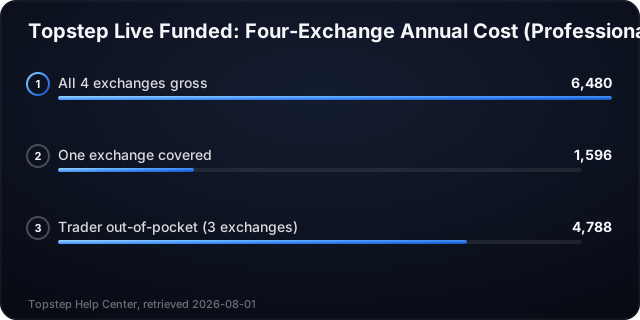
This is the one that catches people. Topstep's own help center documents the cleanest example: on Trading Combine and Express Funded Account plans, Topstep covers Level 1 market data for all four exchanges at no cost (Topstep Help Center, retrieved 2026-08-01). Move to the Live Funded Account and the arrangement inverts. There, the trader pays professional exchange market data at $133 per exchange per month; trading all permitted products requires all four exchanges, about $540 per month, of which Topstep covers one, leaving roughly $399 per month out of pocket (Topstep Help Center, retrieved 2026-08-01).
Read that sequence again. The cost appears because you succeeded. A trader who budgets only for the evaluation stage has budgeted for the cheap half of the relationship.
Is it one-time, monthly, or per-event?
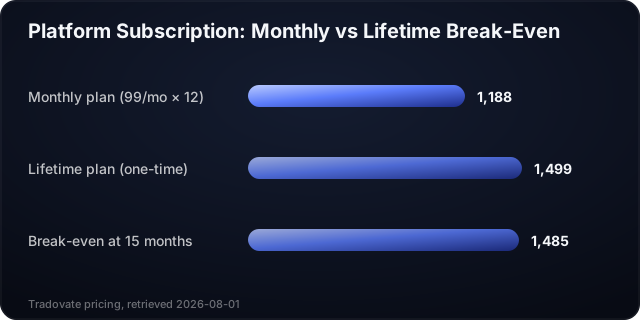
Cadence decides everything over twelve months. A one-time activation charge is close to a rounding error against a year of trading. A $99 monthly subscription is $1,188. A per-event fee, like a reset, scales with something you control, which makes it the only line on the bill you can shrink with skill rather than with a different vendor.
Write the cadence next to every number you collect. A price list that says "$38" without saying "per month" is not yet a usable input.
Who pays it during evaluation vs once the account is live?
Same question as the first, but asked about the platform rather than the data. Topstep states plainly that in the Live Funded Account, the trader is responsible for their own platform license cost (Topstep Help Center, retrieved 2026-08-01). The subscription that felt included during the evaluation becomes a separate out-of-pocket item the day the account goes live.
Ask your firm, in writing, which side of that line each fee sits on. Not a forum post. Not a support chat you did not save. The published help article or the terms page.
The hidden rule nobody reads: professional vs non-professional market-data status
This is the single most expensive fork in the whole cost stack, and most traders never check which side of it they are on.
Exchanges do not charge everyone the same price for the same data. They classify each subscriber as a non-professional or a professional user, and the professional rate is not slightly higher. It is an order of magnitude higher.
What the classification actually costs per month
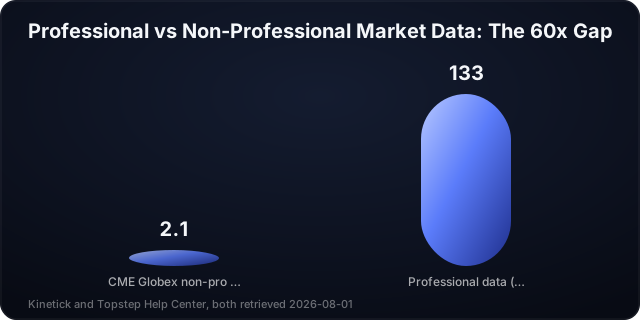
Kinetick lists CME Globex non-professional Level I data at $2.10 per month per exchange, while Topstep's Live Funded Account bills professional data at $133 per exchange per month (Kinetick and Topstep Help Center, both retrieved 2026-08-01), roughly sixty times higher for the professional tier on a comparable per-exchange basis. Over twelve months that gap compounds across every exchange a trader needs, and the trader on the wrong side of the classification usually finds out from a statement, not from a warning.
Classification is not a preference you tick. It turns on things like whether you are registered with a financial regulator, trade on behalf of a firm, or use the data for business purposes. The rules are the exchange's, applied through your data provider. Get your status confirmed by your firm and your platform in writing before you subscribe, and re-confirm it if your employment or registration status changes.
Level I vs Level II, and why depth is a separate bill
Level I is top of book: best bid, best offer, last trade. Level II is depth of market: the resting orders behind the top. If your strategy reads order-book depth, you are buying a second product, not an upgrade to the first.
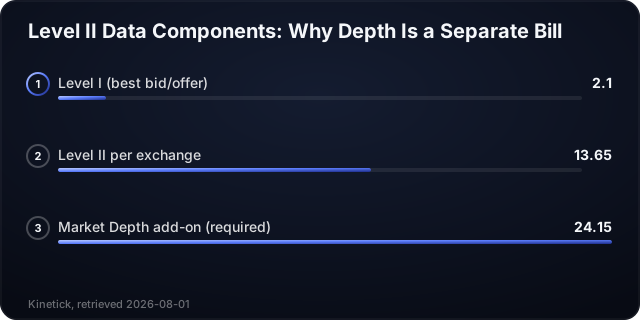
The pricing shows it. Kinetick, NinjaTrader's own market-data service, lists CME Globex non-professional data at $2.10 per month per exchange for Level I and $13.65 per month per exchange for Level II, plus an additional $24.15 per month Market Depth charge required for all Level II data (Kinetick, retrieved 2026-08-01). That last item is easy to miss when you compare per-exchange line items across providers, and it is the one that changes the answer.
So compare providers on the total for the exact configuration you will use, not on the headline per-exchange rate.
The Topstep live-funded case: what's covered and what isn't
Put the two Topstep documents side by side and the shape of the year appears. During the Combine and on the Express Funded Account, Level 1 is covered for all four exchanges and Level 2 depth is a $38 per month upgrade (Topstep Help Center, retrieved 2026-08-01). In the Live Funded Account, data is billed at the professional rate of $133 per exchange per month, with one exchange covered, leaving about $399 per month for all four (Topstep Help Center, retrieved 2026-08-01).
Nothing about that is hidden in the sense of concealed. Both figures sit on public help pages. It is hidden in the sense that almost nobody opens them before paying, which is the only kind of hidden that costs money.
Platform subscription: the cost that survives every reset
Blow the account and the evaluation ends. The platform subscription does not. It renews on its own calendar, indifferent to whether you currently hold a passing account, which is why it deserves its own line in the worksheet rather than being folded into "the cost of the challenge." That distinction matters even more once you understand how prop firm drawdown limits actually end an evaluation, since a breach restarts the clock on these recurring charges without refunding a single month of subscription already paid.
Monthly vs lifetime vs free-tier commission trade-off
Tradovate publishes a Monthly plan at $99 per month and a Lifetime plan for a one-time payment of $1,499, or four installments of $499 (Tradovate, retrieved 2026-08-01).
Lifetime pricing is a bet on your own persistence. At $99 per month against $1,499 once, the break-even is a little over fifteen months of continuous subscription, before you account for the commission difference between tiers. If you are not confident you will still be trading futures in sixteen months, monthly is the cheaper honest answer, and you can convert later.
The free tier is not free either, in the way that matters. It carries the highest per-side commissions, so it is a bet that your volume stays low. Compute it as subscription plus commissions at your realistic monthly volume, and the ranking between the three plans often flips.
The inactivity terms on free tiers
Here is the one that surprises people who step away for a month.
Some platform vendors charge an inactivity fee on their free tier: a flat charge for any 30-day window in which you log in but place no trades. A quiet month, a holiday, or a stretch where you sit out because conditions do not suit your system can be billable on such a plan. Terms differ by vendor and we could not confirm a specific vendor's current figure at the time of writing, so read your own platform's fee schedule for an inactivity clause and put its number, if any, in your worksheet.
Activation, resets and the per-event costs
Per-event costs are the part of the bill your behaviour writes.
A one-time activation fee switches on a passed account for live simulated trading, and some firms charge it while others fold that step into the up-front price. Topstep documents both routes in one place: activating an Express Funded Account costs $149, charged once per account, on its Standard Path, or $0 on its No Activation Fee Path, which carries a higher monthly subscription instead (Topstep Help Center, retrieved 2026-08-01). Same product, two payment routes, and the difference only shows up if you read your firm's activation terms before you choose.
Resets work the same way but repeat. Each breach that ends an evaluation and each restart carries whatever your firm charges for it, so your annual reset spend is your firm's reset price multiplied by your failure count. That multiplier is the only variable in this entire article you control directly. Understanding exactly what ends an account is therefore a cost-control exercise, not just a rules exercise: how drawdown is measured decides when a fresh fee starts, and a consistency breach can end an evaluation you were otherwise passing.
Withdrawal processing and currency conversion belong in this bucket too, per event, and they depend on your firm's payout method and your bank's conversion spread. No published figure covers all firms, so put your own numbers there after reading your firm's payout terms, including the step-by-step withdrawal process for a funded account before you assume a payout is fee-free.
Not every model carries every fee: the bundled counter-example
If the article stopped here it would be a scare piece, and it would be wrong.
The itemized stack above is characteristic of the futures side, where exchange data and third-party platforms are genuinely separate vendors with their own price lists. Bundled models work differently: where a firm supplies its own platform and price feed rather than passing through a third-party exchange feed, there is no separate monthly data charge and no separate platform subscription to itemise. Check your own firm's terms for which architecture it uses rather than assuming by asset class.
So the correct question is not "which firm has hidden fees." It is "which cost architecture am I buying into." A bundled one-time fee can be more expensive than an itemized stack, or far cheaper, and only the twelve-month total tells you which.
ITAfx sits on the instant-funding side of that split, and every account we sell is access to a simulated evaluation and funded environment, not real-money investment. Institutional Trading Academy Ltd. provides simulated trading evaluation services; challenge fees pay for access to evaluation environments, not investments or deposits, and ITA does not act as a broker, custodian, or investment adviser (risk disclaimer, live site-wide on itafx.com). Trading runs on the third-party platform platform (itafx.com). For our own current fee figures by account size, read the pricing page on itafx.com rather than a number restated in a blog post, because a restated price ages badly and a published one does not.
One thing worth stating in the same breath as any split figure you see from us: ITAfx's Instant PRO account advertises up to a 120% profit split, and the reason a split can exceed 100% is that it is 100% of simulated trading profit plus a separate 20% bonus paid on top, not a division of more than the whole (itafx.com FAQ and terms of service). If a number looks impossible, the mechanism should be in the sentence next to it. That standard applies to us the same as to anyone else in this article.
The one table: every documented fee, its cadence, and who pays it
Every figure below is as published by the vendor or firm named, retrieved 1 August 2026. No blended or estimated numbers appear in this table.
| Fee | Source | Amount as published | Cadence | Paid during evaluation or only when live |
|---|---|---|---|---|
| Platform plan, Monthly | Tradovate | $99 per month (Tradovate, retrieved 2026-08-01) | Per month | Either, trader's choice |
| Platform plan, Lifetime | Tradovate | $1,499 one-time, or 4 installments of $499 (Tradovate, retrieved 2026-08-01) | One-time | Either, trader's choice |
| CME Globex non-pro Level I | Kinetick | $2.10 per month per exchange (Kinetick, retrieved 2026-08-01) | Per month | Depends on firm's coverage |
| CME Globex non-pro Level II | Kinetick | $13.65 per month per exchange (Kinetick, retrieved 2026-08-01) | Per month | Depends on firm's coverage |
| Market Depth add-on | Kinetick | $24.15 per month, required for all Level II data (Kinetick, retrieved 2026-08-01) | Per month | With any Level II |
| Level 1 data, Combine / XFA | Topstep | Covered at no cost, all 4 exchanges (Topstep Help Center, retrieved 2026-08-01) | n/a | Evaluation and XFA |
| Level 2 depth upgrade, Combine / XFA | Topstep | $38 per month (Topstep Help Center, retrieved 2026-08-01) | Per month | Evaluation and XFA |
| Professional data, Live Funded | Topstep | $133 per exchange per month; about $540 for all 4, roughly $399 out of pocket with 1 covered (Topstep Help Center, retrieved 2026-08-01) | Per month | Only when live |
| Platform license, Live Funded | Topstep | Trader is responsible for their own platform license cost (Topstep Help Center, retrieved 2026-08-01) | Per platform's own cadence | Only when live |
| Express Funded activation | Topstep | $149 once per account on the Standard Path; $0 on the No Activation Fee Path (Topstep Help Center, retrieved 2026-08-01) | One-time | After passing, Standard Path only |
| Free-plan commissions, standard contracts | Tradovate | $1.29 per side on Free against $0.59 per side on Lifetime (Tradovate, retrieved 2026-08-01) | Per side traded | Either, trader's choice |
Work out your own 12-month number
The five inputs you need
- Challenge or evaluation fee, times the number of attempts you realistically expect in twelve months. Use your honest number, not your optimistic one.
- Platform subscription, annualised. Monthly rate times twelve, or the lifetime price divided across the months you expect to keep trading.
- Market data, annualised, at your confirmed classification and your actual Level I or Level II configuration, for the exact number of exchanges you trade.
- One-time post-pass costs: activation, or whatever your firm calls it, at the price published in your firm's own terms, times the number of accounts you expect to activate.
- Per-event costs: reset price times expected resets, plus withdrawal processing and currency conversion per payout times expected payouts.
Add them. That is your twelve-month cost of ownership. Compare it against what you would need to withdraw to break even, and the account either justifies itself or it does not.
A worked example, labelled as an example
This is an example, not an average, and not a prediction. It uses only published figures, each cited to the vendor that publishes it, in one specific configuration, for one hypothetical futures trader.
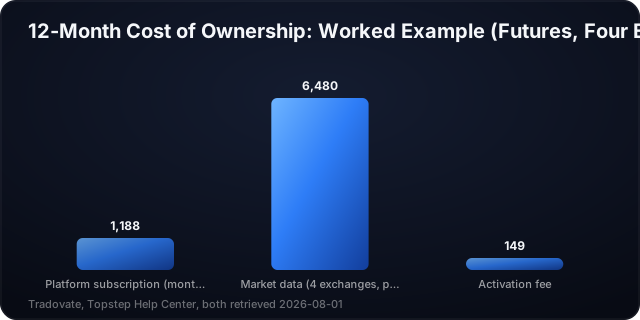
Take Tradovate's Monthly plan at $99 per month, which is $1,188 across twelve months (Tradovate, retrieved 2026-08-01). Add Kinetick's CME Globex non-professional Level II data for all four exchanges at $13.65 per month each, plus the $24.15 per month Market Depth charge required for all Level II data, which is $78.75 per month or $945 across twelve months (Kinetick, retrieved 2026-08-01). Add one Topstep Express Funded Account activated on the Standard Path at $149 once (Topstep Help Center, retrieved 2026-08-01). Platform plus data plus activation: $1,188 + $945 + $149 = $2,282 for the year, before a single challenge fee, reset or payout cost is added.
Now change one input. Four exchanges at Topstep's Live Funded professional rate is $540 per month, $6,480 for the year. One classification change, thousands of dollars of difference in a single line. That is why the classification question belongs before the vendor-choice question.
What to re-check every quarter
Fee schedules move. Every figure in this article is dated 1 August 2026 and comes from a page the vendor can edit tomorrow. So build the habit rather than trusting the snapshot.
Once a quarter, re-open the three pages that matter: your platform's pricing page, your platform's account-fees or exchange-fees page, and your firm's help article on costs. Put the date you checked at the top of your worksheet. If a number changed, change it and recompute the annual total. If your regulatory or employment status changed, re-confirm your market-data classification in writing before the next billing cycle rather than after it.
A trader who does that four times a year is never surprised by a statement. That is the entire point.
Ready to get funded?
50% off instant accounts with code 50CRYPTO.
Get Funded →Frequently Asked Questions
What is the biggest hidden cost in prop trading?
For futures-style accounts, market-data classification is the biggest swing factor: Kinetick lists non-professional Level I data at $2.10 per month per exchange while Topstep's Live Funded Account bills professional data at $133 per exchange per month (Kinetick and Topstep Help Center, both retrieved 2026-08-01).
Do prop firms charge monthly fees after you pass?
Some do, in the sense that costs bundled during evaluation become the trader's responsibility once the account goes live. Topstep states that in the Live Funded Account the trader is responsible for their own platform license cost (Topstep Help Center, retrieved 2026-08-01) and pays professional data at $133 per exchange per month (Topstep Help Center, retrieved 2026-08-01). Others bundle everything into the up-front fee.
Is there a prop firm model without monthly data and platform fees?
Yes. Bundled models, common on the forex and CFD side, trade itemisation for a single up-front number instead of separate exchange-data and platform-vendor bills.
What is an activation fee?
A one-time charge some firms apply to switch on a funded account after you pass an evaluation. Topstep, for example, charges $149 once per Express Funded Account on its Standard Path and $0 on its No Activation Fee Path (Topstep Help Center, retrieved 2026-08-01); the amount varies by firm, so read your own firm's fee page rather than a figure restated elsewhere.
Can a free platform plan really cost money?
Yes. Tradovate's Free plan carries its highest per-side commissions, at $1.29 per side on standard contracts against $0.59 on the Lifetime plan (Tradovate, retrieved 2026-08-01), and NinjaTrader's Free plan adds a $35 fee for any 30-day stretch where you log in but place no trades (NinjaTrader, retrieved 2026-08-01), so "free" only refers to the subscription line, not the total cost.
How do I confirm my market-data classification?
Ask your firm and your platform provider in writing, before you subscribe, and keep the reply. Classification is set by exchange rules and applied by your data provider, and it can change if your employment or registration status changes.
Ready to get funded?
Instant accounts, simulated capital, rules published before you pay. 50% off with code 50CRYPTO.
Get Funded →