 ITA
ITAProp Firm Banned Trading Strategies: What Ends an Account
Which trading strategies get a funded prop account terminated -- and why. Grid, cross-account hedging, HFT, latency arbitrage and gap trading, from firms' own rules.

How this article is verified: Every number and claim above is checked against a primary source, ITAfx's own Terms of Service, official product pages, or the trading platform itself, before publication, then re-verified again immediately before this page goes live. Fact-checked and published on July 31, 2026 by Adrian Caldwell.
The short answer: four behaviour classes, not a list of strategy names
Firms do not really ban strategy names. They ban patterns they can detect and cannot hedge. Every clause across the three rulebooks quoted below falls into one of four classes. The chart below maps all four classes side by side before the detail sections break each one down.
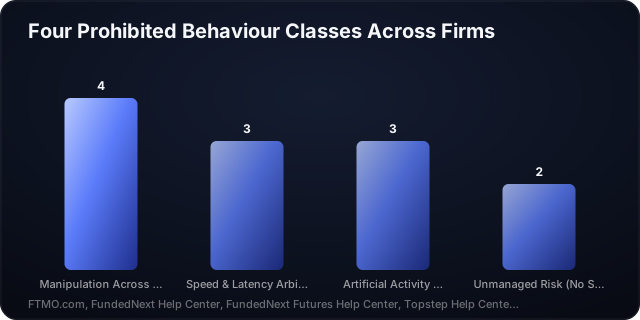
Manipulation across accounts
Holding opposite positions in two accounts you control, or coordinating with another trader so the pair of you is flat while one side collects. FTMO prohibits combinations of trades for manipulative purposes across connected accounts or other members of its Program Group, for example simultaneously entering opposite positions, with the sole exception of doing so on a single simulated account (FTMO.com, retrieved 2026-07-31).
Exploiting speed and stale prices
Latency arbitrage, ultra-high-speed tooling, and anything that profits from a price the feed has not caught up to yet. FTMO forbids trading strategies that exploit errors in its services such as price-display errors, delays in price updates, or an external or slow data feed (FTMO.com, retrieved 2026-07-31).
Manufacturing artificial market activity
Grid, wash trading, and reckless entries into gaps or thin books. FundedNext prohibits grid trading because it can lead to market manipulation and create artificial activity (FundedNext Help Center, retrieved 2026-07-31).
One-sided risk the firm cannot hedge
Not a strategy label at all, but a risk-violation framework: no stop-loss, oversized single-trade exposure, stacked open risk. This is the class most traders trip without knowing a rule existed. If you want the mechanics of that exposure spelled out separately from strategy labels, how prop firm drawdown limits actually work covers the same risk math from the drawdown side.
Everything else in this article is detail on those four.
Why firms ban strategies at all (and why it is not about your edge)
The firm's exposure is real even when the account is simulated
Your fills are simulated. The firm's decision to hedge, or not hedge, your flow in the real market is not. That asymmetry explains the whole rulebook. Topstep says it plainly, prohibiting trading inconsistent with real futures markets, or trading in a way that creates financial risk for Topstep (Topstep Help Center, retrieved 2026-07-31).
Read that clause twice. It is not "we ban grid." It is "we ban results that could not have happened in the real market you are supposedly trading." A profit that only exists because the simulator filled you where a real book would not is, from the firm's side, a loss with no offset. If the distinction between the simulated environment and a live account is unclear to begin with, demo versus funded account mechanics is the place to start.
"Trading according to a real market" as the underlying test
FTMO's version of the same test is framed as unfair advantage: it forbids using any software, artificial intelligence, ultra-high-speed tools, or mass data entry that might manipulate, abuse, or give you an unfair advantage (FTMO.com, retrieved 2026-07-31). Topstep's parallel clause bans unfair technology, using software, AI, ultra-high-speed systems, or mass data entry to gain an unfair advantage (Topstep Help Center, retrieved 2026-07-31).
The wording is nearly identical across two unrelated firms, which tells you it is a category, not a house preference. Once you have that test, you can predict unlisted cases: if your profit depends on the simulation behaving differently from a real venue, assume it is prohibited even if nobody named your technique.
Why a ban is not a judgement on whether the strategy works
A prohibition says nothing about whether a strategy is profitable. Latency arbitrage works extremely well, which is exactly why FundedNext calls it out: it defines latency trading as executing trades based on delayed market data or exploiting delays in trade execution to secure an edge from delayed quotes, and prohibits it as a violation of fair trading practices (FundedNext Help Center, retrieved 2026-07-31). The ban is about who carries the other side, not about your skill. If you are new to how the wider rule set fits together, start with what a prop firm challenge actually evaluates before you read another prohibited-strategy page.
Cross-account and opposite-position hedging: the most misunderstood ban
What it looks like: long EUR/USD on account A, short on account B
You have two evaluation accounts. You go long EUR/USD on one and short EUR/USD on the other, sized the same. Whatever the market does, one account passes and one blows up. Traders describe this to themselves as hedging, or as "protecting the fee." Firms describe it as the single clearest manipulation signature they can query for.
FundedNext defines group hedging across multiple accounts as opening multiple accounts and placing opposite-direction trades on the same asset, and states this is not considered a legitimate trading practice and is prohibited because it does not reflect proper trading methodology (FundedNext Help Center, retrieved 2026-07-31). Its futures documentation gives the same pattern a different name: reverse hedging, a manipulative strategy where a trader opens opposite positions in different accounts to artificially hedge risk (FundedNext Futures Help Center, retrieved 2026-07-31). Topstep bans it as cross-account hedging (single-user), holding opposite positions across multiple accounts simultaneously (Topstep Help Center, retrieved 2026-07-31).
Three firms, three vocabularies, one prohibited behaviour. If you were waiting for the word "hedging" to appear next to the word "banned" in a document you had read, that is why you missed it.
Coordinated trading with other people counts too
Doing it with a friend does not launder it. Topstep prohibits coordinated trading, performing trades in concert with others, including unconnected accounts or third parties, to pool risk, hedge aggregate positions, or trade the same or opposite strategy simultaneously (Topstep Help Center, retrieved 2026-07-31). FTMO's clause reaches the same distance, covering trades performed alone or in concert with other persons, including between connected accounts, accounts held with various operators or providers, or accounts held with other members of its Program Group (FTMO.com, retrieved 2026-07-31).
Note what "various operators or providers" means: the clause is not limited to accounts inside that one firm.
The single-account exception, and why it exists
There is one carve-out, and it is narrow. FTMO's prohibition on simultaneously entering opposite positions carries an explicit exception for entering into such positions on a single simulated account (FTMO.com, retrieved 2026-07-31).
The logic is mechanical. Inside one account, a long and a short in the same instrument nets out in the same equity curve and the same drawdown calculation, so there is nothing to arbitrage. Split across two accounts, the loser's drawdown is capped by the account rules while the winner's profit is not, and the firm has effectively written you a free option. That is the whole ban in one sentence.
Speed and latency: HFT, latency arbitrage, and sim-fill scalping
What counts as high-frequency in a firm's own words
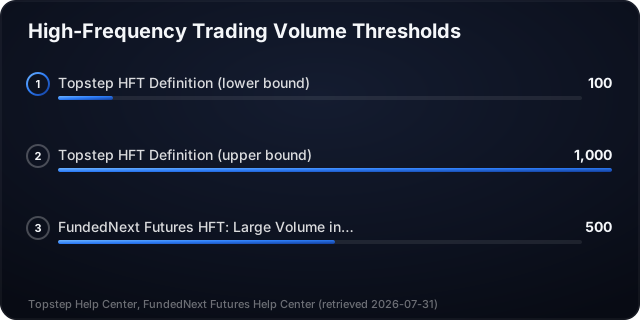
"High frequency" sounds like a term for somebody else's problem until you see the numbers firms attach to it. Topstep characterises the prohibited pattern as usually hundreds or thousands of trades per day, with average durations measured in seconds, not minutes (Topstep Help Center, retrieved 2026-07-31). FundedNext Futures does not allow high-frequency trading, defining it as using powerful algorithms and ultra-fast network connections to execute a large number of trades within a few seconds, and states that engaging in HFT on a futures account may result in account termination (FundedNext Futures Help Center, retrieved 2026-07-31).
Both definitions bundle volume with infrastructure. Neither describes a human clicking a mouse. The chart below lines up the volume and duration thresholds each firm publishes.
Latency and reverse arbitrage: profiting from a stale feed
This is the class with the least ambiguity anywhere in prop-firm documentation. FundedNext prohibits latency trading as executing trades on delayed market data or exploiting execution delays to secure outsized profits with little market risk (FundedNext Help Center, retrieved 2026-07-31). It separately prohibits any form of arbitrage trading, defined as exploiting price discrepancies or time lags across different markets or platforms to generate profits the firm's own page describes as carrying no market risk (FundedNext Help Center, retrieved 2026-07-31). FundedNext Futures describes latency arbitrage as a high-risk strategy that exploits price delays between platforms, relying on speed advantages rather than market analysis (FundedNext Futures Help Center, retrieved 2026-07-31). FTMO's version forbids strategies that exploit price-display errors, delays in price updates, or an external or slow data feed, and says the prohibition applies whether you did it knowingly or unknowingly (FTMO.com, retrieved 2026-07-31).
"Or unknowingly" is the phrase to sit with. Intent is not the test. If you bought a tool from a vendor and the tool works by front-running a feed, the clause still catches you.
Scalping the simulator: unrealistic fills and queue position
Here is the part that surprises futures traders. Topstep prohibits running scalping algorithms designed to exploit unrealistic SIM fills, and making hundreds of rapid trades to take advantage of preferential queue position in the simulator (Topstep Help Center, retrieved 2026-07-31). It also prohibits repeatedly exploiting the relative lack of slippage in the simulator to achieve impossible stop-loss execution (Topstep Help Center, retrieved 2026-07-31).
Queue position means where your order sits in the line of orders waiting at a price level. A simulator often puts you at the front, because there is no real queue to join. A strategy whose edge is entirely that front-of-queue gift is a strategy that stops working the moment anyone hedges it in the real market. Same story for stops: if your backtest survives only because the simulator filled your stop at the exact price with no slippage, the edge is the simulator's, not yours.
Where a fast manual scalper actually sits
Read the clauses again and notice what they require: algorithms, ultra-fast network connections, hundreds or thousands of trades a day, durations in seconds (Topstep Help Center, retrieved 2026-07-31; FundedNext Futures Help Center, retrieved 2026-07-31). A discretionary trader taking twelve intraday trades with a two-minute average hold is not described by any of that. Scalping as a style is not what these pages prohibit. Industrial-scale execution that only pays inside a simulator is.
If you are close to the line, the safe move is not to guess where the line is. It is to get the firm's answer in writing, which is the last section of this article.
Artificial activity: grid, wash trading, and gap or illiquid entries
Grid: why stacked orders read as manipulation
Grid trading places a ladder of buy and sell orders at intervals around price, with no directional call. FundedNext defines it as placing multiple buy and sell orders at different price levels above and below the current market price, and prohibits it because it can lead to market manipulation and create artificial activity (FundedNext Help Center, retrieved 2026-07-31). Its own example is a ladder of buy orders at $100, $105 and $110 against sell orders at $115, $120 and $125, profitable while price oscillates and heavily loss-making on a sharp break below the bottom rung (FundedNext Help Center, retrieved 2026-07-31).
Worth noting where that clause is published: it sits on FundedNext's FX help-centre page on restricted and prohibited strategies. A firm running separate FX and futures products can document the same prohibition in one place and not the other, so do not assume a rule is absent from a product because you only found the sentence in the other product's article. Check the page for the product you are actually buying.
Gap and low-liquidity trades, and the stray-fill problem
Trading a weekend gap or a thin session feels like ordinary opportunism. Two of the three rulebooks name it explicitly. FTMO forbids gap trading, describing it as a high-risk practice that carries potentially unfavourable outcomes if performed in real market conditions due to increased volatility (FTMO.com, retrieved 2026-07-31). Topstep prohibits initiating reckless trades in gapped markets to profit from stray fills, and adds that such fills are improbable in live markets (Topstep Help Center, retrieved 2026-07-31).
A stray fill is a fill the simulator grants inside a gap where no real liquidity traded. It is free money in the simulation and an unhedgeable liability outside it. If your calendar habit is to sit in front of scheduled releases, read what not to do around NFP and other high-impact releases with both clauses in mind. The same weekend-gap exposure also intersects with prop firm weekend holding rules, which govern whether you can even carry a position into the gap in the first place.
Martingale and "gambling": the ban that is not universal
Why "banned everywhere" is the wrong model
The single most repeated claim in this niche is that martingale is banned everywhere. The four verified prohibition lists in this article do not support that shape of statement: none of the clauses quoted above names martingale at all. What they name is cross-account manipulation, speed exploitation, artificial activity and simulator abuse. Whether a given firm restricts position-doubling is a question for that firm's own current page and its support desk in writing, not for a list you found aggregated elsewhere.
What the published clauses actually target: exposure, not labels
So what is the "gambling" enforcement everyone talks about? Read FTMO's catch-all again: it forbids simulated trades that contradict how trading is actually performed in the financial markets, or that the firm reasonably considers might cause it financial, reputational or other harm, and gives overleveraging, overexposure, one-sided bets and account rolling as its examples (FTMO.com, retrieved 2026-07-31). Topstep's parallel catch-all reaches any conduct it determines, at its sole discretion, is uncommercial, games the market, is not a viable strategy, or is not responsible trading (Topstep Help Center, retrieved 2026-07-31).
Notice that neither of those triggers mentions a strategy name. They describe your exposure and your conduct at a moment in time. A doubling sequence can breach them; so can one oversized discretionary trade on a Tuesday. Risk to reward ratio setups built for prop firm rules is the part of this you actually control.
How this differs from a hard strategy prohibition
A hard prohibition is binary: do the thing, face the stated consequence. A risk-violation framework is continuous, and the same strategy passes or fails depending on how you size it and whether the stop was there. That distinction is the practical answer to "can I be banned for my strategy": under a catch-all like FTMO's or Topstep's, the strategy label is not the object of the rule at all. Your exposure and your conduct are.
What each firm says happens to you: the one comparison table
Consequences from warning to termination
| Firm | Where the rule is published (host) | Representative prohibited pattern | Stated consequence range (firm's own wording) |
|---|---|---|---|
| FTMO | ftmo.com | Simultaneous opposite positions across connected accounts (FTMO.com, retrieved 2026-07-31) | Listed under Forbidden Trading Practices as conduct that conflicts with and violates FTMO trading rules; the page states these practices are described in detail in its linked policy (FTMO.com, retrieved 2026-07-31) |
| FundedNext (FX) | help.fundednext.com | Group hedging across multiple accounts, opposite-direction trades on the same asset (FundedNext Help Center, retrieved 2026-07-31) | Prohibited as not a legitimate trading practice; on the same page, for settlement-window exploitation, the firm reserves the right to review the account, void relevant trades, or terminate the account (FundedNext Help Center, retrieved 2026-07-31) |
| FundedNext Futures | helpfutures.fundednext.com | Reverse hedging, latency arbitrage, hedging with correlated instruments, high-frequency trading (FundedNext Futures Help Center, retrieved 2026-07-31) | For HFT specifically, engaging in it on a futures account may result in account termination (FundedNext Futures Help Center, retrieved 2026-07-31) |
| Topstep | help.topstep.com | Cross-account hedging (single-user), coordinated trading, unfair technology (Topstep Help Center, retrieved 2026-07-31) | Exploiting the simulator will get you removed from the program, and Topstep retains the right to reject profit claims if abuse is suspected (Topstep Help Center, retrieved 2026-07-31) |
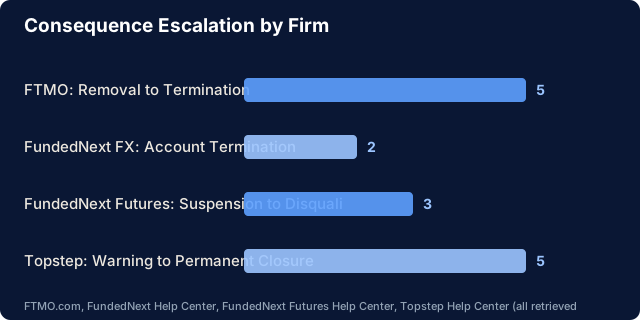
The chart below shows how each firm's stated consequences escalate from a first warning to full termination.
Where the same prohibited pattern gets a different name
The behaviour classes repeat across firms even when the label does not. This table lines up the same underlying pattern against the vocabulary each firm actually publishes for it.
| Behaviour class | FTMO's term | FundedNext's term | Topstep's term |
|---|---|---|---|
| Cross-account opposite positions | Manipulative combinations of trades / simultaneously entering opposite positions (FTMO.com, retrieved 2026-07-31) | Group hedging / reverse hedging (FundedNext Help Center; FundedNext Futures Help Center, retrieved 2026-07-31) | Cross-account hedging (single-user) (Topstep Help Center, retrieved 2026-07-31) |
| Coordinating with other traders | Alone or in concert with other persons, including other Program Group members (FTMO.com, retrieved 2026-07-31) | Not separately named in the cited pages | Coordinated trading (Topstep Help Center, retrieved 2026-07-31) |
| Exploiting delayed prices | Exploiting price-display errors or a slow data feed (FTMO.com, retrieved 2026-07-31) | Latency trading / arbitrage trading (FundedNext Help Center, retrieved 2026-07-31) | Not separately named in the cited pages |
| Stacked ladder orders, no directional view | Not separately named in the cited pages | Grid trading (FundedNext Help Center, retrieved 2026-07-31) | Not separately named in the cited pages |
Reading a consequence clause before you fund
Two things in that table deserve more attention than the strategy names.
First, the published consequence language is not uniform in specificity. Topstep tells you the outcome in plain terms, that exploiting the simulator will get you removed from the program (Topstep Help Center, retrieved 2026-07-31). FundedNext Futures spells termination out only for HFT, saying engaging in it on a futures account may result in account termination (FundedNext Futures Help Center, retrieved 2026-07-31). FTMO's page lists the practices as violations of its trading rules and points to a separate detailed policy for the mechanics (FTMO.com, retrieved 2026-07-31). Same category of conduct, very different amounts of detail about the downside.
Second, the money and the account are separate questions. Topstep states it retains the right to reject profit claims if abuse is suspected, which is a hit to the payout rather than to access (Topstep Help Center, retrieved 2026-07-31). FundedNext reserves the right to void relevant trades as well as terminate the account in its settlement-window clause (FundedNext Help Center, retrieved 2026-07-31). A trader who assumes the worst case is "I lose the account" has not read the clause. In these documents the profit claim can go too. If a rulebook does not fit how you trade, the honest move is to compare how firms structure the wider offer, starting with how to choose the right prop firm for forex trading, before paying a fee, not after a review.
How to audit your own strategy before you pay a fee
Five questions that map to the four classes
Answer these with your actual trade log open, not from memory.
- Do I ever hold opposite positions in the same instrument across two accounts I control, or coordinate entries with another trader? Both are named prohibitions at Topstep and FundedNext (Topstep Help Center, retrieved 2026-07-31; FundedNext Help Center, retrieved 2026-07-31).
- Would my results survive real slippage and a real queue, or does the edge come from fills the simulator granted? Topstep prohibits repeatedly exploiting the simulator's relative lack of slippage (Topstep Help Center, retrieved 2026-07-31).
- Does any part of my process depend on price arriving late, on one platform versus another? That is the definition FundedNext uses for prohibited latency trading and for any form of arbitrage trading (FundedNext Help Center, retrieved 2026-07-31).
- Do I place ladders of orders on both sides without a directional view? That is grid trading, prohibited by name (FundedNext Help Center, retrieved 2026-07-31).
- Has any trade in the last month carried outsized single or stacked open risk? FTMO's catch-all names overleveraging, overexposure and one-sided bets as examples of trades that contradict how real markets work (FTMO.com, retrieved 2026-07-31).
Four "no" answers and a clean fifth do not make you immune, but they clear the four classes as published.
Where the rules live and what to screenshot
Every clause quoted in this article comes from a page you can open yourself: FTMO's Forbidden Trading Practices page, FundedNext's help-centre article on restricted and prohibited trading strategies, FundedNext Futures' prohibited-strategies and HFT articles, and Topstep's Prohibited Conduct and Prohibited Trading Strategies articles. Before you pay, screenshot the prohibited-strategy page and the consequence clause with the date visible. Help-centre articles get edited without a changelog. A dated screenshot is the only version of the rules you can prove you agreed to.
When to ask support in writing instead of guessing
If your strategy sits near a line, for example a fast manual scalp that averages forty trades a day, do not calibrate against a forum. Describe the strategy to support in a ticket, in writing, and keep the reply. A written answer is not a guarantee, but it converts your assumption into the firm's stated position, and it is the only artefact that survives a review. Rules that do not touch strategy at all still end plenty of accounts, from moving a stop after entry to oversizing a single trade out of frustration, patterns closer to trading psychology mistakes that end funded accounts than to anything on a prohibited-strategy page.
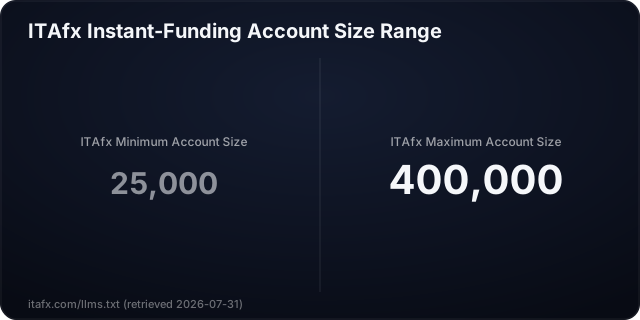
On the ITAfx side, one relevant fact and one honest gap. ITAfx runs an instant-funding model with no evaluation time limit, on simulated account sizes from $50K to $400K, on the third-party platform platform, with payouts typically within 24 hours (itafx.com/llms.txt, retrieved 2026-07-31). The gap: strategy-specific restrictions are not something this article will assert for ITAfx from an internal note. Ask support in writing, exactly as recommended above, and keep the answer. For how the payout side works once an account is in good standing, see the funded account profit withdrawal process.
Ready to get funded?
50% off instant accounts with code 50CRYPTO.
Get Funded →Frequently Asked Questions
Can a manual discretionary trader be banned for their strategy?
Yes, though usually not for being manual. Cross-account hedging and gap trading need no algorithm. FTMO forbids gap trading as a high-risk practice with potentially unfavourable outcomes in real market conditions due to increased volatility, with no exemption for discretionary execution (FTMO.com, retrieved 2026-07-31).
Is hedging between my own two accounts really prohibited?
Yes, at the firms quoted here. Topstep names cross-account hedging (single-user), holding opposite positions across multiple accounts simultaneously, as prohibited conduct (Topstep Help Center, retrieved 2026-07-31). FundedNext says opposite-direction trades on the same asset across multiple accounts can result in account termination (FundedNext Help Center, retrieved 2026-07-31).
Is martingale banned at every prop firm?
No. FundedNext states it does not impose any limitations or restrictions on a trader's strategy, whether discretionary or EAs employing martingale, subject to keeping the same approach across phases (FundedNext Help Center, retrieved 2026-07-31). What gets enforced instead is its risk-violation framework: missing stop-loss, oversized single-trade risk, excess combined open risk (FundedNext Help Center, retrieved 2026-07-31).
Is scalping banned?
Not as a style. What Topstep prohibits is scalping algorithms designed to exploit unrealistic simulator fills and hundreds of rapid trades taking advantage of preferential queue position (Topstep Help Center, retrieved 2026-07-31). Its high-frequency characterisation is hundreds or thousands of trades per day with durations in seconds (Topstep Help Center, retrieved 2026-07-31).
Do banned-strategy rules apply during the evaluation or only when funded?
Both. FTMO's stated consequences include disqualification from the Evaluation Process as well as forfeiture of any potential Rewards and termination of all agreements, which spans evaluation and funded stages (FTMO.com, retrieved 2026-07-31). FundedNext Futures states prohibited strategies result in suspension and disqualification from further participation (FundedNext Futures Help Center, retrieved 2026-07-31).
Do you forfeit profits, or just the account?
Published clauses cover both. FTMO lists forfeiture of any potential Rewards alongside account and agreement termination (FTMO.com, retrieved 2026-07-31). Topstep lists delay or denial of a payout request as a separate consequence from permanent account closure (Topstep Help Center, retrieved 2026-07-31). Which automation tools are permitted, and multi-account copy logistics, are separate rule sets not covered here.
Ready to get funded?
Instant accounts, simulated capital, rules published before you pay. 50% off with code 50CRYPTO.
Get Funded →