 ITA
ITAThe Overconfidence Effect: Why Funded Traders Lose Their Accounts (And the Fix)
Discover how overconfidence systematically destroys funded accounts. Learn the psychological traps that lead to blown challenges and implement protocols.
Short answer
Discover how overconfidence systematically destroys funded accounts. Learn the psychological traps that lead to blown challenges and implement protocols. In a prop firm context this still sits under simulated-capital rules: fees buy access to the evaluation or funded environment, not a deposit of trading capital.
Simulated capital: prop firm evaluation and funded stages discussed here typically run on simulated accounts. Challenge fees pay for access to that environment; they are not a deposit of trading capital. ITAfx accounts are simulated capital.

What Is the Overconfidence Effect in Trading?
The overconfidence effect in funded account management risks occurs when traders systematically overestimate their ability to predict market movements and generate profits, typically following a series of winning trades. This psychological phenomenon causes traders to increase position sizes, ignore risk management protocols, and attribute losses to external factors rather than flawed analysis, leading to account destruction despite initial success.
This isn't about discipline. Not emotions. Not following your plan. It's about a cognitive bias so fundamental to human psychology that even knowing about it doesn't protect you. The overconfidence effect, and it's destroying more funded accounts than any other single factor.
Here's what makes this particularly dangerous for funded traders: the very trait that helps you pass challenges (confidence in your edge) becomes the mechanism of your destruction once you're funded. According to Barber and Odean's landmark study (2000), higher overconfidence was significantly associated with more frequent trading and riskier portfolios, leading to lower risk-adjusted returns. For funded traders operating under strict drawdown limits, this isn't just about reduced returns, it's about account termination.
The overconfidence effect manifests in three distinct ways, each deadly in the funded account context:
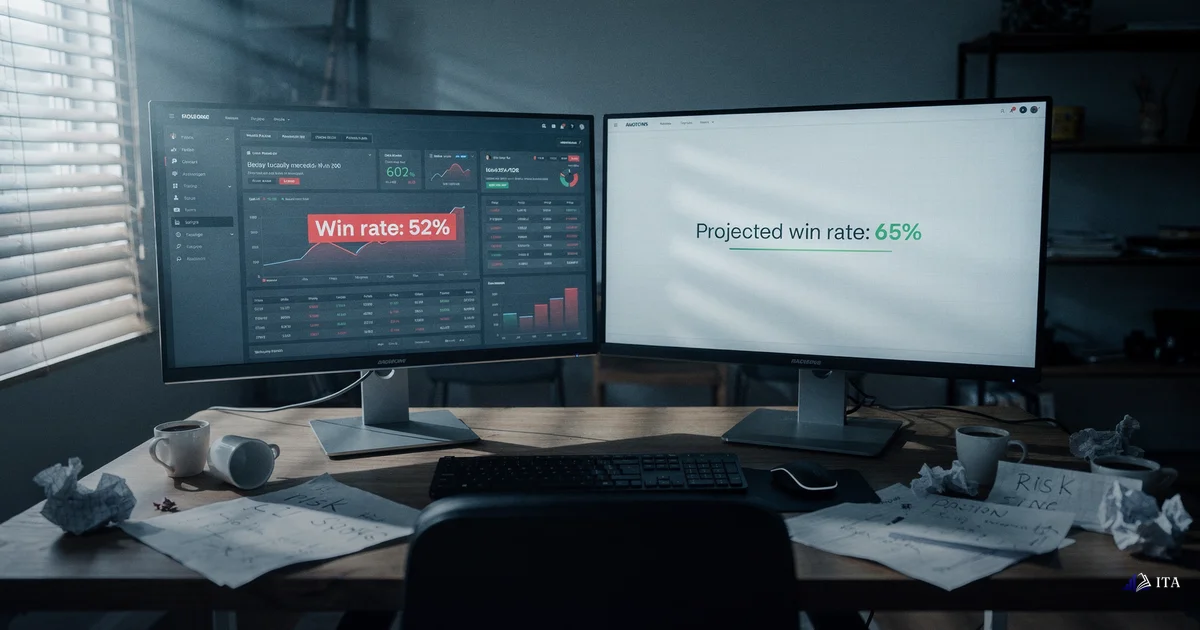
- Overestimation is believing your win rate is higher than it actually is. You think you're hitting 65% winners when your journal shows 52%.
- Overprecision is being too certain about your market read. That EUR/USD setup isn't "definitely going to 1.1200", but overconfidence makes you position as if it is.
- Overplacement is believing you're better than other traders. "Most funded traders fail, but I'm different." The data suggests otherwise.
The Science Behind Overconfident Trading Behavior
Overconfident trading behaviour stems from attribution bias, where the brain credits wins to skill whilst dismissing losses as market anomalies or external interference. When traders win, dopamine reinforces the belief that their analysis was superior. When they lose? Cognitive dissonance protects their self-image by attributing failure to unpredictable events. This creates a dangerous feedback loop that inflates confidence beyond actual competence.
Here's where the funded account structure amplifies the danger. You're not trading your own funds, it's the firm's simulated capital. This creates what behavioural economists call the "house money effect." You take risks you'd never take with your own resources. Add in aggressive profit targets and the pressure to generate returns, and overconfidence doesn't just grow, it metastasises.
The science reveals why this is so universal. Research consistently shows that overconfidence is one of the most robust predictors of excessive trading Research by Barber and Odean (2000) shows the most active traders under-perform the market by approximately 6.5 percentage points per year.
They're not losing because they lack skill. They're losing because overconfidence drives them to trade far more than their edge justifies.
For funded traders, the cascade typically follows this pattern:
- You start with proper 1% risk per trade
- A winning streak hits, three, four, five winners in a row
- Your confidence soars. "I'm really reading this market well."
- The next trade, you risk 1.5%. Still within "reasonable" bounds, you tell yourself
- Another winner. Now 2%. Then 2.5%.
You're not consciously abandoning your risk management, overconfidence is simply recalibrating your perception of what's "appropriate" risk.

Real Trading Scenarios: How Overconfidence Destroys Funded Accounts
Overconfidence destroys funded accounts through a predictable escalation pattern: traders increase position sizes after initial wins, then maintain or double down on elevated risk when losses occur. A trader who passes evaluation with 1% risk per trade often scales to 3-4% after early profits. This means just two consecutive losses at this size can breach the 5-8% daily drawdown limits that terminate most prop firm accounts.
The most insidious part? This happens to experienced traders. Beginners might blow accounts through ignorance, but overconfidence specifically targets those with enough success to feel confident. You need wins to become overconfident. You need to have an edge before you can overestimate it.
This is why funded traders who've proven themselves through challenges are paradoxically vulnerable. Passing the challenge provides the confidence that later destroys the funded account.
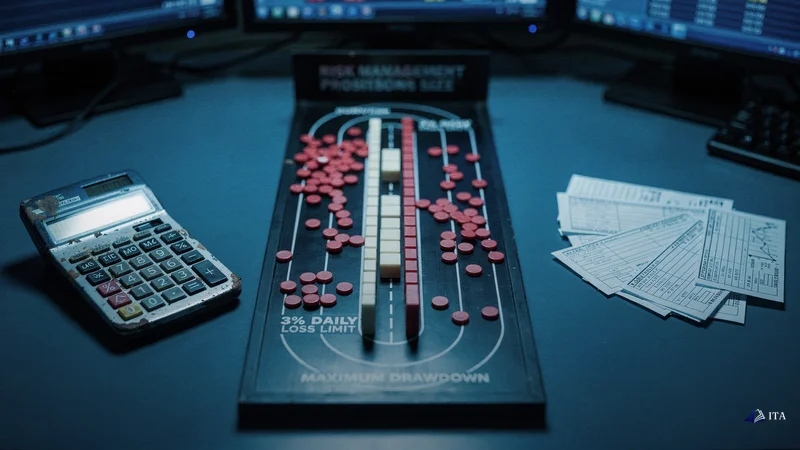
Prop firm rules make this worse, not better. A 3% daily loss limit and 6% maximum drawdown sound protective, but they create a narrow corridor for error. In a normal account, overconfidence might mean a bad month. In a funded account, it means termination. The rules that protect the funded account become the walls that overconfidence drives you into.
The warning signs are subtle because they feel like success:
- Trading more frequently because you're "seeing the market well"
- Holding losers longer because you're "confident in your analysis"
- Adding to positions because the market is "definitely going your way"
Each behaviour feels justified in the moment. Your recent results seem to validate your confidence. But research by Odean (1998) shows overconfident traders are approximately 50% more likely to sell winners than losers. They're quick to book profits (proving they were "right") but slow to accept losses (which would challenge their confidence).
A Protocol for Calibrating Confidence to Reality
Calibrating confidence to reality requires mechanical protocols that measure actual performance against perceived skill before emotional bias can distort trading decisions. These systems use quantitative assessments of win rates, risk-adjusted returns, and drawdown patterns to create objective feedback loops. They prevent confidence from exceeding demonstrated competence, replacing subjective feelings with statistical evidence.
The daily confidence calibration routine takes five minutes but changes how you approach risk. Before the session starts, you answer three questions with specific numbers:
- What's my actual win rate over the last 20 trades?
- What's my average winner versus average loser?
- What's my maximum drawdown over the last 50 trades?
Not what you think these numbers are, the actual figures from your trading journal. This creates a reality anchor. When overconfidence whispers "you're hot right now," the numbers show your actual 55% win rate. When it suggests increasing size, your 1:1.2 reward-to-risk ratio says otherwise.
The numbers don't lie, even when your confidence does.
The pre-trade confidence check is even more direct. Before entering any position, you rate your confidence in this specific trade from 1-10. But here's the key: you also document why. "8/10 confident because price is at major support" is specific and verifiable. "9/10 confident because I'm reading this pair well lately" is overconfidence speaking.
Over time, you'll discover your confidence ratings above 7 show no better results than those at 5-6. But they correlate with larger position sizes and bigger losses.

From Overconfident to Systematically Disciplined Trader
Systematic discipline replaces overconfidence through reverse position sizing protocols that calculate risk from maximum acceptable loss rather than setup confidence. For funded accounts, this means determining position size mathematically. If your daily limit is 3% and you're already down 1%, your maximum risk on the next trade is 2% regardless of how "perfect" the setup appears. This removes discretionary decisions that overconfidence typically hijacks.
Historical performance reality checks combat the attribution bias. Every week, review your last 20 trades with brutal honesty:
- For each winner, identify what was actually skill versus what was favourable market movement
- For each loser, identify what was genuinely unforeseeable versus what your analysis missed
Most traders discover their wins involved more luck and their losses involved more analytical errors than they believed. This isn't pessimism, it's calibration.
The case for systematic approaches is compelling. Overconfident investors tend to be more likely to hold under-diversified portfolios. For funded traders, this translates to concentration in specific pairs or setups they feel they've "mastered."
The calibration protocol forces diversification. No more than 30% of daily risk in any single currency pair, regardless of confidence. When EUR/USD feels like "your pair," that's precisely when you need the protocol most.
The change from overconfident to systematically disciplined isn't about reducing confidence. It's about aligning it with reality. You still trust your edge, but you verify it constantly. You still take decisive action, but based on protocols, not feelings. The confidence becomes quiet and grounded rather than loud and fragile.
Conclusion: Manage Your Psychology, Protect Your Account
Your funded account doesn't care about your confidence. It cares about your drawdown. The market doesn't respect your conviction. It respects your risk management. The protocols transform confidence from a liability into an asset, controlled, measured, and aligned with reality.
The next time you feel that surge of certainty after a winning streak, remember: that feeling isn't your edge speaking. It's the overconfidence effect preparing to destroy your account. The difference between keeping your funding and losing it lies not in eliminating that feeling, but in having systems that prevent it from controlling your position size.
Manage your psychology, protect your funded account. But more importantly, build protocols that protect your funded account from your psychology. Because in funded trading, the greatest risk isn't the market, it's the trader who just had five winners in a row.
Ready to get funded?
50% off instant accounts with code 50CRYPTO.
Get Funded →Frequently Asked Questions
How does the overconfidence effect cause funded traders to blow their accounts?
The overconfidence effect drives funded traders to increase position sizes after winning streaks, often scaling from 1% risk per trade to 3-4% risk. Just two consecutive losses at elevated size can breach daily drawdown limits (typically 5-8%), resulting in immediate account termination and loss of funding.
What are the most common overconfidence traps in prop firm challenges?
Common traps include oversizing after initial wins, holding losing positions longer due to analytical certainty, and concentrating risk in familiar currency pairs. Traders often mistake recent success for permanent edge, leading to aggressive risk-taking that violates firm rules and terminates accounts.
How much risk per trade is appropriate for a funded account to avoid breaching drawdown limits?
Most prop firms recommend 0.5-1% risk per trade for funded accounts, significantly lower than the 1-2% used during challenges. With typical daily limits of 3-5%, this conservative approach prevents single trades from causing rule violations whilst maintaining profit potential over time.
How can traders objectively measure whether they are overconfident about their edge?
Track actual win rates, average winner-to-loser ratios, and maximum drawdown over the last 20-50 trades. Compare these metrics to your perceived performance. Traders often overestimate their win rates and underestimate their risk exposure.
What daily routines help funded traders keep their confidence calibrated to reality?
Implement a five-minute morning routine reviewing actual performance metrics from your trading journal. Before each trade, rate your confidence 1-10 and document specific reasons. Weekly reviews comparing predicted versus actual outcomes reveal the gap between perception and reality, preventing overconfidence escalation.
Key Takeaways
- Implement daily confidence calibration by documenting your actual win rate, average winner-to-loser ratio, and maximum drawdown before each session.
- Use reverse position sizing protocols that calculate risk from maximum acceptable loss rather than setup confidence levels.
- Rate trade confidence 1-10 before entry and document specific reasoning to identify when overconfidence exceeds actual edge.
- Limit daily risk to maximum 30% in any single currency pair regardless of confidence to prevent concentration bias.
- Conduct weekly reality checks reviewing last 20 trades to separate skill from luck in winners and analytical errors in losers.
- Maintain consistent 1-2% risk per trade during winning streaks when overconfidence typically drives position size escalation.
- Apply mechanical protocols that prevent confidence from controlling position size after the dangerous pattern of five consecutive winners.
Start Your Trading Evaluation
Simulated funded accounts up to $400K. Up to 95% profit split.
Get Funded