 ITA
ITAInstitutional FX vs Retail Forex: What Actually Differs
Institutional FX vs retail forex, explained with BIS 2025 turnover data: who trades, how orders reach the market, and where funded accounts sit.

How this article is verified: Every number and claim above is checked against a primary source, ITAfx's own Terms of Service, official product pages, or the trading platform itself, before publication, then re-verified again immediately before this page goes live. Fact-checked and published on August 1, 2026 by Adrian Caldwell.
Institutional FX vs Retail Forex: What Actually Differs
"Institutional FX" is not a strategy, an indicator, or a hidden order-block method: it is a counterparty category, defined by which participants a market survey counts as banks, funds, and corporates rather than individual traders. ITA provides simulated trading evaluation services; challenge fees pay for access to evaluation environments, not investments or deposits, and all trading in evaluation environments is conducted in simulated accounts. Past results do not guarantee future outcomes.
If you searched the term hoping to find the setup a bank desk uses, the honest answer is that the difference is structural, not tactical. That last point matters for the map you are about to read, because a funded evaluation account sits on the retail side of it, not the institutional side. This article defines each layer by its measured share of the market, shows how orders actually reach it, and states plainly what does and does not transfer down to an account your size. For a broader look at how the funded model itself works, see what is a prop firm and how does it work.
What "institutional FX" actually means
The three participant categories BIS actually counts
Every three years the Bank for International Settlements (BIS) surveys the world's largest FX dealers and publishes turnover broken into counterparty types. There are three that matter.
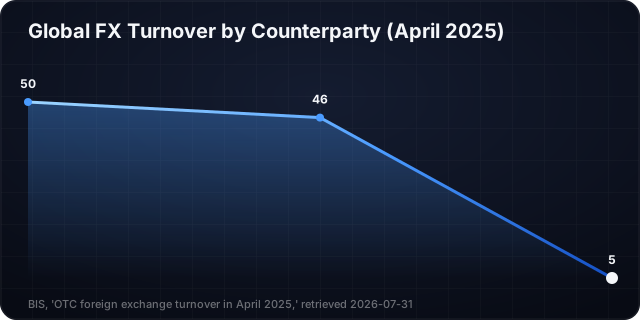
Reporting dealers are the large banks that make prices to everyone else. Inter-dealer trading averaged USD 4.4 trillion per day in April 2025, or 46% of total FX turnover (BIS, "OTC foreign exchange turnover in April 2025," retrieved 2026-07-31).
Other financial institutions (OFIs) is the bucket holding hedge funds, asset managers, pension funds, insurers, smaller banks that are not survey reporters, and the aggregators through which retail brokers pass flow. Dealers' trading with other financial institutions accounted for 50% of average daily FX turnover in April 2025 (BIS, "OTC foreign exchange turnover in April 2025," retrieved 2026-07-31).
Non-financial customers are the corporates: the exporter converting revenue, the importer hedging a supplier invoice. Trading with non-financial customers accounted for just 5% of global FX turnover in 2025, continuing a downward trend (BIS, "OTC foreign exchange turnover in April 2025," retrieved 2026-07-31).
Notice what is missing from those three categories: you. Individual traders are not a BIS counterparty class. Retail flow, when it reaches the interbank market at all, arrives bundled inside the OFI bucket through a broker or a liquidity aggregator.
Why "institutional" is a counterparty type, not a strategy or an indicator
A great deal of retail content sells "institutional order flow" as a chart-reading technique, sometimes dressed up as a VWAP institutional trading strategy. The BIS categories show why that framing collapses. Being institutional is a matter of who your counterparty is, what balance sheet stands behind your position, what execution channel you can access, and what flow information crosses your desk. None of those four things is something you can draw on a candlestick chart.
This is not a claim that institutional practice is useless to you. It is a claim about which parts of it are portable. The last section of this article separates those two piles.
The size gap, measured
USD 9.6 trillion per day, and where it sits
Global OTC foreign-exchange turnover averaged USD 9.6 trillion per day in April 2025, up 28% from the 2022 survey (BIS, "Global FX trading hits $9.6 trillion per day in April 2025," retrieved 2026-07-31). Here is how that splits by counterparty, using the BIS figures directly.
| Counterparty segment | Share of daily FX turnover, April 2025 | What it is |
|---|---|---|
| Dealers with other financial institutions | 50% (BIS, retrieved 2026-07-31) | Hedge funds, asset managers, non-reporting banks, aggregators |
| Inter-dealer (reporting dealer to reporting dealer) | 46%, about USD 4.4 trillion per day (BIS, retrieved 2026-07-31) | The large price-making banks trading with each other |
| Dealers with non-financial customers | 5% (BIS, retrieved 2026-07-31) | Corporates hedging commercial flows |
The two financial segments are the market. Real-economy currency demand, the thing FX nominally exists to serve, is a rounding error beside them.
Why non-financial customers are only 5% of it
Because a corporate treasurer trades when a business need arrives, and a financial institution trades whenever a price looks wrong. Commercial flow is bounded by trade volumes. Financial flow is bounded only by risk appetite and balance sheet, so it compounds through intermediation: a single customer order can be hedged, re-hedged, and warehoused across several dealers, each leg counted again in turnover.
For you, the practical consequence is direction of causality. You are not trading against a corporate hedger's clumsy conversion. You are trading inside a price set by financial counterparties whose whole business is pricing.
Execution: how an institutional order reaches the market vs how yours does
Inter-dealer channels and execution algorithms
An institutional order has choices your account does not. It can be worked through inter-dealer venues, split across multiple dealers, or handed to an execution algorithm that slices it over time to reduce market impact. In 2020 the BIS Markets Committee estimated that execution algorithms accounted for 10 to 20% of global FX spot trading, a figure cited in the BIS Quarterly Review (BIS Quarterly Review, "Dealer-customer and inter-dealer trading in a fragmented spot market," citing Markets Committee (2020), retrieved 2026-07-31).
That choice carries a cost that is rarely mentioned in retail content. The BIS Markets Committee found FX execution algorithms transfer execution risk from dealers to end users, changing how trades reach the market (BIS, "FX execution algorithms contribute to market functioning but bring new challenges," retrieved 2026-07-31). When a desk hands an order to an algorithm, it stops paying a dealer to guarantee a price and starts owning the outcome of the slicing itself. Institutional execution is not free of friction. It is friction the institution chose to take on deliberately.
Retail routing, slippage and the spread you actually pay
Your order has one path: to your broker, and then, depending on that broker's model, into an aggregator or onto its own book. You cannot split it across five dealers. You cannot schedule it over twenty minutes. What you can do is control when you send it and how large it is, which is most of what determines your realised cost.
The mechanics of that cost, why your fill differs from your intended price and what widens the gap, are covered in forex slippage explained rather than repeated here.
Information access: what the desk sees that you do not
Order-flow visibility and clustered stop-loss levels
This is the asymmetry that is real, and it has nothing to do with conspiracy. A dealer sees its own customer flow. That is a genuine information advantage, and it is measurable in market behaviour.
Nobody needs to hunt your individual stop. Stops tend to be placed at the same obvious levels, round numbers and recent highs and lows, because thousands of traders read the same chart. That clustering is documented rather than folkloric: a study of high-frequency exchange rates found currency trends turn unusually rapid when rates reach levels where stop-loss orders are known to cluster (Osler, Journal of International Money and Finance, 2005, retrieved 2026-07-31). A dealer that sees its own customer flow knows more about where those orders sit than you do, and that is the whole of the advantage.
What this means for where you place a stop
It means the level everyone can see is a level other participants can reason about, and that your stop's placement is a decision with a cost, not a formality. The fix is a placement process, not a secret level. Anchoring bias in stop-loss placement covers how to choose one when the obvious level is obvious to everyone, and staying consistent about it is itself a discipline question, covered in how to stay disciplined in funded forex trading.
Geography and timing: the market is concentrated, and so is liquidity
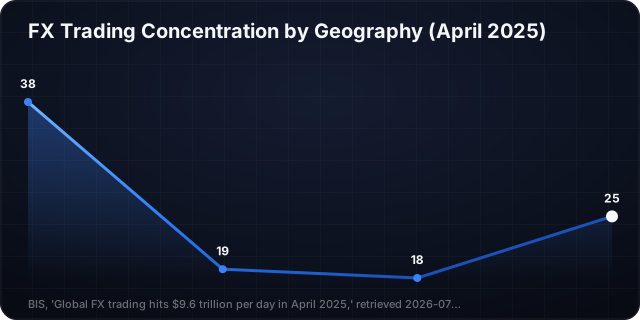
UK 38%, US 19%, and the four-centre 75% concentration
FX trading is geographically concentrated: the United Kingdom held about 38% of global turnover and the United States about 19% in April 2025 (BIS, "OTC foreign exchange turnover in April 2025," retrieved 2026-07-31). Widen the lens slightly and the concentration gets starker. FX sales desks in just four locations, the United Kingdom, the United States, Singapore and Hong Kong SAR, accounted for 75% of all foreign-exchange trading in April 2025 (BIS, "Global FX trading hits $9.6 trillion per day in April 2025," retrieved 2026-07-31).
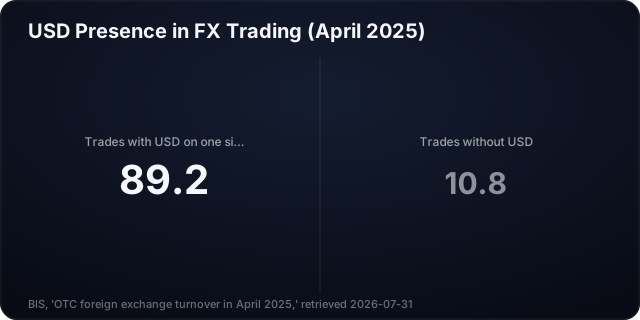
Currency concentration matches geographic concentration. The US dollar remained the dominant FX currency, on one side of 89.2% of all trades in April 2025 (BIS, "OTC foreign exchange turnover in April 2025," retrieved 2026-07-31). If you hold three positions and all three have USD on one side, you hold one bet with three tickets, which is the problem examined in correlation trading for funded forex accounts, and unpacked further in currency correlation analysis for funded trading.
Why the London-New York overlap is when you can actually get filled
Concentration in place becomes concentration in time. The United Kingdom and the United States alone intermediated roughly 38% and 19% of global turnover respectively in April 2025 (BIS, "OTC foreign exchange turnover in April 2025," retrieved 2026-07-31), so the hours in which both of those sales-desk populations are at work are the hours in which the largest share of the market is being priced. The session mechanics are laid out in forex market hours and session overlap.
Capital: real institutional balance sheets, retail accounts, and funded evaluations
Where a prop/funded account sits on the map
A bank desk trades a balance sheet with regulatory capital behind it. A hedge fund trades committed investor money under a mandate. A retail trader trades an account funded from personal savings, usually with leverage supplied by a broker.
A funded evaluation account is a fourth thing, and it is closer to the retail end of the map than the marketing around the category usually admits. The order size is retail. The execution path is retail. The information access is retail. What changes is whose loss it is and how the trader is selected. The difference between a demo and a funded trading account sets out that distinction in detail, and the beginner guide to forex prop firms covers how the model works end to end.
Simulated capital: what a funded account is and is not
For ITAfx specifically, here is the plain version: ITA provides simulated trading evaluation services, challenge fees pay for access to evaluation environments rather than investments or deposits, and all trading in evaluation environments is simulated. ITA does not act as a broker, custodian, or investment adviser (itafx.com, risk disclaimer published site-wide, retrieved 2026-07-31).
ITAfx's product is an instant-funding model with no evaluation time limit, on simulated capital account sizes from $50K to $400K (itafx.com/llms.txt, retrieved 2026-07-31). So a funded trader is not an institution. A funded trader is a retail-sized order taker whose position sizing happens to be scaled to a simulated balance larger than their own savings, which changes the arithmetic of position sizing and nothing at all about execution or information access.
What actually transfers from institutional practice to a retail-sized account
Process that scales down: timing, sizing, execution discipline
Three things survive the size gap intact.
Timing. Trading when the price-setting centres are open is a free improvement, and it follows directly from the BIS concentration figures above.
Sizing as a rule, not a mood. Institutions size positions from a pre-agreed risk limit. That logic is size-independent: a fixed fraction of a $25K simulated account behaves the same way as a fixed fraction of a much larger book, a discipline covered in how to avoid breaching prop firm drawdown limits.
Treating execution as a cost line. Desks measure slippage and impact. So can you, and the measuring is what changes behaviour. The process side of this is collected in risk management strategies for prop firm traders.
Claims that do not survive the size gap
Carry trades are the clean example. Carry trades borrow in low-interest-rate funding currencies to invest in higher-yielding ones; when they unwind, funding currencies, predominantly the yen, appreciate sharply, if briefly, and investment currencies depreciate (BIS Quarterly Review, "Carry off, carry on," September 2024, retrieved 2026-07-31). The structure is real and institutions run it. It also requires holding a leveraged position through a tail event that can move against you violently and briefly. An institution absorbs that inside a diversified book with funding lines. An evaluation account with a drawdown limit does not have that absorption capacity, so the same trade with the same logic produces a different outcome purely because of the balance sheet behind it.
The second category that does not transfer is any claim that reading a chart grants access to dealer flow. A dealer's edge comes from seeing its own customer orders, which is a data feed, not a pattern. Anyone selling you that feed in the shape of an indicator is selling you a story.
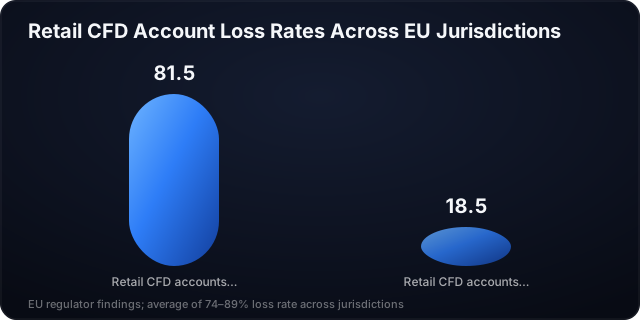
The measured outcome floor for that last group is unflattering, and it is worth stating rather than hiding. When ESMA restricted retail CFD sales in 2018, it reported that 74 to 89% of retail CFD accounts across EU jurisdictions typically lost money, with average losses per client of EUR 1,600 to EUR 29,000 (ESMA, "ESMA agrees to prohibit binary options and restrict CFDs to protect retail investors," 2018, retrieved 2026-07-31).
Ready to get funded?
50% off instant accounts with code 50CRYPTO.
Get Funded →Frequently Asked Questions
Is institutional forex trading a different market from retail forex?
It is the same market, entered through different doors. Retail flow reaches interbank prices bundled through brokers and aggregators, which BIS counts inside the "other financial institutions" category, at 50% of daily turnover (BIS, retrieved 2026-07-31). The price you see is set in the inter-dealer market, which averaged USD 4.4 trillion per day in April 2025 (BIS, retrieved 2026-07-31).
How big is the institutional FX market?
Global OTC FX turnover averaged USD 9.6 trillion per day in April 2025, up 28% from 2022 (BIS, retrieved 2026-07-31). Only 5% of that turnover was trading with non-financial customers such as corporates; the rest sat with financial counterparties, at 46% inter-dealer and 50% with other financial institutions (BIS, retrieved 2026-07-31; shares are published rounded and do not sum to exactly 100).
Can a retail trader use institutional strategies?
Process transfers: timing entries into deep liquidity, sizing from a fixed risk limit, measuring execution cost. Balance-sheet-dependent structures such as carry trades do not, because their risk is absorbed by diversification and funding lines a single account does not have (BIS Quarterly Review, "Carry off, carry on," retrieved 2026-07-31).
Does a funded account make me an institutional trader?
No. Order size, execution path, and information access are unchanged. A funded evaluation account changes whose loss is recorded and how traders are selected, not your position in the market structure.
Where does most FX trading happen?
Four locations account for 75% of it: the United Kingdom, the United States, Singapore and Hong Kong SAR (BIS, retrieved 2026-07-31). The UK alone held roughly 38% and the US roughly 19% in April 2025 (BIS, retrieved 2026-07-31).
Why do so many retail forex accounts lose money?
Regulators found 74 to 89% of retail CFD accounts across EU jurisdictions typically lose money, with average losses per client between EUR 1,600 and EUR 29,000.
Ready to get funded?
Instant accounts, simulated capital, rules published before you pay. 50% off with code 50CRYPTO.
Get Funded →