 ITA
ITAFinancial Commission Prop Firm Certification: What It Requires
What the Financial Commission's Prop Firm Certification actually requires, what it does not protect you from, which firms are certified, and how to file a dispute.

How this article is verified: Every number and claim above is checked against a primary source, ITAfx's own Terms of Service, official product pages, or the trading platform itself, before publication, then re-verified again immediately before this page goes live. Fact-checked and published on July 31, 2026 by Adrian Caldwell.
What the Financial Commission's Prop Firm Certification is
Launched 22 July 2026 as the first self-regulatory framework built for prop firms
Certification is not a rubber stamp on a questionnaire. It is awarded only after the Financial Commission conducts an independent, evidence-based review of the firm's rulebooks, evaluation criteria, payout policies, risk controls and dispute-handling practices (Financial Commission, retrieved 2026-07-30). Reporting on the launch, Finance Magnates quoted Financial Commission COO Nikolai Isayev describing the goal for the sector as bringing "transparent rules, fair enforcement and clear payouts" (Finance Magnates, retrieved 2026-07-30).
Voluntary and non-regulatory: not a licence, not an endorsement of solvency
Here is the sentence most readers will skip and should not. The Commission's own Prop Firm Certification page states that the certification is a voluntary, non-regulatory program and does not constitute licensing, authorization, legal advice, or an endorsement of a firm's financial strength, solvency, profitability or future performance (Financial Commission, retrieved 2026-07-30).
Read that twice. A firm can be certified and still be a firm you should not pay. Certification says a third party looked at documents and found them consistent with a code. It does not say the money will be there in March.
Who the Financial Commission is and what its pre-existing broker membership does
The Commission is not new to disputes. It has run a membership and dispute-resolution structure for brokers for years, with a Dispute Resolution Committee (DRC) whose decisions are stated to be binding on member brokers (Financial Commission, retrieved 2026-07-30). Prop firm certification is a new category bolted onto an existing machine, which matters later when we get to what "binding" covers.
Will a certified firm still be here to pay you? What the code demands on solvency
Financial information sufficient to assess solvency, resilience and payout capacity
This is the strongest clause in the document. At the certification stage, and thereafter on reasonable request or as part of ongoing monitoring, a certified firm must give the Financial Commission financial information reasonably sufficient to assess its solvency, financial resilience and payout capacity (Financial Commission, retrieved 2026-07-30).
Nothing else in the retail prop space asks for that. Trustpilot scores do not. Affiliate rankings do not. Our verification guide on how to know if a prop firm pays covers the checks a trader can still run himself in the absence of a published solvency review.
What counts as evidence
The code names the acceptable forms: audited financial statements, management accounts, cashflow statements, reserve disclosures, or other equivalent financial records (Financial Commission, retrieved 2026-07-30). Those are the documents an operator cannot produce from a marketing budget.
Scenario-based assessment of payout obligations and liquidity strain
As part of certification, the firm participates in what the code calls a voluntary financial resilience and stress-testing review, administered or requested by the Financial Commission, including scenario-based assessment of payout obligations, liquidity strain, operational disruption, or adverse business conditions reasonably relevant to the firm's model (Financial Commission, retrieved 2026-07-30). In plain terms: what happens to this firm if fifty traders pass in the same week.
The limit: reviewed privately, never published as a solvency guarantee
The review happens between the firm and the Commission. You never see the cashflow statement, and the Commission explicitly refuses to endorse the firm's financial strength or solvency (Financial Commission, retrieved 2026-07-30). So the honest reading is: someone competent asked for the numbers, and the answer is not published. That is more than nothing and less than a guarantee.
Which hidden rule can still cost you the account?
Rules must be plain-language and published before you engage
Certified firms must publish all evaluation criteria, program rules, risk controls and payout conditions in clear, plain language, accessible to all participants prior to engagement (Financial Commission, retrieved 2026-07-30). "Prior to engagement" is the operative phrase. A rule you can only find after your card is charged fails this clause.
If you are not yet sure what a baseline rule set even looks like, read our guide to what a prop firm challenge actually is first, then come back and judge a rulebook against this clause.
No retroactive material rule changes without documented consent
This is the clause worth memorising. No material rule change may be applied retroactively to an active genuine participant's ongoing challenge or funded account without that participant's explicit, documented consent (Financial Commission, retrieved 2026-07-30).
Drawdown maths is where this bites. If a firm recalculates how maximum drawdown is measured while you are mid-challenge, the trade plan you built is void through no action of yours. Our breakdown of how to avoid breaching prop firm drawdown limits shows why a change in method, not just in percentage, can end an account.
The one carve-out: the abuse-classification clause
The protection is not unconditional. It falls away when the participant's classification as a genuine participant has changed under the code's abuse-classification clause (Financial Commission, retrieved 2026-07-30). Reclassify the trader, and the retroactive-change ban no longer applies to him.
That is not a loophole hidden in a footnote, it is written into the same sentence as the protection. Treat it as the thing to ask about: what, specifically, moves a trader out of the genuine-participant category at this firm, and who decides.
Reading a firm's rulebook against these clauses even if it is not certified
You do not need a firm to be certified to use the code. Take the consistency rule as a test case: it is exactly the sort of rule that must be published, in plain language, before you pay, and our explainer on how the consistency rule is enforced shows what "published" should look like in practice.
Do they pay, and how fast? Payout clauses in the code
Payout conditions, timelines and methods must be published
The code requires that the conditions, timelines and methods for participant payout be clearly stated and published (Financial Commission, retrieved 2026-07-30). Consistently applied, with clear dispute escalation procedures attached (Financial Commission, retrieved 2026-07-30).
Our look at why prop firms deny payouts covers the hidden triggers this code only requires a firm to disclose, not eliminate.
What the code does not do
It sets no minimum profit split and no maximum payout wait. A firm could publish a ninety-day payout window and comply, because the obligation is disclosure and consistency, not generosity. The code makes the number visible. Whether the number is good is still your judgment call. See our explainer on how profit split works in forex prop firms for the mechanics behind that number.
Requirement-by-requirement: the five commitments and what each proves
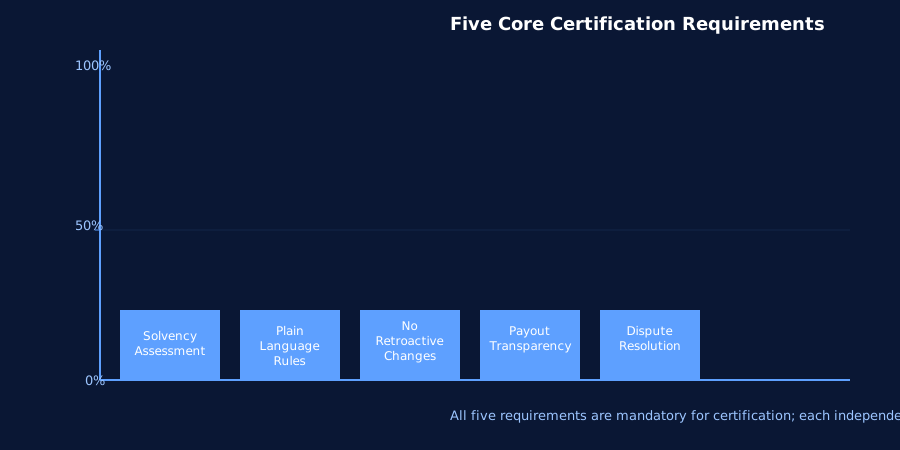
The table below maps each code requirement to what a trader can verify.
| Code requirement | What the firm must show the Commission | What a trader can verify himself | What it does not guarantee |
|---|---|---|---|
| Solvency and payout capacity | Audited statements, management accounts, cashflow, reserve disclosures (Financial Commission, retrieved 2026-07-30) | Nothing directly, the review is private | Financial strength or solvency, explicitly disclaimed (Financial Commission, retrieved 2026-07-30) |
| Scenario-based resilience | Participation in a voluntary stress-testing review: payout obligations, liquidity strain, operational disruption (Financial Commission, retrieved 2026-07-30) | Nothing directly | Future performance (Financial Commission, retrieved 2026-07-30) |
| Plain-language published rules | Rulebook, evaluation criteria, risk controls, payout conditions, pre-engagement (Financial Commission, retrieved 2026-07-30) | Read them before paying; check the date and version | That the rules are fair, only that they are legible and early |
| No retroactive material changes | Consent records for any material change (Financial Commission, retrieved 2026-07-30) | Keep your own copy of the rulebook version you agreed to | Protection if you are reclassified under the abuse clause (Financial Commission, retrieved 2026-07-30) |
| Internal dispute resolution | An IDR process aligned with Commission standards, with acknowledgment, response and escalation timelines (Financial Commission, retrieved 2026-07-30) | Ask for the published timelines; test the support channel before you pay | An enforceable award, see the binding-decision gap below |
The gap that shows up most across all five rows is the same one: private review, disclosed rules, but no published enforcement guarantee.
Which prop firms are certified so far?
As of 20 August 2026, no firm is publicly named as certified
The Financial Commission's current Prop Firm Certification page does not publicly name any certified prop firm, and its official launch announcement names none (Financial Commission, retrieved 2026-08-20).
So if you see a certification badge on a prop firm site today, the burden of proof is entirely on the firm.
What a certified firm gets
Firms that meet the standard receive a public certificate, a listing on financialcommission.org, and the right to display the Financial Commission's authorized certification badge (Financial Commission, retrieved 2026-07-30). Note the order of that list: the certificate and the listing come first, and the badge is downstream of them.
How to check the listing yourself
Go to financialcommission.org and look for the firm in the certification listing. Do not click the badge on the firm's own site and accept where it lands. An image is not a credential, and a badge that links nowhere, or links back to the firm's own page, is the tell.
Ongoing monitoring, annual renewal and structured remediation
Certification is not permanent. Certified firms are subject to an ongoing monitoring protocol and annual renewal, with any shortfalls addressed through a structured remediation process before approval (Financial Commission, retrieved 2026-07-30). Which means a badge has a date attached, and an undated badge tells you nothing about this year.
How to file a dispute through the Financial Commission
Step 1: the firm's internal dispute process
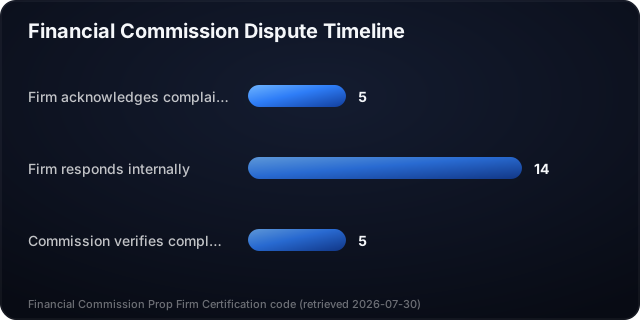
You start with the firm, not the Commission. Under the Commission's published dispute-resolution process, a member firm has 5 days to acknowledge that the complaint was received and 14 days to answer it through its internal dispute resolution procedure, before the complaint can be escalated (Financial Commission, retrieved 2026-07-30). The code obliges certified firms to run an IDR process aligned with those standards, with clear timelines for acknowledgment, response and escalation (Financial Commission, retrieved 2026-07-30).
Practically: file in writing, and note the date you filed. The clock is the evidence.
Step 2: escalating to the Commission
Once a complaint reaches the Commission, it investigates the grounds of the complaint and verifies its validity within 5 business days (Financial Commission, retrieved 2026-07-30). Access to that independent dispute-submission process is one of the five commitments a certified firm makes under the code (Financial Commission, retrieved 2026-07-30).
What it costs you: nothing
The Financial Commission states that its services are absolutely free for traders (Financial Commission, retrieved 2026-07-30). There is no filing fee to weigh against the size of your claim.
The gap to know: binding on brokers
Read this before you file with expectations. The Commission's published process states that DRC decisions are binding on Brokers (Financial Commission, retrieved 2026-07-30). Brokers are the Commission's pre-certification membership category, and that binding-decision language does not yet name certified prop firms (Financial Commission, retrieved 2026-07-30).
So the mechanism you get today is independent review, published pressure and a documented record. That is real. It is not the same as an enforceable award, and any firm or affiliate telling you otherwise is reading a page that has not been written yet.
What to keep
Timestamps of every request and response. Screenshots of the platform state at the moment of the disputed event. The version of the rulebook you agreed to, saved as a file with its date, not a bookmark. Every written response from support, in full, including the ones that say nothing.
What certification changes for how you choose a firm
Use the code as a checklist against any firm, certified or not
No certified firm is named on the official program page as of 20 August 2026, so the code's durable value is as a checklist. Are the rules published in plain language before you pay (Financial Commission, retrieved 2026-07-30). Are payout conditions, timelines and methods stated (Financial Commission, retrieved 2026-07-30). Is there a written internal dispute process with real timelines (Financial Commission, retrieved 2026-07-30). A firm that fails those three does not need a certification body to be judged. Our own guide to how to choose the right prop firm for forex trading walks through the same checklist from the trader's side.
Where ITAfx stands
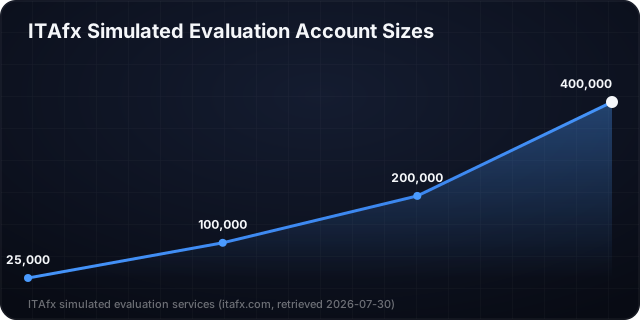
ITAfx offers simulated evaluation accounts on an instant-funding model with no evaluation time limit, and simulated account sizes from $25K to $400K in virtual capital (itafx.com, retrieved 2026-08-20).
Questions worth asking a firm before you pay
What moves me out of the genuine-participant category. Which rulebook version applies to my account, and where is it archived. What is the published payout timeline, in days, and who decides a disputed payout. Ask by email so the answer is in writing.
Ready to get funded?
50% off instant accounts with code 50CRYPTO.
Get Funded →Frequently Asked Questions
Does Financial Commission certification mean a prop firm is regulated?
No. The Commission's own page states the certification is voluntary and non-regulatory and does not constitute licensing or authorization (Financial Commission, retrieved 2026-07-30).
Does certification guarantee I will get paid?
No. The code requires the firm to show the Commission information sufficient to assess solvency and payout capacity (Financial Commission, retrieved 2026-07-30), but the Commission explicitly declines to endorse a firm's financial strength, solvency or future performance (Financial Commission, retrieved 2026-07-30).
Which prop firms are certified right now?
As of 20 August 2026, none is publicly named on the official certification page, and the official launch announcement names none (Financial Commission, retrieved 2026-08-20).
Can a certified firm change the rules mid-challenge?
Not materially and not retroactively, without your explicit documented consent, unless your classification as a genuine participant has changed under the abuse clause (Financial Commission, retrieved 2026-07-30).
How much does filing a dispute cost?
Nothing. The Commission states its services are absolutely free for traders (Financial Commission, retrieved 2026-07-30).
How long does the process take?
The firm has 5 days to acknowledge and 14 days to answer internally (Financial Commission, retrieved 2026-07-30), then the Commission verifies the complaint's validity within 5 business days (Financial Commission, retrieved 2026-07-30).
Ready to get funded?
Instant accounts, simulated capital, rules published before you pay. 50% off with code 50CRYPTO.
Get Funded →