 ITA
ITADo You Need to Pay for an Economic Calendar? Free vs Paid
Free calendars (Forex Factory, Investing.com, TradingView, Myfxbook, FXStreet) vs paid tiers: what buying actually adds for a funded trader.

How this article is verified: Every number and claim above is checked against a primary source, ITAfx's own Terms of Service, official product pages, or the trading platform itself, before publication, then re-verified again immediately before this page goes live. Fact-checked and published on July 31, 2026 by Adrian Caldwell.
The short answer: no, unless you need the data as a machine input
Free calendars give you the four fields a discretionary trader acts on: previous, forecast, actual, and an impact rating. Investing.com's calendar shows Forecast (the consensus estimate), Previous (the last reporting period), and Actual, populated in real time once the official number is published.
So what does money buy? Three things, and you should be able to name which one you need before you pay:
- Programmatic access. You want the data to arrive in code, not in a browser tab. Trading Economics gates its data behind a paid API subscription whose price is scaled to the features you use, the volume of requests, and the distribution you make (Trading Economics API, retrieved 2026-07-31).
- Historical export and breadth. You are backtesting or screening across many series, not watching one release.
- Redistribution. You are putting the data in front of other people, in a product or a service, which is a licensing question rather than a trading one.
If none of those three describes your week, the paid tier is selling you something you will not use. If you have not yet made sense of what a release actually means once it prints, how to read forex economic news releases for a funded account is the companion piece to work through first.
What every free economic calendar already gives you
The four fields that drive a trade: previous, forecast, actual, impact
A scheduled release is a comparison. The market has priced a forecast; the actual number either matches it or does not; the previous print tells you the direction of travel. Investing.com labels exactly those three columns and fills Actual live at release time.
The underlying numbers are not proprietary. They come from national statistical agencies and central banks, published at a fixed timestamp. A vendor does not own Non-Farm Payrolls. What a vendor owns is the presentation: the filters, the timezone handling, the alert system, the breadth of the list.
Impact ratings are a vendor's opinion, not a standard
This is the part traders get wrong most often. There is no industry-wide impact scale.
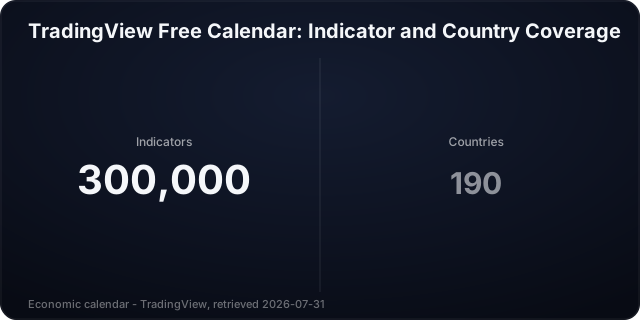
TradingView's economic calendar provides more than 300,000 economic indicators from over 190 countries and lets users filter events by importance (Economic calendar - TradingView, retrieved 2026-07-31).
A vendor's star or colour rating is that vendor's own editorial judgement, not a shared industry standard, so two calendars can rate the same release differently and neither is wrong. Treat the rating as a shortlist generator, then read the event yourself.
Coverage differences that are real: events, countries, indicators
Where the free tools genuinely diverge is breadth, and the figures vendors publish are not measured in the same unit. TradingView's economic calendar provides more than 300,000 economic indicators from over 190 countries (Economic calendar - TradingView, retrieved 2026-07-31).
Those are not comparable numbers. An "event" is a dated calendar entry. An "indicator" is a data series, most of which will never appear on a trading day's schedule. A calendar with 300,000 indicators is not automatically more useful for a same-day trade than one built around a shorter list of events; it is a different kind of database with a calendar view attached.
The free vs paid calendar comparison table
Read the column definitions first, because two of them are frequently conflated. Price means the cost of access to the calendar itself, as documented by the vendor. Impact-rating scale names the exact scale that vendor uses, not a normalised score. Stated coverage is the vendor's own published figure, with the unit labelled, because events, countries, and indicators are three different units and must not be summed or ranked against each other. A blank cell means the source does not state it, not that the answer is no.
| Tool | Price | Impact-rating scale stated | Stated coverage (unit labelled) |
|---|---|---|---|
| TradingView | Free calendar available | Filter by importance (TradingView, retrieved 2026-07-31) | 300,000+ indicators; 190+ countries (TradingView, retrieved 2026-07-31) |
| Trading Economics | Paid API subscription, priced by features, request volume, and distribution (Trading Economics API, retrieved 2026-07-31) | Not stated in sourced material | 20 million indicators; 196 countries (Trading Economics API, retrieved 2026-07-31) |
The blanks are the honest part. Where a vendor does not publish a figure, this article does not invent one.
How impact ratings and coverage compare across three more free calendars
Star ratings, colour bars, and country/event counts are not interchangeable across vendors, and seeing three side by side makes that plainer than any single comparison can.
| Tool | Impact-rating method | Stated coverage (unit labelled) |
|---|---|---|
| Investing.com | One, two, or three stars per event: one star for low expected volatility, two for moderate impact, three for a high-impact event (Investing.com, retrieved 2026-07-31) | Not stated in sourced material |
| FXStreet | Yellow/orange/red volatility bar showing the expected impact of the data on currencies (FXStreet, retrieved 2026-07-31) | 2,000+ events; 40+ countries (FXStreet, retrieved 2026-07-31) |
| TradingView | Filter by importance (TradingView, retrieved 2026-07-31) | 300,000+ indicators; 190+ countries (TradingView, retrieved 2026-07-31) |
Three different labelling systems, three different coverage units. None of this breadth changes what a prop firm's news-restriction clock is measured against, which is the question the rest of this article answers.
What a paid or premium tier actually adds
API access and data export
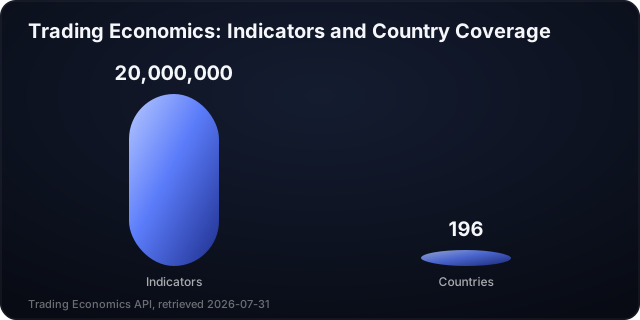
The clearest paid product in this space is not a nicer calendar. It is a data feed. Trading Economics provides current and historical data on 20 million indicators for 196 countries (Trading Economics API, retrieved 2026-07-31), delivered through an API subscription priced by feature use, request volume, and distribution (Trading Economics API, retrieved 2026-07-31). That is a plumbing purchase. You are buying the right to pull series into a spreadsheet, a screener, a research notebook, or an automated system, on a schedule, without a human clicking anything.
TradingView also sells paid plans. This article makes no claim about what those plans add to the calendar specifically, because the sourced material covers its free calendar features only.
Breadth: 20 million indicators, 196 countries
Trading Economics provides current and historical data on 20 million indicators for 196 countries (Trading Economics API, retrieved 2026-07-31), which functions as a research archive. If your question is "how has Brazilian industrial production behaved across the last four tightening cycles", that breadth is the product. If your question is "when is CPI", you are paying for a warehouse to buy one item.
Pricing that is quoted, not listed
Notice how the price works. Trading Economics adjusts its API subscription pricing according to the features used, the volume of requests, and the distribution made (Trading Economics API, retrieved 2026-07-31). That is a data-distribution licence, not a retail trading tool with a shelf price. There is no single number you can hold up against zero and compare. If a vendor quotes rather than lists, it is because the buyer they have in mind is a business, and a discretionary trader is not that buyer.
Does a prop firm's news restriction change the answer?
This is the section most readers came for, and the answer runs against intuition.
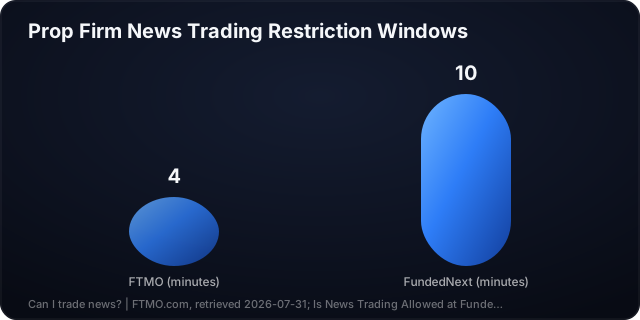
FTMO: a 2-minute window either side, funded accounts only
On FTMO funded accounts, traders may not open or close any trades, including pending Stop Loss or Take Profit orders, on targeted instruments within a window starting 2 minutes before and ending 2 minutes after the release of selected news announcements; the restriction does not apply during the Evaluation Process, and an exception applies only to Swing accounts (Can I trade news? | FTMO.com, retrieved 2026-07-31). Trading on non-targeted instruments is not restricted, and positions opened more than 2 minutes before a restricted event may be held (Can I trade news? | FTMO.com, retrieved 2026-07-31).
FundedNext: 40% of profit inside a 10-minute window, on funded Stellar accounts
On FundedNext accounts, trades executed 5 minutes before and 5 minutes after a listed high-impact news event, a total 10-minute window, fall under the News Reward Share Rule, under which only 40% of the profit from those profitable trades counts toward the trader's account balance; the rule applies to Stellar 1-Step, Stellar 2-Step and Stellar Lite FundedNext Accounts, and Challenge Accounts are not subject to it, while any losses in that window remain the trader's responsibility (Is News Trading Allowed at FundedNext? | FundedNext Help Center, retrieved 2026-07-31).
What the rule depends on: the firm's list, not your feed
Read both rules closely and the same idea appears twice: FTMO restricts "selected news announcements" (Can I trade news? | FTMO.com, retrieved 2026-07-31) and FundedNext restricts "listed high-impact news events" (Is News Trading Allowed at FundedNext? | FundedNext Help Center, retrieved 2026-07-31). The restricted set is defined by the firm, on the firm's published list, measured against the firm's own clock. A broader calendar does not expand or shrink that list. A faster feed does not move the timestamp your firm will audit you against. The mechanics of how a scheduled release moves price around that window are covered separately in economic calendar impact on prop firm trading, which is worth reading before you decide the calendar itself needs upgrading.
What buys compliance is dull and free: open your firm's own restricted-event list, put those specific events in whatever calendar you already use, and timestamp your entries against them. Paying a vendor for 20 million indicators does not help you if the events your firm restricts are outside that list's actual trading day. For the broader pattern of how NFP-style releases catch funded traders out regardless of which calendar they use, see NFP trading: what not to do and how to prepare for key releases.
Who should actually pay
Buy if: you automate, backtest, or redistribute
Three conditions, and they map directly onto what the paid product is documented to sell:
- You automate. Your system needs the number in machine-readable form at release, which means an API subscription (Trading Economics API, retrieved 2026-07-31).
- You backtest across breadth. You need long histories across many series and many countries, which is what 20 million indicators for 196 countries is for (Trading Economics API, retrieved 2026-07-31).
- You redistribute. You are publishing or reselling the data, which is priced as distribution (Trading Economics API, retrieved 2026-07-31).
Do not buy if: you check the calendar each morning
If your routine is opening a calendar, filtering for high-impact events on your pairs, noting the times, and sizing accordingly, buy nothing. Spend the money on nothing, or on something that changes your outcomes, such as a better process for sizing around scheduled events like the FTMO news-restriction window (Can I trade news? | FTMO.com, retrieved 2026-07-31).
The trial question to ask before any subscription
One question, and ask for the answer in writing: what does this tier give me that the free version withholds, stated as a feature, not as a benefit? If the reply is faster data, ask for the latency figure and the measurement method. If the reply is more coverage, ask which unit, events or indicators, and whether the events you actually trade are in the free tier already. Most of the time, they are.
Ready to get funded?
50% off instant accounts with code 50CRYPTO.
Get Funded →Frequently Asked Questions
Is a free economic calendar accurate enough for a funded account?
Yes, for the four fields a discretionary trader needs. Free calendars such as Investing.com's populate Previous, Forecast, and Actual in real time from the same official releases every vendor draws from, so accuracy is not the differentiator between free and paid tiers.
Do paid calendars release data earlier than free ones?
This cannot be verified either way for the vendors covered in this article, because no sourced latency figure exists for them. What is verifiable is that official releases are timestamped at source by the issuing agency, and a prop firm's news rule is measured against that release time, not against any vendor's screen (Can I trade news? | FTMO.com, retrieved 2026-07-31). Treat any unquantified speed claim as marketing until a vendor publishes the number.
What is the real difference between TradingView's free calendar and Trading Economics' paid API?
TradingView's economic calendar provides more than 300,000 economic indicators from over 190 countries for free browser use with importance filters (Economic calendar - TradingView, retrieved 2026-07-31). Trading Economics instead sells API access to 20 million indicators across 196 countries, priced by feature use, request volume, and distribution (Trading Economics API, retrieved 2026-07-31), aimed at automated or redistributed use rather than manual browsing.
Which calendar do prop firms use for their own news rules?
Each firm publishes its own list rather than pointing traders to a specific vendor. FTMO restricts trading on targeted instruments in a window 2 minutes before to 2 minutes after selected news announcements on funded accounts (Can I trade news? | FTMO.com, retrieved 2026-07-31). FundedNext applies its News Reward Share Rule to listed high-impact events in a 10-minute window, counting only 40% of profit from trades placed in that window (Is News Trading Allowed at FundedNext? | FundedNext Help Center, retrieved 2026-07-31). Read your own firm's list, not a vendor's marketing page.
Is it worth paying for an economic calendar just to trade a funded account?
No, in almost every case. A funded-account trader who checks a free calendar each morning already has the previous, forecast, actual, and impact-rating fields a discretionary decision needs, and a prop firm's news-trading restriction is measured against the firm's own published list and clock, not against any paid vendor's feed (Can I trade news? | FTMO.com, retrieved 2026-07-31; Is News Trading Allowed at FundedNext? | FundedNext Help Center, retrieved 2026-07-31).
Ready to get funded?
Instant accounts, simulated capital, rules published before you pay. 50% off with code 50CRYPTO.
Get Funded →