 ITA
ITABollinger Band Squeeze Breakout Strategy: Master Volatility for Funded Accounts
Unlock explosive market moves with the Bollinger Band squeeze breakout strategy. Learn to identify, execute, and manage risk for funded trading success.
Short answer
A Bollinger Band squeeze is a volatility contraction that can precede a breakout. On prop firm accounts the breakout idea fails if position size ignores simulated drawdown limits.
Simulated capital: prop firm evaluation and funded stages discussed here typically run on simulated accounts. Challenge fees pay for access to that environment; they are not a deposit of trading capital. ITAfx accounts are simulated capital.


What is the Bollinger Band Squeeze Breakout Strategy?
The Bollinger Band Squeeze Breakout Strategy identifies periods when volatility contracts to extreme lows before explosive directional moves. The Bollinger Bands contract like a python squeezing its prey. Price coils tighter and tighter, then explodes in a violent breakout that runs for days, leaving a trail of stopped-out traders who entered too early or in the wrong direction.
Here's the truth: the Bollinger Band squeeze breakout strategy has one of the highest theoretical win rates in technical analysis, yet most traders fail with it completely. They see the squeeze. They feel the tension. They enter. They lose.
The problem isn't the strategy. It's that traders treat the squeeze as the signal when it's actually just the setup. Think about it. When Bollinger Bands narrow to their tightest point in months, what's actually happening? The market is holding its breath.
Volatility, measured by standard deviation, has compressed to an extreme. The upper and lower bands, sitting at 2 standard deviations from the 20-period moving average, are telling you that price movement has flatlined.
This is where most educational content stops. "Trade the breakout when price exits the squeeze." But that's like saying "buy low, sell high" (technically correct, utterly useless).
The real Bollinger Band squeeze breakout strategy starts with a number most traders have never calculated: Band Width. Band Width is simply (Upper Band, Lower Band) / Middle Band. When this value hits its lowest point in 6 months (not 20 days, not 50 days, but 6 months), you have a statistically significant compression.
John Bollinger himself emphasised this in his original work: volatility is mean-reverting, and extreme compression precedes expansion with mathematical reliability.
How to Identify a Bollinger Band Squeeze: Objective Rules
Identifying a Bollinger Band squeeze requires objective rules that measure band compression relative to recent volatility. The strategy inverts everything you think you know: you don't trade the squeeze itself, you trade the expansion that follows.

EUR/USD trading around 1.15 Band Width reads 0.0018, the lowest in 6 months. Most traders are already positioning, guessing whether the break will be up or down. They're placing directional bets on a coin flip.
The institutional approach? Place a buy stop above the upper band and a sell stop below the lower band. Not at the bands, beyond them. Then wait.
This is the first cognitive bridge: the squeeze isn't the opportunity, it's the warning that opportunity is coming.
When price finally breaks, it must close a full candle outside the band. Not a wick. Not a touch. A close. This filters out roughly 70% of false breaks.
But even that's not enough. Volume must spike to at least 150% of the 20-period average. Why? Because real breakouts from extreme compression create urgency. Traders who've been waiting on the sidelines suddenly rush in. The order book thickens.
Without this volume confirmation, you're likely catching a head-fake. Here's where most strategies would tell you to enter. But we need one more filter: momentum confirmation.
Executing the Breakout: Entry Signals and Confirmation
Executing the breakout requires confirmation signals beyond price movement alone, particularly RSI momentum readings. On a bullish break, RSI should push above 60. On a bearish break, below 40. This isn't about overbought or oversold levels, it's about directional conviction when volatility expands after extreme compression.

Now for the part that separates institutional thinking from retail gambling: position sizing. Most traders size their positions based on their entry. "I'll risk 2% with a stop at the opposite band." This is backwards.
In funded account trading, whether at ITAfx or elsewhere, you have a daily drawdown limit (typically 3%) and a maximum drawdown (typically 6%). Your position size must be calculated from these limits, not from your desired risk.
Here's the formula:
- Position size = (Daily Loss Limit × Account Balance) ÷ (Stop Distance in $ × Number of Positions)
If you're trading a $100,000 funded account with a 3% daily loss limit, you have $3,000 to work with. If your stop is 50 pips (worth $500 on a standard lot), and you're taking one position:
3,000 ÷ 500 = 6 lots maximum
But here's the kicker: use half that. Why? Because the first rule of squeeze breakouts is that volatility expansion means wider swings. Your stop needs room to breathe.
This brings us to the second major bridge: risk management in squeeze breakouts isn't about protecting capital, it's about surviving volatility.
Risk Management for Squeeze Breakouts: Protecting Capital
Risk management for squeeze breakouts involves setting stops based on the compression level at the squeeze point. Set your stop at 1.5 times the Band Width at the point of the squeeze. If the bands were 40 pips apart at maximum compression, your stop goes 60 pips from entry to account for the inevitable retest.
Your profit target? Start with 3 times the Band Width. Using our 40-pip example, that's 120 pips. But here's where squeeze trading gets interesting: this is your minimum target. Real squeeze breakouts often run 5-10 times the compressed range.
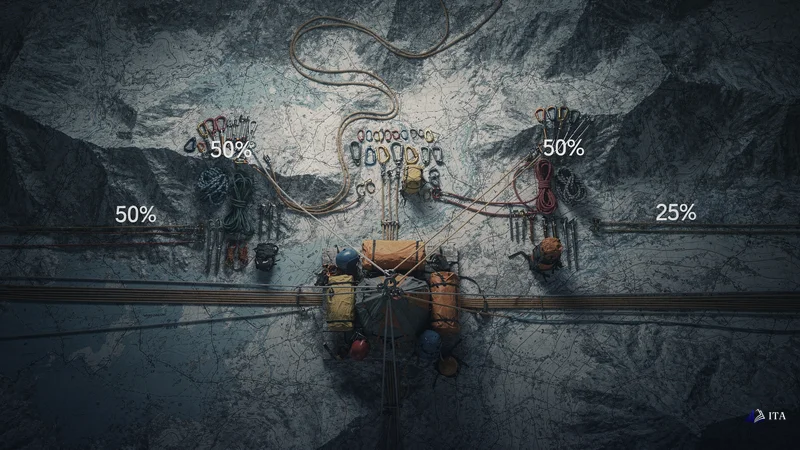
The solution? Scale out. Take 50% at 3× Band Width, 25% at 5×, and let the final 25% run with a trailing stop at the middle band (the 20-period moving average).
Let's see this in action:
Consider a hypothetical gold trade where bands have compressed to their tightest range in months The Bollinger Bands have compressed to their tightest in 6 months:
- Upper band at 4265
- Lower at 4248
- Range of just $17
- Band Width reads 0.004, a historical extreme
You place a buy stop at 4266 (above the upper band) and a sell stop at 4247 (below the lower).
When gold eventually breaks higher with strong volume and momentum confirmation RSI pushes to 65. Your buy stop triggers.
Position Setup:
- Stop placement: 1.5 × $17 = $25.50 below entry = 4242.50
- First target: 3 × $17 = $51 above entry = 4319
- Risk per contract: $25.50 × 100 oz = $2,550
With a $100,000 account and 3% daily limit ($3,000), you can trade 1 contract with room for volatility.
Common Mistakes and How to Avoid Them in Squeeze Trading
Common mistakes in squeeze trading centre on timing errors and false breakout entries. The critical error most traders make is entering too early, before the actual expansion begins.

The squeeze can last days, weeks, even months. The tighter it gets, the more explosive the eventual move, but also the more false starts you'll see. Traders who enter during the squeeze, trying to anticipate direction, face a psychological torture chamber.
Every tiny move feels like the beginning of the breakout. Every pullback triggers their stop. The professional approach? Do nothing. Set your stops. Wait. The market will tell you when it's ready.
This patience requirement creates our third bridge: in squeeze trading, the money isn't made by the clever trader who predicts direction, it's made by the disciplined trader who waits for confirmation.
But what about more sophisticated approaches? Can we improve the basic squeeze breakout? Enter the Bollinger Band-Keltner Channel squeeze (the institutional favourite).
Overlay Keltner Channels (typically 20-period EMA with 1.5× ATR) on your Bollinger Bands. When the Bollinger Bands contract inside the Keltner Channels, you have a "squeeze within a squeeze" (an even more powerful setup).
Why does this work? Keltner Channels measure volatility through Average True Range, while Bollinger Bands use standard deviation. When both volatility measures agree on extreme compression, the subsequent expansion tends to be more violent and more sustained.
Advanced Squeeze Strategies: Combining with Other Indicators
Advanced squeeze strategies combine Bollinger Bands with complementary indicators to filter false signals and enhance timing precision. The rules remain the same: wait for the close outside the Bollinger Bands with volume and momentum confirmation.
But the Keltner squeeze typically produces moves that run 5-10× Band Width instead of 3-5×. For funded traders, this enhanced setup is particularly valuable. The higher probability and larger moves mean you can trade smaller size relative to your targets, staying well within daily drawdown limits while still capturing meaningful profits.
Here's our fourth critical bridge: the best setups aren't the ones that trigger most often, they're the ones that trigger rarely but pay massively.
This brings us to automation. The squeeze breakout is one of the few strategies that actually benefits from mechanical execution. The rules are objective:
- Band Width at 6-month low? Yes/No
- Close outside bands? Yes/No
- Volume > 150% average? Yes/No
- Momentum confirmed? Yes/No
Platforms like third-party platform (used by ITAfx and most prop firms) allow you to code these rules precisely. Set alerts for when Band Width hits extreme lows. Automate the placement of stop orders. Remove the emotional element entirely.
But even with perfect execution, traders sabotage themselves through three predictable mistakes. First, they enter during the squeeze instead of after the breakout. The temptation is overwhelming. You see the setup forming, you want to be "smart money" that gets in early.
This is ego, not edge. The squeeze is the setup, not the signal. Wait for the close outside the bands.
Bollinger Band Squeeze Breakout in Prop Firm Trading
Bollinger Band squeeze breakouts in prop firm trading require volume confirmation to distinguish genuine moves from false signals. A breakout without volume is like thunder without lightning (all noise, no power). Real moves from compressed volatility create urgency in the order book, requiring volume spikes of at least 50% above average.
Second mistake: they place stops too tight. After extreme compression, price needs room to establish direction. The initial breakout often retests the bands before continuing. A stop at 1× Band Width will get hit on normal volatility. Use 1.5× minimum, 2× if you can afford it within position sizing rules.
This is our fifth and final bridge: the difference between theory and profit in squeeze trading is the willingness to give the market room to prove itself.
For prop firm traders, the squeeze breakout offers unique advantages. The setup is rare enough that you're not overtrading. The risk is defined before entry. The reward potential justifies the patience required.
Most importantly, it aligns with the consistency rules most firms enforce. You're not taking random shots, you're executing a mechanical edge.
At ITAfx, where funded accounts go up to $400K, a properly executed squeeze strategy can generate substantial returns while staying within the 3% daily and 6% maximum drawdown limits. The key is position sizing: never risk more than allows you to take 2-3 losses without hitting daily limits.
Let's be clear about something: the Bollinger Band squeeze breakout isn't a holy grail. According to the BIS Triennial Survey, daily FX volume hit $7.5 trillion in 2022, with institutional players dominating the market. You're not outsmarting the market. You're identifying moments when volatility mean reversion creates temporary inefficiency.
The edge comes from discipline, not discovery. Every trader can see the squeeze. Most enter too early, stop too tight, or size too large. The profitable minority wait for confirmation, size for survival, and let winners run.

Ready to get funded?
50% off instant accounts with code 50CRYPTO.
Get Funded →Frequently Asked Questions
What is a Bollinger Band squeeze breakout strategy and how does it work?
A Bollinger Band squeeze breakout strategy identifies periods when volatility contracts to extreme lows before explosive directional moves. The strategy waits for Band Width to hit 6-month lows, then trades the breakout when price closes outside the bands with volume and momentum confirmation, rather than predicting direction during compression.
How do you objectively define a Bollinger Band squeeze using Band Width?
A squeeze is objectively defined when Band Width (Upper Band, Lower Band / Middle Band) reaches its lowest level in 6 months. This mathematical threshold ensures you're trading genuine volatility compression rather than normal consolidation. Many institutional traders use this 6-month lookback as the standard filter.
How can traders filter out false breakouts in a Bollinger squeeze?
Filter false breakouts by requiring three confirmations: price must close a full candle outside the band (not just touch), volume must spike to at least 150% of the 20-period average volume (50% above average), and momentum indicators like RSI must confirm direction (above 60 for bullish breaks, below 40 for bearish breaks).
What risk management rules work best with Bollinger squeeze strategies on funded accounts?
Set stops at 1.5 times the Band Width at squeeze point to account for volatility expansion. Position size based on daily drawdown limits rather than desired risk. Target 3 times Band Width for initial profits, scaling out as the move develops to maximise asymmetric payoffs.
Can Bollinger Band squeezes be combined with Keltner Channels for better signals?
Yes, when Bollinger Bands contract inside Keltner Channels, it creates a 'squeeze within a squeeze' setup. This occurs when both volatility measures (standard deviation and ATR) agree on extreme compression, typically producing larger and more sustained breakout moves than standard squeezes.
Key Takeaways
- Wait for BandWidth to hit 6-month lows before positioning, this filters out 70% of false compression signals that trap early entries.
- Place buy stops above upper bands and sell stops below lower bands, never enter during the squeeze itself to avoid psychological torture.
- Require volume spikes of at least 150% of the 20-period average (50% above average) plus RSI momentum confirmation to distinguish genuine breakouts from head-fake moves.
- Set stops at 1.5 times BandWidth from entry point, compressed volatility needs room to establish direction before trending.
- Scale out at 3x, 5x, and trail final 25% with middle band stops to capture the full expansion cycle.
- Combine Bollinger Bands with Keltner Channels for institutional-grade setups that produce 5-10x BandWidth moves instead of 3-5x.
- Size positions from daily drawdown limits, not entry risk, use half your calculated maximum to survive volatility expansion phases.
Start Your Trading Evaluation
Simulated funded accounts up to $400K. Up to 95% profit split.
Get Funded