 ITA
ITANinjaTrader Cut Off Alpha Futures: Platform Risk Explained
In July 2026 NinjaTrader terminated Alpha Futures, and pending payouts went with it. What platform-vendor risk means for your funded account.

How this article is verified: Every number and claim above is checked against a primary source, ITAfx's own Terms of Service, official product pages, or the trading platform itself, before publication, then re-verified again immediately before this page goes live. Fact-checked and published on July 30, 2026 by Adrian Caldwell.
What happened between NinjaTrader and Alpha Futures in July 2026
The timeline, day by day
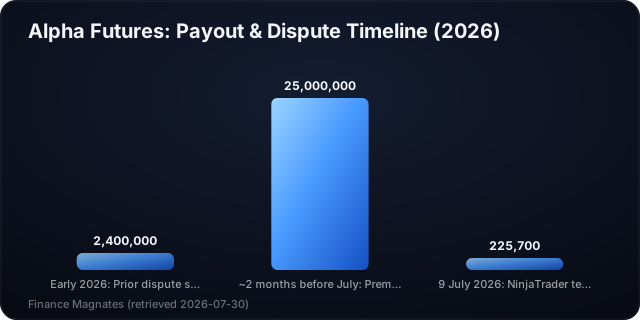
NinjaTrader terminated its platform agreement with the UK prop firm Alpha Futures, and Alpha Futures says the termination notice arrived without warning on 9 July 2026 (Finance Magnates, retrieved 2026-07-30). Within days the consequences reached traders. Finance Magnates' weekly recap reported that the dispute left Alpha Futures traders facing cancelled Premium accounts and unpaid payouts beyond amounts already distributed, and that the reaction on social media was widespread criticism (Finance Magnates, retrieved 2026-07-30).
Note the shape of that sequence. There was no gradual deterioration a trader could watch, no missed payout in June that hinted at July. A commercial relationship the trader was never party to ended, and the effect landed on accounts inside the same week.
What each side says the dispute is about
NinjaTrader's stated basis for terminating was an allegedly outstanding balance of US$225,700, which Alpha Futures says it believed was credit remaining from a prior settlement (Finance Magnates, retrieved 2026-07-30). So the two accounts of the same number are not slightly different, they are opposite. One side calls it a debt. The other side calls it a credit it had already been given.
Why this is still a disputed account, not a finding
Nothing in that paragraph is settled. No regulator has ruled, no court has issued a judgment, and both figures reach the public through the same trade-press reporting. This article does not adjudicate the dispute, and you should be suspicious of any article that does, because the useful lesson does not depend on who is right about the US$225,700.
The lesson is that a two-party billing argument reached a trader's payout at all.
Why the payouts stopped: one vendor, two platforms
How one termination closed two platforms
Here is the structural detail that turned a contract dispute into a payout event. NinjaTrader also owns Tradovate. A firm offering both looks, on a features page, like a firm offering redundancy: two execution venues, two logos, pick your preference. It is one vendor relationship wearing two badges. When the agreement ended, both venues went with it, and Alpha Futures' Premium Plan was cancelled as a result of the NinjaTrader/Tradovate termination (Finance Magnates, retrieved 2026-07-30).
There was no fallback inside that relationship, because there was only ever one relationship.
What "refunded and closed" meant for pending payouts
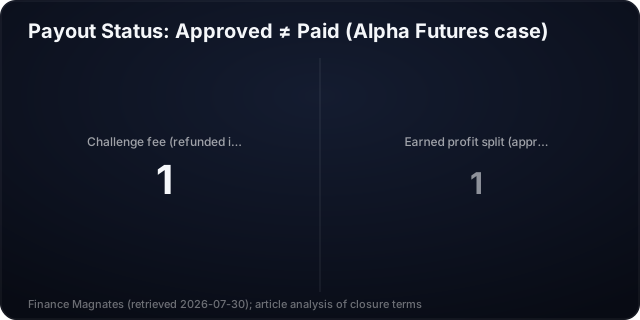
Alpha Futures announced that all active Premium Accounts would be refunded and closed, including all pending and unpaid payouts on the Premium plan beyond amounts already paid (Finance Magnates, retrieved 2026-07-30). Read the second half of that sentence slowly. A refund returns the fee. It does not return the profit split a trader had already earned and been approved for. Those are different amounts, and for a trader who had a good month, they are not close.
Approved is not the same as paid
The concrete version of that abstraction circulated as a screenshot. Treat it as what it is: a trader-circulated screenshot reported in trade press, not audited accounting. Nobody outside the firm has verified that specific balance.
But it names the gap precisely. "Approved" is a status in a dashboard. "Paid" is money that has cleared. Between them sits the firm's ability to keep operating the platform your account lives on. If you want the normal, working version of that sequence, we cover the payout process in our guide on why prop firms deny payouts.
This was not insolvency, and that is the point
Why payout-proof screenshots did not predict this
Run the standard due-diligence checklist against Alpha Futures as of June 2026 and it passes. Alpha Capital Group, which includes Alpha Futures and Alpha Capital, generated "tens of millions" of pounds in revenue over the three years before the July 2026 dispute (Finance Magnates, retrieved 2026-07-30). On its own account, Alpha Futures claims to have paid out more than US$25 million via the Premium Plan in roughly two months before the plan was cancelled (Finance Magnates, retrieved 2026-07-30).
Revenue scale: fine. Payout volume: better than most. Track record: years, not months. A trader screening for solvency would have found nothing to worry about, because solvency was not the problem. The firm's ability to pay and the firm's ability to reach the platform where the accounts sat were two separate things, and only one of them broke.
This is also why payout-proof screenshots are weak evidence in general. They document that a firm paid last month. They say nothing about the infrastructure contracts that made last month possible. The same verification instinct we recommend in our prop firm payout verification guide applies here, with one correction: verify the plumbing, not just the receipts.
The earlier US$2.4m dispute as a visible warning sign
There was one signal, and it was public. The July 2026 dispute followed a separate, prior overcharge dispute between the two companies worth US$2.4 million that had already been settled in early 2026 (Finance Magnates, retrieved 2026-07-30).
A settled dispute is not a prediction. Companies argue about invoices and carry on working together for years. Still, it is the one thing in this story that a diligent reader could in principle have found before paying a fee: documented financial friction between a firm and the vendor that runs its execution. Not proof of anything. A reason to ask a second question.
Solvency risk vs rule risk vs vendor risk
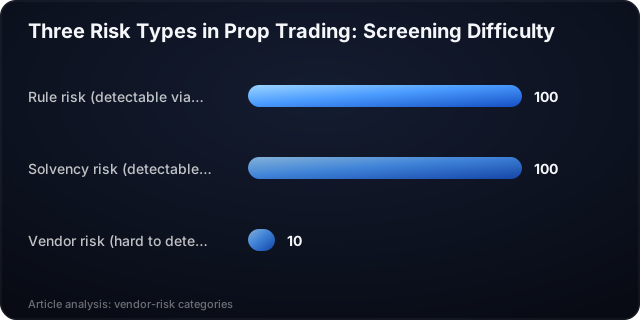
Three distinct failure modes, and they need separate checks:
- Rule risk. The firm changes drawdown, consistency, or payout terms in a way that costs you an account you thought you had passed. You screen for this by reading the rules and their change history. If you have not done that before, our guide to prop firm challenge rules and requirements is the baseline.
- Solvency risk. The firm cannot fund its obligations. You screen for this with scale, longevity, and payout history.
- Vendor risk. The firm can pay and wants to pay, but the platform relationship it depends on has ended. Nothing in the first two checks detects this.
Note that none of the three is the same as account-level risk management, which is about surviving your own drawdown. Vendor risk is counterparty risk. Your position sizing does not touch it.
Platform-vendor risk as a category: what a trader can actually check
Counting real vendors, not badge logos
Do not count platform logos. Count the companies that own them. The question is: how many distinct corporate vendors stand between me and my account? A firm listing four platforms owned by two parent companies has two points of failure, not four. Tradovate sitting under NinjaTrader is the lesson in one line, and there are other clusters like it across the industry.
Ownership is usually findable in ten minutes. Search the platform name plus "acquired by" or "parent company", then check the vendor's own about page.
For context on how this varies between firms, our prop firm comparison is a reasonable starting point, as long as you read it for structure rather than for headline profit splits.
Reading the terms for platform-termination language
Open the firm's terms of service and search for the words "platform", "third party", "terminate", and "suspend". You are looking for one specific answer: what happens to open accounts and pending, already-approved payouts if a platform relationship ends.
Most terms are silent. Silence is itself information, because it means the outcome is discretionary. Some terms say fees may be refunded, which as this case shows is not the same as payouts being honoured. Whatever it says, print it. Two months from now, that clause is the only thing you can point to.
Questions worth asking support before you pay
Send these before the fee, not after. How support answers a specific question in writing tells you more than a testimonials page.
- Which company owns each platform you offer, and are any of them owned by the same parent?
- If a platform provider terminates its agreement with you, what happens to my open account?
- If a payout has been approved but not yet sent when that happens, is it still paid? Point me to the clause.
- Have you had a billing or contractual dispute with a current platform provider in the last two years?
- Can I migrate an active account to a different platform without restarting the evaluation?
You will not always get answers. A firm declining to answer question 3 in writing has told you something useful anyway.
ITAfx's own position on that first question is deliberately simple to verify: the trading platform is third-party platform (itafx.com, retrieved 2026-07-30), and the account terms are published on itafx.com rather than restated here. ITAfx provides simulated trading evaluation services, and challenge fees pay for access to evaluation environments, not investments or deposits.
What this does and does not tell you about choosing a prop firm
What is still unresolved
At the time of writing, the underlying balance dispute is contested and unadjudicated. NinjaTrader alleges a past-due amount, Alpha Futures disputes that characterisation (Finance Magnates, retrieved 2026-07-30). Outcomes for affected traders may change after this article is published, including for the pending payouts covered by the refund-and-closure announcement (Finance Magnates, retrieved 2026-07-30). If you are directly affected, the firm's own communications and the trade-press record will be ahead of this page.
Caution without paranoia
The honest reading is narrower than the internet's. Vendor risk is real, it is structural, and it is under-screened. It is not evidence that every prop firm is a scam, and no checklist above would have flagged 9 July 2026 with certainty in advance. The best available preparation was a slightly better set of questions, not foresight.
So calibrate. Ask who owns the platform. Read the termination clause. Withdraw earned profit promptly rather than letting a balance accumulate in a dashboard, because "approved" is a status and not a settlement. Then trade the plan.
Three risk types at a glance
The three risk types covered above, side by side:
| Risk type | What breaks | How you screen for it | Where it showed up here |
|---|---|---|---|
| Rule risk | Drawdown, consistency, or payout terms change mid-evaluation | Read the rules and their change history | Not the trigger: Alpha Futures' rules did not change |
| Solvency risk | The firm cannot fund its obligations | Check scale, longevity, and payout history | Not the trigger: revenue and payout history both checked out |
| Vendor risk | The platform provider ends its agreement with the firm | Count platform owners and read the termination clause | The actual trigger: NinjaTrader terminated the platform agreement |
Vendor risk is the one due-diligence checklists usually miss, so screen for it separately from rule and solvency risk.
Ready to get funded?
50% off instant accounts with code 50CRYPTO.
Get Funded →Frequently Asked Questions
Is Alpha Futures still safe to trade with?
This article does not answer that, and neither should anyone without access to the firm's contracts. What is on the public record: NinjaTrader terminated the platform agreement, Alpha Futures says the notice came without warning on 9 July 2026 (Finance Magnates, retrieved 2026-07-30), and the firm announced active Premium Accounts would be refunded and closed, including pending and unpaid payouts on that plan beyond amounts already paid (Finance Magnates, retrieved 2026-07-30). Check the firm's current statements before deciding anything.
Why did NinjaTrader cutting off Alpha Futures affect Tradovate accounts too?
Because NinjaTrader owns Tradovate, so a single termination removed both venues, and Alpha Futures' Premium Plan was cancelled as a result of the NinjaTrader/Tradovate termination (Finance Magnates, retrieved 2026-07-30). Two logos, one vendor.
Does a refund cover an approved payout?
Not automatically. Alpha Futures' announcement covered active Premium Accounts being refunded and closed, and explicitly included pending and unpaid payouts beyond amounts already paid (Finance Magnates, retrieved 2026-07-30). A returned fee and an earned profit split are different amounts.
Was Alpha Futures insolvent?
Nothing in the reporting says so. Alpha Capital Group generated "tens of millions" of pounds in revenue over the three years before the dispute (Finance Magnates, retrieved 2026-07-30), and Alpha Futures claims to have paid out more than US$25 million via the Premium Plan in roughly two months before cancellation (Finance Magnates, retrieved 2026-07-30). This was a vendor failure, not a solvency failure, which is exactly what makes it hard to screen for.
Was there any warning before July 2026?
One public signal existed: a prior US$2.4 million overcharge dispute between the two companies had been settled in early 2026 (Finance Magnates, retrieved 2026-07-30). That is documented friction, not a prediction.
How do I check platform-vendor concentration at my own firm?
Count owners, not platforms. Look up each platform's parent company, then search the firm's terms for what happens to open accounts and approved payouts if a platform agreement ends. Ask support to confirm in writing.
Ready to get funded?
Instant accounts, simulated capital, rules published before you pay. 50% off with code 50CRYPTO.
Get Funded →