 ITA
ITAProp Firm Restricted Countries: Check Eligibility Before You Pay
Why prop firms restrict countries, how to verify a firm's own residency terms before paying an evaluation fee, and the conditional answer for US residents.

How this article is verified: Every number and claim above is checked against a primary source, ITAfx's own Terms of Service, official product pages, or the trading platform itself, before publication, then re-verified again immediately before this page goes live. Fact-checked and published on August 4, 2026 by Adrian Caldwell.
The question behind the question: will this firm actually let me get paid?
Nobody searches "restricted countries" out of curiosity. They search it because they are about to spend money and they want to know whether the payout at the end is reachable.
The uncomfortable structure of the purchase is this. Payment is instant and usually needs nothing more than a card. Identity verification comes later, often at the point where a withdrawal is requested. So the checkpoint that decides whether you were ever eligible sits after the checkpoint where you paid.
That gap is the whole problem, and it is entirely avoidable. Every serious firm publishes its eligibility rules in writing before you buy. The trader who loses an account to a residency rule is almost always a trader who read a forum thread instead of the firm's own page, the same shortcut that trips people up when they skip straight to what is a prop firm and how it actually works instead of reading a firm's own terms.
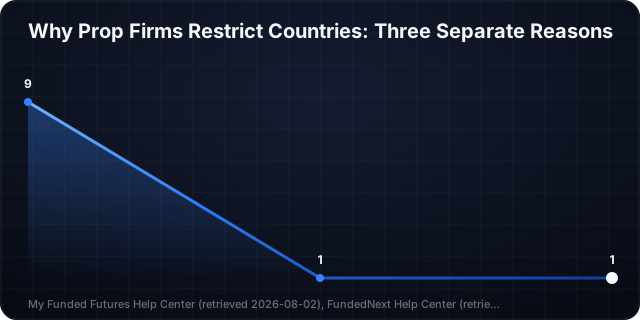
Why prop firms restrict countries at all: three separate reasons, often confused
A country name on a list tells you nothing useful on its own. What matters is why it is there, because the reason determines whether the restriction is absolute or conditional, and whether an alternative route exists.
Sanctions and OFAC-style compliance
The first bucket is sanctions. Cuba, Iran, North Korea, Syria, Russia, Belarus and Crimea all appear on My Funded Futures' restricted list (My Funded Futures Help Center, retrieved 2026-08-02), alongside the same jurisdictions that banks and payment processors decline. The firm's page does not name a specific sanctions programme, and neither will we on its behalf: read the overlap with international sanctions regimes, including US Office of Foreign Assets Control designations, as the likely mechanism rather than as something the firm has stated. My Funded Futures' Restricted Countries Policy names Cuba, Iran, North Korea, Syria, Russia, Belarus, Crimea, Sudan and Venezuela among a long list of restricted jurisdictions (My Funded Futures Help Center, retrieved 2026-08-02).
This bucket is absolute. No support ticket, no alternative entity, no workaround. A firm that offers you one is a firm telling you what it is willing to do with rules it finds inconvenient.
Licensing and regulatory authorization
The second bucket explains why wealthy, stable, heavily regulated countries turn up on restricted lists. It has nothing to do with sanctions. It is licensing: a firm may only offer certain services in a jurisdiction where it holds, or is exempt from needing, the relevant authorization.
My Funded Futures states plainly that it is unable to accept traders from the countries on its list due to regulatory restrictions and compliance requirements (My Funded Futures Help Center, retrieved 2026-08-02). That is a futures firm using the same language a CFD firm would. The mechanism generalises across firm types.
This bucket is where conditional answers live. A firm that cannot serve you through its global product may be able to serve you through a licensed affiliate, which is exactly what happens with the US, covered further down.
Operational constraints: payment processors, platforms and fraud exposure
The third bucket is the least discussed and the most common. Payment processors refuse certain corridors. Platform providers impose their own geographic terms. Fraud and chargeback rates in specific markets push a firm to close the door on commercial grounds alone.
FundedNext's help center is candid about this without itemising it. The firm writes that while its aim is to provide equal trading opportunities to individuals worldwide, due to certain constraints, FundedNext has decided to restrict access (FundedNext Help Center, retrieved 2026-08-02). "Certain constraints" is doing heavy lifting in that sentence, and the honest reading is that the reasons are commercial and operational as much as legal.
Bucket three is why two firms in the same niche can publish completely different lists. Their processors differ. Their platform contracts differ. Their fraud history differs.
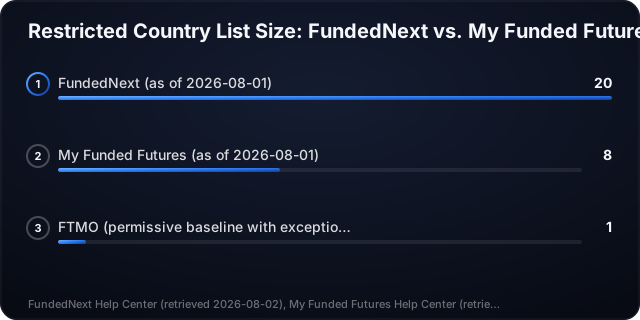
What the named firms actually publish (retrieved 2 August 2026)
Here is what three firms say in their own documents. Note the column that matters most: where the policy lives, so you can go and read it yourself rather than trusting this table six months from now.
| Firm | Where the policy is published | Stated rationale (firm's own wording) | Stated consequence | Retrieved |
|---|---|---|---|---|
| FundedNext | Help center article, "Are any countries restricted on FundedNext CFDs?" (help.fundednext.com) | "due to certain constraints, FundedNext has decided to restrict access" (FundedNext Help Center, retrieved 2026-08-02) | Account terminated in accordance with terms and policies (FundedNext Help Center, retrieved 2026-08-02) | 2 August 2026 |
| My Funded Futures | Help center article, "Restricted Countries Policy" (help.myfundedfutures.com) | "unable to accept traders from the below countries due to regulatory restrictions and compliance requirements" (My Funded Futures Help Center, retrieved 2026-08-02) | KYC documents required as part of identity verification (My Funded Futures Help Center, retrieved 2026-08-02) | 2 August 2026 |
| FTMO | FAQ page, "Who can join FTMO?" (ftmo.com/en/faq) | Global acceptance apart from listed exceptions, all clients over 18 (FTMO.com, retrieved 2026-08-02) | US clients routed to affiliated entity at ftmo.oanda.com (FTMO.com, retrieved 2026-08-02) | 2 August 2026 |
FundedNext's list, and why it is not what you think
As retrieved on 2 August 2026, FundedNext's help center lists residents and citizens of Bangladesh, Myanmar, Belarus, North Korea, Syria, Grenada, Chad, Malaysia, Belize, Antigua and Barbuda, Cape Verde, Tuvalu, Vietnam, Bouvet Island, Burundi, Cook Islands, Eritrea, Comoros, Sri Lanka and Fiji as unable to access its trading platform (FundedNext Help Center, retrieved 2026-08-02). Re-check the firm's page before you pay: lists like this change without notice.
Look at that list closely. Grenada, Antigua and Barbuda, Belize and Cape Verde are not sanctioned states. Their presence is a licensing and operational story, not a sanctions story. This is precisely why a scraped list republished on a comparison site is worse than useless: it strips the reason.
My Funded Futures' policy
The My Funded Futures list is far longer and includes several countries with large, active retail trading communities, among them China, Hong Kong, Malaysia, Pakistan, Ukraine, the United Arab Emirates and Vietnam, alongside the sanctions-driven entries (My Funded Futures Help Center, retrieved 2026-08-02). Re-check the firm's page before you pay: lists like this change without notice.
The comparison with FundedNext is the lesson. Malaysia and Vietnam appear on both. The UAE and Hong Kong appear on one. Two firms, one industry, different answers. There is no such thing as "the prop firm restricted countries list."
FTMO's baseline
FTMO states that, apart from the exceptions listed on its FAQ, it accepts clients globally, that no specific qualifications are required, and that all clients must be over the age of 18 (FTMO.com, retrieved 2026-08-02). Re-check the firm's page before you pay: lists like this change without notice.
That is a permissive baseline stated clearly, with the exceptions in the same document. It is the shape you want to see.
Verify before you pay: a five-minute check on the firm you are about to buy from
This is the part to actually do. It takes less time than reading a single comparison review.
1. Find the firm's own eligibility document
Search the firm's own domain, not the open web. Try the help center, the FAQ, and the terms of service. The document you want is usually called "Restricted Countries", "Who can join", or a numbered clause in the terms headed "Eligibility". If a comparison site is the only place you can find the firm's country rules, you have not found the firm's country rules.
2. Read the residency clause against the citizenship clause
These are not the same thing and firms differ on which they use. FundedNext's wording covers residents and citizens of restricted countries (FundedNext Help Center, retrieved 2026-08-02), which means a passport alone can trigger the rule even for someone who has lived elsewhere for a decade. Other firms test residency only. Read which word the document uses. If it uses both, both apply to you.
3. Check what the terms say happens if you are identified after purchase
This is the clause that decides what your fee was worth. FundedNext states that if a resident or citizen of any restricted country is identified as accessing or attempting to access its services, the associated account will be terminated in accordance with FundedNext's terms and policies (FundedNext Help Center, retrieved 2026-08-02).
Termination, not a refund conversation. Read your firm's equivalent clause and read it before the card is charged, because afterwards you are arguing against a term you already agreed to. The broader rulebook you are agreeing to is worth understanding in full; see our guide to funded account rules for beginners.
4. Ask support in writing and keep the reply
Policy pages update without notice, and the version you read is not necessarily the version enforced next quarter. Open a ticket, state your country of residence and your citizenship in plain words, ask whether you are eligible to purchase and to receive a payout, and save the reply as a PDF with the date visible. A screenshot of a live chat is weaker than an email but far better than nothing.
If a firm's answer is vague, that vagueness is itself the answer.
Where a restricted residency is actually caught: KYC and the first payout
Identity verification is the checkpoint
Nothing about your residency is meaningfully verified when you pay. It is verified when you submit documents. My Funded Futures states that traders are required to verify their identity by submitting Know Your Customer (KYC) documents as part of its identity-verification process (My Funded Futures Help Center, retrieved 2026-08-02).
Neither firm's published policy states at which moment those documents are demanded, so treat the timing as a question to put to support rather than a known constant. What the documents do establish is the order of operations: eligibility is proven at verification, long after the card is charged. The sequence an ineligible trader should fear is pay, trade, pass, request payout, get caught. Understanding what the withdrawal process involves in advance, including the documents it asks for, removes most of the surprise.
Residency versus temporary travel
There is real nuance here, and it belongs to individual firms rather than to the industry. My Funded Futures states that traders travelling to or vacationing in any of these restricted countries can execute trades on their accounts while there, but that it is highly recommended to inform the customer support team about trading plans in a restricted country. The same policy adds a hard limit: while trading in a restricted country is allowed, traders cannot purchase new accounts or reset current accounts during their stay there (My Funded Futures Help Center, retrieved 2026-08-02).
Read that carefully. It is one firm's stated position on temporary presence, not a general industry rule, and it is not permission to misstate where you live. Residency is a fact about you that the firm will eventually document. Telling support in advance that you will be trading from abroad is cheap; explaining an unexpected login location during a payout review is not.
Circumventing a restriction with a VPN is a different subject entirely, with different consequences, and we cover it separately rather than relitigating it here.
Can a US resident open a prop firm account? The conditional answer
Yes, conditionally, and the condition is which entity you are actually contracting with.
FTMO: served through an affiliated US entity
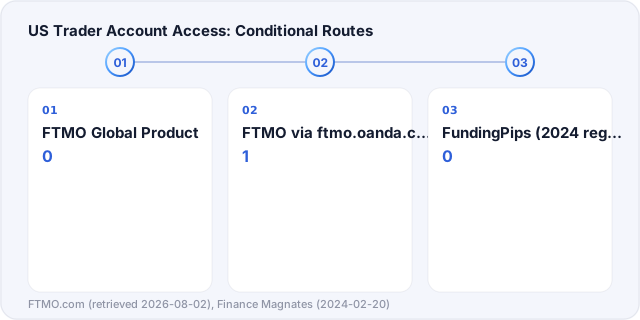
FTMO's own FAQ states that clients in the United States of America can use FTMO services facilitated via its affiliated entity at ftmo.oanda.com (FTMO.com, retrieved 2026-08-02). That is a licensing answer, not a sanctions answer. The global product is not offered to US persons; a separate affiliated entity is.
The OANDA partnership and what "simulated" means in it
FTMO announced on 26 August 2025 a strategic partnership with OANDA giving users in the United States access to an educational platform and simulated trading tools, with rewards earned through simulated trading using simulated capital (FTMO.com, retrieved 2026-08-02).
The phrase "simulated capital" is not a footnote there. It describes the product. A US trader routed to that entity is buying access to a simulated environment, exactly as an ITAfx trader is, and should read the entity's own terms rather than assuming the global brand's terms carry over.
Funding Pips, February 2024: what happens without approvals
The third possible meaning of "US allowed" is the expensive one. Finance Magnates reported in February 2024 that Funding Pips' trading-platform partnership had been terminated by the platform provider because the firm was serving clients from the USA without the necessary regulatory approvals, and reported in the same coverage that the firm then completed a full migration of user accounts and transaction history to a competing platform and came back online within about a week (Finance Magnates, retrieved 2026-08-02). Note what that was and was not: a supplier cutting the firm off, not a regulator sanctioning it.
Traders did not choose that outcome, and they did not cause it. Their platform simply stopped, and it took a scramble and a platform migration to restart it. So "we accept US clients" can mean a licensed affiliate, a different platform, or a firm operating beyond its approvals, and only the last one is invisible until it breaks.
What to check yourself
Find the entity name on the checkout page and in the terms, and confirm it is the one authorised to serve you. Confirm which platform your account will run on. Confirm whether any state-level condition applies. This is not legal advice and this article cannot give you any; the firm's own entity disclosure is the document that answers it. If your residency rules a firm out, comparing alternatives on how to choose the right prop firm, eligibility first, price second, is the right order.
Red flags: a firm whose eligibility rules you cannot find
No published restricted-country document. All three firms above publish theirs at a stable, findable URL. A firm that does not either has no policy or does not want you reading it.
Terms that reserve the right to terminate without stating the criteria. Compare that with FundedNext, which states both the criterion and the consequence in the same short article (FundedNext Help Center, retrieved 2026-08-02). A blank cheque to terminate is not a policy. The same instinct that catches a vague eligibility clause is the one to apply when checking whether a prop firm actually pays out.
Support that will not answer residency questions in writing. A firm that knows who it may lawfully serve can say so in an email. One that dodges is telling you about its compliance posture, and you are the one who will pay for it.
ITAfx publishes its own simulated-account terms, including account types and risk parameters, in its terms of service on itafx.com, and it is operated by Institutional Trading Academy Ltd, Saint Lucia, company no. 2025-00535 (itafx.com/terms-of-service/, retrieved 2026-08-02). Hold us to the same test you apply to everyone else: if you cannot find it in writing, do not accept it. If you are new to how evaluations work at all, start with what is a funded forex account before comparing eligibility rules.
Your pre-payment checklist
Run these before the card is charged. Every one is answerable yes or no.
- Have I found the firm's own eligibility or restricted-countries document on the firm's own domain?
- Does the document restrict by residency, by citizenship, or by both, and which applies to me?
- Is my country on the list as retrieved today, not as reported by a comparison site?
- Does the document state what happens to an account identified after purchase?
- Have I asked support in writing, naming my residence and citizenship, and saved the dated reply?
- Do I know which legal entity is on the checkout page and whether it is authorised to serve my country?
- Do I know which platform my account will run on, and whether that platform accepts my jurisdiction?
- Do I know what documents KYC will ask for before my first payout, and can I produce them today?
Every per-firm list in this article was retrieved on 2 August 2026. These lists change without notice. The workflow above is durable; the lists are not.
Ready to get funded?
50% off instant accounts with code 50CRYPTO.
Get Funded →Frequently Asked Questions
Which countries are restricted by prop firms?
There is no single industry list. Sanctions-related jurisdictions such as Cuba, Iran, North Korea, Syria, Russia, Belarus and Crimea appear on most lists (My Funded Futures Help Center, retrieved 2026-08-02), but beyond those, firms diverge sharply. FundedNext's list as retrieved on 1 August 2026 includes Malaysia, Vietnam, Sri Lanka, Grenada and Belize among others (FundedNext Help Center, retrieved 2026-08-02). Check the specific firm.
Can a US resident open a prop firm account?
Sometimes, through a separate entity. FTMO states that US clients can use its services via its affiliated entity at ftmo.oanda.com (FTMO.com, retrieved 2026-08-02), following a partnership announced on 26 August 2025 that gives US users access to an educational platform and simulated trading tools (FTMO.com, retrieved 2026-08-02). Verify the entity, not the brand.
Why do prop firms restrict some countries?
Three reasons, often confused: sanctions compliance, licensing and regulatory authorization, and operational limits such as payment processors and platform terms. My Funded Futures cites regulatory restrictions and compliance requirements (My Funded Futures Help Center, retrieved 2026-08-02); FundedNext cites "certain constraints" (FundedNext Help Center, retrieved 2026-08-02).
What happens if I buy an account and my country turns out to be restricted?
Read the firm's stated consequence. FundedNext states that an identified resident or citizen of a restricted country will have the associated account terminated in accordance with its terms and policies (FundedNext Help Center, retrieved 2026-08-02).
Can I trade while travelling in a restricted country?
It depends on the firm. My Funded Futures states that traders travelling or vacationing in a restricted country can execute trades while there, but highly recommends informing customer support of those plans (My Funded Futures Help Center, retrieved 2026-08-02). Do not assume another firm's policy matches.
When is my residency actually checked?
At identity verification. My Funded Futures requires traders to submit Know Your Customer (KYC) documents as part of its identity-verification process (My Funded Futures Help Center, retrieved 2026-08-02), which for most firms is triggered by the first withdrawal request.
Ready to get funded?
Instant accounts, simulated capital, rules published before you pay. 50% off with code 50CRYPTO.
Get Funded →