 ITA
ITAHow Prop Firm Payouts Are Taxed: 1099-NEC, W-9, W-8BEN
What prop firms actually publish about payout taxes: 1099-NEC thresholds, W-9 vs W-8BEN, gross reporting, and the questions to bring your accountant.

How this article is verified: Every number and claim above is checked against a primary source, ITAfx's own Terms of Service, official product pages, or the trading platform itself, before publication, then re-verified again immediately before this page goes live. Fact-checked and published on August 1, 2026 by Adrian Caldwell.
Short answer: a payout is income, and nobody withheld anything for you
Why a payout is not investment or capital-gains income
You did not deposit money into a brokerage account and watch it appreciate. You paid a fee for access to an evaluation environment, traded a simulated account, met the objectives, and requested a payout. The firm paid you for hitting a performance target. This is distinct from what a funded forex account actually is, which sets up the structure this payout comes out of.
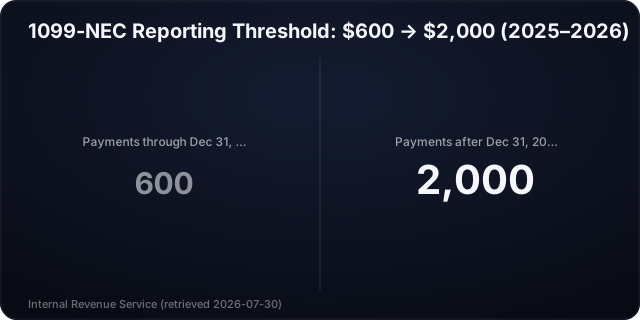
In United States terms, that shape has a name. The IRS states that Form 1099-NEC reports payments of $600 or more (rising to $2,000 for payments made after December 31, 2025) made in the course of a business to a person who is not an employee, for services (Internal Revenue Service, retrieved 2026-07-30). Services. Not securities sold, not positions closed at a gain.
This is why "can I treat my prop firm payouts as capital gains" tends to run into a wall. The number on the form the firm files describes compensation, not a disposal of an asset you owned.
Why the money arrives whole, and what that means in April
Read the three firms' own pages reviewed for this article and the same absence appears in each of them: no withholding line. Nothing is deducted and remitted to a tax authority on your behalf. FTMO's own FAQ states the trader, not FTMO, is solely responsible and liable for the payment of any and all taxes, levies, or fees that apply under the FTMO Account Agreement (FTMO.com, retrieved 2026-07-30).
If you are used to a paycheque, this is the trap. A paycheque arrives already net of tax. A payout arrives gross, and the liability arrives later, with you.
What this article is not, and who actually answers your case
Every firm quoted here says the same thing about advice, and so does this page. FTMO's own FAQ states it "is neither able nor authorised to provide any tax advice or instructions" (FTMO.com, retrieved 2026-07-30). Topstep's own Help Center states "Topstep can't give tax advice. What we can do is tell you exactly what forms we send, what you're responsible for, and how your 1099-NEC works" (Topstep Help Center, retrieved 2026-07-30). FundedNext's own Help Center answers the question with one word and a sentence: "No. FundedNext does not provide tax advice" (FundedNext Futures Help Center, retrieved 2026-07-30).
Neither can we. Your residency, your other income, your local rules, and your treaty position all change the answer, and none of them are visible from here. The last two sections of this article exist to make your appointment with a local tax professional short and useful.
Do you pay tax on it, and does the firm tell the tax authority?
1099-NEC: the $600 threshold, and the $2,000 threshold for payments after 31 December 2025
This is the fear underneath the query: does this show up somewhere official.
For US persons, often yes. The IRS rule is that a business reports payments totaling $600 or more, rising to $2,000 for payments made after 31 December 2025, made during the calendar year to a person who is not an employee, for services (Internal Revenue Service, retrieved 2026-07-30).
Read that twice, because two numbers live in one sentence and they apply to different periods. Payments through 31 December 2025 sit under the $600 figure. Payments made after that date sit under the $2,000 figure. A reader who blends them into a single threshold will either expect a form that never arrives or fail to expect one that does.
Topstep's own Help Center confirms the older threshold in live use: it "sent 2025 1099s on January 31, 2026, via email to US citizens who received over $600 in Payouts in 2025" (Topstep Help Center, retrieved 2026-07-30).
One thing the threshold does not do: decide whether the income is taxable. It decides whether a form gets filed. Those are separate questions, and the second one is your accountant's.
Gross, not net: why the form can show more than you received
Here is the detail that surprises first-time filers. Topstep's own Help Center states plainly that the IRS requires it to report the gross payout amount, before any fees (Topstep Help Center, retrieved 2026-07-30).
So if processing or transfer fees came out of a payout, the figure on the information return can be larger than the figure that hit your bank. The gap is not an error and it is not the firm's to reconcile for you. It is a documentation job, and it is yours: keep your own payout log, with dates, gross amounts, and every fee deducted.
That log is worth more than it looks. It is the difference between an accountant reconciling your return in ten minutes and an accountant asking you for records you never kept.
Nonemployee compensation, Schedule C, and the $400 self-employment tax line
Once income is reported as nonemployee compensation, the IRS's own guidance describes where it goes: an independent contractor is generally considered self-employed and should report nonemployee compensation on Schedule C (Form 1040) (Internal Revenue Service, retrieved 2026-07-30).
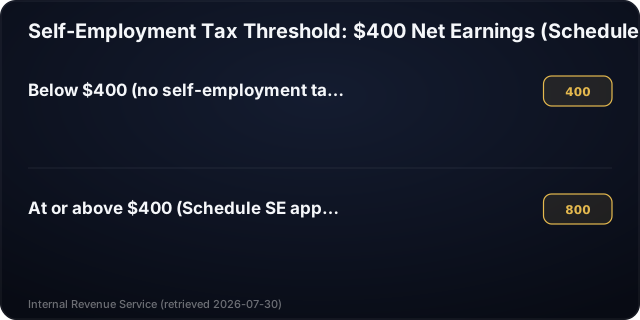
There is a second line most new filers miss. The IRS states that most self-employed individuals must pay self-employment tax, comprising Social Security and Medicare taxes, once net earnings from self-employment reach $400, calculated on Schedule SE (Form 1040) (Internal Revenue Service, retrieved 2026-07-30).
Note the asymmetry. The information-return threshold is measured in hundreds or thousands of dollars of payments received. The self-employment tax threshold is $400 of net earnings, and it does not wait for a form to arrive. No rates, no bracket arithmetic, and no worked example appear on this page, on purpose: those depend on your full picture.
The hidden rule: the forms you sign before your first withdrawal
W-9 before the first payout request, for US persons
Traders discover this at the worst moment, on the day they finally want their money. The tax form is not a year-end afterthought. At some firms it is a gate on the withdrawal itself, one more item alongside the profit split mechanics that determine what the gross payout figure even is before tax touches it.
FundedNext's own Help Center publishes it directly: "Only U.S. citizens and U.S. residents requesting a withdrawal must submit a W-9 form. You will be prompted to submit a W-9 before your first withdrawal request" (FundedNext Futures Help Center, retrieved 2026-07-30).
The practical read: if your legal name, address, or taxpayer identification number are not to hand, your first payout stalls on paperwork, not on trading. Sort that before you hit the button, not after.
W-8BEN if you are a non-US person outside the US
Non-US treatment is where the firms stop agreeing, and that divergence is the finding rather than something to smooth over.
Topstep's own Help Center routes a "Non-US citizen living outside the US" to a "W-8 BEN" rather than a W-9 (Topstep Help Center, retrieved 2026-07-30). FundedNext's own Help Center documents the opposite posture: "Non-U.S. traders do not need to submit any tax forms to FundedNext. FundedNext does not collect tax forms or issue tax documents for non-U.S. traders" (FundedNext Futures Help Center, retrieved 2026-07-30).
Both statements are published by the firms themselves. So the answer to "what tax form will I sign as a non-US trader" is genuinely firm-specific, and the only reliable source is the help centre of the firm actually paying you.
And note what a firm collecting no form does not mean. No form collected is not the same as no tax owed where you live. Your local obligation is set by your own jurisdiction, not by a firm's paperwork policy.
Delivery timing: January 31, by email and dashboard
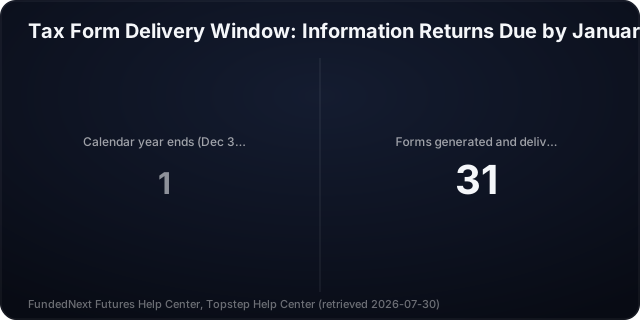
Where an information return does get issued, late January is the window to watch. FundedNext's own Help Center states its 1099-NEC forms are "Generated after the end of the calendar year. Delivered by January 31. Available via email and in your FundedNext Dashboard under Tax Documents" (FundedNext Futures Help Center, retrieved 2026-07-30). Topstep's 2025 forms went out on the same calendar date, 31 January 2026, by email (Topstep Help Center, retrieved 2026-07-30).
Two habits follow. Check the email address on your trading account is one you still read. And check the dashboard yourself in early February rather than waiting for an email that may have been filtered.
What each firm publishes in its own words
A prop firm payout is compensation for meeting performance objectives on a simulated evaluation account, not a gain on capital the trader deposited. Blank cells below mean the firm's own page does not state it; a blank is silence, not a "no." Collecting a W-9 is a separate column from issuing a 1099, because a firm can do one without the other.
| Firm | US tax form collected | Information return issued | Non-US person handling as published | Withholding |
|---|---|---|---|---|
| FTMO | Not stated | Not stated | Not stated | Not stated; trader solely liable for all taxes (FTMO.com, retrieved 2026-07-30) |
| Topstep | W-9 for US citizens anywhere in the world, and for resident aliens with an ITIN; W-8BEN for non-US persons outside the US (Topstep Help Center, retrieved 2026-07-30) | 1099-NEC for 2025 to US citizens over $600 in payouts, sent 31 January 2026 by email, reporting gross before fees (Topstep Help Center, retrieved 2026-07-30) | W-8BEN (Topstep Help Center, retrieved 2026-07-30) | Not stated |
| FundedNext | W-9, required before the first withdrawal request, US citizens and residents only (FundedNext Futures Help Center, retrieved 2026-07-30) | 1099-NEC, generated after year-end, delivered by January 31 by email and dashboard (FundedNext Futures Help Center, retrieved 2026-07-30) | No forms collected, no tax documents issued (FundedNext Futures Help Center, retrieved 2026-07-30) | Not stated |
| ITAfx | See ITAfx's own published payout terms on itafx.com | See ITAfx's own published payout terms on itafx.com | See ITAfx's own published payout terms on itafx.com | See ITAfx's own published payout terms on itafx.com |
Where all three agree: no tax advice, and the liability is yours
The columns diverge. The bottom line does not. FTMO's own FAQ states it "is neither able nor authorised to provide any tax advice or instructions" (FTMO.com, retrieved 2026-07-30). Topstep's own Help Center states "Topstep can't give tax advice" (Topstep Help Center, retrieved 2026-07-30). FundedNext's own Help Center states "No. FundedNext does not provide tax advice" (FundedNext Futures Help Center, retrieved 2026-07-30). And FTMO's own FAQ states the trader is "solely responsible and liable for the payment of any and all taxes, levies, or fees" (FTMO.com, retrieved 2026-07-30).
Three firms, three documentation styles, one shared boundary. Anyone promising you a definitive prop-firm tax answer is claiming a certainty the firms themselves decline to claim.
Employee, contractor, or investor? What the agreements actually say
Why firms describe the relationship by contract, not by label
The queries want a label. The documents give a contract.
FTMO's own FAQ on the legal relationship between a trader and FTMO does not call the trader an employee, a contractor, or an investor. It states: "The relationship between an FTMO Trader and FTMO is based on the FTMO Account Agreement that we will sign with you" (FTMO.com, retrieved 2026-07-30).
That is not evasion. It is precise. The rights, obligations, and payment terms live in a signed agreement, and the answer to "what am I" depends on that document plus the law where you file, not on a word the firm chose to use in a FAQ.
Why "independent contractor" is a tax-filing consequence, not a job title the firm grants
The label most readers arrive with comes from the tax side, not the firm side. A 1099-NEC reports nonemployee compensation for services (Internal Revenue Service, retrieved 2026-07-30), and the IRS guidance for a recipient of that form is that an independent contractor is generally considered self-employed and reports the income on Schedule C (Form 1040) (Internal Revenue Service, retrieved 2026-07-30).
So the sequence runs form first, filing status second. No firm "makes you a contractor." The paperwork describes a payment for services, and your filing follows from that description and from your own facts.
The limit of this section, stated plainly: it shows what the published documents say. It does not classify your situation, and nothing here speaks to employment-law status, benefits, or worker-classification tests. Those questions are outside what the sources support.
Before you take a definitive-sounding answer from a trading influencer, read our guide to vetting a self-described expert who is selling you a course instead of filing your return.
Twelve questions to bring your tax professional
Copy this into an email. Every question is framed so a professional with local knowledge can answer it, and none of them is answered on this page.
Questions about the payout itself
- My payouts are compensation for a service performed on a simulated evaluation account, not gains on capital I deposited. How should that be classified on my return where I live?
- If a firm issues me a 1099-NEC as nonemployee compensation, which schedule does that income belong on for me, and does Schedule C apply to my facts? (Internal Revenue Service, retrieved 2026-07-30)
- My net earnings from this activity may exceed $400. Does self-employment tax on Schedule SE apply to me this year? (Internal Revenue Service, retrieved 2026-07-30)
- Do I need to make estimated payments during the year, given that no firm withheld anything from my payouts? (FTMO.com, retrieved 2026-07-30)
- Payments through 31 December 2025 sit under a $600 reporting threshold and later payments under $2,000. Does that change what I should expect to receive, or what I must report? (Internal Revenue Service, retrieved 2026-07-30)
Questions about deductions and record-keeping
- My 1099-NEC shows gross payouts before processing fees. How should I document those fees so the reported figure reconciles with what I actually received? (Topstep Help Center, retrieved 2026-07-30)
- Challenge and evaluation fees are fees for access to a simulated environment, not trading losses on deposited funds. Are they deductible as a business expense in my situation?
- Which records do you want me to keep monthly: payout confirmations, fee receipts, platform subscriptions, anything else?
- Should this activity be reported in my own name or through an entity, and what changes if it does?
Questions if you are outside the US
- One firm asks non-US traders for a W-8BEN and another states it collects no tax forms from non-US traders at all. Does either fact affect what I owe locally? (Topstep Help Center, retrieved 2026-07-30) (FundedNext Futures Help Center, retrieved 2026-07-30)
- If no firm issues me any document, what evidence of income does my tax authority expect from me?
- Is there a treaty position between my country and the firm's country that I need to declare, and which form does that require?
Before your first payout request: a short checklist
Confirm the legal name and country on your account match your identity document before you request anything, because a mismatch stalls the payout at the paperwork stage rather than the trading stage. If you are a US person, expect a tax-form prompt as part of the withdrawal flow, not as a year-end email (FundedNext Futures Help Center, retrieved 2026-07-30). Keep your own payout log with gross amounts and every fee, because an information return reports gross (Topstep Help Center, retrieved 2026-07-30). Diarise late January and check both your email and your dashboard (FundedNext Futures Help Center, retrieved 2026-07-30).
For the mechanics of the request itself, see how a payout request actually works, step by step, which this article deliberately does not restate. For the objectives that have to be satisfied before a payout exists to be taxed, see the account rules explained for beginners. If your first information return is coming because payouts have become a pattern rather than an event, this account of reaching a repeating withdrawal cadence and our notes on scaling once payouts are recurring are the next reads. ITAfx's own payout terms are published on itafx.com, and those terms, not this article, govern an ITAfx payout.
Ready to get funded?
50% off instant accounts with code 50CRYPTO.
Get Funded →Frequently Asked Questions
Are prop firm payouts taxable?
Firms do not answer that question and neither do we. What is documented is that no firm quoted here withholds tax, and that FTMO's own FAQ states the trader is "solely responsible and liable for the payment of any and all taxes, levies, or fees" (FTMO.com, retrieved 2026-07-30). Whether and how the income is taxed depends on your jurisdiction and your facts, which is a question for a local professional.
Will I get a 1099 from a prop firm?
If you are a US person and the firm issues information returns, possibly. The IRS threshold is $600, rising to $2,000 for payments made after 31 December 2025 (Internal Revenue Service, retrieved 2026-07-30). Topstep issued 2025 forms to US citizens who received over $600 in payouts that year (Topstep Help Center, retrieved 2026-07-30). FundedNext delivers by January 31 via email and dashboard (FundedNext Futures Help Center, retrieved 2026-07-30).
Do prop firms withhold tax from payouts?
None of the published pages reviewed here describes a withholding process. FTMO's own FAQ instead states the tax liability is solely the trader's (FTMO.com, retrieved 2026-07-30). Plan on receiving the gross amount and owing later.
Is a prop firm payout self-employment income?
A 1099-NEC reports nonemployee compensation for services (Internal Revenue Service, retrieved 2026-07-30), and the IRS states an independent contractor is generally considered self-employed and reports on Schedule C (Form 1040) (Internal Revenue Service, retrieved 2026-07-30). Whether that describes you is a filing question for your professional, not a status a firm assigns.
Why does my 1099 show more than I was paid?
Because it reports gross. Topstep's own Help Center states the IRS requires it to report the gross payout amount before any fees (Topstep Help Center, retrieved 2026-07-30). Keep fee receipts so the difference is documented.
What form do non-US traders sign?
It depends on the firm. Topstep's own Help Center directs a non-US citizen living outside the US to a W-8BEN (Topstep Help Center, retrieved 2026-07-30). FundedNext's own Help Center states non-US traders submit no tax forms and receive no tax documents from it (FundedNext Futures Help Center, retrieved 2026-07-30). Check the help centre of the firm paying you.
Ready to get funded?
Instant accounts, simulated capital, rules published before you pay. 50% off with code 50CRYPTO.
Get Funded →