 ITA
ITAProp Firm Max Lot Size and Position Limits: What Firms Cap
How FTMO, FundedNext, Topstep and MyFundedFutures cap lot size and open contracts, from each firm's own rules, and why CFD and futures caps differ.

How this article is verified: Every number and claim above is checked against a primary source, ITAfx's own Terms of Service, official product pages, or the trading platform itself, before publication, then re-verified again immediately before this page goes live. Fact-checked and published on August 5, 2026 by Adrian Caldwell.
The short answer: there is no single "max lot size" in prop trading
The two cap mechanisms in one paragraph
A lot is the standard unit of trade size on forex and CFD accounts; a contract is the equivalent unit on futures. The two account types cap them differently, and the difference is structural, not cosmetic. On CFD and forex accounts, the number that stops you is normally your available margin and your loss limit, with a platform-level order ceiling sitting behind them as a backstop. On futures accounts, the firm publishes a maximum number of contracts you may hold open at one time, per account, and the platform simply rejects order number six when the cap is five.
That means the same question, "how many lots can I trade," has a table answer on futures and a calculation answer on forex.
Which firms use which
FTMO and FundedNext are CFD and forex firms. FTMO publishes one hard number: a 50-lot maximum volume per order on Forex as set in the platform settings, regardless of trading style or strategy (FTMO FAQ, retrieved 2026-08-02). FundedNext states plainly that it sets no maximum lot size on its CFD Challenge Accounts or on FundedNext Accounts after the Challenge phase, as long as margin and platform rules are respected (FundedNext Help Center, retrieved 2026-08-02).
Topstep and MyFundedFutures are futures firms, and both publish per-account contract tables. Both also shrink the number in some circumstances, which is the part traders miss. If futures accounts are new territory, the dedicated futures funded-account guide covers the account structure before the contract math matters.
Will the cap stop you getting paid? What the rule actually does
Hard numeric caps vs discretionary exposure clauses
Breaching a published numeric cap is normally a rejected order, not a failed account. The platform will not fill volume above the ceiling, so the practical consequence is an execution you did not get, at a price you wanted.
The clause that carries real account risk is the discretionary one. It is exposure-based rather than ticket-based, and the judgement belongs to the firm: FundedNext, for example, warns that overuse of margin can be flagged as risky behavior even when no loss limit has been breached (FundedNext Help Center, retrieved 2026-08-02). It is not a number you can look up before you trade. Correlated exposure across pairs is its own discipline; see how correlated pairs compound risk on funded accounts for the mechanics.
FundedNext's language has the same shape from the other direction. Even with no fixed lot cap, overuse of margin without breaching a loss limit may still be flagged as risky behavior (FundedNext Help Center, retrieved 2026-08-02).
Why "no fixed cap" does not mean "no cap"
Three things bind a forex position even when the firm publishes no lot ceiling: your margin, your daily and total loss limits, and the firm's judgement about concentrated exposure. Two of those are arithmetic. The third is a clause. A trader who plans around "no maximum lot size" and ignores the risky-behavior wording has read half the rule. The same misreading pattern shows up in how traders breach drawdown limits without realizing it: the published number is never the whole rule.
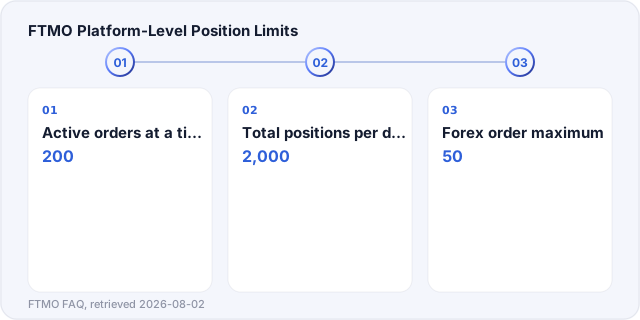
FTMO also discloses platform-level server limits that are distinct from the per-order lot cap: 200 active orders at a time and 2,000 total positions per day, with additional protections against expert advisors overloading the server with messages (FTMO FAQ, retrieved 2026-08-02). Those numbers rarely matter to a discretionary trader. They matter a great deal to anyone running a high-frequency-style automated book.
If you are arriving without context on what else an evaluation imposes, start with the broader rule set.
CFD and forex accounts: margin, platform ceilings and per-order limits
FTMO: 50 lots per Forex order, plus server-level order and daily position limits
FTMO's FAQ states the maximum volume per order on Forex, as per the platform settings, is 50 lots, regardless of trading style or strategy used (FTMO FAQ, retrieved 2026-08-02). Note the wording: per order. It is a per-ticket ceiling, not a per-account exposure ceiling.
FundedNext: no fixed cap on standard accounts, explicit caps in the Monthly Competition
FundedNext's Help Center is explicit that there is no fixed maximum lot size across Stellar 1-Step, Stellar 2-Step and Stellar Lite Challenge accounts, nor on FundedNext Accounts after the Challenge phase (FundedNext Help Center, retrieved 2026-08-02).
The exception is a different product. FundedNext's Monthly Trading Competition, which is not a standard Challenge or funded account, enforces a maximum of 5 open positions at a time, a 5-lot maximum on Forex pairs, and a 3-lot maximum on Indices and Commodities (FundedNext Help Center, retrieved 2026-08-02). If you read a forum post claiming FundedNext caps you at 5 lots, this is almost certainly the rule being quoted, applied to the wrong product.
What actually binds first: margin, loss limit, or the ceiling
On a CFD or forex evaluation, run the order in that sequence. Margin decides whether the order can open. The daily and total loss limits decide how far it can move against you before the account is done. The platform ceiling decides only whether you have to split the ticket. For most retail-sized accounts, the loss limit binds long before 50 lots does, which is why sizing work belongs in risk management method rather than in a lot-size lookup.
Futures accounts: a fixed contract number tied to account size
MyFundedFutures: Builder is flat, Flex scales with balance
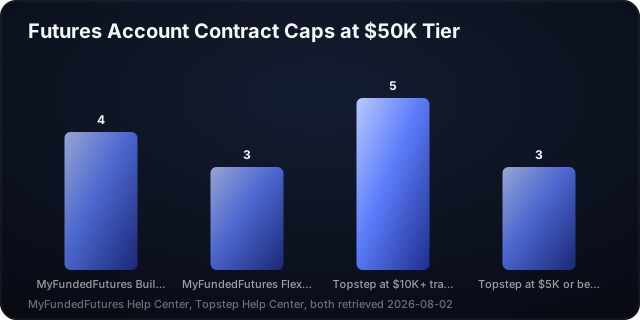
MyFundedFutures publishes two different structures. The Builder Plan $50K account carries a maximum of 4 minis, or 40 micros, and that number is identical in the evaluation stage and the sim-funded stage, with no scaling of the contract cap on this plan (MyFundedFutures Help Center, retrieved 2026-08-02).
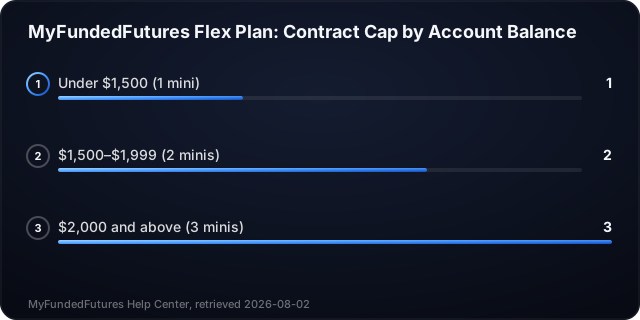
The Flex Plan $50,000 account scales instead. In its sim-funded stage the cap is 1 mini or 10 micros from $0 to $1,499, 2 minis or 20 micros from $1,500 to $1,999, and 3 minis or 30 micros at $2,000 and above (MyFundedFutures Help Center, retrieved 2026-08-02).
How micros are counted against the limit
This is where traders miscount. MyFundedFutures uses the same ratio in its published caps, quoting 4 minis as 40 micros (MyFundedFutures Help Center, retrieved 2026-08-02). Micros do not buy you extra room. They buy you finer granularity inside the same room.
The comparison table: published caps at the $50K tier, side by side
| Firm | Product/plan | Account type | Stage the cap applies to | Published cap | Cap mechanism | Source |
|---|---|---|---|---|---|---|
| FTMO | Platform servers | CFD/forex | Evaluation and funded | 200 active orders at a time; 2,000 positions per day | Fixed platform-level number | FTMO FAQ, retrieved 2026-08-02 |
| FundedNext | Stellar 1-Step, 2-Step, Lite | CFD/forex | Challenge and FundedNext Account | No fixed maximum lot size | Margin-only, plus risky-behavior judgement | FundedNext Help Center, retrieved 2026-08-02 |
| FundedNext | Monthly Trading Competition | CFD/forex | Competition only | 5 open positions; 5 lots Forex; 3 lots Indices/Commodities | Fixed number | FundedNext Help Center, retrieved 2026-08-02 |
| Topstep | Live Funded Account | Futures | Funded | Tightens to 5 contracts at $10,000 tradable balance or below, 3 at $5,000 or below | Fixed number, balance-linked | Topstep Help Center, retrieved 2026-08-02 |
| MyFundedFutures | Builder Plan $50K | Futures | Evaluation and sim-funded | 4 minis or 40 micros, both stages | Fixed number, no scaling | MyFundedFutures Help Center, retrieved 2026-08-02 |
| MyFundedFutures | Flex Plan $50,000 | Futures | Sim-funded | 1 mini under $1,500; 2 minis $1,500 to $1,999; 3 minis at $2,000+ | Fixed number, balance-linked | MyFundedFutures Help Center, retrieved 2026-08-02 |
Cells are left out rather than estimated where a firm does not publish the figure at this tier.
When the cap shrinks: balance-linked limits on funded accounts
Topstep: 5 contracts at $10,000 tradable balance, 3 at $5,000
On Topstep's Live Funded Account, the standard Maximum Position Size adjusts automatically as tradable balance falls: 5 contracts once tradable balance reaches $10,000 or below, and 3 contracts once it reaches $5,000 or below. Those limits update on Fridays and return to standard levels once balance rises back above the thresholds (Topstep Help Center, retrieved 2026-08-02).
Read the cadence, not just the number. A drawdown on Monday does not necessarily cut your size that afternoon, and a recovery on Monday does not necessarily restore it that afternoon either. The update happens on Fridays (Topstep Help Center, retrieved 2026-08-02).
MyFundedFutures Flex: the cap climbs as balance climbs
The Flex $50,000 plan runs the same logic from the bottom up: you start the sim-funded stage at 1 mini or 10 micros below $1,500, reach 2 minis at $1,500, and 3 minis at $2,000 and above (MyFundedFutures Help Center, retrieved 2026-08-02).
The trap in both cases is identical. A trader sizes a recovery plan on the headline cap, takes a drawdown, and finds the cap has shrunk exactly when the plan needed it most. Recovering a loss with fewer contracts than you lost it with is a different, slower problem than the one you planned for. Because the trigger is a balance threshold, how drawdown is calculated directly determines when your size gets cut.
How to size the account to your strategy before you pay
Work backwards from worst-case open exposure, not headline size
Start with the largest position your strategy actually holds at once, including scale-ins and correlated pairs. Then ask which account tier still holds that position after a realistic drawdown, not before one. On futures with a balance-linked cap, that is a hard structural constraint: below the threshold, the size simply is not available. On CFD accounts, the loss limit almost always binds before the lot ceiling, so the question becomes how much room your stop needs rather than how many lots the platform allows.
Check the funded-stage rule, not just the evaluation rule
The two stages are not always the same document. Contract limits are also one of the places that change over time under a scaling plan.
Verify on the firm's own documentation before paying
Every figure above comes from the firm's own FAQ, Help Center or terms, and every one of them can change without notice. Open the source page, confirm the tier you are buying, and confirm the stage. If you are comparing firms on fees and rules more broadly, that comparison sits alongside this one rather than inside it.
Where ITAfx sits
ITAfx is an instant-funding firm: funded accounts run from $50K to $400K in simulated capital, with no evaluation time limits, on the third-party platform platform (itafx.com/llms.txt, retrieved 2026-08-02). Account terms, including any platform-level position parameters, are published on itafx.com and are the version you should check before purchase, rather than a table in a blog post that ages. If the simulated-versus-live distinction is new to you, the demo and funded account comparison covers it.
Ready to get funded?
50% off instant accounts with code 50CRYPTO.
Get Funded →Frequently Asked Questions
What is the maximum lot size at a prop firm?
There is no industry-wide number. CFD and forex firms typically cap exposure through margin and loss limits rather than a fixed lot size, while futures firms publish a fixed maximum contract count per account tier, as shown by FTMO, FundedNext, Topstep and MyFundedFutures (respective Help Centers/FAQs, retrieved 2026-08-02).
Does FTMO have a lot limit?
Yes. FTMO states the maximum volume per order on Forex, per the platform settings, is 50 lots, regardless of trading style or strategy (FTMO FAQ, retrieved 2026-08-02).
Does FundedNext limit lot size?
Not on its standard products. FundedNext states it sets no maximum lot size on CFD Challenges or FundedNext Accounts, provided margin is managed responsibly, though overuse of margin may be flagged as risky behavior (FundedNext Help Center, retrieved 2026-08-02). Its Monthly Trading Competition is separate and does cap size at 5 lots on Forex and 3 on Indices and Commodities (FundedNext Help Center, retrieved 2026-08-02).
How many contracts can I trade on a $50K futures account?
It depends on the firm and plan. MyFundedFutures publishes 4 minis or 40 micros on the Builder Plan $50K (MyFundedFutures Help Center, retrieved 2026-08-02), and a balance-scaled 1 to 3 minis on the Flex Plan $50,000 sim-funded stage (MyFundedFutures Help Center, retrieved 2026-08-02).
Does the limit change after I pass?
Sometimes. MyFundedFutures Builder keeps the same 4-mini cap in evaluation and sim-funded (MyFundedFutures Help Center, retrieved 2026-08-02), while Topstep's Live Funded Account tightens Maximum Position Size to 5 contracts at $10,000 tradable balance or below and 3 at $5,000 or below, updating on Fridays (Topstep Help Center, retrieved 2026-08-02).
What happens if I exceed a published cap?
On CFD and forex platforms, an order above the published ceiling is typically rejected rather than filled, meaning the practical consequence is a missed execution, not a failed account; the account-risk clauses instead come from discretionary, exposure-based rules the firm applies at its judgement, as FundedNext's own risky-behavior language illustrates (FundedNext Help Center, retrieved 2026-08-02).
Ready to get funded?
Instant accounts, simulated capital, rules published before you pay. 50% off with code 50CRYPTO.
Get Funded →