 ITA
ITAProp Firm Inactivity Rules: How Long Before Your Account Expires?
How many days without trading closes a prop firm account? FTMO, FundedNext and Topstep rules quoted from their own docs, plus which pauses stop the clock.

How this article is verified: Every number and claim above is checked against a primary source, ITAfx's own Terms of Service, official product pages, or the trading platform itself, before publication, then re-verified again immediately before this page goes live. Fact-checked and published on July 31, 2026 by Adrian Caldwell.
The short answer: 30 days is the common inactivity limit, but the clock differs by firm
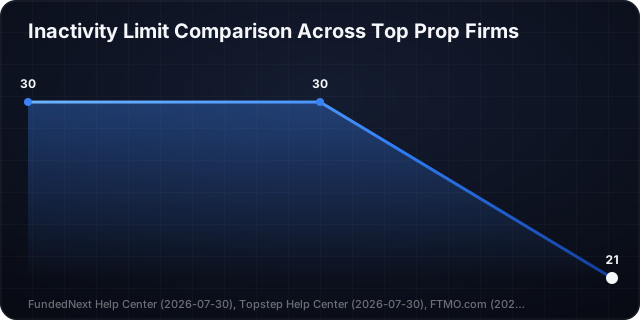
Three firms, three documented positions. FundedNext accounts, including Stellar 1-Step, Stellar 2-Step, Stellar Lite, and Stellar Instant, expire after 30 days of inactivity (FundedNext Help Center, retrieved 2026-07-30). Topstep Express Funded Accounts (XFAs) with no trading activity for more than 30 days may be closed (Topstep Help Center, retrieved 2026-07-30). FTMO takes a softer, contact-first line: if a trader leaves an account inactive for a few weeks, FTMO says it will contact the trader to confirm the account is not sitting unused on its server (FTMO.com, retrieved 2026-07-30).
So 30 days is the number you will see most often. It is not a standard, it is a coincidence of three separate rulebooks, and one of the three ("may be closed") is discretionary rather than automatic. This sits alongside other documented account limits, such as prop firm weekend holding rules, that many traders assume are uniform and are not.
What counts as "activity": an opened position, not a login
This is where readers lose accounts. FundedNext's own wording describes the trigger as a trader not placing a trade on the account for 30 consecutive calendar days (FundedNext Help Center, retrieved 2026-07-30). Topstep's wording is "no trading activity" (Topstep Help Center, retrieved 2026-07-30). Neither firm defines a login, chart time, or a watchlist edit as the thing that resets the count. FundedNext tells traders to "log in and trade to stay active" (FundedNext Help Center, retrieved 2026-07-30), and the condition it actually publishes is placing a trade within the 30 consecutive calendar days.
Treat the clock as resetting only when a position opens. If your firm's documentation says something different for your account type, that documentation wins over this page.
Why nobody publishes a universal number
There is no industry body setting inactivity policy, and each firm sets the rule for its own server costs and its own account stages. Aggregator glossary pages flatten this into "usually 30 days," which is true on average and useless in the one case that matters: yours. The number that applies to you sits in your firm's help center, under your account type, and it can change. If you are still comparing options at the outset, see what a prop firm challenge actually involves before assuming every evaluation runs on the same clock.
Two clocks people confuse: challenge expiry vs inactivity expiry
A challenge with no deadline can still be closed for sitting still. These are two different rules, and removing one does not remove the other.
FTMO: no maximum time limit since July 2023
FTMO states there is no maximum time limit to complete the FTMO Challenge, for both the 1-Step and 2-Step evaluations (FTMO.com, retrieved 2026-07-30). That was a change, not an original design: in July 2023 FTMO removed the 30- and 60-calendar-day time limits from its Evaluation Process, which also made free repeats and 14-day extensions unnecessary (FTMO.com, retrieved 2026-07-30).
Read that carefully, because it is often quoted as "FTMO has no time pressure." What was removed is the deadline to finish. Nothing in that announcement says an account can be left untouched forever.
Inactivity is a separate rule that survives the removal of time limits
FTMO's own blog post announcing the end of time limits also describes the inactivity behaviour in the same breath: leave an account inactive for a few weeks and FTMO will contact you to make sure it is not sitting unused on its server (FTMO.com, retrieved 2026-07-30). That is the second clock, still running, published alongside the removal of the first.
The practical translation: "no deadline to pass" and "no consequence for not trading" are not the same sentence. Firms that publish both rules expect you to read both.
Calendar days, not trading days: how the count actually runs
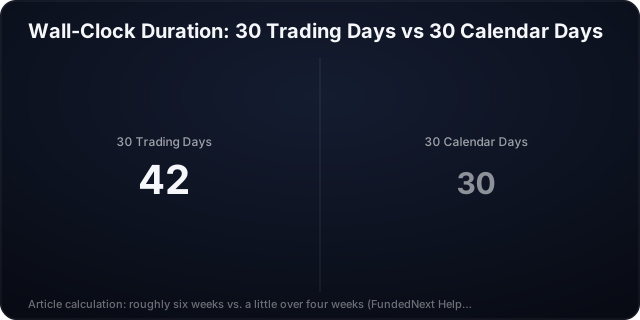
Here is the sentence most likely to cost a reader an account. FundedNext counts the 30-day inactivity period in consecutive calendar days, which means weekends and holidays are included in the count (FundedNext Help Center, retrieved 2026-07-30).
"Trading days" and "calendar days" are different conditions. They must never be read as equivalent. Thirty trading days is roughly six weeks of wall-clock time. Thirty calendar days is a little over four weeks. If you assume the friendlier definition and your firm uses the stricter one, you lose about two weeks of margin you thought you had.
Weekends and holidays are inside the count
FundedNext says so explicitly (FundedNext Help Center, retrieved 2026-07-30). Every Saturday and Sunday in your break is a day spent. So is a market holiday when you could not have traded even if you wanted to.
There is also no negotiation available at FundedNext: the firm does not offer the option to extend or customize the inactivity period, and the policy applies uniformly to all accounts (FundedNext Help Center, retrieved 2026-07-30).
Why a two-week holiday plus a slow week is already close to the edge
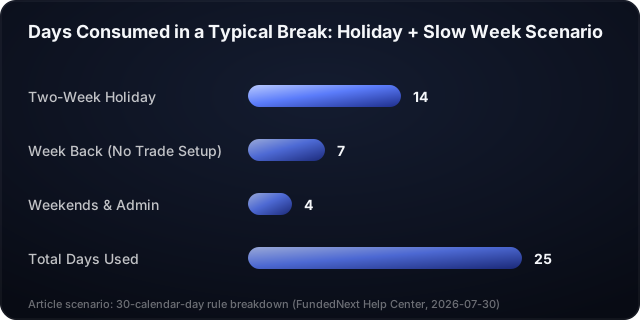
Count it out on a 30-calendar-day rule. Fourteen days away. Then a week back at your desk waiting for a setup that never appears, because you are disciplined: 21 days. A weekend either side of that, plus a couple of days of admin, and you are at 25 or more with no trade placed. Nothing about that sequence looks reckless. It looks like patience. On a calendar-day clock, patience and absence count the same.
Inactivity rules by firm and account stage (documented)
Empty cells mean the firm publishes nothing on that point in the pages cited here, not that the answer is zero or unlimited.
| Firm | Account stage | Documented inactivity limit | Unit of counting | Pause/freeze available | Extension offered |
|---|---|---|---|---|---|
| FTMO | Challenge / evaluation (1-Step and 2-Step) | No maximum time limit to complete (FTMO.com, retrieved 2026-07-30); FTMO contacts the trader after "a few weeks" of inactivity (FTMO.com, retrieved 2026-07-30) | Not published as a day count | Yes, a requested "freeze", i.e. a pause, especially for planned longer inactivity such as a holiday (FTMO.com, retrieved 2026-07-30) | Time limits and 14-day extensions removed in July 2023 (FTMO.com, retrieved 2026-07-30) |
| FundedNext | Stellar 1-Step, Stellar 2-Step, Stellar Lite | Expires after 30 days of inactivity (FundedNext Help Center, retrieved 2026-07-30) | 30 consecutive calendar days, weekends and holidays included (FundedNext Help Center, retrieved 2026-07-30) | Yes, self-service pause on an active CFD account, 30 days maximum, one-time use per account lifetime (FundedNext Help Center, retrieved 2026-07-30) | No, the period cannot be extended or customized (FundedNext Help Center, retrieved 2026-07-30) |
| FundedNext | Stellar Instant (funded stage) | Expires after 30 days of inactivity (FundedNext Help Center, retrieved 2026-07-30) | 30 consecutive calendar days, weekends and holidays included (FundedNext Help Center, retrieved 2026-07-30) | Yes, same one-time 30-day CFD pause (FundedNext Help Center, retrieved 2026-07-30) | No (FundedNext Help Center, retrieved 2026-07-30) |
| Topstep | Express Funded Account (XFA) | May be closed after more than 30 days with no trading activity (Topstep Help Center, retrieved 2026-07-30) | Published as days without trading activity | No, XFAs cannot be put on hold (Topstep Help Center, retrieved 2026-07-30) | Not published |
Evaluation-stage entries
At the evaluation stage the two structures are opposites. FTMO publishes no day count for inactivity at all and instead describes contacting the trader (FTMO.com, retrieved 2026-07-30), on top of an evaluation with no maximum time limit (FTMO.com, retrieved 2026-07-30). FundedNext publishes a hard number, 30 days, and applies it to Stellar 1-Step, 2-Step and Lite alike (FundedNext Help Center, retrieved 2026-07-30).
Funded-stage entries
The funded stage is where the rule bites hardest, because there is more to lose. FundedNext's 30-day expiry covers Stellar Instant accounts by name (FundedNext Help Center, retrieved 2026-07-30). Topstep's XFAs sit at the strict end: more than 30 days without trading activity may end the account (Topstep Help Center, retrieved 2026-07-30), and there is no hold available to prevent it (Topstep Help Center, retrieved 2026-07-30). Understanding how a stage transition works in the first place helps here too; see how long it takes to get funded at a prop firm.
Which pauses actually stop the clock
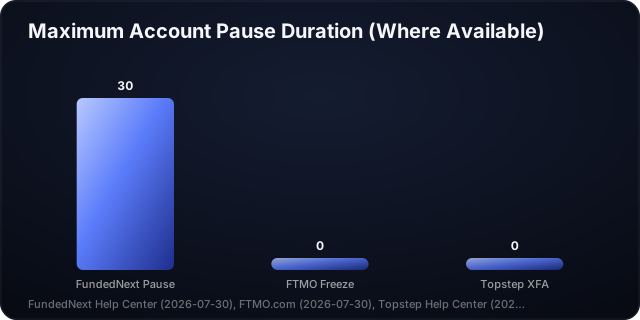
Three published mechanisms, three very different levels of protection.
Request-based freeze vs self-service pause
FTMO's is request-based. Its traders can request a so-called "freeze", i.e. a pause, of an account, especially in case of planned longer inactivity such as a holiday (FTMO.com, retrieved 2026-07-30). You ask, in advance, before the absence, not after you come back to a closed account.
FundedNext's is self-service and much more tightly capped. A trader can pause an active CFD account directly from the Account Overview page with a single click; the maximum pause duration is 30 days, and it is a one-time use feature per account (FundedNext Help Center, retrieved 2026-07-30). Eligibility is conditional: the account must have no open trades, no pending KYC verification, no pending withdrawals, and must not be under review (FundedNext Help Center, retrieved 2026-07-30).
Read the last clause again. One time. Per account lifetime. Spend it on a long weekend in month two and it is not there for the family emergency in month nine. And because FundedNext does not extend or customize the inactivity period for anyone (FundedNext Help Center, retrieved 2026-07-30), the pause is the only lever, and it only works once.
When no pause exists: plan around the rule instead
Topstep Express Funded Accounts cannot be put on hold (Topstep Help Center, retrieved 2026-07-30), while accounts with no trading activity for more than 30 days may be closed (Topstep Help Center, retrieved 2026-07-30). There is no escape hatch to request. The only defence is scheduling: know your last trade date, and do not let a planned absence run past the documented window.
If a rule set genuinely does not fit your calendar, that is a legitimate reason to compare firms rather than to fight the rule, the same way it is worth comparing before you commit to any funded account rules more broadly.
What to do before a planned break from trading
- Find the rule for your exact account type. Not the firm's brand-level FAQ, and not a glossary page. FundedNext names the specific products its 30-day expiry covers (FundedNext Help Center, retrieved 2026-07-30); Topstep's parameter page is specific to Express Funded Accounts (Topstep Help Center, retrieved 2026-07-30).
- Check whether the firm contacts you first. FTMO says it does, after a few weeks of inactivity (FTMO.com, retrieved 2026-07-30). Others simply expire the account. Assume nobody will email you unless the firm says in writing that it will.
- Log the date of your last opened position. One line in a note, updated each time you trade. It is the only date the clock cares about.
- Request the freeze or pause before you leave. FTMO's freeze is for planned longer inactivity (FTMO.com, retrieved 2026-07-30). FundedNext's pause is one-time and capped at 30 days (FundedNext Help Center, retrieved 2026-07-30). Neither works retroactively.
- Confirm no pause exists before relying on one. Topstep XFAs cannot be put on hold (Topstep Help Center, retrieved 2026-07-30).
Read your own account type, not a glossary page
Every figure in this article is attributed to a firm's own page for a reason. Aggregators mix account stages, quote withdrawn rules, and average numbers that were never comparable. FTMO's time limits were removed in July 2023 (FTMO.com, retrieved 2026-07-30), which is exactly the kind of change a third-party summary can lag by years. Check the firm's own page for the current rule.
Screenshot the rule and note the date it was published
Save the page, not a paraphrase. Note the date you captured it. If a dispute happens, the firm's own wording on the day you acted is the strongest thing you can hold, and it also protects you against a policy that quietly changed while you were away.
How ITAfx handles the clock
ITAfx sells access to simulated evaluation accounts on an instant-funding model with no evaluation time limit (ITAfx published terms, retrieved 2026-07-30), and current account rules are published at itafx.com rather than restated here, because rule tables change. Simulated evaluation accounts behave differently from a live account in ways worth understanding before you plan a break.
Ready to get funded?
50% off instant accounts with code 50CRYPTO.
Get Funded →Frequently Asked Questions
How many days can I go without trading at a prop firm?
It depends on the firm. FundedNext accounts expire after 30 days of inactivity (FundedNext Help Center, retrieved 2026-07-30), counted as 30 consecutive calendar days including weekends and holidays (FundedNext Help Center, retrieved 2026-07-30). Topstep XFAs may be closed after more than 30 days with no trading activity (Topstep Help Center, retrieved 2026-07-30). FTMO publishes no day count and says it contacts traders after a few weeks of inactivity (FTMO.com, retrieved 2026-07-30).
Do prop firm challenges still expire?
FTMO states there is no maximum time limit to complete the FTMO Challenge, for both 1-Step and 2-Step (FTMO.com, retrieved 2026-07-30), after removing its 30- and 60-calendar-day limits in July 2023 (FTMO.com, retrieved 2026-07-30). That removes the deadline to pass, not the separate inactivity rule.
Does the inactivity count use trading days or calendar days?
At FundedNext it is calendar days: 30 consecutive calendar days, with weekends and holidays included (FundedNext Help Center, retrieved 2026-07-30). Never assume trading days unless your firm's documentation says trading days.
Can I pause my prop firm account?
Sometimes. FTMO traders can request a freeze, especially for planned longer inactivity such as a holiday (FTMO.com, retrieved 2026-07-30). FundedNext offers a one-click pause on an active CFD account, capped at 30 days, not extendable, and usable once per account lifetime (FundedNext Help Center, retrieved 2026-07-30). Topstep XFAs cannot be put on hold (Topstep Help Center, retrieved 2026-07-30).
Can I get the inactivity window extended?
Not at FundedNext, which does not offer the option to extend or customize the inactivity period and applies the policy uniformly to all accounts (FundedNext Help Center, retrieved 2026-07-30).
Does logging in reset the clock?
The published wording refers to trading activity and to placing a trade, not to logging in (FundedNext Help Center, retrieved 2026-07-30; Topstep Help Center, retrieved 2026-07-30). Treat an opened position as the only reliable reset.
Ready to get funded?
Instant accounts, simulated capital, rules published before you pay. 50% off with code 50CRYPTO.
Get Funded →