 ITA
ITAProp Firm Payout Caps: How to Verify the Real Terms
"No payout cap" is an aggregator claim, not a firm's term. Here's how to find a prop firm's real split, cap and payout timing on its own site.

How this article is verified: Every number and claim above is checked against a primary source, ITAfx's own Terms of Service, official product pages, or the trading platform itself, before publication, then re-verified again immediately before this page goes live. Fact-checked and published on July 30, 2026 by Adrian Caldwell.
Why "no payout cap" is almost never the firm's own words
Your first fear is simple and correct: will this firm actually pay me. The honest answer is that no third-party page can tell you. Only the party that owes you money can. If you have not yet worked out what a prop firm challenge even involves before you get to payout terms, it helps to start with what a prop firm challenge is first.
What the first page of results actually is: review farms and comparison lists
Type the query and look at what you are reading. Look at what the results tend to be: comparison articles listing eight or twelve firms in a table, each row containing a phrase like "no payout cap" or "unlimited withdrawals." These pages are frequently monetised by affiliate links, which is legal, disclosed on the better ones, and beside the point. The problem is not motive. The problem is provenance.
The missing link: none of them point to the term they're summarising
Open one of those comparison tables and try to trace a single cell back to its source. In most cases there is no link to the firm's payout page, no quoted sentence, and no date. You are being asked to accept a two-word summary of a multi-clause contractual condition, with no way to check whether the condition still exists.
Who owes you money is who you read
If a payout is refused, you will not be arguing with the comparison site. You will be reading the firm's terms document with a support agent. That document is the only text with any force. So read it first, not third.
If a page makes a specific numeric claim with no source, no date, and no link, treat it as unverified regardless of how the site presents itself. The same discipline applies to trading claims generally, and our broader verification guide for whether a prop firm pays at all covers the wider set of red flags separately.
The four things "payout terms" actually bundles together
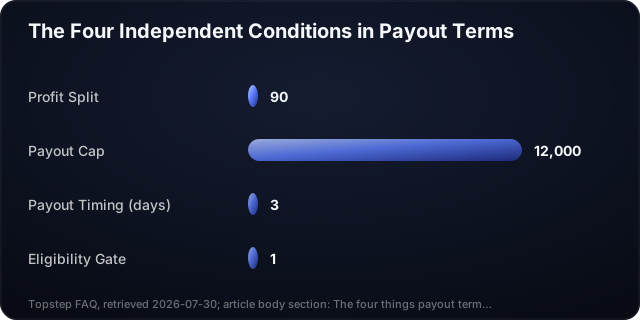
"No cap" cannot be verified because it is not a claim about one thing. Payout terms are at least four independent conditions, and a firm can be genuinely generous on one while restrictive on another.
The profit split (what percentage is yours)
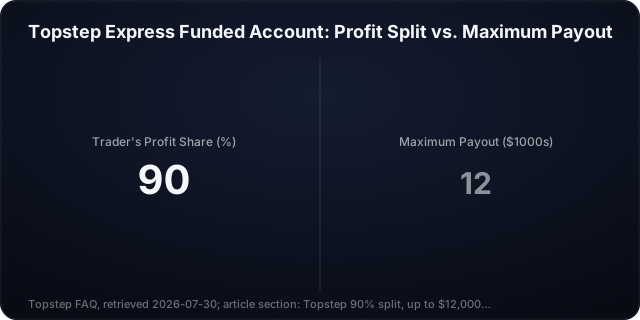
The split is the share of simulated profit that becomes your payout. It is usually the loudest number in marketing copy because it is the easiest to compare. Topstep states on its own site that traders keep 90% of their profits (Topstep, How It Works page, retrieved 2026-07-30). The mechanics behind that percentage, and why it is rarely the whole story, are worth understanding on their own; see how profit split actually works at forex prop firms.
The payout cap (a ceiling per cycle, or none)
A cap is a maximum amount per payout request, or per week, or per month. Three very different things. "No cap" could mean any of: no per-request ceiling, no monthly ceiling, or no ceiling at all. The word "cap" alone does not tell you which.
The payout timing (request to received)
Timing is the gap between submitting a request and money arriving. Bank or processor settlement time is a separate leg from the firm's own processing window, and firms usually describe it separately if at all. It is a different clock entirely from how long it takes to get funded in the first place, which is worth not confusing with payout timing.
The eligibility gate (minimum days, minimum profit, consistency conditions)
The gate is everything you must satisfy before the split, cap and timing become relevant at all. Minimum trading days. Minimum profit threshold. Conditions on how evenly profit was distributed across your trades. A firm with a perfect split and no cap can still be a firm you never reach a payout from, because the gate sits in front of all three of the other conditions.
Four conditions. One phrase. That is the whole problem with a summarised term.
Where the binding terms live on a firm's own site
Now the procedure. Three places, in this order of authority.
Payout or withdrawal page, help centre, and the terms document
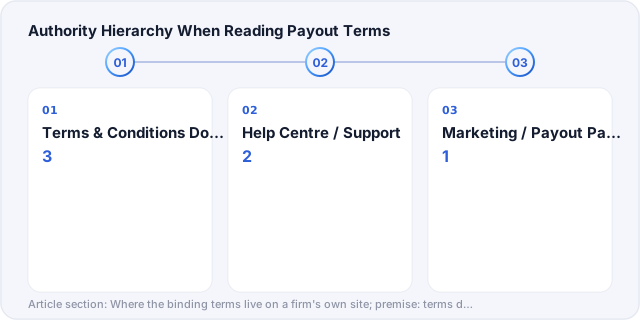
Start with the firm's payout or withdrawal page, usually linked from the footer or the pricing page. Then the help centre, which is often more specific and more current than marketing pages. Then the terms and conditions document, which is the one that actually governs. Read all three, because the specificity increases as you go and so does the number of qualifiers.
What to do when the three disagree with each other
They will disagree, and this is normal rather than sinister: marketing pages are updated less often than help centres. When they conflict, the terms document governs. Treat marketing copy as an advertisement of intent and the terms document as the obligation. If a figure appears only in marketing and nowhere in the terms, you have found a claim, not a term.
Screenshot and date-stamp: terms change without announcement
Prop firm terms change, sometimes quietly. Screenshot the page, save the URL, and write down the date you read it. A figure verified on 30 July 2026 is not a figure verified in October. If a payout dispute happens, the dated screenshot of what was published when you paid is the most useful thing you will own.
Two figures, read from a firm's own documentation
Here are two real figures, read from the firm's own page rather than a list. Read the table for what it shows about reading, not for a ranking.
| Firm | Figure as published | Which of the four conditions it answers | Source page | Date read |
|---|---|---|---|---|
| Topstep | "Keep 90% of your profits." (Topstep, How It Works page, retrieved 2026-07-30) | Profit split | topstep.com How It Works page | 30 July 2026 |
| Topstep | "Earn payouts up to $12,000 in as little as 3 days." (Topstep, How It Works page, retrieved 2026-07-30) | Cap and timing, tier not stated | topstep.com How It Works page | 30 July 2026 |
Topstep: 90% split, and a $12,000 payout figure whose tier the page does not state
Topstep's How It Works page states, under a heading reading "Simple, fast payout policy," that traders can "Earn payouts up to $12,000 in as little as 3 days" (Topstep, How It Works page, retrieved 2026-07-30). Read where that sentence sits. It appears in a general payout block on a page that also describes several distinct account types, and it does not itself name which of them the $12,000 applies to. So the honest reading is: the figure is published, and the tier it attaches to is not. That is precisely the question to take to support, and precisely the gap an aggregator would quietly fill in for you.
What this example shows that a top-10 list cannot
Look at the empty space in that table. There is no eligibility column filled for Topstep, because that figure was not stated on the page read. The blank is the lesson. An aggregator would have filled every cell, and the confident cells would have been the invented ones. When your own verification leaves a gap, you know exactly what to ask about. When someone else's summary leaves no gap, you know nothing at all.
Notice also that these two figures answer two different conditions: split, and a cap-plus-timing figure whose tier the page does not state. Neither is comparable to a blanket "no cap" claim seen on a comparison site. A ranking built on fragments like these would be a ranking of nothing.
Four questions to put to any firm before you pay an evaluation fee
Take these to the firm's own site and, where the site is silent, to support in writing.
Is this figure tied to a specific account tier or product?
Ask which account sizes and which product names the figure applies to. If the answer is "the Express account only," and you were about to buy something else, you just saved yourself the fee.
What must I do to become eligible for a first payout?
Minimum days, minimum profit, and any condition on how that profit was earned. Ask for the full list, then ask whether anything else can delay or void a first payout. The mechanics of the request itself are worth understanding before you get there, not after.
Is the ceiling per request, per month, or absent?
Make them pick one. "There is no cap" is not an answer to this question. "There is no per-request or monthly ceiling on payout amount" is.
Where is this written, and can support confirm it?
This is the step almost everyone skips. Ask support to confirm the answer in writing and keep the reply. An email or chat transcript with a date on it is evidence. A number you half-remember from a comparison table is not. Then, when you move on to comparing firms properly, you are reading terms instead of a list.
ITAfx sells access to simulated evaluation accounts, and its own profit split and payout timing are published on itafx.com, where you should verify them by exactly the method above rather than taking our word for it here. This article has to pass its own test.
Ready to get funded?
50% off instant accounts with code 50CRYPTO.
Get Funded →Frequently Asked Questions
Is "no payout cap" ever a real term?
It can be, but only when the firm itself writes it in a document that also defines the payout cycle, the eligibility gate, and the split. Absent those definitions, it is a marketing phrase, not a term.
Do I need to read the full terms and conditions?
Read the payout and withdrawal sections in full, and search the document for "payout," "withdraw," "consistency," and "eligible." That covers most of the risk in a few minutes.
What if a firm's help centre and marketing page give different numbers?
The terms document governs. If the terms document is silent, ask support in writing and keep the reply, then treat the marketing number as unverified until they confirm it.
How often should I recheck a firm's payout terms?
Before you pay any fee, and again before your first payout request. Terms change without announcement, and the version that matters is the one in force when you request.
Does a higher profit split mean a better payout?
Not on its own. A 90% split behind a gate you cannot clear pays less than a lower split you actually reach, as illustrated by Topstep's own published 90% figure (Topstep FAQ, retrieved 2026-07-30). Split, cap, timing and eligibility have to be read together.
Ready to get funded?
Instant accounts, simulated capital, rules published before you pay. 50% off with code 50CRYPTO.
Get Funded →