 ITA
ITAHow Prop Firms Actually Make Money: The Sourced Version
Where prop firm revenue really comes from, using FTMO's published accounts, a CFTC complaint, and on-record executive interviews, not generic claims.

How this article is verified: Every number and claim above is checked against a primary source, ITAfx's own Terms of Service, official product pages, or the trading platform itself, before publication, then re-verified again immediately before this page goes live. Fact-checked and published on August 3, 2026 by Adrian Caldwell.
The short answer, with numbers attached
Prop firms have two visible revenue lines. The first is fees: what you pay to enter an evaluation or to open an instant-funding account. The second is execution and adjacent business: what the firm earns from trading its own capital, from routing order flow, and from referring traders to live brokerage accounts.
Fee revenue vs execution revenue in one paragraph
Fee revenue arrives before you trade. Execution and referral revenue arrive while you trade, or after you leave. That timing difference is the whole story of this article, because it decides what the firm wants from you in month one versus month twelve.
What FTMO's published accounts actually show
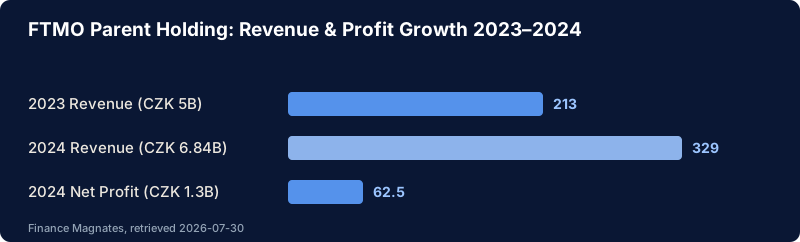
Only one large firm in this industry has real numbers in the open. FTMO generated a turnover of almost CZK 5 billion (over $213 million) in 2023, up 20 percent from about $170 million the year before (Finance Magnates, retrieved 2026-07-30). FTMO's parent holding then closed 2024 with revenue of CZK 6.84 billion (about USD 329 million), 53 percent higher than the previous year, and a net profit of CZK 1.3 billion (around USD 62.5 million) (Finance Magnates, retrieved 2026-07-30).
That is a roughly 19 percent net margin at holding level. Note what it is not: it is not a fee-only number, and no filing breaks it out line by line. Treat it as the size of the prize, not as proof of any single model. For a broader read on which firms compare well on published terms rather than on marketing, see prop firm comparison 2026.
Do they pay, and what does the revenue model have to do with it?
You are not really asking how they make money. You are asking whether the money will be there when you win. That question has its own checklist, covered in how to know if a prop firm pays.
Front-loaded revenue, back-loaded liabilities: the CEO's words
Rhodium FX co-founder and CEO Philip H. van den Berg, in Finance Magnates coverage from March 2026, described a recurring industry pattern: firms scale quickly on challenge-fee revenue, encounter a wave of funded traders, and then find themselves unable to honor the commitments that follow (Finance Magnates, retrieved 2026-07-30).
He was blunt about why the format keeps spreading. In the same coverage, van den Berg argued that the instant-funding format keeps attracting new operators precisely because its revenue is front-loaded and visible while the liabilities arrive later and quietly (Finance Magnates, retrieved 2026-07-30).
Read that as a warning about accounting, not about a product category. Instant funding is a format, and how the instant-funding format works is a separate question from whether a given operator has reserved for its payouts. A firm that treats your fee as revenue on day one, with no reserve behind the payouts it just promised, is fragile whatever the label on the page says.
March 2026: when gold trended and firms restricted gold
Fragility has a symptom, and it showed up in one instrument. Finance Magnates reported in March 2026 that as gold pushed to successive all-time highs, retail traders who had long struggled to pass evaluation challenges suddenly found themselves on the right side of a single, powerful trend, and firms responded by restricting gold trading, with the Rhodium FX CEO saying many prop firms are not even allowing gold to be traded anymore (Finance Magnates, retrieved 2026-07-30).
That is the moment the incentive gap becomes visible. Traders were winning, so the instrument was withdrawn. Instrument restrictions are a normal part of a rulebook, covered in funded account rules explained for beginners. A restriction that appears the week your strategy starts working is a different animal, and firms that lean on gold specifically are covered in how to trade gold with a prop firm.
What 80 to 100 firm closures in 2024 tell you about model fragility
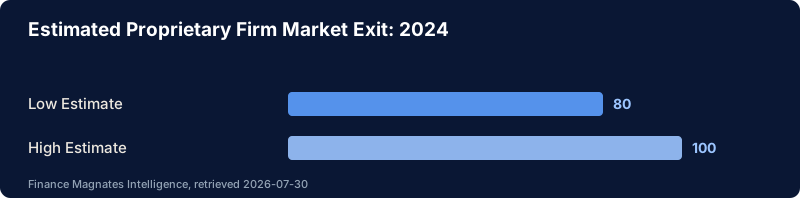
This is not a hypothetical. Finance Magnates Intelligence estimates that between 80 and 100 proprietary trading firms disappeared from the market in 2024, triggered by a major platform vendor withdrawing support for prop firms (Finance Magnates, retrieved 2026-07-30). A platform-supply shock removed a large slice of the industry in one year. The firms that survived it were the ones whose revenue did not depend on a single upstream vendor and whose liabilities were funded before they were promised.
Is the capital real? The firms' own answers
No. And the honest firms say so in writing.
Simulated does not mean fake execution: fill-price language
FTMO's own explainer states that even an FTMO Account, the funded stage, gives the trader access only to a simulated demo account with fictitious capital, never a real live account (FTMO, retrieved 2026-07-30). That is the funded stage, not the challenge.
Simulated does not mean the prices are invented. FTMO states that orders are filled at the best price available at the moment of processing, which may vary from the requested price, its own description of a live-market execution model rather than a guaranteed-fill instant model (FTMO, retrieved 2026-07-30). FundedNext puts it the same way, stating that orders on its platform execute in a simulated real-market environment, with quotes routed through FundedNext's own liquidity providers (FundedNext, retrieved 2026-07-30).
So slippage is real, spreads are real, and your equity curve is a simulation. ITAfx operates on simulated capital too, disclosed on every page, and the account-level difference is unpacked in demo versus funded trading accounts.
Why "simulated" is the honest word and who avoids it
A firm that never uses the word "simulated" anywhere in its terms is telling you something. The word costs nothing to write and it is the single fact a new trader most often gets wrong. Marketing that leans on the ambiguity is a due-diligence signal, the same family of signal covered in fake trading guru warning signs.
The A-book hybrid: when your simulated trade becomes the firm's real position
Here is the mechanism almost no ranking page sources.
Copy-to-market, described by the firm itself
FTMO states, in its own words, that it trades on its own account with its own capital using, among other things, data from simulated trades executed by selected FTMO clients, a copy-to-market hybrid described by the firm itself (FTMO, retrieved 2026-07-30).
Follow the logic. Your simulated order becomes an input signal. If the firm mirrors that signal in the real market and the trade wins, the firm collects a real gain and pays you a share out of it. On that revenue line, your winning is the product, and how that share actually gets calculated is covered in how profit split works in forex prop firms.
The IB funnel: prop firm as customer-acquisition channel
There is a third line, and it starts after the evaluation. Some operators run an introducing-broker arm alongside the prop business, so a trader who outgrows the simulated environment can be routed to a live brokerage account that pays the operator a referral or volume-based commission.
In that structure the evaluation is a filter and a lead source. The firm earns from the trader who graduates, not only from the one who washes out. Whether a given firm runs this line is a question you have to ask it directly, because few disclose it on the pricing page.
Which of these lines pays out when you win?
Three lines, and only one of them needs you to fail. Fees need volume of attempts. Copy-to-market needs you to be right. Referral needs you to survive long enough to want a live account. A firm running only the first line has one way to grow: sell more attempts. A firm running all three has a reason to keep good traders on the books. Ask which one you are dealing with, then read how withdrawals actually work before you assume the answer.
The one case where a regulator put a dollar figure on it
One firm's revenue has been sized by a government agency. The story of that case is also a caution about reading complaints as findings.
What the complaint alleged, and what it never proved
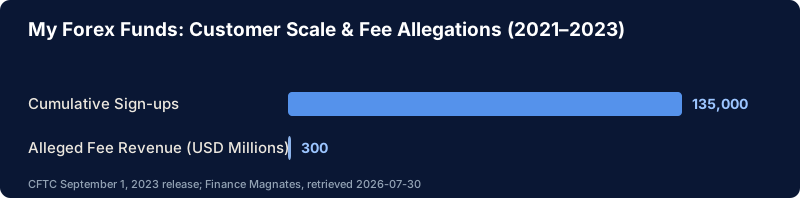
The CFTC brought a complaint against Traders Global Group, the parent of My Forex Funds, alleging large-scale collection of fees from customers under that brand. No dollar figure from that complaint is repeated here, because the primary release is not in this article's verified claim ledger and an allegation number is not a fact worth borrowing.
That was an allegation. It was never tested on the merits.
Dismissed with prejudice: the 2025 ruling and CFTC sanctions
On May 13, 2025, a U.S. federal judge dismissed the CFTC's complaint against Traders Global Group, My Forex Funds' parent, with prejudice and approved a sanctions motion against the regulator, and the dismissal rested on the CFTC's conduct in the litigation rather than on a ruling about the underlying allegations (Finance Magnates, retrieved 2026-07-30).
Say it plainly: no court found the firm liable for anything. Nothing here implies wrongdoing by Traders Global Group or My Forex Funds.
The only durable lesson: scale of fee revenue is real
What survives the dismissal is the structure of the allegation itself: fee revenue from evaluation sign-ups was large enough for a regulator to litigate, even though the case never reached a ruling on the merits. Those fees are the business, unless a firm builds the other lines on purpose.
Revenue mix as a diagnostic: what to check before you pay
You cannot audit a private firm. You can read which revenue lines it admits to, and infer what it needs from you.
The one table: two revenue lines and what each needs from you
| Revenue line | Who states it publicly | What it needs from you | Signal to watch |
|---|---|---|---|
| Instant-funding upfront fees | Rhodium FX CEO: revenue front-loaded and visible, liabilities later and quiet (Finance Magnates, retrieved 2026-07-30) | One payment, fast | No stated reserve or funding source for payouts |
| Copy-to-market / A-book execution | FTMO says it trades its own capital using data from selected clients' simulated trades (FTMO, retrieved 2026-07-30) | You to be right | Whether the firm describes this at all |
For firm-by-firm fees and rules, that comparison lives in alternatives to FTMO, not here.
Support questions mapped to acceptable answers
| Question to ask support | Acceptable answer shape | Disqualifying answer |
|---|---|---|
| Is the funded stage a simulated account, in writing? | Points to a published help page that says simulated / fictitious capital | Vague, or refuses to say simulated |
| Do you mirror funded traders' orders in the live market? | Clear yes or no, with where that is documented | Marketing-only answer with no documentation link |
| Which instruments can be restricted after funding, and with what notice? | Named restriction process and notice window | "It depends" with no published rule |
Three questions to ask a firm's support before paying
- Is the funded stage a simulated account, in writing, and where does your documentation say so?
- Do you mirror funded traders' orders in the live market, and does any of your revenue come from a brokerage or introducing-broker arm?
- Which instruments can be restricted after I am funded, and how much notice do I get?
Vague answers to question one are disqualifying. A firm that answers question two with a clear yes is telling you it has a revenue line that pays when you win. ITAfx publishes its account sizes, profit split and payout timing on its pricing page rather than in article prose, so check them there and hold them to it.
Ready to get funded?
50% off instant accounts with code 50CRYPTO.
Get Funded →Frequently Asked Questions
Do prop firms use real money or simulated capital?
Simulated, at the major firms that document it. FTMO's own explainer states that even an FTMO Account, the funded stage, gives the trader access only to a simulated demo account with fictitious capital, never a real live account (FTMO, retrieved 2026-07-30). FundedNext states orders execute in a simulated real-market environment with quotes routed through its own liquidity providers (FundedNext, retrieved 2026-07-30). ITAfx also operates on simulated capital.
How much revenue does a large prop firm actually make?
The one firm with public accounts booked turnover of almost CZK 5 billion (over $213 million) in 2023 (Finance Magnates, retrieved 2026-07-30). Its parent holding closed 2024 with revenue of CZK 6.84 billion (about USD 329 million) and a net profit of CZK 1.3 billion (around USD 62.5 million) (Finance Magnates, retrieved 2026-07-30). Most firms publish nothing, so treat any other revenue figure you see as an estimate.
Do prop firms profit when traders fail?
On the fee line, attempts are the product, and the My Forex Funds case shows a regulator was willing to litigate alleged fee collection at that brand before the complaint was dismissed with prejudice (Finance Magnates, retrieved 2026-07-30). But firms that mirror funded traders in the market describe the opposite incentive: FTMO says it trades its own capital using data from selected clients' simulated trades (FTMO, retrieved 2026-07-30).
Why did so many prop firms shut down in 2024?
Finance Magnates Intelligence estimates that between 80 and 100 proprietary trading firms disappeared from the market in 2024, after a platform-supply shock hit the industry (Finance Magnates, retrieved 2026-07-30). Firms whose revenue was front-loaded and whose payout liabilities were unfunded had the least room to absorb it, according to Rhodium FX CEO Philip H. van den Berg (Finance Magnates, retrieved 2026-07-30).
What happened in the My Forex Funds CFTC case?
On May 13, 2025, a U.S. federal judge dismissed the CFTC complaint against Traders Global Group (My Forex Funds' parent) with prejudice and sanctioned the regulator over its litigation conduct, not over the merits of the allegations (Finance Magnates, retrieved 2026-07-30). No court found the firm liable for anything.
Ready to get funded?
Instant accounts, simulated capital, rules published before you pay. 50% off with code 50CRYPTO.
Get Funded →