
Fibonacci Retracement Strategy for Funded Forex Traders
Master the Fibonacci Retracement Strategy for funded forex accounts. Learn precise levels, confluence, and advanced techniques to optimize your trading.

What is Fibonacci Retracement and Why It Matters for Funded Traders
Most traders can draw Fibonacci retracements. Click from swing low to swing high, watch the golden ratios appear, place a trade at 61.8%. Simple. Clean. Wrong.
The traders who consistently extract profits from funded accounts using Fibonacci, the ones who turn mathematical ratios into withdrawal notifications, operate on an entirely different level. They don't see Fibonacci as a standalone tool. They see it as one layer in a multi-dimensional analysis framework that reveals where institutional money actually moves.
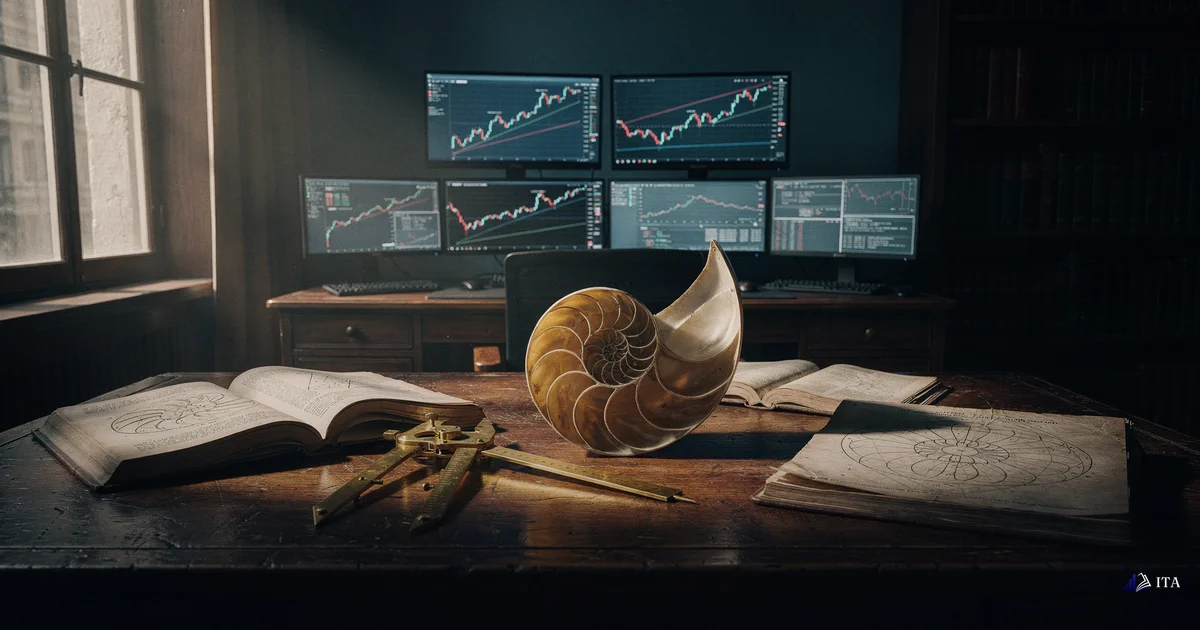
The golden ratio appears everywhere in nature. From spiral galaxies to flower petals, the 1.618 proportion creates visual harmony. Leonardo Fibonacci introduced these sequences to Western mathematics in 1202, but traders only began applying them to markets in the 20th century. The premise is elegant: markets, being expressions of human psychology, follow natural mathematical patterns.
The standard retracement levels — 23.6%, 38.2%, 50%, 61.8%, and 78.6% — represent potential reversal zones where price might find support or resistance during a pullback. The 50% level isn't technically a Fibonacci number, but traders include it because markets often reverse at the halfway point of a move.
How to Draw Fibonacci Retracements Correctly for High-Probability Setups
Fibonacci retracements are drawn correctly by identifying significant swing highs and swing lows on higher timeframes, then applying the 23.6%, 38.2%, 50%, 61.8%, and 78.6% levels to measure potential support and resistance zones. The key lies in selecting swings that represent genuine market structure changes rather than minor price fluctuations.
Drawing Fibonacci correctly starts with identifying genuine swing points, not arbitrary peaks and valleys. A swing high requires price to form a peak with lower highs on both sides. A swing low needs higher lows flanking a valley. This sounds basic until you realise most traders violate this rule constantly, drawing from minor fluctuations that hold no structural significance.
The timeframe hierarchy matters more than the tool itself. Funded traders who succeed with Fibonacci start on weekly charts, identifying major swings that define market structure. They then cascade down to daily charts for intermediate swings, finally reaching 4-hour and 1-hour charts for execution precision. Each timeframe's Fibonacci levels stack like transparent overlays, revealing zones where multiple timeframes agree.
When multiple timeframe Fibonacci levels converge within a small price range, this creates high-probability reversal zones If the weekly 61.8% retracement sits at 1.1580, the daily 50% at 1.1575, and the 4-hour 38.2% at 1.1582, you've identified a 7-pip zone where three timeframes converge. This isn't coincidence — it's market structure revealing itself through mathematical relationships.
Fibonacci Confluence: Combining with Support/Resistance and Order Blocks
The real edge emerges when Fibonacci meets other forms of technical analysis. Support and resistance levels that align with Fibonacci retracements create confluence zones — areas where multiple analytical methods reach the same conclusion. An old resistance level at 1.1585 that now aligns with a 61.8% retracement transforms from a simple horizontal line into a high-probability reversal zone.
Order blocks add another dimension. These are areas where institutional orders previously accumulated, visible as the last opposing candle before a strong directional move. When an order block overlaps with a Fibonacci level, you're identifying zones where smart money previously positioned and where mathematical relationships suggest they might position again.
Supply and demand zones operate on similar principles but focus on price ranges rather than specific levels. A supply zone from 1.1590-1.1600 that contains a 78.6% Fibonacci retracement creates a resistance band with multiple confirmation factors. Price entering this zone faces both historical selling pressure and mathematical resistance.
But Fibonacci analysis extends beyond retracements. Extensions project potential profit targets by extending the Fibonacci ratios beyond the original move. The 127.2%, 161.8%, and 261.8% extensions mark where price might reach after breaking previous highs or lows. Funded traders use these levels to set profit targets that align with market structure rather than arbitrary round numbers.

Advanced Fibonacci Strategies for Funded Account Success
Time-based Fibonacci introduces temporal analysis. Instead of measuring price vertically, these tools measure time horizontally, identifying when reversals might occur based on the duration of previous moves. A rally that lasted 34 periods might see reversals at 21, 34, or 55 periods later, all Fibonacci numbers. This temporal awareness helps funded traders anticipate not just where but when markets might turn.
Position sizing through Fibonacci creates a mathematical framework for risk management. Instead of risking a fixed percentage per trade, sophisticated traders adjust position size based on the Fibonacci level they're trading. A 38.2% retracement might warrant full position size, while a 78.6% level — being a deeper, riskier retracement — might call for half size. This dynamic sizing acknowledges that not all Fibonacci levels carry equal probability.
The mistakes that eliminate most traders from funded accounts stem from misunderstanding what Fibonacci actually represents. They treat these levels as magnetic price barriers that guarantee reversals. They draw from insignificant swings that hold no structural weight. They ignore confluence and trade naked Fibonacci levels in isolation. They force Fibonacci onto every chart, even when price action shows no clear swings or mathematical relationships. Our guide on Fibonacci Retracement Forex covers this in more depth.
Over-reliance creates tunnel vision. Traders become so focused on Fibonacci levels they ignore fundamental catalysts, market sentiment, or simple price action signals that contradict their analysis. The levels become a crutch rather than a tool, leading to forced trades that lack genuine edge.

Common Mistakes to Avoid When Trading with Fibonacci
Common Fibonacci trading mistakes include drawing retracements from insignificant price spikes, using incorrect timeframes for swing identification, and treating all Fibonacci levels as equally valid support or resistance zones. These errors create meaningless levels that price ignores, leading to false signals and poor trade entries that could have been avoided with proper swing selection methodology.
Forcing Fibonacci where it doesn't fit reveals amateur thinking. Not every market movement follows Fibonacci ratios. Trending markets often ignore retracements entirely, while ranging markets might bounce between levels that have nothing to do with golden ratios. Professional traders recognise when Fibonacci applies and when it doesn't.
Practical application brings theory into reality. Take EUR/USD on a daily chart. Identify the most recent significant swing low and high. Draw your Fibonacci retracement. Now switch to the 4-hour chart and identify swing points within that same directional move. Draw another set of retracements. Where do levels cluster? Mark these zones.
Next, scan left on your chart. Where do historical support and resistance levels sit? Do any align with your Fibonacci clusters? These become primary zones for potential trades. Add order blocks, those final opposing candles before strong moves. Do any overlap with your confluence zones?

Practice Exercises: Applying Fibonacci to Real Market Scenarios
For GBP/JPY, combine Fibonacci with trendline analysis. Draw major trendlines on the daily chart, then apply Fibonacci retracements to the most recent impulse wave. Where Fibonacci levels intersect with trendlines, you've identified dynamic confluence, zones that move with price rather than remaining static.
Gold (XAU/USD) offers unique Fibonacci opportunities The metal's tendency to respect mathematical relationships makes extension targets particularly valuable. After identifying a completed retracement, project extensions to set profit targets. The 161.8% extension often marks significant resistance in gold trends.
At Institutional Trading Academy, this multi-dimensional approach to Fibonacci forms part of the broader institutional methodology. Rather than teaching Fibonacci as an isolated indicator, ITA's framework integrates it with order flow analysis, market structure, and risk management protocols that funded traders actually use.
The institutional methodology means understanding why Fibonacci works, it represents zones where mathematical relationships align with trader psychology and institutional positioning. Access to capital through ITA's instant funded accounts up to $800K allows traders to apply these strategies with meaningful position sizes, where proper Fibonacci analysis translates to significant returns.

How ITA Enhances Your Fibonacci Trading Edge
The community insights at ITA reveal how successful funded traders actually implement Fibonacci strategies. They share confluence discoveries, discuss time-based applications, and demonstrate how mathematical precision combines with market understanding to create consistent profitability. This isn't retail education repackaged, it's institutional methodology made accessible.
The transformation from drawing lines to understanding market mathematics marks the evolution from retail to professional trading. Fibonacci retracements aren't magic, they're a mathematical framework that reveals where market participants likely positioned and might position again. When combined with proper confluence analysis, time-based study, and dynamic position sizing, these golden ratios become a powerful edge in funded trading.
The traders who master this approach don't see Fibonacci levels. They see confluence zones where mathematics, market structure, and institutional behaviour align. They understand that the edge isn't in the tool but in how multiple tools combine to reveal high-probability opportunities. Most importantly, they recognise that Fibonacci is one part of a complete trading methodology, powerful when integrated, dangerous when isolated. Our guide on Fibonacci Retracement Levels in Forex covers this in more depth.
Every funded trader who achieves consistent withdrawals understands this truth: success comes not from finding the perfect indicator but from layering multiple forms of analysis until the market's probable direction becomes clear. Fibonacci provides the mathematical framework. Confluence provides the confirmation. Discipline provides the edge. At ITA, all three combine into a methodology that transforms theoretical knowledge into funded account profits.

Frequently Asked Questions
Which Fibonacci retracement level is most reliable for forex trading?
The 61.8% retracement level is widely regarded as the most reliable across major forex pairs, attracting institutional positioning due to its mathematical significance and widespread professional recognition. This golden ratio level attracts institutional positioning due to its mathematical significance and widespread recognition among professional traders, making it a high-probability reversal zone.
How do I identify valid swing points for drawing Fibonacci retracements?
Valid swing points require at least 3-5 candles of market structure on either side. A swing high needs lower highs before and after the peak, while a swing low requires higher lows flanking the valley. Always start with weekly or daily charts for major swings, then refine on 4-hour timeframes.
Can Fibonacci retracements work without confluence from other indicators?
While Fibonacci levels can identify potential reversal zones independently, combining them with support/resistance levels meaningfully improves trading accuracy. The most successful funded traders layer Fibonacci with order blocks, moving averages, or volume profile for confluence confirmation before entering positions.
What's the biggest mistake traders make with Fibonacci retracement strategy?
The most costly error is drawing Fibonacci on minor price swings instead of significant market structure. Traders often connect random peaks and valleys on 15-minute charts, creating levels that institutional algorithms ignore completely. Always validate your swing points on higher timeframes first to ensure structural significance.
How should I set stop losses when trading Fibonacci retracement levels?
Place stops beyond the next Fibonacci level from your entry, typically 10-20 pips past to avoid stop hunts. For a 61.8% retracement entry, set your stop beyond the 78.6% level. This approach maintains favourable risk-reward ratios while respecting market structure and avoiding premature exits.
Key Takeaways
- Draw Fibonacci retracements from genuine swing points requiring 3-5 candles of structure on either side, not random peaks.
- Focus on 61.8% and 38.2% levels — they show highest reaction frequency across major forex pairs in trending markets.
- Layer multiple timeframes: weekly for major swings, daily for intermediate, 4-hour for precise entry confluence zones.
- Combine Fibonacci with order blocks and support/resistance levels to build higher-probability confluence zones.
- Use extensions at 127.2%, 161.8%, and 261.8% to set profit targets based on market structure, not arbitrary numbers.
- Place stops beyond the next Fibonacci level from entry — typically 10-20 pips past to avoid institutional stop hunts.
- Avoid forcing Fibonacci on every chart — not all market movements follow golden ratios, especially in ranging conditions.
Start Your Trading Evaluation
Simulated funded accounts up to $800K. Up to 95% profit split.
Get Funded