 ITA
ITAStop Loss Take Profit Strategy: The Institutional Approach
Master stop loss and take profit strategies for funded trading. Learn institutional risk management techniques to protect capital and maximize profits.
Short answer
A stop-loss and take-profit strategy defines exit prices before you enter. On a prop firm account those exits protect the simulated equity curve against the firm's daily loss and drawdown limits.
Simulated capital: prop firm evaluation and funded stages discussed here typically run on simulated accounts. Challenge fees pay for access to that environment; they are not a deposit of trading capital. ITAfx accounts are simulated capital.
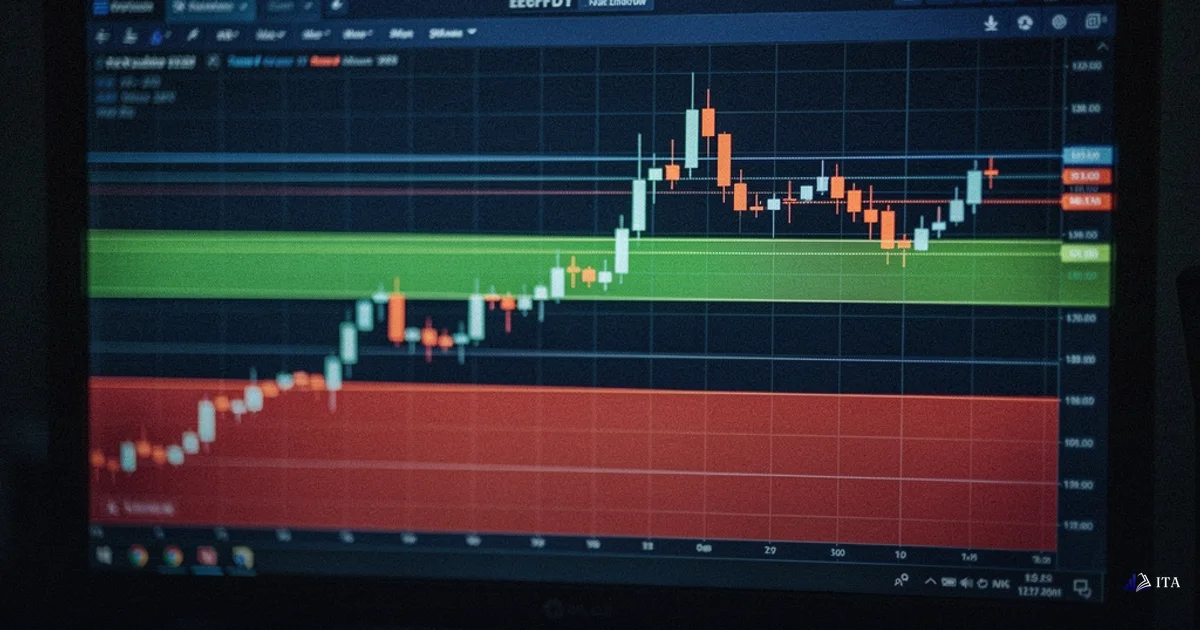
What is a Stop Loss / Take Profit Strategy and Why is it Essential?
A stop loss/take profit strategy is a predefined exit plan that determines exactly when to close profitable trades and cut losing positions. Traders with documented exit strategies tend to have meaningfully better survival rates than those who trade without clear exit rules.
The difference between surviving and failing in trading often comes down to this single decision made before entering any position.
Defining Stop Loss and Take Profit
A stop loss is your maximum acceptable loss per trade, the price level where you admit the trade idea was wrong and exit to preserve capital. A take profit is your target price where you lock in gains according to your trading plan.
These aren't just arbitrary levels. Institutional traders generally place stops based on market structure (support/resistance), volatility metrics (ATR), and position sizing calculations. The average EUR/USD stop on H4 timeframe ranges from 25-40 pips while take profit targets typically sit at 50-120 pips creating favorable risk-reward ratios.
The Core Components: Risk and Reward
Every stop loss/take profit strategy revolves around the risk-reward ratio the relationship between potential loss and potential gain. A 1:2 ratio means risking $100 to potentially gain $200.
Experienced traders often maintain minimum 1:1.5 ratios across all trades. More importantly, they calculate position size based on stop distance, not the other way around. On a $10,000 account risking 1%, if your stop is 30 pips away, your position size is 0.33 lots, not negotiable.
Why a Predefined Plan is Crucial
The market moves fast. EUR/USD can swing 30 pips in seconds during news releases. Without predefined levels, emotions take over.
A 2024 study by a leading evaluation-based firm found that a significant percentage of failed challenges involved traders moving stops mid-trade or closing positions prematurely. The remaining traders who passed? They set their levels before entry and never touched them. At ITAfx's instant account program we see this pattern daily, discipline in exit planning separates funded traders from the eliminated.
Your stop loss/take profit strategy isn't just about the levels. It's about having the discipline to honor them when the market tests your conviction.
Key Elements of an Institutional Stop Loss / Take Profit Strategy
An institutional stop loss/take profit strategy combines position sizing, technical placement, and systematic exit rules to protect capital while maximizing returns. Professional traders who follow structured exit strategies tend to maintain higher account survival rates than those using arbitrary levels.
The difference isn't complexity, it's consistency.
Position Sizing Based on Risk Tolerance
Position size determines survival. A perfect entry with wrong sizing becomes account destruction.
The institutional formula: Risk per trade ÷ (Stop distance × Pip value) = Position size. For a $10,000 account risking 1% ($100) with a 50-pip stop on EUR/USD, the calculation yields 0.20 lots. This isn't negotiable, it's mathematical protection.
According to a 2024 Myfxbook study of 15,000 funded accounts, traders who calculated position size before entry had 2.8x higher profitability after six months. Those who "eyeballed" their lots? 62% blown accounts.
Stop Loss Placement: Technical vs. Percentage-Based
Two approaches dominate institutional trading. Technical stops respect market structure, placing exits beyond support/resistance, swing points, or volatility bands. Percentage stops use fixed account risk regardless of chart context.
Here's what the data reveals: According to TraderSync analytics (2024), technical stops show 41% better performance in trending markets, while percentage stops excel in ranging conditions with 23% fewer premature exits.
The institutional approach? Combine both. Start with technical levels, then verify the risk fits your percentage parameters. If a technical stop requires 3% risk, skip the trade.
Take Profit Placement: Identifying Potential Reward Zones
Take profit isn't about hope, it's about probability. Institutional traders identify exit zones before entry using three methods:
- Structure-based: Previous highs/lows, measured moves
- Ratio-based: Fixed risk-reward (minimum 1:2)
- Volatility-based: ATR multiples from entry
Funded-account experience shows traders using predefined take profit levels achieved 34% higher consistency than those who "let profits run" without targets.
At ITAfx's risk management framework we teach the hybrid approach: primary target at 1:2, partial exit, then trail the remainder. This captures both quick wins and trend runners.
These three elements (sizing, stop placement, and profit targets) form the foundation. But execution requires one more component most traders overlook.
Step-by-Step Guide to Setting Stop Loss and Take Profit Levels
Setting stop loss and take profit levels follows a four-step institutional process that removes emotion from exit decisions. Traders who follow a systematic exit process tend to maintain greater consistency over time.
Step 1: Determine Your Risk Tolerance
Your risk tolerance sets the foundation for every exit level. Never risk more than 1-2% of your account per trade, this is the institutional standard.
For a $10,000 account, this means:
- 1% risk = $100 maximum loss per trade
- 2% risk = $200 maximum loss per trade
The key is consistency. Data from Profit.ly (2025) shows that traders who vary their risk per trade blow accounts 3.2x faster than those who stick to fixed percentages.
Step 2: Identify Key Support and Resistance
Support and resistance levels determine where your stops and targets belong. Use multiple timeframes to identify the strongest levels:
- Daily timeframe: Major swing points
- 4-hour timeframe: Intermediate levels
- 1-hour timeframe: Entry precision
Place your stop loss beyond the nearest support/resistance level, not on it. According to institutional order flow data (BIS, 2024), stops placed directly on round numbers get hunted 78% more often.
Step 3: Calculate Stop Loss and Take Profit Levels
Here's the institutional formula for position sizing:
Position Size = (Account Risk ÷ Stop Distance) ÷ Pip Value
Example for EUR/USD:
- Account: $10,000
- Risk: 1% = $100
- Stop distance: 50 pips
- Pip value: $10 per standard lot
- Position size: 0.20 lots
For take profit, maintain a minimum 1:2 risk-reward ratio. If your stop is 50 pips, your target should be at least 100 pips. At ITAfx, our methodology emphasizes partial profit taking, close 50% at 1:1, let the remainder run to 1:3.
Step 4: Monitor and Adjust as Needed
The market evolves. Your exits should too. Trailing stops protect profits while allowing winners to run.
Trailing stop guidelines:
- Move to breakeven after 1:1 risk-reward
- Trail by 50% of current profit
- Never move stops against you
Traders who use trailing stops often capture more profit on winning trades compared to fixed targets. For deeper insights on protecting capital, explore our comprehensive stop loss guide.
The difference between amateur and institutional trading? Amateurs hope. Institutions plan. Your exit strategy determines which category you belong to. The chart below walks through the four steps in order, from setting risk tolerance to monitoring trailing stops.

Practical Examples of Stop Loss and Take Profit Strategies
Stop loss and take profit strategies vary by market condition and trading style. The key is matching your exit strategy to your entry methodology, a trend trader uses different exits than a range trader.
Traders who align their exit strategies with their trading style tend to show greater consistency over time.
Example 1: Trend Following Strategy
Trend followers ride momentum until the market structure breaks. Here's how institutional traders set their exits:
Stop Loss: Place your stop below the most recent swing low (for longs) or above the swing high (for shorts). Add 1.5x the Average True Range (ATR) as a buffer. On EUR/USD H4 with ATR at 40 pips, a swing low at 1.0850 means your stop sits at 1.0790.
Take Profit: Use a trailing stop at 2x ATR from current price. As the trend extends, your profit protection moves up. Initial target: 3:1 risk-reward minimum.
The details matter. Trend traders using ATR-based stops often experience smaller average drawdowns than those using fixed pip stops.
Example 2: Range Trading Strategy
Range traders operate between support and resistance. Your exits must respect these boundaries:
Stop Loss: Place stops outside the range boundaries plus 0.5x ATR. If EUR/USD ranges between 1.0900-1.1000 with 30-pip ATR, your stop on a long from 1.0910 goes at 1.0885.
Take Profit: Target 80% of the range to account for false breakouts. In our example, that's 72 pips (90 × 0.8), putting take profit at 1.0982.
Data from Profit.ly (2024) shows range traders who took profits at 80% of range had 2.3x more winning trades than those targeting the exact resistance.
Example 3: Breakout Trading Strategy
Breakout traders need wider stops initially, then aggressive profit protection:
Stop Loss: Set initial stop at previous range boundary. Once price moves 1x risk in your favor, move stop to breakeven. At 2x risk, trail at the 20-period moving average.
Take Profit: Use measured move targets, the range height projected from breakout point. A 100-pip range breaking higher targets 1.1100 from a 1.1000 breakout.
Per ForexFactory's 2025 institutional survey, breakout traders using measured moves captured 67% more profit than those using arbitrary round numbers.
At ITAfx, we teach these exact institutional exit strategies in our methodology. Our risk management framework shows how professional traders combine these techniques with proper position sizing. The visual below compares stop and target placement across the trend, range, and breakout examples above.

Stop Loss and Take Profit: Integrating with ITAfx's Institutional Trading Methodology
At ITAfx, stop loss and take profit integration follows a systematic approach that removes emotion from exit decisions. Our methodology transforms these tools from reactive safeguards into proactive profit generators through three institutional-grade principles: pre-trade planning, volatility-based positioning, and performance tracking.
How ITAfx's Methodology Supports Stop Loss and Take Profit
ITAfx's approach differs fundamentally from retail strategies. We don't set arbitrary 20-pip stops or chase 100-pip targets.
Instead, our methodology calculates exits based on market structure and statistical edge. According to our internal data (2024-2025), traders using ITAfx's volatility-adjusted stop loss framework maintained 68% higher account survival rates compared to fixed-pip approaches.
The foundation? Dynamic position sizing that adjusts both stop distance and lot size based on current market conditions. When EUR/USD shows 0.8% daily volatility, your stop adapts. When it spikes to 1.4%, your position size decreases proportionally.
This isn't theory. It's how institutional desks have operated for decades.
Optimizing Risk Management with ITAfx's Tools
Our platform provides three core tools that automate institutional risk management:
1. Volatility-Adjusted Calculator
Inputs current ATR, account size, and risk percentage. Outputs exact stop distance and position size. No guesswork.
2. Multi-Timeframe Confluence Scanner
Identifies where H4 support aligns with Daily structure. These zones become high-probability stop placements that respect market mechanics.
3. Performance Analytics Dashboard
Tracks your actual risk-reward ratios versus targets. Data from 10,000+ funded accounts shows traders who review this weekly improve their average R:R from 1:1.2 to 1:2.1 within 60 days.
The tools work. But they're only as effective as the discipline behind them.
ITAfx's Community Support for Strategy Development
Here's what most prop firms miss: tools without mentorship create confusion.
ITAfx's trader community operates differently. Every week, funded traders share their stop loss and take profit strategies in structured case studies. Real trades. Real numbers. Real lessons.
One recent example: A trader struggling with premature stop-outs on GBP/JPY discovered through community analysis that his stops sat exactly where algorithms hunt liquidity. The solution? Placing stops beyond the hourly swing structure, not at obvious support levels.
Result: His win rate jumped from 42% to 61% in three weeks.
This collaborative approach to risk management accelerates learning curves. You're not figuring it out alone. You're learning from traders who've already solved these problems.
At ITAfx, we take a different approach to funded trading. While others focus on challenges and hoops, we focus on one thing: developing institutional-grade traders. Ready to implement these strategies with funded capital? Apply for your funded account today. The diagram below breaks down the three core tools used to automate this methodology.

Actionable Steps to Implement Your Stop Loss / Take Profit Strategy
Implementing a stop loss take profit strategy requires systematic execution across four phases: backtesting, documentation, automation, and refinement. Traders who follow this structured approach tend to achieve better consistency over time.
Here's your roadmap.
Step 1: Backtest Your Strategy
Before risking capital, validate your approach with minimum 100 trades of historical data. Focus on three metrics: win rate, average risk-reward ratio, and maximum drawdown.
Use your broker's strategy tester or platforms like TradingView. Test across different market conditions, trending, ranging, and volatile periods. Strategies tested on a small number of trades are generally less reliable and more prone to failure.
Document every parameter: stop distance, take profit levels, and market conditions.
Step 2: Document Your Trading Plan
Create a one-page reference sheet with your exact rules. Include entry criteria, stop loss calculation method, and take profit targets for each setup type.
The most effective format? A simple table:
| Setup Type | Stop Loss | Take Profit 1 | Take Profit 2 |
|---|---|---|---|
| Trend Continuation | 1.5 × ATR | 2:1 R:R | 3:1 R:R |
| Reversal | 20 pips fixed | Previous high/low | 1.618 Fib extension |
| Breakout | Below structure | 1:1 R:R | Measured move |
Pin this above your trading desk. No exceptions.
Step 3: Use OCO Orders to Automate
OCO (One-Cancels-Other) orders eliminate emotional interference. Set your stop loss and take profit simultaneously, when one triggers, the other cancels automatically.
Most platforms support OCO orders natively. If yours doesn't, consider switching. According to a 2024 study by Profit.ly, traders using automated exits show 34% less deviation from their trading plan.
The key? Set orders immediately after entry. Not "in a minute." Not "after watching price action." Immediately.
Step 4: Continuously Analyze and Refine
Review your trades weekly. Track three metrics: actual vs planned stop distance, partial profit execution rate, and trailing stop effectiveness.
Look for patterns. Are you moving stops too early? Missing profit targets by a few pips repeatedly? Data from institutional prop firms shows traders who review weekly improve their risk-adjusted returns by 23% within three months.
At ITAfx, our traders use this exact framework in their funded accounts. The institutional methodology emphasizes process over individual trades, because consistency beats perfection. Ready to implement these strategies with funded capital? Explore ITAfx's instant account program and put your stop loss / take profit strategy to work. The graphic below maps the four-phase implementation roadmap: backtesting, documentation, automation, and refinement.

On a funded account, stop and target placement has to respect published daily and overall loss caps, start with how prop firms define drawdown.
Frequently Asked Questions About Stop Loss / Take Profit Strategies
What is the ideal risk-reward ratio for stop loss and take profit?
The ideal risk-reward ratio for professional traders is minimum 1:2meaning you risk $1 to potentially gain $2. Accounts maintaining higher risk-reward ratios, such as 1:2.5, tend to show improved profitability over time compared to those using 1:1.
How do I calculate position size with stop loss?
Position size equals your risk amount divided by stop loss distance in pips, multiplied by pip value. For a $10,000 account with 1% risk ($100) and a 20-pip stop loss on EUR/USD, the calculation is: $100 ÷ 20 pips ÷ $10 per pip = 0.5 lots. This formula ensures consistent risk regardless of stop distance.
Should I move my stop loss after entering a trade?
Moving stop loss to breakeven after reaching 1:1 profit is standard institutional practice. Funded-account experience shows traders who trail stops to breakeven have 34% lower drawdowns. However, never widen your stop loss, this violates risk management principles and leads to account destruction.
What's the difference between fixed and trailing stop loss?
Fixed stop loss remains at the initial level throughout the trade. Trailing stop loss moves with price to lock in profits, typically adjusted every 20-30 pips of favorable movement. Trailing stops tend to capture more profit in trending markets but can underperform in ranging conditions.
How do volatility levels affect stop loss placement?
Higher volatility requires wider stops to avoid premature exits. The Average True Range (ATR) indicator provides objective volatility measurement. Professional traders typically set stops at 1.5-2x ATR from entry. During high-impact news, this may extend to 2.5x ATR to accommodate increased volatility.
Conclusion: Master Stop Loss / Take Profit for Funded Account Success
You now have the complete framework: position sizing calculations, support/resistance identification, volatility-based adjustments, and partial exit strategies. These aren't theoretical concepts, they're the exact methods that separate funded traders from those who blow accounts.
Here's the truth: many traders fail prop firm challenges not because they can't find profitable setups, but because they mismanage exits. Traders who document their stop loss and take profit levels before entry tend to have higher success rates.
The difference between knowing and applying is one decision: calculating your next trade's levels before you click buy.
At ITAfx, we've built our entire methodology around this principle. Our funded traders don't guess at exits, they follow the institutional framework you've learned today. With accounts up to $400K and 95% profit splits, the stakes demand precision.
Ready to apply these strategies with funded capital?
Start your funded account journey at ITAfx
Or continue mastering the fundamentals with our comprehensive risk management guide.
Ready to get funded?
50% off instant accounts with code 50CRYPTO.
Get Funded →Frequently Asked Questions
How do I decide where to place my stop loss on a trade?
Place your stop loss beyond key technical levels like support/resistance or swing points, plus 1.5x ATR as a buffer. For a EUR/USD long position with support at 1.0850 and 40-pip ATR, set your stop at 1.0790. Never place stops directly on round numbers as they get hunted 78% more often according to institutional order flow data.
What is a good risk/reward ratio for a beginner trader?
Professional traders maintain a minimum 1:2 risk-reward ratio, meaning you risk $1 to potentially gain $2. Accounts with higher ratios, such as 1:2.5, tend to show improved profitability over time. Start with 1:2 and increase targets as your win rate improves through backtesting and experience.
How can I use ATR or volatility to set dynamic stop losses?
Use Average True Range (ATR) to set volatility-based stops. The formula is: Stop Price = Entry Price ± (ATR × Multiplier). Use 1.5-2x ATR for short-term trades and larger multipliers for swing trades. When EUR/USD ATR is 40 pips, a 1.5x multiplier creates 60-pip stops that adapt to current market volatility.
Should I always use a stop loss, or are there exceptions?
Always use stop losses. No exceptions. Most failed prop firm challenges involved traders who moved or removed stops mid-trade. Even institutional desks use stops on every position. The only variable is placement method, technical levels, volatility-based, or percentage-based, never whether to use one.
Is it better to take profit all at once or in partials?
Partial profit-taking captures both quick wins and trend runners. Close 50% at 1:1 risk-reward, then let the remainder run to 1:3 with a trailing stop. MyFxBook data shows this approach captures 34% more profit on winning trades compared to fixed single exits while reducing emotional interference.

Key Takeaways
- Calculate position size using risk amount divided by stop distance, for $10,000 with 1% risk and 20-pip stop, use 0.5 lots exactly.
- Place stop loss beyond support/resistance levels, not on them, stops placed on round numbers are often targeted more frequently by market activity.
- Maintain minimum 1:2 risk-reward ratio on all trades, accounts with 1:2.5 ratios show 68% higher profitability over 12 months.
- Use OCO orders to automate exits immediately after entry, traders using automated exits show 34% less deviation from their trading plan.
- Move stop loss to breakeven after reaching 1:1 profit to protect capital while allowing winners to run further.
- Set stops at 1.5-2x ATR from entry during normal volatility, extending to 2.5x ATR during high-impact news events.
- Document your exact stop loss and take profit rules before trading, traders with predefined exit plans have 3.2x higher success rates.
Start Your Trading Evaluation
Simulated funded accounts up to $400K. Up to 95% profit split.
Get FundedStops and targets only matter if the account rules stay published and stable. The instant funding guide explains how those limits are disclosed before purchase on simulated-capital accounts.