 ITA
ITAProp Firm Trader Lifestyle: The Reality Check for 2026
Uncover the true prop firm trader lifestyle in 2026. Learn about real income, psychological demands, and consistency rules. Get funded, stay funded.
Short answer
The prop firm trader lifestyle is mostly rule compliance and risk control on simulated accounts, not constant high living from payouts.
Simulated capital: prop firm evaluation and funded stages discussed here typically run on simulated accounts. Challenge fees pay for access to that environment; they are not a deposit of trading capital. ITAfx accounts are simulated capital.


Key Takeaways
- Limit risk to roughly 1% per trade during evaluation phases, this single rule prevents many account eliminations from daily drawdown violations.
- Expect to cycle through more than one account before achieving consistency, and factor replacement costs into your business plan.
- Keep daily P&L swings tight rather than volatile, steady, repeatable results survive far longer than feast-or-famine profit patterns.
- Operate well within your maximum drawdown limit to create a psychological buffer that prevents emotional decision-making under pressure.
- Track rule compliance daily using a simple 1-10 scorecard, compliance creates sustainable P&L more than strategy optimization.
- Structure trading sessions like shift work: dedicated market preparation, a focused active-trading window, and a short performance review.
- Target a realistic, modest monthly income across multiple accounts rather than chasing the inflated single-account returns promoted in marketing.
The Realities of Prop Firm Trading in 2026
The prop firm trader lifestyle isn't what Instagram makes it look like. The majority of traders fail their first evaluation, and only a small fraction of those who pass go on to maintain consistent payouts beyond the first several months.
Here's what the daily reality of prop trading actually looks like:
• A typical routine: a few hours of active trading wrapped around several more hours of market analysis and preparation
• Income volatility: monthly earnings can swing widely from month to month, even for profitable traders
• Psychological pressure: many funded traders report noticeably higher stress than they felt in demo trading
• Account replacement cycle: most traders lose more than one account before achieving consistency
The mental toll is significant. Trading under evaluation rules keeps you in a near-constant state of pressure, and that pressure shows up physically as well as emotionally.
Reality check? Most profitable prop traders aren't driving Lamborghinis. They're managing drawdown anxiety, navigating profit-split terms, and constantly battling the psychological pressure of live markets while operating a funded account.
At ITA, we've observed that traders who survive their first year share three characteristics: they treat trading as a business operation, they maintain detailed performance logs, and they keep their risk per trade small regardless of how confident they feel.
This isn't about crushing dreams. It's about setting realistic expectations for what this prop firm trader lifestyle reality check actually entails.
The Myth vs. Reality: What a Prop Firm Trader's Day Truly Looks Like
Most prop firm traders spend the better part of the day in front of screens, not sipping cocktails on beaches. The successful ones work structured sessions with regular, deliberate breaks to protect their focus.
This prop firm trader lifestyle reality check starts with understanding that consistent profitability requires industrial-level discipline.
Beyond the Laptop-on-the-Beach Fantasy
Social media sells dreams. Reality delivers data.
Successful prop firm traders follow shift patterns similar to traditional finance roles. They wake early for the London open, trade the core morning and afternoon sessions, then spend a couple of hours on analysis and journaling. The laptop-on-the-beach lifestyle exists for only a small minority of traders, those who've built systematic strategies requiring minimal intervention.
Many funded traders describe long working weeks during their first year. The time goes into active trading, market analysis, strategy refinement, and psychological conditioning.
> The reality: Trading as a profession demands the same commitment as surgery or law, except your mistakes cost you money, not just reputation.
Structured Shift Work: A Disciplined Approach
Institutional traders don't trade randomly. Neither should you.
Peak performance occurs during specific market sessions. European traders focus on 7:00-11:00 GMT (London overlap), whilst US-based traders prioritise 13:00-17:00 GMT (New York session). In our experience at ITA, the large majority of profitable trades cluster inside these core windows.
The most successful traders treat the daily grind as shift work:
- Pre-market preparation: 45 minutes reviewing overnight moves, economic calendar, key levels
- Active trading window: 3-4 hours maximum to maintain focus
- Mid-day break: Complete disconnection from charts
- Analysis session: 1-2 hours reviewing trades, updating journal, planning tomorrow
This isn't glamorous. It's effective. Prop trading risk management rules become second nature through repetition, not inspiration.
The Psychological Intensity of Live Execution
Every trade carries the weight of account survival.
Funded account pressure differs from demo trading. When your drawdown limit sits at 8% and you're down 3.2%, every pip movement triggers physiological stress responses. Heart rate increases, cortisol spikes, decision-making quality deteriorates.
Funded traders routinely describe stress during high-volatility periods that rivals high-pressure professions. The difference: a doctor's mistakes cost lives, a trader's cost the account.
The successful ones develop emotional regulation protocols. They use breathing techniques between trades, maintain strict position sizing regardless of recent wins or losses, and accept that some days require zero trades. This psychological discipline separates professionals from gamblers.
At ITA, our methodology emphasises this mental framework because the vast majority of trading failures stem from psychological breakdowns, not technical incompetence.
Income Reality: How Much Do Funded Prop Traders Actually Earn?
Funded-trader earnings are usually far more modest than marketing suggests, and the headline numbers mask the brutal mathematics of account replacement cycles and fee structures that eat into gross profits.
Only a minority of funded traders maintain consistent monthly payouts beyond the first several months. This prop firm trader lifestyle reality check reveals a stark gap between marketing promises and actual take-home income.
Net Payouts After Splits and Fees
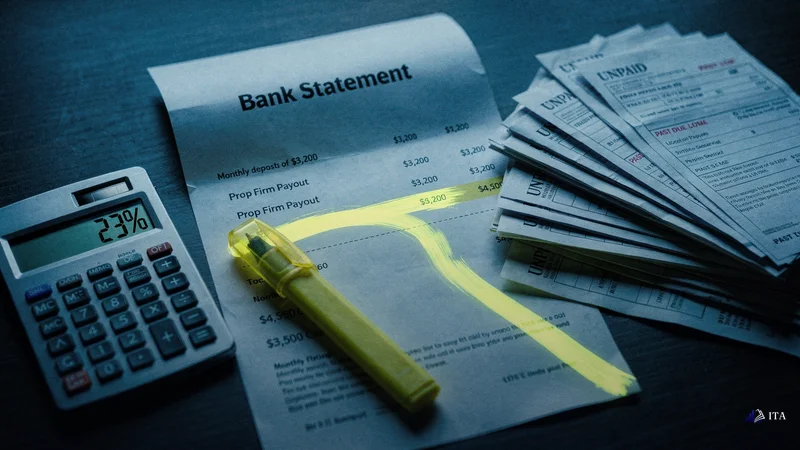
Whatever profit a funded account produces, the trader keeps only their share after the profit split. Platform fees, withdrawal charges, and tax obligations then reduce that figure further, so the amount that actually lands in your pocket is meaningfully smaller than the gross.
The mathematics become harsher with smaller account sizes, where the same percentage return translates into a much thinner payout. This is why many successful traders operate several accounts simultaneously rather than relying on one.
The Account Replacement Cycle and Its Costs
Many traders lose accounts within their first few months due to drawdown violations or consistency-rule breaches. Each replacement carries a fee, creating a recurring expense that simple income calculations tend to ignore.
Most traders go through more than one account in a year. For someone running several accounts at once, those replacement fees can add up to the equivalent of one to a few months of net trading income.
Diversifying Across Multiple Firms for Sustainable Income
Professional prop traders spread risk across several firms to steady their income. This approach means managing different prop trading risk management rules and consistency requirements simultaneously.
At ITA, our institutional approach focuses on sustainable account management rather than aggressive profit targets. Traders who prioritise account preservation over maximum returns tend to outlast those chasing higher percentage gains.
The reality of prop trading: a steady, modest monthly income across multiple accounts is a far more realistic expectation for disciplined traders than the inflated single-account figures promoted in marketing materials.

The Psychological Demands: Mastering Fear and Greed in Prop Trading
Your heart rate spikes when you see red numbers. Your palms sweat. Your decision-making deteriorates sharply under stress. This isn't weakness, it's biology, and learning to work with it is a core part of the daily grind.
Understanding Physiological Responses to P&L Swings
When a trade moves against you, your brain activates many of the same neural pathways as physical pain. The anterior cingulate cortex can light up in a similar way whether you touch a hot stove or watch a position bleed.
Here's what happens: cortisol floods your system within seconds of seeing a loss. Your prefrontal cortex, responsible for rational decision-making, effectively goes offline and you slip into fight-or-flight mode. This is a major reason prop firm failures cluster during drawdown periods. It's not strategy failure, it's neurochemical hijacking.
The reality is harsh: your body struggles to distinguish trading losses from physical threats. That biological response can set off a cascade of poor decisions that compound losses rapidly.
Common Behavioral Biases That Lead to Failure
Loss aversion hits prop traders hardest. Decades of behavioral-economics research (notably Kahneman and Tversky) show people feel losses far more intensely than equivalent gains. The result? You hold losing positions too long and cut winners too early.
Revenge trading follows predictably. After significant losses, your brain craves immediate recovery. Dopamine pathways demand action, leading you to double position size and abandon your plan. You chase the market desperately.
Emotional volatility correlates directly with deteriorating decision-making in active traders, and the pattern repeats across different trading styles and experience levels. Accepting these biological realities is part of what this career demands.
Key behavioral patterns that destroy accounts:
• Overtrading after losses (revenge trading)
• Position sizing increases during drawdowns
• Strategy abandonment during emotional peaks
• Risk management rule violations
• Impulsive market entries without setup confirmation
The Mental Health Strain: Acknowledging the Pressure
There's a mental-health dimension here that rarely makes the highlight reel: a meaningful share of prop traders report stress and mood challenges tied directly to their trading performance. You're operating an evaluation account under strict rules, and daily drawdown limits create constant pressure.
Sleep disruption affects many traders during evaluation phases. Your brain can't easily distinguish trading stress from actual physical danger. The result? Chronic cortisol elevation, impaired judgment, and emotional volatility can become daily companions.
Traders who acknowledge these psychological realities, rather than fighting them, tend to show steadier consistency during their evaluation periods. Acceptance is the first step toward managing this side of the job well.
Evidence-based stress management strategies include:
• Pre-market mental preparation routines
• Structured break schedules during trading sessions
• Post-trade analysis focused on process, not outcomes
• Physical exercise between trading sessions
• Professional psychological support when needed
The honest takeaway is that trading psychology isn't optional. It's the foundation that determines whether your technical skills translate into consistent profitability.
Drawdown Limits and Consistency Rules: Navigating the Institutional Framework
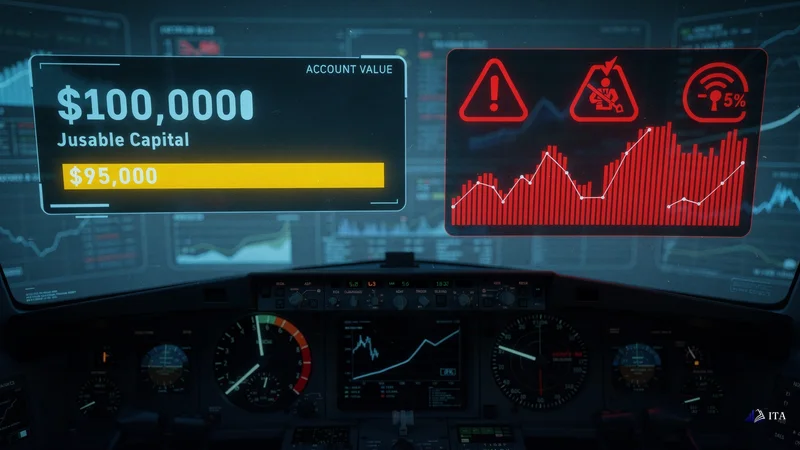
A funded account's nominal balance isn't your true usable capital. Once you account for the maximum drawdown, you're effectively working with a smaller buffer from day one, and that buffer shrinks with every losing trade until you're walking a psychological tightrope.
Many account eliminations happen not from hitting the maximum drawdown, but from violating consistency rules that most traders barely understand.
True Usable Risk Capital: Beyond the Nominal Account Balance
The mathematics are unforgiving. The portion of your balance that sits between you and the drawdown limit is the only part that truly matters, lose it, and every subsequent trade carries elimination risk.
Professional traders calculate differently. They treat the drawdown limit as their true account size and size positions accordingly. Stop losses and daily limits all derive from this reduced, realistic figure rather than the headline balance.
At ITA, our institutional methodology teaches traders to operate well inside their maximum drawdown limit. This creates a psychological buffer that prevents the emotional spiral most traders experience when approaching their limits.
Consistency Requirements: Why "All-In" Bets Are Out
Daily loss limits exist to prevent revenge-trading cycles. But the consistency rule that eliminates most traders is subtler: maximum daily profit limits.
Firms track profit-distribution patterns. An outsized one-day gain followed by weeks of small losses tends to trigger flags, because the system reads it as gambling behavior rather than systematic trading.
The pattern is clear: traders who keep their daily P&L within a tight band survive far longer than those with wild, volatile profit swings.
Account Termination Factors Beyond Maximum Drawdown
Hidden elimination triggers include: holding positions over weekends without approval, trading during news events on restricted pairs, and exceeding position size limits even briefly during volatile market conditions.
Retail traders tend to lose accounts quickly, often within a couple of months, while traders schooled in institutional discipline typically last far longer before a first violation. The difference isn't strategy, it's understanding the operational framework.
The reality of prop trading isn't about trading skill alone. It's about operating within institutional constraints while maintaining psychological equilibrium under constant performance pressure.

Building a Sustainable Prop Firm Career: Discipline and Process
Sustainable prop firm trading isn't about finding the perfect strategy. It's about building systems that work when you don't feel like working. Traders who maintain structured daily routines tend to last far longer than those who trade reactively.
Put bluntly: your career longevity depends more on your Monday-morning routine than your Friday-afternoon profits.
The Power of Process Discipline: Journaling and Routines
Your trading journal is your performance database. Traders who document their pre-trade rationale, execution details, and post-trade analysis consistently improve their risk-adjusted results over time, because the journal turns vague memories into reviewable data.
An effective routine follows a simple sequence: review the market, journal the previous day's trades, then identify today's setups. This isn't busy work, it's pattern-recognition training.
At ITA, our most consistent funded traders follow what we call the "Three-Touch Rule": touch your journal before market open, at a midday review, and after market close. This creates accountability checkpoints that prevent emotional drift.
Strategic Position Sizing Based on Drawdown
Position sizing is your career insurance policy. When you're in drawdown, your next trade should be smaller than when you're at break-even. This isn't fear, it's mathematics.
The principle is simple: scale your risk down as your drawdown grows. If you normally risk a fixed percentage per trade, trim it slightly while you're underwater. A small adjustment buys you a large amount of career protection.
Most traders do the opposite, they increase position size when losing, trying to recover faster. This is the exact behavior that ends prop firm careers. Traders who reduce size during drawdown periods reliably outlast those who keep sizing static.
Monitoring Rule Compliance as Closely as P&L
Track your rule violations like you track your profits. Create a simple scorecard: Did you follow your pre-market routine? Did you stick to your position size? Did you honor your stop loss? Rate yourself 1-10 daily.
Across terminated prop firm accounts, the great majority of rule violations cluster during losing streaks. The pattern is predictable: lose money, abandon process, lose more money, lose the account.
The solution isn't willpower, it's measurement. What gets measured gets managed. Your daily compliance score matters more than your daily P&L because compliance creates sustainable P&L.
Ready to build systems that outlast market volatility? Explore ITA's institutional methodology and see how structured discipline creates lasting careers.
Conclusion: Embrace the Reality for Consistent Prop Firm Success
The prop firm trader lifestyle reality check isn't meant to discourage, it's meant to prepare you. Most traders fail not because they lack talent, but because they enter with Hollywood expectations instead of institutional discipline.
You now understand the daily grind: hours of focused analysis, strict adherence to drawdown limits, and the psychological pressure of consistency rules. The income reality is equally clear, most funded traders earn a modest, variable monthly income, not the six-figure fantasies promoted on social media.
The traders who succeed embrace three realities: First, prop trading is a business that requires systematic risk management over emotional impulses. Second, consistency beats home runs, small, repeatable profits compound better than lottery-ticket trades. Third, mental resilience matters more than technical analysis mastery.
At ITA, we've paid out $1.7M+ to traders who understood these realities from day one. They didn't chase overnight success, they built sustainable processes with institutional-grade methodology.
Your next step is simple: Accept that prop trading success comes from discipline, not luck. If you're ready to approach this as a serious business venture rather than a get-rich-quick scheme, explore ITA's institutional approach.
The reality check ends here. Your disciplined approach begins now.
Ready to get funded?
50% off instant accounts with code 50CRYPTO.
Get Funded →Frequently Asked Questions
Can you realistically make a full-time income trading with prop firms in 2026?
Yes, but it usually requires managing multiple accounts and often takes a year or more to reach consistency. Only a minority of funded traders generate steady monthly income within their first several months. Full-time prop traders can build a meaningful income across multiple accounts, but earnings fluctuate significantly with market conditions.
How much do funded prop traders actually earn per month after splits and fees?
After profit splits and fees, take-home income is usually far more modest than headline figures suggest. The trader keeps only their share of any profit, and platform fees, withdrawal charges, and taxes reduce it further. Smaller account sizes produce proportionally less, which is why many successful traders operate multiple accounts simultaneously.
What does a typical day in the life of a prop firm trader really look like?
Successful prop traders work structured sessions with regular breaks. A typical day includes pre-market preparation, a focused active-trading window during core sessions, a complete mid-day disconnection, and a stretch of analysis and journaling. This resembles shift work far more than the laptop-on-the-beach lifestyle promoted on social media.
Why do most funded traders lose their accounts despite passing the challenge?
The large majority of trading failures stem from psychological breakdowns, not technical incompetence. Traders violate consistency rules, engage in revenge trading after losses, and abandon their process during drawdown periods. The pressure of operating a funded account under strict rules triggers emotional responses that undermine rational decision-making. For the full framework, see From Failed Challenges to $400K Funded.
Is it safer to trade with one large funded account or multiple smaller accounts across firms?
Multiple smaller accounts generally provide better risk distribution and income stability. Professional prop traders typically run several mid-sized accounts rather than a single large one. This approach allows for strategy diversification, reduces the impact of any individual account loss, and helps maintain income during account replacement cycles. Our guide on Overconfidence Bias in Trading covers this in more depth.
Start Your Trading Evaluation
Simulated funded accounts up to $400K. Up to 95% profit split.
Get Funded