 ITA
ITARevenge Trading: Why Most Traders Fail, And a 5-Step Protocol to Break Free
Understand the neuroscience behind revenge trading after losing streaks. Learn a proven 5-step protocol to regain control, manage emotions, and trade.
Short answer
Understand the neuroscience behind revenge trading after losing streaks. Learn a proven 5-step protocol to regain control, manage emotions, and trade. In a prop firm context this still sits under simulated-capital rules: fees buy access to the evaluation or funded environment, not a deposit of trading capital.
Simulated capital: prop firm evaluation and funded stages discussed here typically run on simulated accounts. Challenge fees pay for access to that environment; they are not a deposit of trading capital. ITAfx accounts are simulated capital.
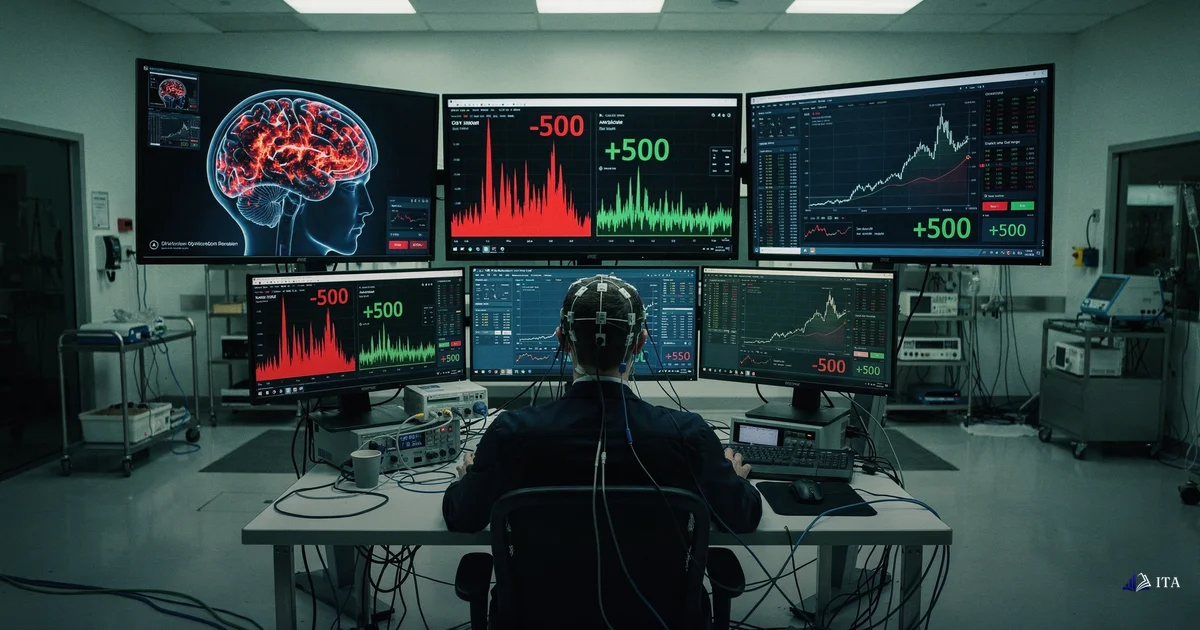

The Emotional Trap: Why Losing Streaks Trigger Revenge Trading
Losing streaks trigger revenge trading because consecutive losses activate the brain's loss aversion mechanism, creating an emotional override that makes risk management rules feel irrelevant. Your chest tightens after the third loss in a row, your jaw clenches, and suddenly you're calculating how many lots it would take to recover everything in one trade.
This isn't weakness. It's neuroscience.
When you experience a losing streak, your brain doesn't process it as a series of independent statistical events. Instead, loss aversion, the cornerstone of prospect theory, means you feel those losses approximately twice as intensely as equivalent gains. A $500 loss doesn't just cancel out a $500 win; it hits your psyche with double the force.
But the real damage happens deeper. After a loss, your amygdala, the brain's threat detection center, activates and floods your system with cortisol and adrenaline. This stress response can suppress your prefrontal cortex, the region responsible for logic, planning, and impulse control. Neuroscientists call this an "amygdala hijack," and this acute stress response can impair decision-making for many people.
The result? You're no longer the rational trader who wrote that trading plan. You're operating from your survival brain, and it has one message: fix this threat immediately.
This fixation on breakeven becomes all-consuming. Your brain anchors to your starting balance and treats any deficit as an emergency requiring immediate action. Trading platforms that have analyzed user behavior report a disturbing pattern: revenge trades are typically placed within minutes of a loss and often at 2-3 times normal position size.
You're not broken. Your brain is doing exactly what evolution programmed it to do when facing a threat. The problem is that evolution didn't account for leveraged forex markets.
The Vicious Cycle: How Emotional Trading Destroys Accounts
Emotional trading destroys accounts through a predictable sequence where manageable drawdowns become catastrophic losses. The data is brutal: platforms studying emotional trading behavior show that P&L distributions skew sharply negative when traders shorten the time between trades after a loss.
Here's how the destruction unfolds. First comes the position sizing explosion. That careful 1% risk per trade you follow when calm? Gone. Revenge traders routinely risk 3-5% or more, desperately trying to recover losses in a single trade. The mathematics of ruin accelerate, what would have been a recoverable 5% drawdown becomes 15% in hours.
Then cognitive tunnel vision takes hold. Your brain, flooded with stress hormones, literally narrows your field of attention. You stop seeing the market objectively. Every tiny retracement looks like a reversal opportunity. Every minor support level seems unbreakable. You're no longer reading the market; you're projecting your desperation onto it.
The negative feedback loop completes when these rushed, oversized, poorly analyzed trades inevitably fail. Each additional loss amplifies the stress response, further degrading decision quality. Brain-science research identifies three mechanisms driving this spiral: dopamine withdrawal after losses creates a craving for the "high" of winning, the amygdala hijack we've discussed, and cognitive tunnel vision that blocks alternative solutions.
We've seen funded traders turn a 2% drawdown into account termination in under an hour. The same traders who spent months carefully passing their evaluation, destroyed by thirty minutes of emotional trading. The market didn't beat them. Their own brain chemistry did.
The 5-Step Protocol to Overcome Revenge Trading
Breaking the revenge trading cycle requires more than motivation. You need mechanical interventions that work even when your prefrontal cortex is offline. This protocol, refined through analysis of successful funded traders, creates multiple circuit breakers between loss and response.
Step 1: Implement a Mandatory Cooling-Off Period
The single most effective intervention is time. Expert protocols recommend a mandatory 15-30 minute no-trade window after any loss. This isn't a suggestion, it's a hard rule. Close your platform. Set a timer. Walk away from your screens.
Why does this work? Cortisol and adrenaline have half-lives. That acute stress response weakens predictably over 15-20 minutes. By forcing a delay, you allow your prefrontal cortex to come back online. Many funded traders go further, implementing platform-level lockouts that prevent order entry for preset periods after losses.
Step 2: Engage in a Post-Loss Ritual
During your cooling-off period, execute a specific ritual. Proven components include: acknowledging the loss out loud ("we lost $X on that trade"), extracting one learning point, mentally rehearsing your ideal execution for the next setup, and affirming your commitment to process over outcome.
This isn't mystical thinking. It's cognitive restructuring. By forcing your brain to engage analytically with the loss, you shift activation from the emotional amygdala back to the rational prefrontal cortex.
Step 3: Journal Your Emotional State and Triggers
Before you can trade again, document three things: your current emotional state on a 1-10 scale, what specific thought triggered the urge to revenge trade, and what you would tell another trader in your exact situation. This externalisation creates psychological distance between you and the emotion.
The most successful funded traders don't just record trades, they map their emotional patterns. Over time, you'll identify your specific triggers. Maybe it's consecutive losses. Maybe it's giving back morning profits. Once mapped, these triggers become predictable and manageable.
Step 4: Re-evaluate Position Sizing After a Loss
Reduce position size after losses, don't increase it. If you normally risk 1% per trade, drop to 0.5% for the next two trades after a loss. This serves two purposes: it prevents catastrophic damage if you're still emotionally compromised, and it forces you to focus on execution quality rather than recovery speed.
Think of it as trading with training wheels after a crash. There's no shame in protecting yourself from yourself.
Step 5: Review Daily Loss Limits and Auto Stop-Outs
Before your next trade, confirm your daily loss limit is active. Most professional traders set this at 2-3% of account equity. But use platform-level enforcement, not willpower. Set automatic account lockouts that trigger at your daily limit. Our guide on How to Handle Losing Streaks in Funded Accounts covers this in more depth.
Funded trading firms like ITAfx enforce daily loss limits of 3% specifically because they understand the psychology of drawdowns. When you hit that limit, you're done for the day. No exceptions. No "just one more trade to get back to breakeven."
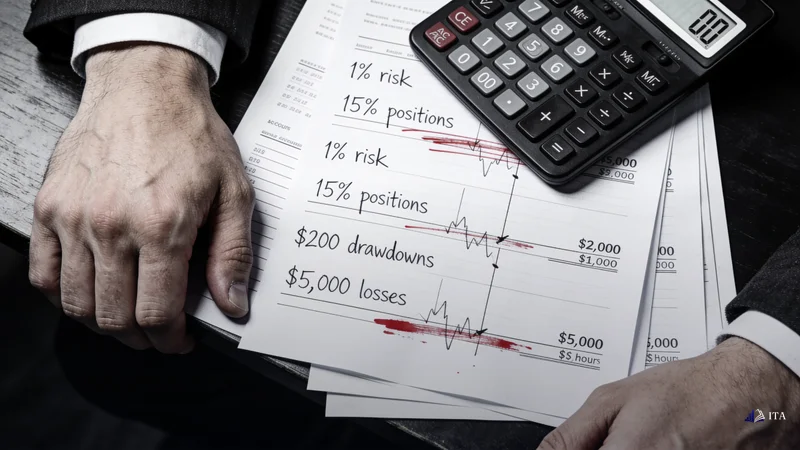
Building Mental Resilience: Treating Losses as Data, Not Threats
The protocol handles the acute crisis, but long-term success requires rewiring how your brain processes losses. This isn't about becoming emotionless, it's about creating new neural pathways that interpret market feedback differently.
Start with pre-session check-ins. Before you even open your platform, spend 2-5 minutes in conscious breathing. Not meditation, specific box breathing: inhale for 4 counts, hold for 4, exhale for 4, hold for 4. Repeat 4-5 times. This activates your parasympathetic nervous system, pre-emptively calming the threat detection system.
During these check-ins, remind yourself of a fundamental truth: losses are data points, not threats to your survival. Your amygdala can't tell the difference between a trading loss and a sabre-toothed tiger, but your prefrontal cortex can, if you train it.
Developing an objective mindset toward drawdowns requires reframing. Instead of "we lost $500," try "The market provided feedback that our analysis was incomplete." Instead of "we need to make this back," try "Our job is to execute our process regardless of account balance."
This isn't positive thinking nonsense. It's cognitive reappraisal, a technique validated across thousands of trading psychology case studies. By changing the narrative, you change the neurological response.
The role of discipline isn't to suppress emotion, it's to create structures that function when emotion peaks. Every professional trader has felt the revenge trading urge. The difference? They've built systems that activate before their worse impulses do. Like a surgeon following a precise protocol before every incision, the goal is a process you execute without having to think it through in the moment.

Practical Safeguards: Tools and Habits for Consistent Trading
Practical safeguards for consistent trading include concrete tools and habits that funded traders use to maintain discipline even after difficult losses. Theory without implementation is worthless, which is why these specific systems focus on actionable steps rather than abstract concepts.
Automated risk controls form your first line of defense. Modern platforms offer multiple circuit breakers: maximum position size limits, maximum daily loss lockouts, time-based trading restrictions, and maximum orders per day. Use all of them. Set these during calm periods and make them difficult to override.
Your written trading plan becomes your external prefrontal cortex. But here's what most traders miss, the plan must include specific protocols for drawdown periods. Document exactly what you'll do after one loss, after two consecutive losses, after hitting 50% of your daily limit. When emotion floods your system, you follow the written protocol, not your feelings.
Continuous learning from trading psychology insights isn't optional, it's maintenance. The traders who maintain funded accounts long-term dedicate time weekly to studying their psychological patterns. They track correlation between emotional states and trading outcomes. They identify which market conditions trigger their worst behavior.
Some practical tools that work: Trading journal apps that force emotional check-ins before order entry. Platform plugins that display your rules on-screen during drawdowns. Accountability partners who you message after every losing day. Physical distance, some traders keep their phone in another room to prevent impulsive mobile trading after desktop losses.
Remember: many traders who experience rapid losses tend to increase their risk per trade. You're fighting millions of years of evolution. Don't rely on willpower when you can use technology. Review your post-loss decisions like a forensic analyst combing through evidence: methodical, objective, and free of blame.

Conclusion: Master Your Mind, Master Your Trades
Revenge trading isn't a character flaw you need to overcome through sheer willpower. It's a predictable neurological response to financial loss, as automatic as flinching from a flame. The traders who succeed long-term don't have superior emotional control, they have superior systems.
The 5-step protocol isn't just theory. It's a practical framework that interrupts your brain's threat response and creates space for rational decision-making. Implement the cooling-off period today. Set up those platform-level controls before your next session. Write out your post-loss ritual and keep it beside your trading station.
Your brain will always react to losses with the urgency of a survival threat. But you can build circuit breakers between that reaction and your response. The market will still be there in 30 minutes. Your account might not be if you trade in the next 30 seconds.
The difference between the 90% who increase risk after losses and the 10% who maintain consistency isn't talent or wisdom. It's preparation. They've accepted that their brain will malfunction under stress and built systems that function anyway.
Stop treating revenge trading as a battle against yourself. Start treating it as an engineering problem with a mechanical solution. Because in the end, you don't need to master your emotions, you need to master the gap between feeling and action.
Ready to implement these safeguards? Explore how ITAfx's funded accounts include built-in risk controls designed to protect traders from their own psychology.
Ready to get funded?
50% off instant accounts with code 50CRYPTO.
Get Funded →Frequently Asked Questions
What exactly is revenge trading and how do I recognize it in my own behavior?
Revenge trading occurs when you abandon your trading plan after losses and make impulsive, oversized trades trying to immediately recover. Key signs include increasing position size after losses, trading within minutes of a loss, feeling physically tense or angry, and obsessively calculating breakeven scenarios.
How long should I wait before trading again after I take a loss?
Many traders use a cooling-off period, often 15-30 minutes, to let emotions settle before making decisions. This isn't optional, it's a mechanical rule that helps prevent stress and impulsivity from overriding logical decision-making in the moment.
Why do losing streaks feel so much worse than single losses from a psychological perspective?
Loss aversion from prospect theory means you feel losses approximately twice as intensely as equivalent gains. Consecutive losses amplify this effect, triggering your brain's threat detection system and creating an emergency response that demands immediate action to "fix" the perceived threat.
What role does position sizing play in revenge trading and how can I fix it?
Revenge traders routinely increase position size to 3-5% risk or more, trying to recover losses quickly. The fix is counterintuitive: reduce position size after losses to 0.5% for the next two trades. This prevents catastrophic damage and forces focus on execution quality over recovery speed.
Can automated risk controls meaningfully reduce revenge trading, and how should they be set?
Yes, automated controls are essential because they function when your prefrontal cortex is offline. Set daily loss limits at 2-3% of account equity with platform-level enforcement, maximum position size limits, and time-based trading restrictions. Use technology, not willpower, to fight millions of years of evolution.
Key Takeaways
- Implement a mandatory 15-30 minute cooling-off period after any loss to allow stress hormones to subside naturally.
- Reduce position size to 0.5% after losses instead of increasing it, protect yourself from emotional compromisation.
- Use platform-level daily loss limits at 2-3% with automatic lockouts that cannot be overridden by willpower alone.
- Document your emotional state and triggers in a trading journal before re-entering the market after losses.
- Practice box breathing (4-4-4-4 pattern) before each session to activate your parasympathetic nervous system preemptively.
- Reframe losses as market feedback rather than personal threats, change the narrative to change your neurological response.
- Set maximum position size limits and daily order restrictions during calm periods when rational thinking prevails.
Ready to get funded?
Instant accounts, simulated capital, rules published before you pay. 50% off with code 50CRYPTO.
Get Funded →