 ITA
ITAOvercoming Prop Firm Evaluation Anxiety Mindset: 6 Proven Mindset Strategies
Learn evidence-based strategies to overcome prop firm evaluation anxiety. Master breathing techniques, trading plans, and mindset shifts that help traders.
Short answer
Learn evidence-based strategies to overcome prop firm evaluation anxiety. Master breathing techniques, trading plans, and mindset shifts that help traders. In a prop firm context this still sits under simulated-capital rules: fees buy access to the evaluation or funded environment, not a deposit of trading capital.
Simulated capital: prop firm evaluation and funded stages discussed here typically run on simulated accounts. Challenge fees pay for access to that environment; they are not a deposit of trading capital. ITAfx accounts are simulated capital.


Understanding Prop Firm Evaluation Anxiety
Evaluation anxiety differs from regular trading stress in three critical ways. First, you're trading in an artificial performance window, typically 30-60 days to hit specific targets without breaching drawdown limits. Second, every trade carries double weight: it affects both your profit target and your maximum loss threshold. Third, the evaluation fee creates sunk-cost pressure that amplifies poor decision-making.
The psychological literature on performance anxiety reveals why this combination is so destructive. When traders perceive evaluation as a high-stakes test of worth rather than a demonstration of process, their prefrontal cortex, responsible for rational decision-making, becomes impaired by stress hormones. This leads to the exact behaviors that violate evaluation rules: overleveraging to "speed up" results, holding losing trades hoping for reversal, and trading outside proven setups.
The Anxiety-Performance Connection
Research on skill-based competitions shows a consistent pattern. Camerer and Lovallo's study found subjects systematically over-entered competitions when they overrated their abilities and underweighted competition difficulty. In prop firm evaluations, this manifests as traders taking on excessive risk in the final days, believing they can "push through" to reach profit targets.
But traders who pass evaluations don't try to eliminate anxiety. They build systems that function despite it.
Strategy 1: Develop a Complete Trading Plan
The most powerful anxiety antidote isn't meditation or positive thinking, it's a written trading plan so detailed that decisions become automatic. Trading psychology guides emphasize that a complete plan becomes an anchor under pressure, removing the cognitive load of in-the-moment choices.
Essential Plan Components
Your evaluation trading plan must specify exact entry criteria for each setup you trade. Not "breakout trades," but "breakout of 20-period high with volume above 50-period average and RSI above 60." Every variable that influences your decision gets written down and quantified.
Exit rules require equal precision. Define both target exits ("close 50% at 1:1 risk-reward, remainder at 2:1") and stop losses ("initial stop at swing low minus 5 points"). Include specific scenarios for moving stops to breakeven and trailing profit. The goal: zero discretionary decisions during trade management.
Position sizing follows a mechanical formula based on ITAfx's evaluation rules. With a 3% daily loss limit and 6% maximum loss, many successful traders risk 0.5% per trade, allowing for six consecutive stops before hitting daily limits. The formula becomes: lots = (account balance × 0.005) ÷ (stop distance in dollars × contract value).
Implementation Tips
Print your plan and keep it visible during every trading session. When anxiety peaks, your eyes can verify you're following the system rather than improvising. Create a pre-trade checklist that confirms each setup meets all criteria before entry. This physical act of checking boxes interrupts the impulse to chase suboptimal trades.
The plan eliminates the "should we take this trade?" Anxiety loop. Either the setup meets your written criteria or it doesn't. No negotiation, no second-guessing, no emotional override.

Strategy 2: Master Pre-Trade Routines
Elite athletes don't step onto the field and immediately perform, they follow precise warm-up routines that prepare both body and mind. Successful prop firm traders apply the same principle, using pre-trade routines to shift from reactive to responsive states.
Effective Routine Elements
Start with a technical review that grounds you in objective data. Check the economic calendar for high-impact events. Review daily pivot points and key support/resistance levels. Note which pairs show clear trending behavior versus ranging conditions. This 10-minute process activates analytical thinking before emotional reactions can dominate. Physical preparation matters more than most traders realize. Stand up and do 20 jumping jacks or push-ups to discharge nervous energy. The brief exercise shifts your nervous system from sympathetic (fight-or-flight) to parasympathetic (calm-focused) dominance. Follow with 60 seconds of deep breathing: four counts in, hold for four, four counts out. Mental rehearsal completes the routine. Visualize yourself executing trades according to plan, entering at signals, managing positions mechanically, closing at targets. Include visualization of losses: see yourself taking stops calmly and moving to the next setup. This mental practice reduces emotional shock when real losses occur.
Sample Pre-Trade Routine
Here's a 15-minute routine used by funded traders:
- Minutes 1-5: Review economic calendar and mark news times
- Minutes 6-10: Identify key levels on primary trading pairs
- Minutes 11-12: Physical movement (push-ups/stretching)
- Minutes 13-14: Box breathing exercise (detailed in Strategy 4)
- Minute 15: Read trading plan rules aloud
The routine becomes a psychological trigger. By the final minute, your mind recognizes the pattern and shifts into "trading mode", alert but calm, focused but flexible. Anxiety can't dominate a mind that's already occupied with systematic preparation.
Strategy 3: Implement Process-Focused Evaluation
The cruelest irony of prop firm evaluations: focusing on profit targets increases the likelihood of failure. Successful traders flip the script by measuring process execution rather than monetary outcomes. This isn't motivational rhetoric, it's a practical system that reduces anxiety by changing what you track.
Process vs. Outcome Metrics
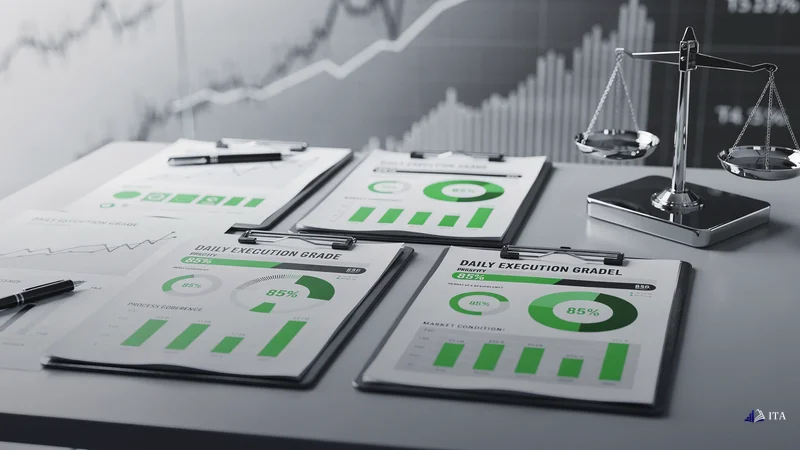
Outcome metrics create anxiety because they're partially outside your control. You can execute a perfect trade and still lose money due to unexpected news or random market movement. Checking your profit/loss after each trade reinforces the gambling mindset that destroys discipline. Process metrics measure only what you control: Did you follow entry rules? Did you place stops at planned levels? Did you size positions according to formula? These binary yes/no questions have clear answers that reinforce systematic behavior. Create a daily scorecard with five to seven process metrics. Example metrics: "Waited for all entry signals before trading" (yes/no), "Held winners to first target" (yes/no), "Stopped trading after two consecutive losses" (yes/no). Score yourself at the end of each session. A perfect process score with a losing day builds confidence; a profitable day with poor process scores warns of unsustainable luck.
Daily Process Scorecard
Here's a proven scorecard template:
- Pre-market routine completed: ☐
- All trades met plan criteria: ☐
- Position sizes followed formula: ☐
- Stops placed at planned levels: ☐
- Held to target (no early exits): ☐
- Respected daily loss limit: ☐
- Post-trade journal completed: ☐
Aim for 6/7 or better daily. Track your weekly average. Funded traders report that consistent 85%+ process scores correlate with evaluation success regardless of market conditions. The scorecard becomes your real evaluation metric, account balance becomes a lagging indicator of process quality.
Strategy 4: Use Box Breathing for Stress Management
Stress management research consistently identifies breathing techniques as the fastest way to interrupt anxiety spirals. Box breathing, used by Navy SEALs and emergency room surgeons, works because it's impossible to maintain panic while breathing in a controlled pattern.
Box Breathing Technique
The technique requires exactly 16 seconds per cycle:
- Inhale through your nose for 4 counts
- Hold your breath for 4 counts
- Exhale through your mouth for 4 counts
- Hold empty for 4 counts
Perform minimum three cycles (48 seconds) for noticeable effect. The counting occupies your conscious mind while the breathing pattern activates your parasympathetic nervous system. Heart rate decreases, muscle tension releases, and clarity returns. Practice box breathing during calm periods so it becomes automatic under stress. Many traders set hourly reminders for a single cycle, this prevents anxiety accumulation rather than treating it after the fact.
When to Use Box Breathing
Implement box breathing at five critical moments:
- Immediately after a losing trade (before reviewing what happened)
- When you feel the urge to revenge trade
- Before entering a position that feels "too big"
- After profitable trades (excitement impairs judgment too)
- At any point when physical tension appears (clenched jaw, tight shoulders)
The technique works because anxiety requires physical tension to sustain itself. Controlled breathing breaks the tension-thought-emotion loop before it spirals into poor trading decisions. You can't simultaneously catastrophize about drawdowns while counting breath cycles.

Strategy 5: Maintain a Trading Journal
Journaling sounds basic until you understand how funded traders actually use it. Rather than a diary of feelings, effective journals become pattern-recognition systems that identify and interrupt anxiety triggers before they affect trading.
Journal Entry Components
Psychology research frames journaling as a way to identify emotional triggers and conditions preceding poor decisions. Each entry requires five specific elements: Pre-trade state: Rate your confidence (1-10) and note any physical sensations (tension, fatigue, excitement). This baseline helps identify when you're trading from suboptimal states. Setup quality: Grade how well the trade met your plan criteria (A through F). C-grade setups taken from anxiety consistently lose money. Execution precision: Document any deviations from plan, early exits, moved stops, increased size. These micro-violations predict major rule breaks. Emotional markers: Note specific thoughts during the trade ("Need to make back losses," "This has to work," "Market owes me"). These phrases signal anxiety-driven trading. Lesson extracted: Write one specific adjustment for next time. Not "be more patient" but "wait for hourly close above resistance before entering."
Sample Journal Entry
Date: March 15, 10:45 AM
Pair: EUR/USD Long
Pre-trade state: Confidence 6/10, tight shoulders after morning loss
Setup quality: B (all signals present, but forcing due to earlier loss)
Execution: Entered full size instead of half (anxiety deviation)
Emotional markers: "Need to recover morning's loss quickly"
Result: -$500 (hit stop)
Lesson: After any loss, trade half size on next setup regardless of quality
Weekly Journal Review
The magic happens in weekly review. Look for patterns: Do losses cluster after specific triggers? Does confidence below 7 predict poor execution? Do certain times of day show more emotional trading? One funded trader discovered she consistently overtraded between 2-4 PM when fatigue peaked. Another found that any day starting with a loss exceeding 1% led to revenge trading. These patterns, invisible in the moment, become obvious in review. Anxiety loses power when you can predict and prepare for it.

Strategy 6: Reframe the Evaluation Mindset
The most profound shift successful evaluation candidates make isn't technical, it's perceptual. They stop viewing evaluation as a test and start viewing it as a demonstration. This isn't semantic games; it fundamentally changes how your nervous system responds to each trade.
Effective Mental Reframes
Trading psychology experts emphasize treating evaluation as practice or process demonstration rather than personal validation. Consider these reframes:
From "we must pass" to "we will demonstrate our process": Passing becomes a byproduct of good execution rather than the goal itself. This reduces attachment to individual trade outcomes.
From "The firm is judging me" to "we're showing our systematic approach": You shift from performance anxiety to teaching mode, calmer, more methodical, less reactive.
From "we're risking our evaluation fee" to "we're investing in skill demonstration": The fee already spent; now you're simply executing the process you've paid to showcase.
Simulation Mindset
The ultimate reframe treats the entire evaluation as an elaborate simulation, because technically, it is. You're trading a simulated account to demonstrate you can manage simulated capital professionally. This isn't about minimizing the importance; it's about removing the emotional weight that creates poor decisions.
Professional pilots train in flight simulators with absolute seriousness but without fear of crashing. They focus on executing procedures correctly, knowing real-world performance will mirror simulation habits. Apply the same approach: trade the evaluation with professional discipline but without existential anxiety. You're demonstrating competence in a controlled environment, not fighting for survival.
This mindset shift appears simple but requires daily reinforcement. Write "DEMONSTRATION MODE" at the top of your trading plan. When anxiety surfaces, remind yourself: "we're here to show our process, not prove our worth."
The traders who pass prop firm evaluations haven't eliminated anxiety, they've built systems that function regardless of emotional state. Your trading plan removes discretionary decisions. Pre-trade routines create physiological calm. Process scoring redirects focus from outcomes to execution. Box breathing interrupts stress responses. Journaling identifies patterns before they become problems. Mental reframes transform evaluation from test to demonstration.
These aren't feel-good strategies or motivational platitudes. They're mechanical interventions that successful traders implement systematically. The 5-15% who pass evaluations on their first attempt don't possess superior psychology, they possess superior protocols.
Your next step isn't to master all six strategies simultaneously. Choose one, preferably the written trading plan, and implement it completely before adding others. Build your anxiety-management system the same way you'd build a trading strategy: systematically, with measurement and refinement.
The evaluation exists to identify traders who can follow rules under pressure. These strategies ensure you remain the trader who follows rules, regardless of pressure. That's not just the path to passing, it's the foundation of professional trading itself. Our guide on Prop Firm Trader Interview Preparation covers this in more depth.
Ready to put these strategies into practice? Explore ITAfx's instant account options and start your evaluation with confidence built on systematic preparation, not hope.
Ready to get funded?
50% off instant accounts with code 50CRYPTO.
Get Funded →Frequently Asked Questions
How do I stop overtrading during a prop firm evaluation?
Create a written trading plan with specific daily loss limits and stick to it mechanically. Most successful traders risk only 0.5% per trade during evaluations, allowing six consecutive stops before hitting daily limits. Use a pre-trade checklist to verify each setup meets your criteria before entry.
What is the best mindset for passing a prop firm challenge?
Treat the evaluation as a demonstration of your trading process, not a test of personal worth. Focus on executing your system consistently rather than achieving profit targets. This mindset shift reduces anxiety and prevents the emotional decisions that cause most evaluation failures.
How can I calm down before entering a trade?
Use box breathing: inhale for 4 counts, hold for 4, exhale for 4, hold empty for 4. Perform at least three cycles before any trade entry. This technique interrupts anxiety responses and activates your parasympathetic nervous system for clearer decision-making.
Should I trade smaller position sizes during a funded account evaluation?
Yes, most successful evaluation candidates risk 0.5% per trade instead of the maximum allowed. This conservative sizing prevents emotional spirals from large losses and allows multiple attempts to recover from mistakes without breaching drawdown limits.
How do journaling and process goals reduce trading anxiety?
Journaling identifies emotional triggers before they affect trading, while process goals measure what you control rather than market outcomes. Track metrics like 'followed entry rules' or 'placed stops at planned levels' instead of profit/loss to build confidence through consistent execution.
Key Takeaways
- Create a detailed trading plan with exact entry criteria and mechanical exit rules to eliminate anxiety-driven decisions during evaluations.
- Use a 15-minute pre-trade routine including technical review, physical movement, and box breathing to shift into focused trading mode.
- Track process metrics (entry signals, stop placement, position sizing) instead of profit/loss to maintain discipline and reduce emotional trading.
- Practice box breathing (4-4-4-4 pattern) for 48 seconds minimum to interrupt anxiety spirals and restore rational decision-making.
- Maintain a structured trading journal with pre-trade state, setup quality, and emotional markers to identify and prevent anxiety triggers.
- Reframe evaluation as demonstrating your systematic process rather than proving personal worth to reduce performance pressure.
- Risk maximum 0.5% per trade during evaluations to allow six consecutive stops before hitting daily loss limits.
Ready to get funded?
Instant accounts, simulated capital, rules published before you pay. 50% off with code 50CRYPTO.
Get Funded →