 ITA
ITALoss Aversion in Trading: The Hidden Cost in Your Position Sizing Decisions
Uncover how loss aversion silently sabotages your position sizing. Learn practical protocols to overcome emotional biases and implement systematic risk controls.
Short answer
Uncover how loss aversion silently sabotages your position sizing. Learn practical protocols to overcome emotional biases and implement systematic risk controls. In a prop firm context this still sits under simulated-capital rules: fees buy access to the evaluation or funded environment, not a deposit of trading capital.
Simulated capital: prop firm evaluation and funded stages discussed here typically run on simulated accounts. Challenge fees pay for access to that environment; they are not a deposit of trading capital. ITAfx accounts are simulated capital.
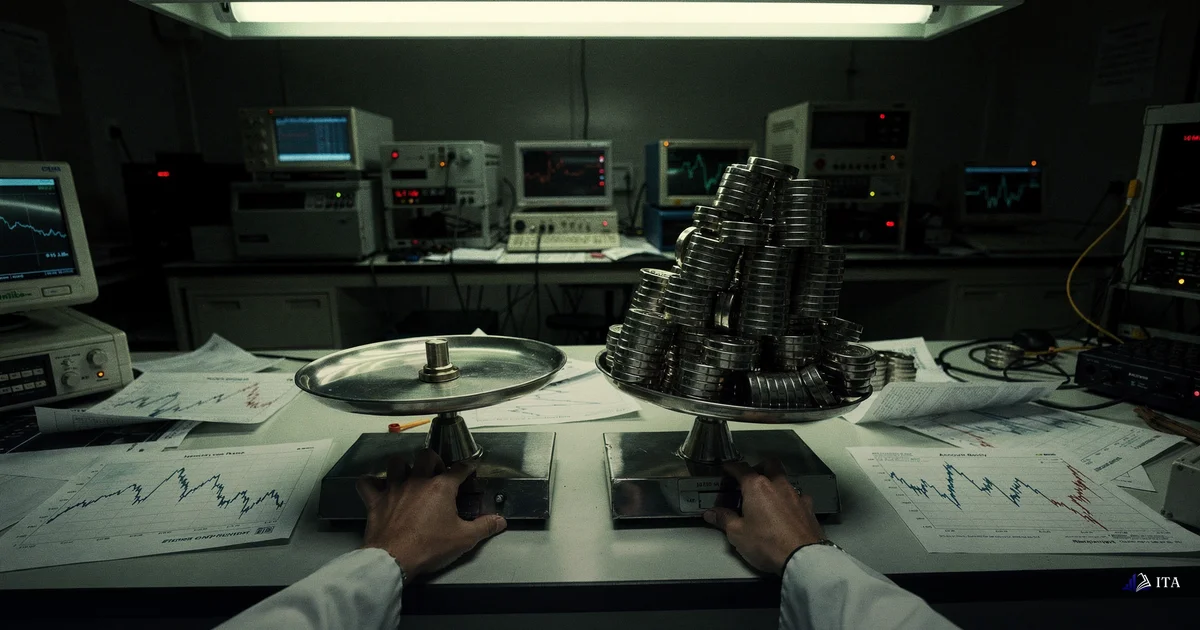

The Psychological Trap: How Loss Aversion Distorts Position Sizing
Loss aversion causes traders to double down after losses, creating a psychological trap that systematically destroys accounts through oversized revenge trades. When facing a $500 loss, the brain's risk-reward calculation inverts, what should trigger smaller positions instead triggers larger ones as traders chase recovery.
Most traders double their position size on the next trade.
Not because they're reckless. Not because they lack discipline. But because their brain is experiencing something Kahneman and Tversky documented in 1979: losses hurt approximately twice as much as equivalent gains feel good. That $500 loss registers in your nervous system like $1,000 of pain.
Why Losses Feel Twice as Painful as Gains
The loss aversion coefficient sits at roughly 2.25 in controlled experiments. This isn't a personality flaw, it's evolutionary hardwiring. Our ancestors who felt losses more acutely survived longer than those who didn't. But in modern markets, this same mechanism destroys trading accounts.
When you're in profit, your brain becomes cautious. You want to protect what you have. When you're in loss, your brain switches modes entirely. You become willing to take larger risks to escape the pain of being down. Prospect theory calls this the reflection effect: risk-averse in gains, risk-seeking in losses.
The Disposition Effect: Holding Losers, Selling Winners
This asymmetry shows up in the data. Odean's analysis of trading accounts found traders are 50% more likely to sell a winning position than a losing one. The proportion of gains realized sits at 14.8% versus only 9.8% for losses.
Think about your own trading. How often have you closed a winning trade at +20 pips while letting a loser run to -60? The mathematics of successful trading demands the opposite: quick losses, patient winners. But loss aversion inverts this logic.
Asymmetric Sizing: Risking More After Losses
The most dangerous manifestation isn't holding losers, it's position sizing. After a loss, traders unconsciously increase their risk per trade. After a win, they reduce it. The market quality hasn't changed. The setup quality hasn't changed. Only their emotional state has changed. Our guide on Risk management guide for funded trading accounts covers this in more depth.
This creates a deadly spiral. Losses lead to larger positions. Larger positions lead to larger losses. The account bleeds out not from bad analysis, but from loss-aversion-driven position sizing. What started as a manageable drawdown becomes an account-ending streak.
The Science Behind It: Prospect Theory and Cognitive Biases
Prospect theory explains why traders become risk-seeking after losses and risk-averse after gains, creating the exact opposite behaviour needed for consistent profitability. Kahneman and Tversky's research demonstrates that losses feel twice as painful as equivalent gains feel pleasurable, driving systematic position sizing errors.
Prospect theory revealed something counterintuitive: humans don't evaluate outcomes rationally. We evaluate them relative to a reference point, usually our current position. And we weight losses and gains asymmetrically.
When you're down $2,000 on the day, your reference point shifts. Suddenly, a 50/50 bet to either lose another $1,000 or get back to breakeven looks attractive. The same trader who would never risk $1,000 on a coin flip when they're up will eagerly take that bet when they're down. The risk hasn't changed. The math hasn't changed. But the framing has.
Confirmation Bias: Seeking Validation for Bad Trades
Loss aversion doesn't operate alone. It recruits other biases. When you're holding a losing position, confirmation bias kicks in. You start seeing evidence everywhere that the trade will turn around. That minor support level becomes major in your mind. That slight divergence becomes a reversal signal.
You're not analyzing anymore, you're rationalizing. Every piece of information gets filtered through the lens of "how does this support our losing position?" Meanwhile, clear exit signals get ignored or explained away. The position size that seemed reasonable at entry now represents too much pain to realize.
Endowment Effect: Valuing What You Own Too Highly
Once you own a position, you value it more highly than before you owned it. This endowment effect compounds with loss aversion. Not only does the loss hurt twice as much, but you've also attached your identity to the trade. Closing it means admitting error. Our guide on Correlation Trading Strategies for Forex Prop Firms covers this in more depth.
So you move the stop loss. You add to the position. You tell yourself it's "investing" now, not trading. Professional traders recognize these thoughts as warning signals. When you catch yourself justifying a position rather than analyzing it, loss aversion has taken control.
Real Trading Scenarios: Where Loss Aversion Strikes Hardest
Loss aversion strikes hardest during drawdown periods, news events, and consecutive losing streaks, scenarios where emotional override is most likely to destroy disciplined position sizing. These real market conditions expose the gap between theoretical knowledge and actual trading behaviour under pressure.
Doubling Down: Increasing Size to 'Get Back to Even'
Friday afternoon. You're down $1,500 on the week. One more trade could get you back to breakeven. Instead of your usual 0.5% risk, you calculate: "we need to make $1,500. If we target 30 pips, we need..." And suddenly you're trading 5 lots instead of 1.
The setup isn't better. The market isn't offering more edge. You're simply in pain and want it to stop. This is loss aversion at its most destructive, using position size as a tool for emotional regulation rather than risk management.
Moving Stops: Avoiding Realized Losses at All Costs
Your stop loss sits 20 pips away. Price creeps toward it. At -15 pips, you move the stop to -30. "Just giving it room to breathe," you tell yourself. At -25, you move it to -50. By the time you finally exit at -80 pips, you've taken four times your planned loss.
Moving stops is loss aversion made visible. You're so desperate to avoid the pain of realizing a loss that you guarantee a larger loss later. The irony: the psychological pain at -80 pips is far worse than it would have been at -20.
Under-Sizing Good Setups: Fear of Losing Profits
After a winning streak, loss aversion flips. Now you have profits to protect. That perfect setup you'd normally trade at 1% risk? You take it at 0.25%. The market gives you exactly what your analysis predicted, but your position is too small to matter.
This is loss aversion's hidden cost, the profits you don't make because you're protecting yesterday's gains. You become tentative exactly when you should be aggressive, and aggressive exactly when you should be cautious.

Practical Protocols: Implementing Systematic Position Sizing
Fixed Fractional Risk: The 1-2% Rule for Every Trade
The antidote to loss aversion isn't willpower, it's mathematics. Fixed fractional position sizing removes emotion from the equation. Here's the protocol:
Decide your risk per trade when you're calm, not when you're trading. Most professionals risk between 0.5% and 2% per trade. At ITAfx, funded traders who maintain consistent profitability typically risk around 1% per position.
The formula is mechanical: Position size = (Account balance × Risk percentage) ÷ (Stop loss in pips × Pip value). If you have a $50,000 account, risk 1%, and your stop is 25 pips on EUR/USD: Position size = ($50,000 × 0.01) ÷ (25 × $10) = 2 lots.
No adjustments for how you feel. No increases after losses. No decreases after wins. The same percentage, every trade, regardless of your emotional state.
Volatility-Adjusted Sizing: Adapting to Market Conditions
Fixed percentage risk is the foundation, but markets aren't static. When volatility doubles, your position size should halve. This isn't an emotional decision, it's mathematical.
Use the Average True Range (ATR) as your volatility measure. If EUR/USD typically shows 60-pip daily ranges but current ATR reads 120 pips, reduce position size by 50%. Your risk in dollar terms stays constant while your risk in market terms adapts.
This prevents loss aversion from creeping in through the back door. When markets get volatile, traders often increase size to "make back losses faster." Volatility-adjusted sizing makes this impossible.
Pre-Committed Stop-Loss: Technical Structure, Not Emotion
Your stop loss should be determined by market structure, not by how much you're willing to lose. Find the level where your trade idea is proven wrong, a break of support, a violated trendline, a failed pattern. That's your stop, regardless of the pip distance. Our guide on Prop Firm Drawdown Rules covers this in more depth.
If the technical stop requires risking more than your position sizing allows, you don't move the stop, you reduce the position size or skip the trade. This prevents the classic loss aversion trap of using tight stops to trade bigger size, only to get stopped out repeatedly.
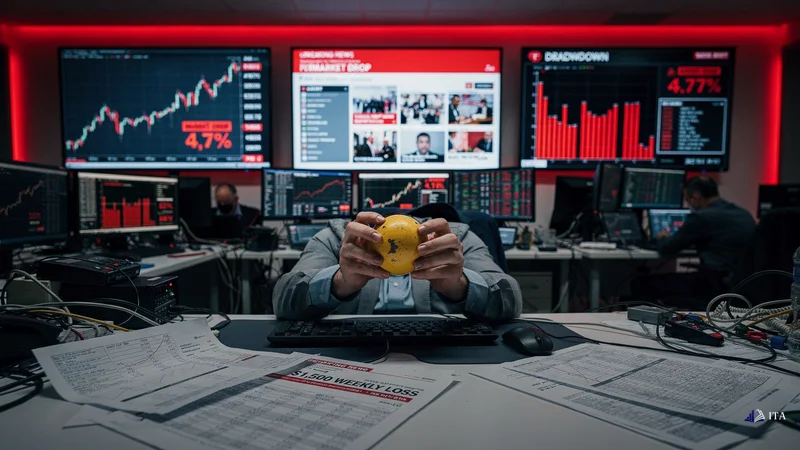
Daily Practice: Building Resilience Against Emotional Overrides
Building resilience against emotional position sizing overrides requires specific daily practices that rewire automatic responses to losses. Systematic pre-trade rituals, post-loss protocols, and position size calculators create barriers between emotion and execution when loss aversion peaks.
Trading Journaling: Tracking Emotional Triggers
Your trading journal needs an emotion column. For every trade, record: What was your emotional state at entry? Did you follow your position sizing rules? If not, what triggered the deviation?
Patterns emerge quickly. You'll notice you increase size after two consecutive losses. Or you halve position size when you're up more than 3% on the week. These patterns are loss aversion in action. Once visible, they become manageable.
Automated Orders: Removing Discretion from Execution
The simplest way to beat loss aversion is to remove the opportunity for it to act. Use pending orders with predetermined position sizes. Set your stop loss and take profit at entry, then walk away.
Platforms like third-party platform allow you to template your position sizing. Create templates for your standard risk percentages. When you place a trade, select the template. No mental math, no opportunity for loss aversion to suggest "just this once" you should risk more.
Backtesting & Simulations: Trusting Your Edge Through Drawdowns
Loss aversion thrives on uncertainty. When you don't trust your edge, every loss feels like the beginning of the end. Backtesting provides the antidote: statistical confidence.
Run your strategy through historical data. Calculate the maximum drawdown, average winner, average loser. More importantly, see how many consecutive losses are normal. When you know your strategy can handle seven straight losses and remain profitable, that fourth loss loses its emotional sting.

Conclusion: Master Your Mind, Master Your Position Sizing
Loss aversion isn't a character flaw you need to overcome through discipline. It's hardwired psychology that every trader faces. The professionals aren't the ones who don't feel it, they're the ones who build systems that function despite it.
Your brain will always hurt twice as much from losses. You'll always want to size up after losing and size down after winning. Accept this. Then build your position sizing protocol to make these impulses irrelevant.
Fixed fractional risk. Volatility adjustments. Pre-committed stops. Automated execution. These aren't just risk management tools, they're psychological guardrails that keep loss aversion from destroying your account.
The market doesn't care about your emotional state. Your position sizing shouldn't either. Build the system once, when you're calm. Follow it always, especially when you're not.
The traders who stay funded share one trait: systematic position sizing that never varies based on recent results. They've learned what neuroscience proves, you can't beat loss aversion with willpower. You beat it with math.
Start tomorrow with this: write down your risk percentage. Calculate position sizes before you open your platform. Remove the decision from the moment of execution. Your future self, the one not hijacked by loss aversion, will thank you.
Ready to get funded?
50% off instant accounts with code 50CRYPTO.
Get Funded →Frequently Asked Questions
How does loss aversion specifically affect position sizing after consecutive losses?
Loss aversion causes traders to increase position size after losses to recover quickly, creating a dangerous spiral. When facing consecutive losses, the brain experiences roughly twice the pain of equivalent gains, driving traders to risk more capital on subsequent trades rather than maintaining disciplined sizing rules.
What percentage of account equity should I risk per trade to minimize loss aversion impact?
Professional traders typically risk between 0.5% and 2% per trade to minimize emotional decision-making. At ITAfx, consistently profitable funded traders usually risk around 1% per position. This amount prevents single losses from triggering the emotional override that leads to revenge trading and oversized positions.
How can I measure if loss aversion is affecting my trading through journal data?
Check your trading journal for position size variations based on recent results rather than setup quality. If you hold losing trades longer than winners or move stops to avoid realizing losses, these indicate loss aversion. Track if position sizes increase after losses or decrease after wins without changes in market conditions.
Should I reduce position size during losing streaks for psychological reasons?
Temporarily reducing position size by 50% during drawdowns can help maintain psychological stability until you achieve two winning trades. This isn't about mathematics but about staying calm enough to execute your strategy properly. Return to normal sizing once rule-adherence and emotional stability are restored.
What role do automated orders play in preventing loss aversion-driven sizing changes?
Automated stop-losses, profit targets, and position size templates remove discretionary decisions when loss aversion peaks. By pre-setting these parameters before entering trades, you eliminate the opportunity for emotional overrides. Platforms like third-party platform allow templated position sizing that prevents in-the-moment emotional adjustments.
Key Takeaways
- Use fixed fractional position sizing at 1-2% per trade to eliminate emotional decision-making after losses.
- Calculate position size mathematically: (Account × Risk%) ÷ (Stop Loss Pips × Pip Value) for consistent execution.
- Reduce position size by 50% when volatility doubles using Average True Range (ATR) as your measure.
- Set stop losses based on market structure, not dollar amounts, violated support levels determine exit points.
- Track emotional triggers in your trading journal to identify when loss aversion affects your position sizing decisions.
- Use automated pending orders with predetermined sizes to remove discretionary decisions during emotional trading moments.
- Temporarily cut standard risk by 50% during losing streaks until achieving two winning trades for psychological stability.
Ready to get funded?
Instant accounts, simulated capital, rules published before you pay. 50% off with code 50CRYPTO.
Get Funded →