 ITA
ITAInstant Accounts for Traders Failing Evaluations: What You Need to Know
Instant accounts offer immediate funding without evaluations but cost 3-5x more. Learn when they're worth it, the stricter rules, and if they suit your trading style.
Short answer
Instant accounts offer immediate funding without evaluations but cost 3-5x more. Learn when they're worth the premium and whether they suit your trading style. In a prop firm context this still sits under simulated-capital rules: fees buy access to the evaluation or funded environment, not a deposit of trading capital.
Simulated capital: prop firm evaluation and funded stages discussed here typically run on simulated accounts. Challenge fees pay for access to that environment; they are not a deposit of trading capital. ITAfx accounts are simulated capital.


The Problem: Why Traders Fail Prop Firm Evaluations
Traders fail prop firm evaluations primarily because evaluation parameters create artificial constraints that conflict with proven trading strategies, forcing aggressive profit targets within 30 days while maintaining strict drawdown limits that don't reflect real institutional trading environments. Pass rates range from just 5% to 15%, not because traders lack skills, but because evaluation parameters create artificial constraints that don't reflect actual trading environments.
The Pressure of Profit Targets and Deadlines
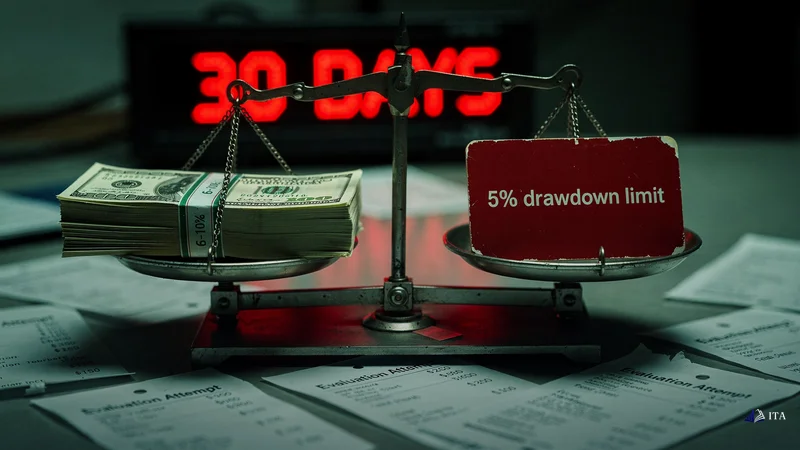
Evaluation challenges create an artificial urgency that doesn't exist in real institutional trading. You need to generate 6-10% returns within 30 days while staying under 5% drawdown. This compressed timeframe forces traders into a paradox: trade aggressively enough to hit targets, but conservatively enough to avoid drawdown limits.
The psychological impact is measurable. When traders see day 25 approaching with only 3% profit banked, they invariably increase position sizes. What starts as disciplined 0.5% risk per trade balloons to 2-3% "recovery" trades. The evaluation structure actually incentivizes the behavior it claims to filter out.
Strict Drawdown Rules and Emotional Trading
Drawdown rules in evaluations are particularly unforgiving. Most firms use trailing drawdown calculations that lock in your highest balance as the new baseline. Make 4% profit on day one? Your maximum loss is now calculated from that peak, not your starting balance.
This creates a ratchet effect where early success becomes a trap. A trader who gains 5% in week one now has less room for normal market volatility. One news spike, one overnight gap, one miscalculated position can breach the drawdown limit, even if the account is still profitable overall.
Strategies That Struggle with Aggressive Goals
Certain trading approaches are structurally incompatible with evaluation parameters. Mean reversion strategies that target 20-30 pip moves with high win rates generate steady returns over months, not weeks. Position traders who hold trades for 3-5 days can't generate enough round trips to compound returns within 30 days.
The evaluation model implicitly favors day trading and scalping, strategies that generate multiple opportunities daily. But these same strategies require exceptional discipline to avoid overtrading, creating another paradox: the traders most likely to pass are often those who need capital least, while systematic traders with proven long-term edges fail repeatedly on short-term variance.
This structural mismatch between evaluation design and diverse trading styles explains why instant accounts emerged. It's not a shortcut. It's an acknowledgment that the evaluation model itself filters out profitable traders whose methods don't fit the 30-day sprint format.
What are Instant Accounts and How Do They Work?
Instant accounts provide immediate access to simulated funded trading capital for a higher upfront fee ($600-2,000), eliminating the traditional 30-60 day evaluation process and its artificial profit targets, allowing traders to prove performance through ongoing results rather than time-pressured challenges. Instead of proving yourself through a challenge, you pay for immediate access to a simulated funded account and prove yourself through ongoing performance.
Immediate Access vs. Evaluation Challenges
The operational difference is stark. With traditional evaluations, you pay $150-200, receive a demo account, and must hit specific targets: typically 8-10% profit in Phase 1, then 5% in Phase 2, all while staying under drawdown limits. Pass both phases (a process taking 30-60 days minimum) and you receive a simulated funded account.
Instant accounts eliminate this entire process. You pay $600-2,000 depending on account size, and within hours you're trading a simulated funded account. No profit targets to chase. No evaluation deadlines. No two-phase progression.
The psychological relief is immediate: you can trade your actual strategy instead of optimizing for evaluation metrics.
Higher Upfront Costs: The Trade-Off for Speed
The pricing differential reflects risk transfer. Instant accounts typically cost 3-5× more than equivalent evaluation accounts. A $100,000 evaluation might cost $400, while an instant account for the same capital runs $1,500-2,000.
This premium prices in the firm's increased risk. Without evaluation data, firms can't gauge your discipline, risk management, or consistency. They compensate through higher fees and stricter ongoing rules, transferring the evaluation from a one-time test to continuous monitoring.
The Two Dominant Prop Firm Models: A Comparison
The market has crystallized around two distinct approaches. Traditional evaluation firms like ITAfx offer both models, recognizing that different traders benefit from different paths. The evaluation model works for traders with aggressive short-term strategies and strong challenge-taking psychology. Instant accounts serve traders with proven strategies who struggle with artificial constraints.
At ITAfx, the Instant On Demand accounts ($50K-$400K) provide immediate access with no evaluation requirements. Traders keep up to 95% of profits and face a 6% maximum loss limit with 3% daily loss. The alternative Challenge path requires passing two phases but offers the same profit split once funded.
Neither model is inherently superior. They serve different trader profiles and psychological makeups. What's often missed in comparisons is that both models lead to the same destination: a simulated funded account with identical trading conditions. The only question is which path aligns with your trading style and financial reality.
For someone who's failed multiple evaluations, the higher upfront cost of instant accounts might actually represent the lower total expense.
When Instant Accounts Make Economic Sense
The decision between evaluation and instant accounts isn't philosophical. It's mathematical. Once you understand the breakeven dynamics, the choice often becomes clear.
Calculating Your Break-Even Point: Cost of Failed Evaluations
Take your target account size and compare total costs across both paths. For a $50,000 simulated funded account: evaluation attempts cost $150-200 each, while instant accounts run $600-800. Your breakeven point sits at 3-4 failed evaluations.
But the real calculation includes opportunity cost. Each evaluation attempt takes 30-60 days. Four failed attempts represent 4-8 months of potential trading profits foregone. If your strategy generates even modest 2-3% monthly returns, the opportunity cost of repeated evaluations can exceed the instant account premium.
Consider this scenario: you've failed three evaluations over six months, spending $550 total. An instant $50,000 account costs $750. The $200 difference buys you immediate market access. If you can generate just $200 in profits over the next month (a 0.4% return), you've already recouped the premium.
Strategies Suited for Instant Accounts: Consistent, Modest Returns
Instant accounts particularly suit traders whose strategies conflict with evaluation parameters. Certain approaches thrive without evaluation pressure:
- Mean reversion traders targeting 1-2% monthly returns can't generate 8% in 30 days without abandoning their edge
- Position traders holding multi-day swings can't create enough round trips for evaluation profits
- Systematic traders following mechanical rules can't adapt to evaluation-specific requirements without breaking their discipline
These strategies share a common trait: consistent modest returns over extended periods. They're exactly what prop firms want in funded traders, yet they systematically fail evaluations designed for aggressive short-term performance.
The Time Value of Money: Accessing Capital Sooner
Every month spent in evaluation purgatory represents foregone compound growth. A trader generating 3% monthly returns on a $100,000 instant account earns $3,000 per month. Over the 2-3 months typically required to pass evaluations, that's $6,000-9,000 in missed profits.
The premium for instant accounts, perhaps $1,000 extra upfront, looks different when viewed against potential earnings. This calculation becomes even more compelling for experienced traders with proven track records who simply can't conform to evaluation constraints.
Timing matters in markets. The strategy that works brilliantly today might face different conditions in three months. Instant accounts let you capitalize on current market conditions rather than hoping they persist through your evaluation period. For traders with time-sensitive strategies or those tracking specific market cycles, immediate access can be worth multiples of the premium paid.

The Hidden Challenge: Stricter Rules in Instant Accounts
Instant accounts compensate for skipping evaluations through significantly tighter risk parameters. Understanding these constraints before committing can mean the difference between success and expensive failure.
Daily Loss Limits: Often Tighter Than Evaluation Accounts
Daily loss limits typically range from 3-4% versus the 5% common in simulated funded accounts obtained through evaluation. This 1-2% difference might seem marginal, but it fundamentally changes risk management calculations.
On a $100,000 account, a 3% daily limit gives you $3,000 of breathing room (enough for perhaps two losing trades at 1.5% risk each). The standard 5% limit allows $5,000, accommodating three similar losses or one larger position with a wider stop.
This compressed margin for error means instant account traders must operate with exceptional precision from day one. The psychological impact compounds the mathematical constraint. Knowing you have less room for normal volatility creates hesitation. Traders report taking profits earlier, cutting positions faster, and avoiding perfectly valid setups that require wider stops. The tighter limit doesn't just constrain risk. It alters trading behavior.
Consistency Rules: The Ongoing Performance Filter
While instant accounts skip profit targets, many enforce consistency requirements that evaluation accounts don't. ITAfx's Instant On Demand accounts, for instance, require no single day's profit to exceed 15% of total profits. This prevents lucky home runs from masking poor process.
These rules create a different kind of pressure. Instead of racing toward a profit target, you must maintain balanced performance indefinitely. A trader who makes $5,000 one exceptional day can't withdraw until generating $33,333 total profit. The rule enforces the institutional principle of reproducible edge over gambling variance.
Profit Splits and Withdrawal Limits: What to Expect
Instant accounts typically offer 70-85% profit splits versus the 80-95% common for evaluation-based programs. This 10-15% difference directly impacts long-term earnings potential. On $10,000 monthly profits, keeping 85% versus 95% means $1,000 less income ($12,000 annually).
For full-time traders, this split differential can equal months of living expenses. The convenience of instant access carries a permanent tax on all future earnings.
Withdrawal frequencies and minimums often differ too. Some instant account programs limit withdrawals to monthly or bi-weekly, with higher minimum thresholds. Where evaluation-based accounts might allow $500 withdrawals weekly, instant accounts may require $1,000 minimum monthly. These restrictions impact cash flow management for traders relying on consistent income.
The cumulative effect of stricter rules, lower splits, and withdrawal constraints creates a higher bar for long-term success. Instant accounts aren't easier. They're differently difficult.

Who Should Consider Instant Accounts (and Who Should Avoid Them)
The marketing targets frustrated evaluation failures, but success with instant accounts requires specific trader characteristics. Understanding whether you fit the profile can save thousands in misallocated fees.
Ideal Profile: Experienced Traders with Proven Discipline
Instant accounts work best for a narrow segment: experienced traders with documented track records who struggle specifically with evaluation constraints, not trading discipline. Success stories suggest passing at least 2-3 evaluations successfully before considering instant accounts.
The ideal candidate has 2+ years of consistent trading history, preferably with verified results. They understand their strategy's expectancy, maximum drawdown periods, and recovery patterns. Most importantly, they can demonstrate why evaluation parameters conflict with their approach, not why they lack discipline.
Systematic traders often fit this profile perfectly. Someone following a mechanical strategy with 55% win rate and 1:1.5 risk/reward might generate 3-4% monthly returns consistently but can't produce 8% in 30 days without overriding their system. The evaluation fails them, not because they can't trade, but because they won't break their rules.
Red Flags: Why Beginners Should Start with Evaluations
Beginners gravitate toward instant accounts to avoid the "hassle" of evaluations, but this path typically leads to expensive failure. Without evaluation pressure testing your discipline, you won't discover critical weaknesses until they cost 3-5× more.
The evaluation process, despite its flaws, teaches essential prop firm survival skills:
- You learn to respect drawdown limits absolutely
- You discover how your strategy performs under time pressure
- You understand the psychological weight of trading "someone else's" capital
These lessons cost $150-200 in evaluations but $1,000+ in blown instant accounts.
Red flags that suggest avoiding instant accounts include: less than one year of consistent trading, no documented track record, inability to explain your edge mathematically, history of revenge trading or position sizing errors, or viewing instant accounts as a way to "skip the hard part." If any of these apply, the evaluation process offers cheaper tuition.
The Role of Backtesting and Strategy Validation
Before committing to instant accounts' higher fees, extensive validation proves essential. This means 500+ trades backtested across multiple market conditions, forward testing for at least 3-6 months, and documented drawdown and recovery cycles. Without this data, you're gambling with expensive stakes.
A strategy that looks profitable over 50 trades might reveal devastating drawdowns over 500. The evaluation process forces this discovery through live pressure; instant accounts assume you've already done this work.
Strategy validation for instant accounts must include stress testing against the specific rules you'll face. How does your approach perform with 3% daily loss limits? Can you maintain consistency requirements while following your edge? Would tighter constraints force system modifications that compromise profitability?
These questions need answers before paying premium fees. Traders who succeed with instant accounts typically could pass evaluations, they simply choose not to for efficiency. Those who can't pass evaluations rarely succeed with instant accounts either, regardless of marketing promises.

Making the Decision: Evaluation vs. Instant Funding
The choice between evaluation and instant accounts ultimately reduces to three factors: long-term payout efficiency, psychological fit, and your foundational skill level. Understanding how these interact reveals the optimal path.
Long-Term Payout Efficiency: A Critical Factor
The mathematics of career earnings often favor evaluation-based programs despite higher failure rates. A trader earning $5,000 monthly keeping 95% nets $4,750. The same trader with instant accounts keeping 85% nets $4,250 (a $500 monthly difference, or $6,000 annually).
Over a five-year career, this 10% split difference compounds to $30,000 in foregone earnings. The $800 saved by choosing instant accounts over multiple evaluation attempts looks shortsighted against this long-term cost. For traders planning to make this their profession, maximizing the profit split through evaluation success pays dividends for years.
However, this calculation assumes eventual evaluation success. For traders genuinely incompatible with evaluation parameters (not lacking discipline, but following strategies that can't conform), the opportunity cost of endless failed attempts outweighs the split advantage. Six months of failed evaluations means six months of zero earnings, far exceeding any split advantage.
Psychological Pressures: Removed vs. Introduced
Instant accounts remove evaluation pressure but introduce different psychological challenges. Without profit targets driving decisions, traders must self-motivate performance. Without deadlines creating urgency, discipline must come entirely from within.
The evaluation process, despite its stress, provides structure. You know exactly what success looks like: hit these numbers, avoid these mistakes, receive access. Instant accounts' open-ended nature can paradoxically create more anxiety. When every day is a potential violation day, when there's no finish line to cross, some traders find the pressure more intense, not less.
Consider your psychological profile honestly. Do external targets help you perform, or do they create destructive pressure? Can you maintain discipline without deadlines, or do you need structure? The answers determine which model aligns with your mental game.
ITA's Perspective: Building Foundational Discipline First
At ITAfx, we offer both instant and evaluation paths because different traders genuinely need different approaches. However, our data shows traders who succeed long-term typically share one trait: they've proven their discipline through some form of pressure testing before accessing larger capital.
Our Instant On Demand accounts serve experienced traders who've already built this foundation elsewhere. They're not avoiding evaluation because it's difficult. They're choosing efficiency because evaluation parameters don't match their proven approach. The $50K-$400K instant account options exist for traders who can demonstrate why their strategy conflicts with 30-day challenges, not for those who simply failed them.
For most traders, especially those with less than two years of consistent experience, the Challenge path offers better long-term outcomes. Yes, you might fail initially. But each failure teaches crucial lessons about drawdown management, position sizing, and psychological control. These lessons, learned on a $200 evaluation, prevent $2,000 instant account failures later.
The path to consistent funded trading rarely runs straight. Whether through evaluation challenges or instant accounts, success demands the same fundamentals: proven strategy, disciplined execution, and psychological resilience. The method you choose should amplify your strengths, not mask your weaknesses.
Choose instant accounts when evaluation parameters genuinely conflict with your proven approach. Choose evaluations when you need structure to develop discipline. But never choose either as a shortcut. In prop trading, shortcuts lead to expensive dead ends.

Ready to get funded?
50% off instant accounts with code 50CRYPTO.
Get Funded →Frequently Asked Questions
Are instant funded accounts worth it for traders who keep failing evaluations?
Instant funded accounts become economically rational once you've spent more on failed evaluations than the instant account fee. For a $50,000 account, this typically occurs after 3-4 failed attempts. However, if you're failing evaluations due to poor risk management or emotional trading, instant account won't solve these issues, it just makes them more expensive to discover.
How much more expensive are instant accounts compared to traditional evaluation challenges?
Instant account typically costs 3-5× more than evaluation challenges for equivalent capital. A $100,000 evaluation might cost $400, while instant account runs $1,500-2,000. This premium reflects the firm's increased risk of funding traders without evaluation data. Additionally, instant accounts often offer lower profit splits (70-85% vs 80-95%).
What types of traders are best suited for instant account models?
Experienced traders with systematic approaches that generate consistent but modest returns benefit most from instant account. Mean reversion traders, position traders holding multi-day swings, and those following mechanical strategies often struggle with evaluation time constraints despite having profitable long-term edges. The ideal candidate has 2+ years of verified trading history.
Do instant account accounts have stricter drawdown and consistency rules?
Yes, instant accounts typically enforce tighter daily loss limits (3-4% versus 5% for evaluation-based funding) and additional consistency requirements. These stricter parameters compensate for the lack of evaluation filtering. The reduced daily loss buffer significantly impacts risk management calculations and can force modifications to otherwise profitable strategies.
Should beginner traders use instant account or start with evaluation accounts first?
Beginner traders should almost always start with evaluations despite the challenge. The evaluation process teaches essential prop firm survival skills at a fraction of instant account costs. Each failed evaluation provides valuable lessons about drawdown management, position sizing under pressure, and psychological control. These lessons cost $150-200 in evaluations but $1,000+ in blown instant accounts.
Key Takeaways
- Calculate your evaluation breakeven point: instant account costs 3-5× more but becomes rational after 3-4 failed attempts at $150-200 each.
- Instant accounts enforce stricter daily loss limits (3-4% vs 5%) and consistency rules that require exceptional precision from day one.
- Mean reversion and position trading strategies that generate steady monthly returns often fail evaluations but thrive with instant account's open timeframe.
- Lower profit splits (70-85% vs 80-95%) create permanent earnings disadvantage: $1,000 less monthly income on $10,000 profits over career lifetime.
- Success requires 2+ years documented trading history and proven strategy validation through 500+ backtested trades across multiple market conditions.
- instant account relocates the discipline test from evaluation phase to funded account management without solving underlying psychological trading issues.
- Choose instant account when evaluation parameters conflict with your proven approach, not as shortcut to avoid developing fundamental trading discipline.
Ready to get funded?
Instant accounts, simulated capital, rules published before you pay. 50% off with code 50CRYPTO.
Get Funded →