
Economic Calendar Impact on Funded Trading Decisions: Master Risk in 2026
Understand how the economic calendar impacts funded trading decisions. Learn risk management strategies to navigate high-impact news and protect your.
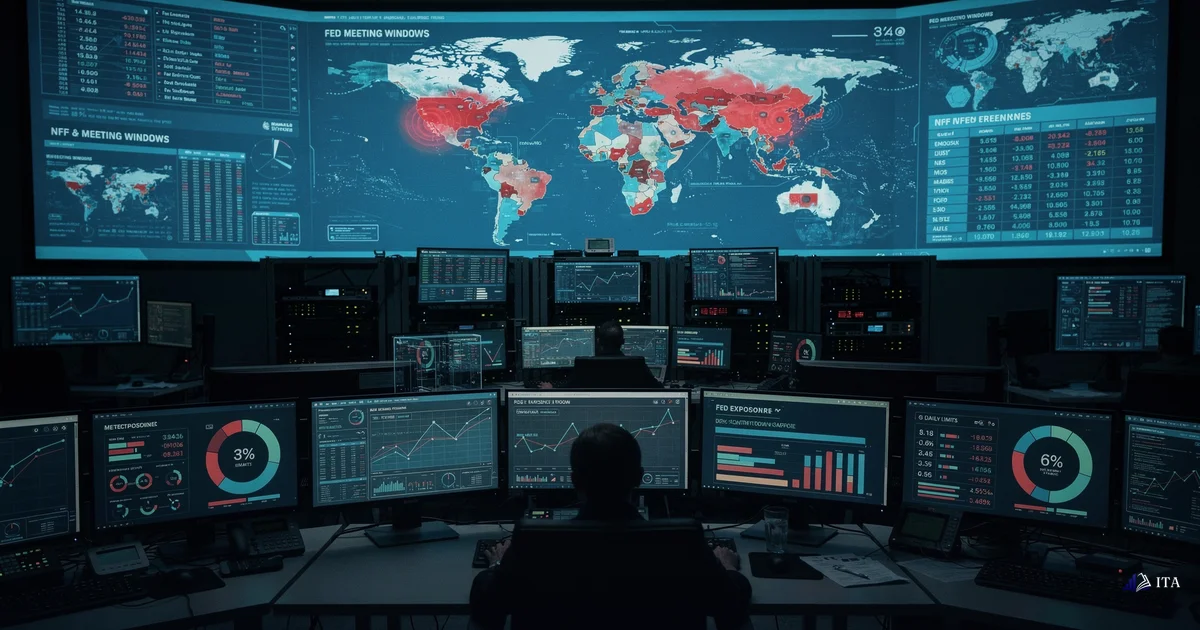

The Challenge: Why Economic Calendar Events Threaten Funded Accounts
Every high-impact event on that calendar marks a moment when the normal rules of market behaviour temporarily cease to function. Spreads that hold steady at 0.8 pips suddenly gap to 12. Liquidity that allows instant fills at your price evaporates, leaving orders to slip through thin air. Stop losses that should trigger at precise levels get swept past in millisecond spikes that don't appear on your chart.
For a funded trader operating under strict drawdown rules, typically 3% daily and 6% maximum at ITAfx, these structural breakdowns represent existential threats. It's not about whether EUR/USD goes up or down after CPI. It's about whether your risk management framework can survive the temporary breakdown of market mechanics.
Here's what changes everything: the traders who survive long-term don't try to predict these events. They map them.
Think of the 2026 economic calendar as a navigation chart marking underwater rocks. You don't need to know which way the current will push your ship when you hit the rocks. You need to know where the rocks are, how big they are, and exactly how far away you need to steer to avoid them.
Understanding High-Impact Economic Releases for 2026
High-impact economic releases for 2026 create predictable volatility windows where EUR/USD spreads widen from 0.8 to 15 pips and stop losses slip by 40+ pips. The U.S. Non-Farm Payrolls report (first Friday, 8:30 AM ET), CPI (mid-month), PCE (month-end), and Federal Reserve decisions represent the most significant market-moving events where liquidity providers step away from quotes during 45-minute reaction periods.
But here's where it gets interesting. These aren't random chaos events. They follow patterns.
Take the Federal Reserve meetings scheduled for 2026, January 28-29, March 18-19, April 29-30. Each creates three distinct volatility windows: the 2:00 PM ET statement release (immediate spike), the 2:30 PM press conference start (secondary volatility), and the Q&A session (gradual normalisation). A funded trader who maps these windows knows exactly when their edge disappears and when it returns. Our guide on How to Read Forex Economic News Releases for covers this in more depth.
Institutional traders systematically map these volatility windows They track not just the event timing but the volatility decay curve, how long it takes for spreads to normalise, for liquidity to return, for price to stop spiking on air. For NFP, it's typically 15-30 minutes. For Fed decisions with press conferences, it can stretch to 90 minutes.

Risk Management Framework: Navigating News Events as a Funded Trader
This brings us to the framework that separates surviving funded traders from the casualties.
First, they identify their no-trade zones with surgical precision. Not "don't trade during news" but specific windows: 15 minutes before to 30 minutes after for employment data, 15 minutes before to 45 minutes after for central bank decisions, the entire press conference window for Fed meetings. These aren't suggestions, they're system boundaries where the assumptions underlying their strategy cease to hold.
Second, they adjust position sizing inversely to event density. A week with NFP, CPI, and a Fed meeting isn't a week to trade normal size, it's a week to cut risk by 50-75% on any positions held through the volatility windows. The math is straightforward: if normal market conditions give you a 60% win rate with 1:2 risk-reward, but news events can slip your stops by 2x, your expected value turns negative unless you adjust size accordingly.
Third, and this is what most miss, they trade the calendar itself as information.

Strategic Adaptation: Integrating Calendar Awareness into Your Trading Plan
Strategic calendar awareness integration requires positioning for pre-event uncertainty rather than post-news reactions. Markets begin pricing volatility days before high-impact clusters, with implied volatility rising and ranges tightening as participants position defensively. This pre-event market behaviour creates superior trading opportunities compared to attempting to capture post-announcement momentum when spreads widen and execution becomes unpredictable.
The institutional approach goes even deeper. Rather than viewing news as binary events, they track deviations from consensus. The market prices in the forecast — if NFP is expected at 200K, that's already in the price. The trade isn't predicting the number but understanding how the market will react to the deviation. A 150K print (50K miss) creates different dynamics than a 250K print (50K beat), even though both are 50K from consensus.
But here's the crucial distinction for funded traders: you're not trying to trade the news. You're trying to preserve capital through the news. Our guide on Economic Calendar for Forex Trading covers this in more depth.
At ITAfx, where traders manage accounts up to $800K with 3% daily loss limits, a single news spike can end everything. The traders who last aren't the ones who catch every CPI move, they're the ones who never let a news event take them out. They've internalised that missing a opportunity costs nothing, but a breached account costs everything.

The ITA Advantage: Trading with Institutional Discipline Around News
This preservation mindset leads to a counterintuitive approach: the best news traders are often flat during news.
They close positions 15 minutes before impact, watch the spike and reaction, then enter on the normalisation. They're not trying to catch the first move, they're waiting for the market to show its hand, for spreads to tighten, for real liquidity to return. The first 5-minute candle after NFP might move 100 pips, but it's often noise. The second 15-minute candle, when institutional flow starts dominating retail reaction, tells the real story.
The calendar becomes a tool for identifying these high-probability re-entry zones. After the initial chaos, markets often establish clear levels, the spike high, the spike low, the pre-news range. These become your roadmap for entering with proper risk control once conditions normalise. Our guide on Fibonacci Retracement Levels covers this in more depth.
For swing traders holding positions multiple days, the calendar forces a different adaptation. You can't exit every position before every medium-impact event, you'd never hold anything. Instead, you implement sliding risk adjustments. Full position size in quiet periods, 50% size when holding through single events, 25% size when multiple events cluster, flat during the major catalysts like Fed decisions.

Conclusion: Master the Economic Calendar, Master Your Funded Account
The economic calendar isn't your enemy. It's your early warning system. The question isn't whether you'll respect it, it's whether you'll respect it before or after it takes your account.
Frequently Asked Questions
How should funded traders adjust position size around high-impact economic news?
Reduce position size by 50-75% when holding through major events like NFP, CPI, or Fed decisions. Normal market conditions allow standard 1-2% risk per trade, but news events can slip stops by 2x their intended distance. The math is straightforward: if spreads widen from 0.8 to 15 pips during volatility, your effective risk multiplies beyond acceptable levels for funded account drawdown limits.
Which 2026 economic calendar events matter most for forex funded accounts?
U.S. Non-Farm Payrolls (first Friday, 8:30 AM ET), CPI releases (mid-month), PCE data (month-end), and Federal Reserve meetings create the highest volatility. For 2026, key Fed meetings are January 28-29, March 18-19, and April 29-30. These events routinely trigger spread widening from 0.8 to 15+ pips and can slip stop losses by 40+ pips during reaction periods.
Should funded traders avoid trading during NFP and central bank decisions entirely?
Not entirely, but implement precise no-trade zones: 15 minutes before to 30 minutes after for employment data, 15 minutes before to 45 minutes after for central bank decisions. The complete avoidance approach isn't necessary, what matters is avoiding the structural breakdown periods when spreads widen and liquidity disappears. Many successful traders close positions before news, then re-enter once conditions normalise.
What tools provide the most reliable economic calendar for funded traders?
Forex Factory, TradingView, and Investing.com provide comprehensive impact ratings and real-time data releases. Professional traders also monitor CME Group's economic release calendar for institutional perspective. The key isn't the tool but understanding impact ratings: red-flag events require position adjustments, while medium-impact events need awareness but not necessarily avoidance.
How do prop firm drawdown rules change economic calendar strategy?
Strict drawdown limits at firms like ITAfx (3% daily, 6% maximum) make news spike protection critical for survival. A single news event that slips stops by 40 pips can breach daily limits on normal position sizes. This transforms the economic calendar from a trading opportunity list into a risk management map where preservation trumps profit-seeking during volatility windows.
Key Takeaways
- Map volatility windows 15 minutes before to 30 minutes after high-impact events like NFP and Fed decisions.
- Reduce position size by 50-75% during weeks with multiple scheduled economic releases to preserve capital.
- Close positions 15 minutes before major news releases, then re-enter during market normalisation phases.
- Track deviation from consensus rather than predicting news outcomes — markets price in forecasts, not surprises.
- Implement sliding risk adjustments: full size in quiet periods, 25% size during event clusters.
- Focus on post-news re-entry zones using spike highs and lows as roadmap levels for proper execution.
- Treat the economic calendar as regime shift warnings where normal market mechanics temporarily break down.
Start Your Trading Evaluation
Simulated funded accounts up to $800K. Up to 95% profit split.
Get Funded