 ITA
ITACrypto Trader Switching to Funded Account: Master the Mental Shift
Transitioning from crypto to a funded account demands a critical mental shift. Learn to overcome performance pressure, manage drawdown, and preserve capital.
Short answer
Transitioning from crypto to a funded account demands a critical mental shift. Learn to overcome performance pressure, manage drawdown, and preserve capital. In a prop firm context this still sits under simulated-capital rules: fees buy access to the evaluation or funded environment, not a deposit of trading capital.
Simulated capital: prop firm evaluation and funded stages discussed here typically run on simulated accounts. Challenge fees pay for access to that environment; they are not a deposit of trading capital. ITAfx accounts are simulated capital.


The Hidden Pressure: Why Funded Accounts Challenge Crypto Traders
The approval email lands in your inbox: you're funded. Maybe you cleared an evaluation, maybe you were approved straight into an instant account. Either way, there's now a $100,000 or $200,000 balance attached to your name, sitting inside a set of rules you didn't write. Your first instinct is to trade it the way you traded your own crypto capital: same read on momentum, same conviction on entries, same appetite for size.
Three weeks later, you're reading a violation notice instead of a payout statement.
This is not a rare story. A large share of newly funded crypto traders lose the account within the first few months, and usually not because their market read was wrong. It's because the account itself runs on a different set of physical and psychological rules than the one they trained on.
Personal crypto capital runs on internal permission. You decide what counts as a good trade, you decide when to size up, and nobody reviews your drawdown at the end of the week. A funded account replaces that internal permission with external constraints, and the adjustment is bigger than most traders expect.
Start with the market itself. Crypto trades 24 hours a day, seven days a week, with no scheduled open, no scheduled close, and no exchange-level circuit breaker to pause a violent move. If Bitcoin drops 12% in an hour, trading continues without interruption. A funded account, even one that includes crypto CFDs, sits inside a market structure built around defined sessions, weekend closures and, on the regulated instruments most firms also offer, genuine volatility halts. That single structural difference changes when you're even allowed to react, and it's one of the first things crypto traders underestimate.
Then there's the drawdown math. A typical funded account caps daily loss around 3% and total loss around 6%. Crypto traders used to riding 20 to 30% swings in a single session experience that limit as a straitjacket. Do the arithmetic: a -3% day already burns half the daily allowance. In crypto, that's an unremarkable Tuesday.
The Mental Minefield: Common Psychological Pitfalls for Crypto Traders
The psychological gap runs deeper than adjusting to a smaller loss limit. Crypto trading builds specific habits over months or years, and several of the most reinforced ones become direct liabilities the moment a firm's rulebook is attached to your capital.
Research into crypto trading behavior keeps turning up the same warning sign: a meaningful share of frequent traders show patterns consistent with problematic, compulsive trading, with trading frequency itself ranking among the strongest predictors, second only to markers associated with problem gambling. None of that disappears the day a funded account opens. It just meets a much less forgiving environment.
The 24/7 habit is the clearest example. Crypto trains you to check charts at 2 a.m., react to a headline the moment it drops, and treat every hour as a potential trading hour. That hypervigilance is at least adaptive in a market that never sleeps. In a funded account it becomes a liability: constant monitoring during live sessions produces hesitation on setups you'd normally take without a second thought, simply because every trade now carries evaluation weight.
Then there's a pitfall tied specifically to the shift in trading hours that rarely gets named: weekend withdrawal. A crypto trader's nervous system is calibrated to treat every dip as actionable, at any hour, any day. A funded forex or indices account closes Friday evening and doesn't reopen until Sunday night or Monday morning. For the first few weekends, many traders catch themselves refreshing a platform that hasn't moved since Friday's close, convinced they're missing "the real move" happening somewhere they can no longer touch. That forced, literal inactivity, no chart to refresh, no candle to trade, can generate its own spike of anxiety, and traders who don't expect it often respond by overtrading the moment the market reopens to make up for two days of nothing.
Layer the overtrading cycle on top of that and the picture gets worse. The same instincts that might let you recover a bad crypto trade by doubling down become the exact rule violation that gets a funded account terminated: rapid position cycling that burns through a daily loss limit before lunch, followed by revenge trading in an attempt to win it back. Our guide on how to stay disciplined in funded forex trading goes deeper into breaking that specific cycle.
The addiction parallel here isn't a figure of speech. The dopamine loop of checking prices, watching open positions and hunting the next setup mirrors behavioral addiction cycles researchers have documented elsewhere. Funded trading asks you to interrupt that loop while performing at your best, which is a genuinely difficult combination, closer to quitting a habit cold turkey during an exam than to a simple change in strategy.
Institutional Discipline: The Framework for Funded Success
Willpower alone doesn't close this gap. What closes it is a complete operational framework, the kind institutional desks have leaned on for decades. Professional traders rarely win through sharper prediction or faster reflexes. They win through process discipline that removes emotion from the moment of execution.
That starts with how you define a goal. Crypto traders tend to fixate on a dollar outcome: "this account needs to make $5,000 this week." Outcome framing like that manufactures exactly the kind of pressure that produces bad decisions.
Institutional thinking flips the framing entirely. The goals become process goals:
• Follow the pre-trade checklist on every single position
• Honor the stop loss without exception, including the ones that turn out wrong
• Log every trade within ten minutes of closing it
A common institutional-style risk framework, outlined here, boils down to a short set of guardrails:
• Keep risk under 1% of the account on any single trade
• Set a daily loss limit at roughly half of the account's maximum daily drawdown
• Use pre-placed stop losses, not mental ones
• Cap the number of losing trades you'll take in a single day
None of these are suggestions. They're circuit breakers, built by the trader rather than the exchange, standing between an emotional trigger and an account-ending decision.
Position size deserves its own mention, because crypto instincts get it backwards here. A $200,000 funded account does not mean trading ten times larger than a $20,000 crypto account. It means trading a smaller percentage of a bigger number, with tighter risk control on each position. When a single trade risks only 0.3 to 0.5% of capital, that trade stops carrying emotional weight. You stop needing to be right and start needing to follow process. Our guide on building a consistent prop firm trader mindset expands on this shift.
The trading journal changes character too. It stops being an optional log of entries and exits and becomes mandatory equipment, one that documents process rather than outcome: "Pre-trade checklist: 7 of 10. Emotional state: still tense from yesterday's loss. Position size cut to 0.3% because of that. Entry delayed until confirmation printed, despite the urge to chase."
None of that is about tracking profit. It's about building visibility into the decision patterns that, left unexamined, quietly wreck funded accounts.
Practical Protocols: Overcoming Emotional Reactions
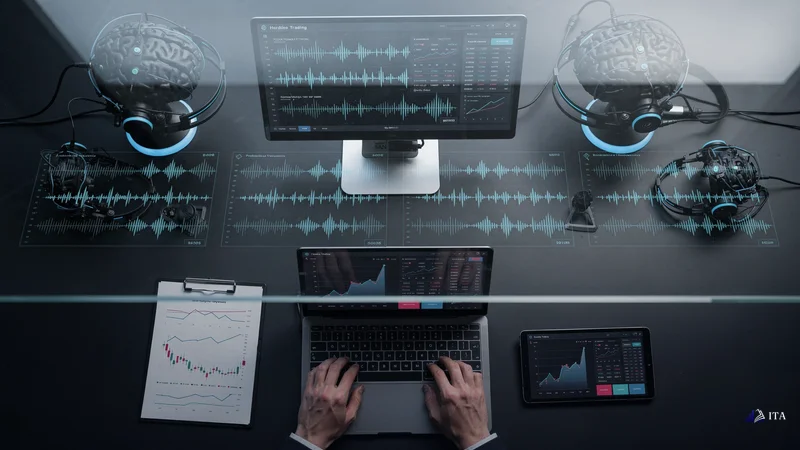
Emotional reactions get interrupted by mechanical protocols, not by trying harder to stay calm. These protocols create an automatic circuit breaker between an emotional trigger and an account-damaging decision, and they keep working even during genuinely stressful sessions.
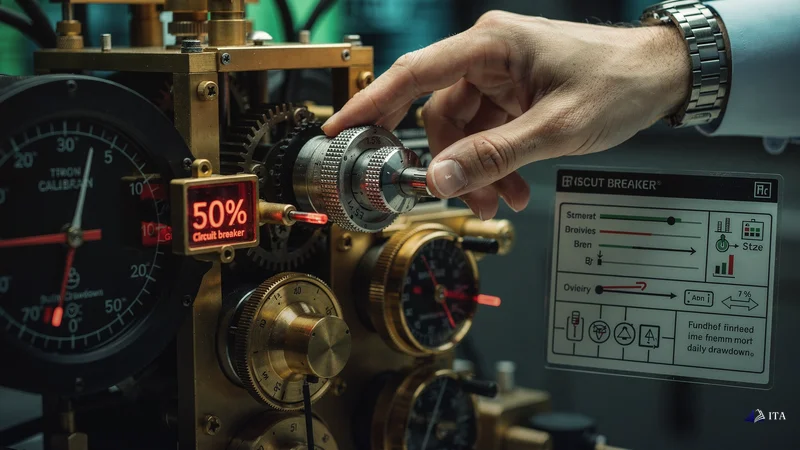
The daily loss limit gets calculated before the market opens, not during a losing streak. Take 50% of the account's maximum daily drawdown: if the account allows a 3% daily loss, the circuit breaker trips at 1.5%.
That number isn't a target, it's an emergency brake. Write it down somewhere you'll actually see it, and when you hit it, the session is over. No exceptions, no "one more trade to get it back." The market opens again tomorrow; a terminated account doesn't.
Routine-based execution removes decision fatigue, and this is where the shift in market hours becomes an ally instead of a constraint. Crypto trains you to treat every hour as an opportunity, because technically it is one. A funded account, by contrast, hands you a defined session with an actual close. Use it. Build a routine around it the way an institutional desk would: a fixed time for pre-session analysis, an entry window that lines up with your sharpest hours, and a hard stop at the session's close, not just a minimized browser tab. When the market's own clock says the session is done, treat that as permission to log off, not as an interruption to fight against.
Mandatory breaks matter more than they sound like they should. Step away from the screen for at least fifteen minutes every two hours, not to check a phone or scroll a crypto feed, but to physically disconnect. The irony is real: traders who can watch crypto charts for sixteen straight hours lose funded accounts because they can't manage fifteen minutes away from one.
The physical setup matters too. Trading a funded account from the exact same desk, same monitors, same chair you use for crypto speculation keeps you in the same psychological mode. Change something deliberate, the layout, the lighting, even where you sit, so the environment itself signals "funded account mode" instead of "crypto mode."
Actionable Steps: Your Transition Checklist to Funded Trading
The transition works best as a systematic audit of current behavior, followed by a deliberate rebuild of the habits that sit between analysis and execution.
Start by documenting a typical trading day, honestly:
• What time do you check prices first, and last?
• How many times an hour do you glance at open positions?
• What actually triggers an entry: your analysis, or the market simply moving?
• How many times do you check the market after hours, or over a weekend, purely out of habit, even knowing nothing has changed?
• How do you feel after a loss: energized to recover it, or defeated?
This isn't about judging yourself. It's data collection, and you can't fix a pattern you haven't written down.
Building a funded-specific trading plan means setting the crypto playbook aside. The new plan puts risk first and opportunity second. Define maximum risk per trade (0.3 to 0.5%, not 2%). Set the daily loss limit. Build position sizing rules that shrink during a drawdown instead of growing to "win it back."
A pre-trade checklist helps enforce that in the moment:
• Market condition assessment
• Setup quality score against your own criteria
• Honest check on emotional state
If any item falls below your threshold, there's no trade, full stop.
Mental rehearsal sounds soft, but it earns its place. Spend five minutes before each session visualizing perfect process, not winning trades, just following the rules regardless of outcome. Rehearse the feeling of stopping at your daily loss limit while price keeps moving without you. Rehearse closing a winner at target instead of hoping it runs further. These small rehearsals build the pathway that actually fires under real pressure.
The hardest item on this checklist is admitting you might need outside help. If your crypto trading already shows signs of a problem, compulsive checking, trading to escape a bad mood, hiding losses from people close to you, a funded account with real rules will surface that faster, not slower. Professional support is worth seeking before an account gets terminated, not after.

Beyond the Challenge: Maintaining a Long-Term Funded Mindset
Getting funded was never the actual test. The real test starts once the account is live and there's no evaluation left to pass, only rules left to keep. This is where crypto traders run into an uncomfortable truth: a funded account doesn't fix a psychological weakness, it exposes it.
Every habit carried over from crypto trading gets amplified under a firm's constraints. The instinct to revenge trade after a loss now moves faster and costs more. The urge to size up after a winning streak now threatens the entire account, not just that week's profit.
So what separates the traders who last from the ones who become a statistic? Mostly, an understanding that discipline isn't something performed when someone's watching, it's an identity. The moments that matter most are the ones with no oversight at all: when breaking a rule "just this once" is easy, when an obvious setup sits just outside the plan, when nobody would ever know. That's when a funded account reveals who a trader actually is.
Sustaining discipline without anyone watching requires infrastructure most crypto traders never had to build. Systems that run whether or not you feel like following them:
• Alerts that force a step away from the screen
• Position sizing calculators that remove the mental math
• A trade log that has to be filled in before the next entry is allowed
None of this is about becoming a robot. It's about building infrastructure that supports very human limitations.
The path isn't linear. There will be days when following the rules costs money. Setups will pass that don't meet your criteria, and some of them will have worked. Winners will get closed at target and keep running another 200 pips without you.
That's not failure, it's the cost of staying in the game long enough to matter. Every funded trader with a real track record tells some version of the same story: they learned to value staying funded over squeezing out the last few points of a move.
Conclusion: Your Funded Journey Starts with Mindset Mastery
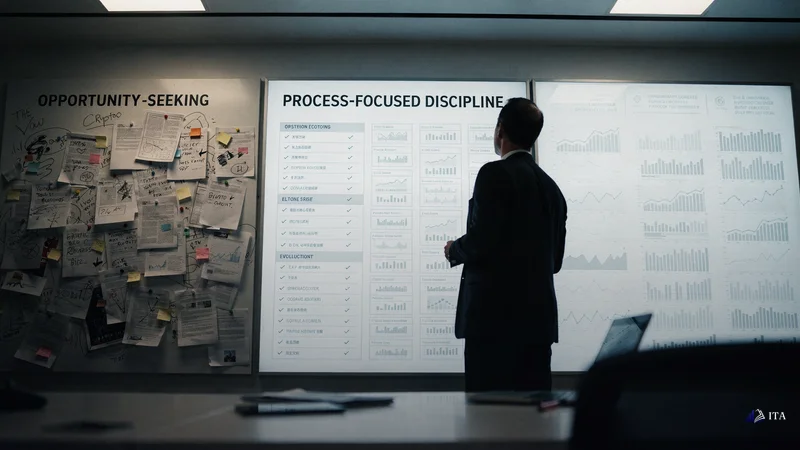
Moving from crypto trading to sustained funded trading isn't really about a better strategy or a sharper indicator. It's about becoming a different kind of trader: one who values discipline over opportunity, process over outcome, and staying funded over any single trade.
Traders who make this transition successfully tend to describe the same turning point: the old identity had to go before the new one could take hold. The version of you that bought a dip on conviction alone and let a position run because it felt right doesn't survive institutional constraints, and trying to keep that version alive inside a funded account is usually what ends it.
The trader who does survive follows rules with something close to religious devotion, takes the small consistent win over the swing for the fences, and can actually sleep knowing the account will still be there tomorrow.
The next step isn't another strategy or another chart pattern. It's a decision: keep being the crypto trader who dreams about a funded account, or become the trader who's actually built to hold one.
Start today with something concrete. Write down your trading rules, not your strategies, your behavioral rules: when you'll trade, when you'll stop, how you'll size positions, and what counts as an automatic end to the session. Then follow those rules for one week on your current trading, crypto or otherwise. Just one week.
The funded account was never the goal. It's the tool. The goal is becoming the trader who's earned the right to keep it.
Ready to put this mindset to work? Learn how ITAfx's institutional approach helps traders bridge the gap from crypto speculation to funded discipline. Apply for your funded account today.
Ready to get funded?
50% off instant accounts with code 50CRYPTO.
Get Funded →Frequently Asked Questions
Why do crypto traders fail after getting funded accounts?
Crypto traders fail funded accounts because they struggle to adapt from 24/7 market psychology to institutional constraints. The constant position monitoring and high risk tolerance that works in crypto becomes destructive under strict drawdown limits and evaluation pressure. Research into crypto trading behavior has found that a meaningful share of frequent traders show patterns consistent with problematic, compulsive trading.
How is trading a funded account psychologically different from personal crypto trading?
Funded trading introduces performance pressure under observation and external evaluation that doesn't exist with personal capital. Every trade carries weight beyond profit and loss, it affects your access to capital. This creates hesitation on good setups and anxiety about rule violations that crypto traders rarely experience with their own money.
What are the best risk management rules for funded crypto traders?
Keep risk below 1% per trade, implement a daily loss limit at 50% of maximum daily drawdown, use pre-placed stop losses, and set a maximum number of losing trades per day. For funded accounts, position sizing should scale down, not up, compared to your crypto trading. The goal is survival, not optimization.
How can traders avoid revenge trading in funded accounts?
Implement mandatory circuit breakers: calculate 50% of your maximum daily drawdown as your stop point and honor it without exception. Take 15-minute breaks every two hours away from screens. Document your emotional state before each trade in your journal. When you hit your daily limit, you're done, the market will be there tomorrow.
What mindset shift is required to succeed with funded account?
The fundamental shift is from outcome focus to process focus. Stop measuring success by percentage gains and start measuring by rule adherence and consistency. Institutional traders value survival over speculation, singles over home runs, and discipline over opportunity. Profits follow process, not the reverse.
Key Takeaways
- Many crypto traders lose funded accounts due to psychological patterns that clash with institutional constraints.
- Replace outcome goals like '$5,000 this week' with process goals like 'follow pre-trade checklist for every position'.
- Implement a daily loss limit at 50% of maximum drawdown, if your account allows 3% daily loss, stop at 1.5%.
- Trade smaller position sizes in funded accounts: 0.5% risk per trade makes individual outcomes emotionally neutral.
- Take mandatory 15-minute breaks every two hours to reset your nervous system and prevent overtrading cycles.
- Document emotional state and process adherence in your trading journal, not just trades and outcomes.
- Create environmental cues that signal 'institutional trading mode' by changing your physical setup from crypto trading.
Ready to get funded?
Instant accounts, simulated capital, rules published before you pay. 50% off with code 50CRYPTO.
Get Funded →