
Confirmation Bias in Forex Entry: Why Traders See Only What They Want
Uncover how confirmation bias distorts forex trade entries, leading to costly mistakes. Learn evidence-based protocols to make objective trading decisions.


The Confirmation Bias Trap: How It Distorts Your Forex Entries
Confirmation bias distorts forex entries by making traders seek evidence that supports their predetermined market view whilst ignoring contradictory signals. You've analysed the setup for twenty minutes, found an ascending triangle on EUR/USD with increasing volume and moving average crossover, every signal screams "buy. " But confirmation bias has already filtered out the bearish divergence on RSI and the resistance cluster just above current price.
Within ten minutes, price breaks below the triangle and your stop gets hit. You stare at the screen, confused. How did you miss the divergence on the RSI? Why didn't you notice the resistance level from last week? When did that bearish engulfing candle form on the 4-hour chart?
The answer is both simple and terrifying: you saw exactly what you wanted to see.
This isn't a story about discipline or emotional control. It's about how your brain betrays you at the exact moment you need objectivity most, right before you click "buy" or "sell. " The mechanism behind this betrayal has a name: confirmation bias. And according to research from behavioural finance, it's not a weakness you can overcome through willpower alone.
The conventional trading wisdom tells you to "stay disciplined" and "follow your plan. " But what if your plan itself is compromised by the way your brain processes information? What if the very act of forming a directional bias creates a neurological filter that blocks contradictory evidence?
The Science Behind Biased Trading: Evidence from Financial Psychology
Financial psychology research demonstrates that biased trading stems from predictable cognitive mechanisms in the brain's decision-making centres, particularly the prefrontal cortex's interaction with emotional processing regions. Confirmation bias isn't a character flaw, it's a measurable, predictable cognitive mechanism that can be countered with specific protocols designed to interrupt automatic thought patterns.
The science behind this is sobering. A landmark NBER working paper analysing millions of retail forex trades found that traders systematically take more risk after uninformative positive feedback. They're not learning from wins, they're using random success to reinforce whatever story they already believe. Studies indicate that traders with confirmation bias tend to hold losing positions longer while cutting winners faster
Think about what this means for your entry decisions. Every time you form a bullish view on a pair, your brain begins a process that researchers call "asymmetric belief updating. " You'll weight confirming signals (that bullish crossover) far more heavily than disconfirming ones (the bearish divergence). You'll remember the times your pattern worked and forget when it failed. You'll even unconsciously switch timeframes until you find one that supports your bias.
At ITAfx, where traders manage funded accounts up to $800K, we see this pattern play out daily in evaluation data. The traders who pass aren't necessarily the ones with better strategies, they're the ones who've built systems to see what they don't want to see. Our guide on Cognitive Biases covers this in more depth.
The real-world mechanics of confirmation bias in forex entry are almost laughably predictable once you know the patterns.
Real-World Forex Scenarios: When Confirmation Bias Strikes Hardest
Confirmation bias strikes hardest in forex during timeframe shopping, news interpretation, and pattern recognition scenarios where traders have multiple data points to cherry-pick from. The "timeframe shopping" phenomenon exemplifies this: you spot a bull flag on the 15-minute chart, but when the 1-hour shows consolidation, you check the 5-minute for a micro-breakout that "confirms" your bias, classic motivated reasoning.
Or take the post-move pattern hunt. EUR/USD just rallied 80 pips. Now you're scanning for entry signals in the direction of the move, finding "bull flags" in what are actually random consolidations. Your brain, primed by the recent price action, interprets neutral patterns as bullish signals. You're not trading the market, you're trading your recent memory.
The news interpretation trap might be the most dangerous. Non-Farm Payrolls comes in below expectations. If you're already long USD, you'll focus on the revision to last month's positive number or the uptick in hourly wages. If you're short, you'll emphasise the headline miss. Same data, opposite interpretations, both seemingly "objective. "
The solution isn't to try harder to be objective, it's to build mechanical protocols that make subjective interpretation impossible.
The pre-trade checklist is your first line of defence, but not the generic "check support and resistance" variety. Your checklist must force you to document evidence against your trade before you can document evidence for it. At ITAfx, successful funded traders often use a "devil's advocate" protocol: for every bullish signal you identify, you must document two bearish ones. Only if you can refute the bearish signals with objective criteria (not subjective interpretation) can you proceed.

Practical Protocols to Counter Confirmation Bias at Entry
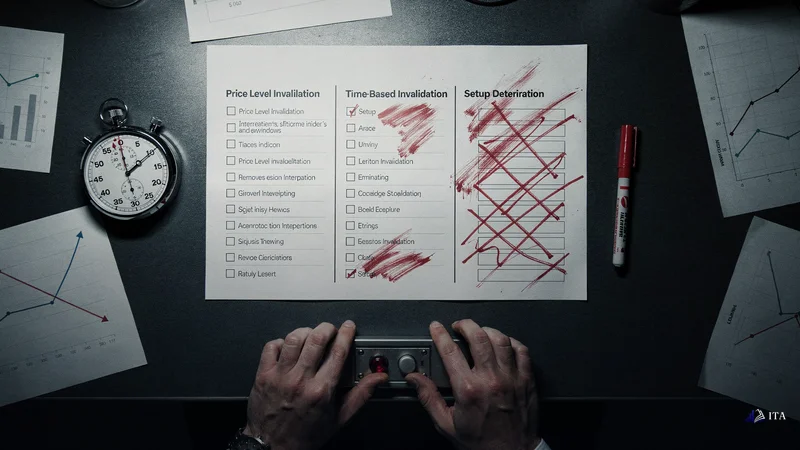
Defining invalidation levels before entry removes the interpretation window entirely. But your invalidation can't be a price level alone. It must include scenario-based criteria. "If price breaks below 1.0920" is vulnerable to bias ("it's just a stop hunt"). "If price closes below 1.0920 on the hourly AND momentum turns negative" is harder to rationalise away.
The "opposing thesis" requirement might feel extreme, but it's grounded in how professional institutions actually trade. Before entering any position, you must write a one-paragraph thesis for the opposite direction. If you can't make a credible case for the other side, you don't understand the market context well enough to trade it.
These aren't just risk management tools, they're cognitive bias interruption systems.
The daily practices that reinforce objective trading work because they address the root cause, not the symptoms. Systematic journaling isn't about recording your trades, it's about documenting your reasoning process before confirmation bias can rewrite history. When you journal the "why" behind every entry in real-time, you create an audit trail of your actual thought process, not the revised version your brain constructs after the fact.
Limiting external noise during open positions seems basic until you understand the mechanism. Every tweet, every forum post, every "technical analysis" video you consume while in a position gets filtered through your directional bias. Your brain literally gives more weight to confirming opinions and discounts opposing views. The funded traders who maintain consistent profitability often have a simple rule: no external input between entry and exit.
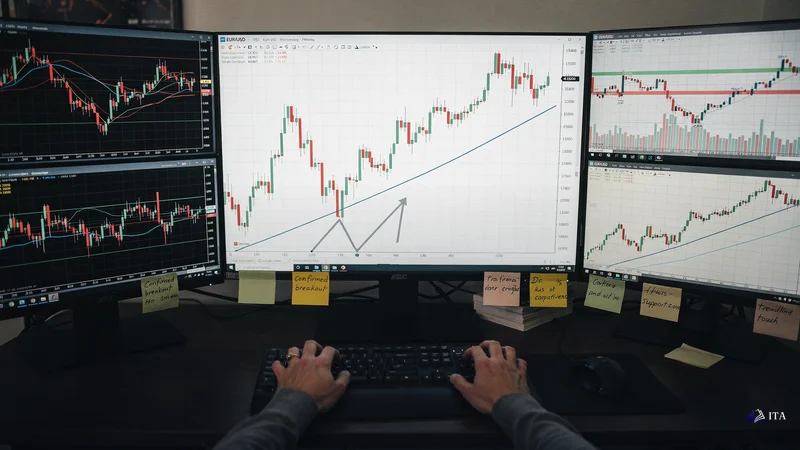
Cultivating Objective Trading: Daily Practices for Bias Reduction
The mentorship and accountability factor works because confirmation bias is invisible from the inside. You cannot see your own filtering process, it happens below conscious awareness. An external observer, whether a mentor or accountability partner, can spot patterns in your analysis that you're blind to. They'll notice when you consistently ignore certain timeframes, dismiss specific indicators, or rationalise away particular price actions.
But it's not actually about the trades you take, it's about the reality you construct.
Every time you enter a position based on filtered information, you're not just risking capital. You're reinforcing a false model of how markets work. You're building a trading worldview based on selective evidence. Over time, this compounds into a completely distorted understanding of price action, where your "experience" is really just confirmed prejudice.
The traders who break through to consistent profitability, whether with their own capital or managing funded accounts up to $800K, share one characteristic: they've learned to seek disconfirmation actively. They celebrate finding reasons not to take a trade. They get excited when their analysis uncovers contradictions. They've rewired their reward system from "finding trades" to "finding truth. "
This isn't natural. Your brain evolved to quickly identify patterns and stick to them, a survival mechanism that becomes a liability in markets. Fighting confirmation bias means fighting your own neurology. That's why mechanical protocols aren't optional extras, they're the core of professional trading.
Conclusion: Master Your Mind, Master Your Forex Entries
Successful trading isn't about finding perfect setups. It's about seeing the market as it is, not as you want it to be. That starts with admitting that right now, at this moment, you're probably seeing exactly what you want to see. The question is: are you ready to see what's actually there? Apply for your funded account today and put these protocols to work with funded account.
Frequently Asked Questions
How does confirmation bias specifically affect forex trade entries?
Confirmation bias causes traders to selectively seek information supporting their predetermined market view while dismissing contradictory signals. In forex entry, this manifests as timeframe shopping, cherry-picking technical indicators, and interpreting neutral price action as confirming signals, leading to poorly timed entries based on filtered information.
What are the most common examples of confirmation bias in EUR/USD trading?
Common examples include switching timeframes until finding a bullish pattern after EUR/USD rallies 80 pips, focusing only on positive economic data when already long USD, and interpreting random consolidations as continuation patterns. Traders often hunt for bull flags in neutral price action simply because recent momentum was upward.
Can pre-trade checklists actually eliminate confirmation bias in forex?
Pre-trade checklists reduce but don't eliminate confirmation bias. Effective checklists force traders to document evidence against their trade before documenting supporting evidence. The key is requiring objective, mechanical criteria rather than subjective interpretation, and mandating at least two opposing signals for every bullish signal identified.
What does academic research reveal about confirmation bias in financial markets?
NBER research analysing millions of retail forex trades found traders systematically take more risk after uninformative positive feedback, reinforcing existing narratives rather than updating beliefs objectively. Studies show traders exhibit asymmetric belief updating, weighting confirming signals far more heavily than disconfirming ones, leading to persistent incorrect market views.
How do ITAfx traders combat confirmation bias when managing funded accounts?
At ITAfx, successful funded traders use devil's advocate protocols requiring two bearish signals for every bullish one identified. They define scenario-based invalidation criteria beyond simple price levels, limit external input during open positions, and maintain systematic journals documenting reasoning processes before confirmation bias can rewrite trading history.
Key Takeaways
- Document evidence against your trade before documenting evidence for it using a devil's advocate protocol.
- Define mechanical invalidation criteria beyond price levels — include scenario-based conditions like momentum shifts.
- Write a one-paragraph opposing thesis before entering any position to test your market understanding.
- Limit external input between entry and exit to prevent confirmation bias from filtering opposing views.
- Use systematic real-time journaling to create an audit trail of reasoning before bias rewrites history.
- Seek disconfirmation actively — celebrate finding reasons not to take trades rather than finding entries.
- Apply the three-reason test: document three ways your trade will fail before proving them wrong mechanically.
Start Your Trading Evaluation
Simulated funded accounts up to $800K. Up to 95% profit split.
Get Funded