 ITA
ITACognitive Biases: Why Forex Traders Destroy Accounts (And the Fix)
Uncover the cognitive biases that sabotage forex traders. Learn how loss aversion, overconfidence, and confirmation bias impact decisions and discover the mechanical defences that neutralise them.
Short answer
Uncover the cognitive biases that sabotage forex traders. Learn how loss aversion, overconfidence, and confirmation bias impact decisions and discover the mechanical defences that neutralise them. In a prop firm context this still sits under simulated-capital rules: fees buy access to the evaluation or funded environment, not a deposit of trading capital.
Simulated capital: prop firm evaluation and funded stages discussed here typically run on simulated accounts. Challenge fees pay for access to that environment; they are not a deposit of trading capital. ITAfx accounts are simulated capital.

The Psychological Traps: Identifying Destructive Cognitive Biases in Forex
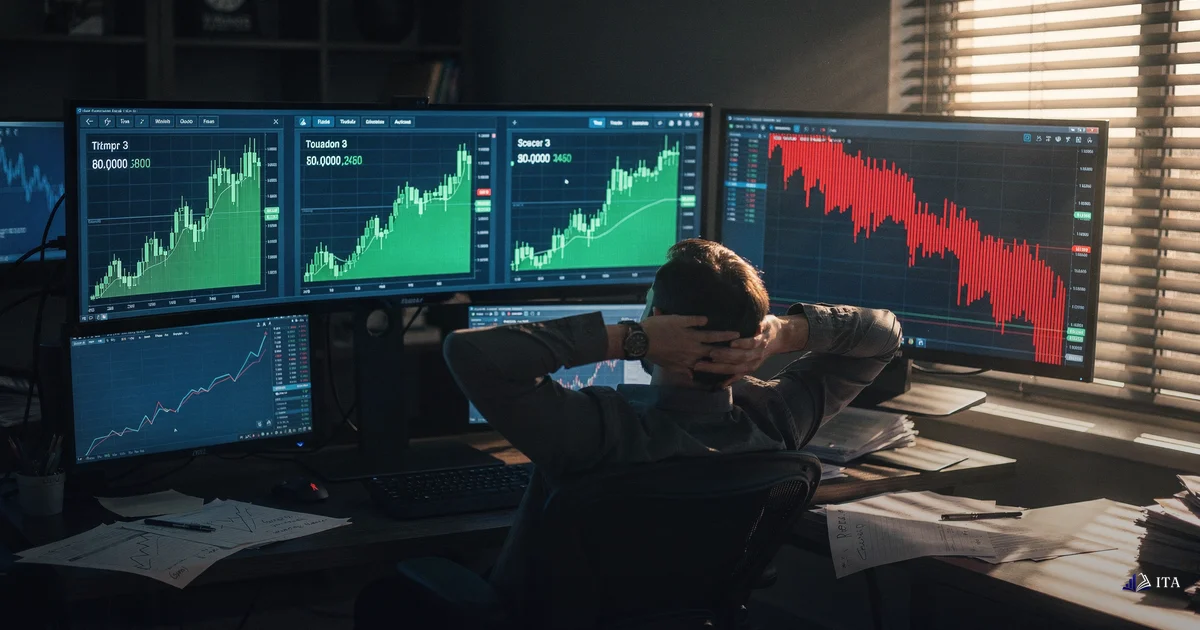
You know the setup. Friday afternoon, three winning trades in a row. Account up 4.2% for the week. You're sharp, reading the market perfectly. EUR/USD sets up exactly like your playbook, same pattern that's worked all week.
You double your position size. Just this once.
Monday morning, you're staring at a -8.7% drawdown.
This isn't a discipline problem. It's not about needing more willpower or a better trading journal. Behavioral finance research has suggested that overconfident individual investors tend to trade more frequently than their less confident peers, often earning lower returns after costs as a result. Your brain just executed a survival program written before humans invented money.
The conventional wisdom says you need better emotional control. Meditate more. Journal your feelings. Visualise success. But here's what seven years of prop firm data actually reveals: the traders who consistently extract profits aren't the ones with the best psychology. They're the ones who've accepted their psychology is unfixable and built systems accordingly.
The Science Behind the Sabotage: How Your Brain Undermines Trading Decisions
Let's map the battlefield. Your trading brain operates on two levels. The conscious level, where you analyse charts, calculate risk, and make plans. Then there's the limbic level, where 200,000 years of survival programming fires faster than conscious thought. When these two levels conflict, the ancient brain wins. Every time.
Loss aversion provides the clearest example. Tversky and Kahneman's groundbreaking research in the Quarterly Journal of Economics (1991) demonstrated that retail investors exhibit a strong loss aversion with losses weighing about 2 to 2.5 times more heavily than equivalent gains in their decision-making. In trading terms: that -$500 position feels twice as painful as a +$500 winner feels good. Your brain interprets the red number as a survival threat, triggering the same neural pathways as physical danger.
Now add the other cognitive landmines. Confirmation bias makes you see only evidence supporting your position. Recency bias overweights the last few trades. The disposition effect, documented by Terrance Odean in the Journal of Finance (1998), shows individual investors subject to selling winners too early and holding losers too long underperform those who do not exhibit it by about 5 percentage points per year. Each bias compounds the others, creating a psychological avalanche that buries rational decision-making.
But here's where the story turns. Research on forex trading behavior shows that cognitive biases trigger at specific moments, under specific conditions, with mechanical regularity. If you can predict them, you can pre-empt them. Our guide on Loss Aversion covers this in more depth.
Watch how biases manifest in trading. Take the overconfidence cascade. After three winning trades, your brain floods with dopamine. Risk feels smaller. Setups look clearer. You increase position size, not because the setup is better, but because your neurochemistry has shifted your perception of probability. The market hasn't changed. Your brain has.
Real Trading Scenarios: How Biases Manifest in Live Markets
Or consider the confirmation bias trap during drawdown. You're long EUR/USD. Price drops 40 pips. Instead of reassessing, your brain selectively notices every bounce, every support level, every piece of news that suggests reversal. You add to the position. Then add again. By the time you accept the loss, it's three times your planned risk.
The recency bias scenario plays out differently but ends the same. Your system signals long, but the last two longs stopped out. Despite 65% historical win rate, your brain overweights recent pain. You skip the trade. It runs 200 pips without you. Frustrated, you chase the next marginal setup, entering late with oversized risk.
Each scenario shares a pattern: emotional state overrides systematic process. The solution isn't to become emotionless. It's to build processes that execute regardless of emotion.
Enter the mechanical defence system. Think of it as psychological armour, protection that activates automatically when your brain enters the danger zone. These aren't suggestions or guidelines. They're non-negotiable protocols that execute before your biases can interfere.
Start with the pre-trade checklist. Not a mental checklist, a physical document you must complete before your platform allows order entry. Position size calculated from maximum drawdown backwards. Entry, stop, and target levels written down. Scenario planning for both directions: "If price does X, I will do Y." No checklist, no trade. Your future self under pressure will thank your current self for the handcuffs.

Practical Protocols: Implementing Defenses Against Cognitive Biases
Risk management frameworks provide the next layer. Hard stops entered with your initial order, not mental stops you'll move when price approaches. Position sizing algorithms that prevent overleverage regardless of confidence level. Daily loss limits that lock your account after hitting threshold. These aren't training wheels. They're what institutional traders call "risk architecture", systematic protection against predictable human failure.
The trading journal serves a different purpose than most assume. It's not for recording your feelings. It's for pattern recognition. Which setups generate overconfidence? When does confirmation bias appear? What market conditions trigger revenge trading? Data defeats denial. When you see the same mistake seventeen times in your journal, pretending it won't happen again becomes impossible.
Scenario planning completes the framework. Before entering, write two plans: what you'll do if the trade works, and what you'll do if it fails. Specific actions, not vague intentions. "If price hits target, I will close 75% and move stop to breakeven." "If price hits stop, I will not re-enter for 24 hours." Pre-commitment bypasses in-the-moment decision-making where biases live.
These protocols work because they operate faster than emotional interference. By the time your overconfident brain wants to double position size, the risk algorithm has already set your maximum. When confirmation bias screams to hold the loser, your stop has already executed. The system trades while your biases watch from the sidelines. Our guide on Candlestick Patterns for Beginners covers this in more depth.
Building resilience requires daily practice, but not the kind you'd expect. Forget affirmations and visualisation. Focus on process repetition until it becomes automatic. Every morning: review your protocols. Every trade: execute the checklist. Every evening: update the journal. Consistency in process creates consistency in results.
Daily Practice: Building a Resilient Trader Mindset
Mindfulness helps, but applied specifically. Don't meditate on being a successful trader. Notice when emotional states shift. "I feel invincible after that win." "I want revenge after that loss." Recognition without action. You're not trying to change the feeling, just notice it, label it, then execute your protocol anyway.
The power lies in accepting your limitations. You'll always feel overconfident after wins. Losses will always sting twice as hard as gains feel good. Your brain will always see patterns that aren't there and miss the ones that are. These aren't weaknesses to overcome. They're constants to plan around.
Institutional traders learned this decades ago. They don't hire trading psychologists to fix their minds. They build systems that assume their minds are unfixable. Risk departments that override position sizing. Compliance systems that enforce stops. Systematic strategies that remove discretionary decisions. They trade profitably not despite their biases, but because their systems expect them.
The traders who survive prop firm evaluations follow the same path. They stop trying to become psychologically perfect and start building mechanically sound processes. They accept that their brain is a faulty trading instrument and design accordingly. Our guide on Head and Shoulders Pattern Forex covers this in more depth.
Your next trade will test this. When you spot the setup, notice the urge to skip the checklist because "this one's obvious." Feel the desire to increase size because you're "in the zone." Recognise the voice saying the stop is too close. Then execute your protocol exactly as written. Let your system trade while your biases complain.
Ready to get funded?
50% off instant accounts with code 50CRYPTO.
Get Funded →Frequently Asked Questions
What are the most dangerous cognitive biases in forex trading?
Loss aversion, overconfidence, and the disposition effect are the most destructive biases. Loss aversion causes traders to hold losing positions too long while cutting winners early. Overconfidence leads to oversized positions after winning streaks. The disposition effect creates a systematic pattern of poor trade management that can cost traders 5% annually in performance.
How does loss aversion cause forex traders to blow up accounts?
Loss aversion makes losses feel 2.5 times more painful than equivalent gains feel good. This causes traders to avoid realizing losses by moving stops, adding to losing positions, or refusing to exit bad trades. The emotional pain of accepting a loss overrides rational risk management, leading to catastrophic drawdowns.
Why do forex traders hold losing positions too long?
Multiple biases combine to create this pattern: loss aversion makes closing losses emotionally painful, the endowment effect creates attachment to positions, and confirmation bias makes traders seek only information supporting their thesis. Status quo bias reinforces keeping things as they are rather than taking action to cut losses.
How can traders reduce confirmation bias before entering a trade?
Write two scenarios before entering: what would make the trade work and what would make it fail. Force yourself to identify specific price levels or market conditions that would invalidate your thesis. Use a pre-trade checklist that requires documenting both bullish and bearish factors for every setup.
What risk-management rules help prevent bias-driven forex losses?
Implement hard stops entered with initial orders, position sizing algorithms that prevent overleveraging, daily loss limits that lock accounts after threshold hits, and mandatory cooling-off periods after losses. These mechanical rules execute faster than emotional interference, protecting against predictable human judgment failures during high-stress trading moments.
Key Takeaways
- Build mechanical defence systems that execute trades before your biases can interfere with systematic decision-making.
- Use pre-trade checklists as non-negotiable protocols, position sizing calculated backwards from maximum drawdown limits.
- Accept that loss aversion makes losses feel 2.5 times more painful than equivalent gains feel good.
- Implement hard stops entered with initial orders, not mental stops you'll move when price approaches target levels.
- Track bias patterns in your trading journal to identify which setups generate overconfidence and confirmation bias.
- Practice scenario planning before entering trades, write specific actions for both winning and losing outcomes.
- Recognise that institutional traders build systems assuming their minds are unfixable, not psychologically perfect.
Start Your Trading Evaluation
Simulated funded accounts up to $400K. Up to 95% profit split.
Get Funded