 ITA
ITALoss Aversion Psychology in Prop Firm Drawdowns: The Hidden Cost
Discover how loss aversion psychology causes prop firm drawdown failures. Learn evidence-based strategies to overcome behavioral biases and protect your.


The Drawdown Death Spiral
The drawdown death spiral starts the moment loss aversion overrides your risk management rules and turns a calculated trader into an emotional one. You know the rules. You have sized your positions correctly. You understand risk management better than most retail traders ever will. Yet here you are, staring at a -3.8% drawdown on your funded account, and something in your decision-making has quietly shifted.
The next trade you take will not look like your normal trades, not because you decided to change your approach, but because your brain has already begun protecting you from further pain. That is not a discipline failure. It is biology working exactly as it evolved to.
Here is how the spiral typically plays out. You start the day at -1.2%, a normal loss well inside your daily limit. Instead of stopping, you take another trade, but you quietly cut the position size, not because your plan calls for it, but because some part of you is bracing for more pain. The trade works, yet the smaller size means you only claw back 0.3%. Now you sit at -0.9%, and the math has turned against you: getting back to breakeven now needs a winner several times larger than the loss that put you there. Your brain will not let you take that size.
This is where the spiral accelerates. The rational move is to trade normally or stop entirely, but loss aversion pushes you into a middle ground where every decision is distorted by the pain of an unrealised loss. You hold losers hoping they turn around. You cut winners early to lock in anything positive. Trading becomes a negotiation with your own fear rather than an execution of your edge.
The data backs this up. In an analysis of roughly 10,000 discount brokerage accounts, individual investors were about 50% more likely to sell a winning position than a losing one, even when the losing position was the one that objectively needed to go. Prop firm trading adds a wrinkle that retail trading does not have: a visible drawdown meter on your dashboard that turns this bias into a constant, unavoidable trigger.
The Neuroscience Behind Loss Aversion
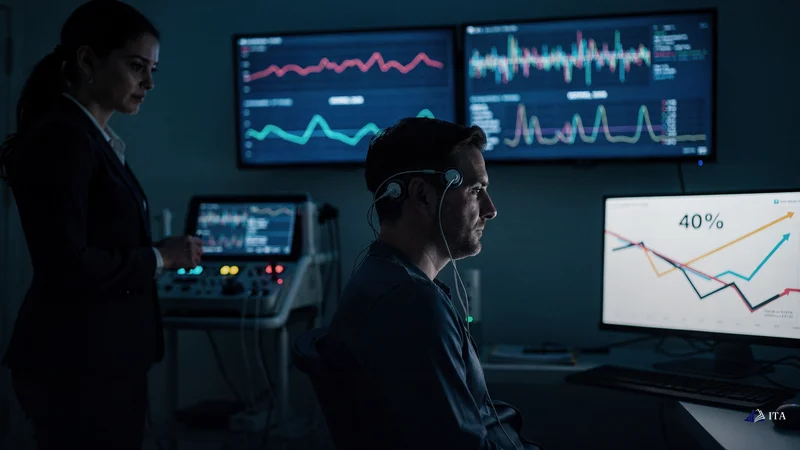
Loss aversion is not a personality trait or a lack of willpower. It is measurable brain activity. When researchers show traders potential losses inside an fMRI scanner, the amygdala and insula light up, the same regions that activate under physical threat. Your prefrontal cortex, the part responsible for weighing probabilities calmly, gets partially sidelined in the process. Functionally, your brain has trouble telling a red number apart from real danger.
The scale of this effect shows up consistently across behavioral finance research: loss aversion coefficients are commonly estimated in the range of roughly 1.5 to 2.5, meaning a loss of a given size tends to feel meaningfully worse than an equivalent gain feels good. This traces back to Kahneman and Tversky's original prospect theory research, which won Kahneman a Nobel Prize and remains the foundation for almost everything written about trading psychology since.
Prospect theory also explains a stranger pattern: people become risk-seeking specifically in the domain of losses. Faced with a certain small loss versus a gamble that might avoid it entirely, most people, including experienced traders, choose the gamble, even when the expected value clearly favours taking the loss. That single mechanism explains a large share of the account-destroying decisions covered in the rest of this guide.
None of this makes professional traders immune. Traders with stronger loss aversion tend to cut position size noticeably following a losing day, tightening their personal risk limits far below what their prop firm or broker actually requires. The bias does not disappear with experience. It just gets quieter and harder to notice.
Loss Aversion in Stop-Loss Placement
Stop-loss placement is where loss aversion shows up most visibly, and it distorts your stops in two opposite directions at once.
The tight-stop trap: some traders place stops so close to entry that ordinary market noise triggers them constantly. The logic feels sound: smaller losses should hurt less. In practice, it guarantees a higher frequency of losses, death by a thousand cuts, because normal volatility keeps clipping positions that were never actually wrong. Research on retail order flow shows stops clustering tightly around entry prices and round numbers, creating exactly the kind of predictable exit zones that produce repeated, avoidable small losses.
The moved-stop trap: the opposite failure is more expensive per occurrence. Price approaches your stop, and instinct says "give it a little more room." You move the stop once, then again, and a clean, planned loss becomes two, three, sometimes five times larger than intended. This is prospect theory in its purest form: a certain, small, already-accepted loss feels worse in the moment than an uncertain, larger one, so the brain keeps choosing the gamble.
Both traps come from the same source, so the fix is not "try harder to leave stops alone." It is removing the decision from the moment your judgement is least reliable. Bracket orders, where the stop and target are placed at the same instant as the entry, make the stop mechanically difficult to touch mid-trade. You are pre-committing while your brain is still rational, protecting yourself from the version of you that shows up thirty seconds into a losing trade.
A second, smaller shift compounds the effect: track outcomes in R-multiples instead of currency. "I lost 1R" carries less emotional weight than "I lost $500," even though the numbers describe the same event. Research on trader decision-making found that adopting this kind of systemised, outcome-based framing measurably reduces both the behavioural bias and the physiological stress response tied to a loss.
Loss Aversion in Funded Account Performance
Funded accounts raise the stakes of an already powerful bias. A loss on a personal account costs you money. A loss that breaches a daily or maximum drawdown limit on a funded account can end the evaluation or the funded status itself, which means the psychological weight includes every future payout you were hoping to earn, not just today's number.
Three patterns show up repeatedly in funded accounts. The first is revenge trading: after hitting a meaningful daily loss, the rational move is to stop for the day, but the actual response is often to increase size to "make it back quickly." Traders are considerably more likely to break their own risk rules in the period shortly after taking a loss than during a normal session. The second is trading paralysis: after a red day, fear of approaching the limit again causes traders to cut size dramatically, sometimes to a fraction of normal, or to skip valid setups entirely, so the account bleeds slowly through missed opportunity rather than through a single bad trade. The third is the stop-adjustment pattern already covered above, which tends to get more frequent as a daily limit gets closer.
Prop firm performance data reflects the scale of this: a large share of funded account failures are traced to psychology-driven rule violations rather than a flawed strategy or a genuinely bad market. The strategy usually still works. The trader simply stopped executing it once the drawdown meter turned a probability decision into a threat-response decision.

The Fix: Engineering Systems That Do Not Rely on Willpower
The most consistent funded traders do not try to out-willpower loss aversion. They build mechanical systems that function whether or not they are emotionally compromised in the moment, on the assumption that they probably will be. Personal Loss Limits at 50%: if your prop firm allows a 3% daily loss and a 6% maximum loss, treat your own limits as 1.5% and 3%. That is not overly cautious, it is realistic: the limit gets set while you are thinking clearly, not while loss aversion is already influencing the decision. Algorithmic Position Sizing: let the drawdown level dictate size automatically, rather than deciding in the moment:
- Account at 0% to -1% drawdown: normal risk per trade
- Account at -1% to -2% drawdown: 50% of normal risk
- Account at -2% to -3% drawdown: 25% of normal risk
- Account beyond -3% drawdown: stop trading until the next week
The formula makes the decision your compromised brain cannot be trusted to make on its own. Pre-Defined Exits: before entering any trade, define three exits at once, a target, a stop, and a time-based exit, and treat all three as non-negotiable. No discretion, no "just five more minutes." Automated Circuit Breakers: where your platform allows it, set an automatic full close and session lock once your personal daily loss limit is hit. When the override is removed from your hands entirely, loss aversion has nothing left to act on. Position Sizing Below the Standard Range: some funded traders push risk per trade down to 0.25 to 0.5% rather than the commonly cited 1 to 2%. At 0.5% risk, six consecutive losing trades are needed to reach a 3% daily limit, which mathematically lowers the odds that any single loss can trigger a panic response. The Mandatory Pause: after any day with a loss of 1% or more, implement a 24 to 48 hour trading halt as a rule, not a suggestion. The stress hormones released during a loss take time to clear, and trading through them behaves a bit like driving while impaired, you feel capable, but your reactions are measurably worse.
Rewiring Your Response to Losses: Daily Practice
Structural rules remove the worst decisions, but daily practice is what makes the rules easier to follow over time. The Drawdown Journal: instead of a typical trade log, track three data points every time you are in drawdown: emotional state before entering a trade (1 to 10), how far your position size deviated from normal (percentage), and how much longer you watched the position compared with your average. After around 20 logged trades, patterns tend to appear. Most traders discover they check open positions three to four times more often while in drawdown, manufacturing extra psychological micro-losses along the way, and that they are trading meaningfully smaller on average, which quietly makes recovery slower than it needs to be.
The Stop-Loss Journal: every time you feel the pull to move a stop, write down the original level, where you want to move it, why, and what you expect to happen, then leave the stop alone. Reviewing these notes weekly tends to be humbling: the stated reasons for wanting to move a stop are usually wrong. Pair this with tracking Maximum Adverse Excursion against your actual exit on every trade. If price never reached your stop but you still lost more than planned, you moved it. If price went further than your stop but you lost less, you cut early. Either way, the gap between the two numbers is loss aversion, quantified.
Pre-Market State Anchoring: before the session opens, write three things down: today's maximum acceptable loss in dollars, the exact time you will stop trading if that level is reached, and one sentence on why the rule protects your edge. Rate your own state from 1 to 10, and if it is below 7, treat that as a legitimate reason to sit the session out rather than a weakness to push through. Decisions made in a calm state consistently outperform decisions made under stress, so this practice effectively borrows judgement from a version of you that is not currently compromised.
Loss Rehearsal: before a session, or once a week using a demo account, deliberately visualise or take a full stop-loss and sit with it rather than looking away. When a loss has already been mentally rehearsed, the real version tends to carry less sting. Reframe the outcome as data rather than failure: instead of "I lost $200," try "this setup produced a -1R result, noted for review." The language shapes how much the event actually costs you emotionally, and after enough repetitions the reframe becomes automatic rather than effortful.
The Recovery Rebuild: after a significant drawdown, resist the urge to return to full size immediately. A graduated schedule works better: 25% of normal size in week one, 50% in week two, 75% in week three, and full size in week four. The point is not speed of recovery, at reduced size you will not recover quickly regardless, it is rebuilding the psychological footing that the drawdown eroded, one uneventful week at a time.
None of this eliminates loss aversion permanently. Across studied trader populations, even experienced participants continue to show loss aversion coefficients in the same general range as novices: experience does not remove the bias, it just makes people better at building safeguards around it. At Institutional Trading Academy (ITAfx), this pattern shows up consistently across funded accounts: the traders who sustain long-term results are rarely the ones who report feeling nothing during a drawdown. They are the ones who assumed in advance that they would feel plenty, and built rules that did not depend on feeling calm to work. Loss aversion will keep testing your psychology before it tests your risk management, and systems, not willpower, are what tend to decide which one wins.
Frequently Asked Questions
What is loss aversion in trading psychology?
Loss aversion is the psychological bias where traders feel losses more intensely than equivalent gains. Behavioral finance research commonly estimates loss aversion coefficients in the range of roughly 1.5 to 2.5, meaning a loss tends to feel meaningfully more painful than an equivalent gain feels good. This bias causes traders to hold losing positions too long and cut winning positions too early.
Why do prop firm traders blow accounts after hitting drawdown?
Drawdown triggers myopic loss aversion, where frequent P&L checks make each red number feel like a fresh wound. Traders unconsciously reduce position sizes, making recovery mathematically improbable, or overtrade trying to 'get back to even.' The visible drawdown meter on trading platforms amplifies this psychological trigger constantly.
How should you size positions after hitting drawdown?
Implement algorithmic position sizing: normal risk at 0-1% drawdown, 50% normal risk at 1-2% drawdown, 25% normal risk at 2-3% drawdown, and stop trading beyond 3% drawdown. This mechanical approach prevents loss aversion from compromising your risk perception during recovery periods.
Should you stop trading after hitting your daily loss limit?
Yes, implement a mandatory 24-48 hour pause after any day with 1% loss or greater. This isn't about reflection, it's allowing stress hormones to metabolise. Trading through elevated cortisol levels is scientifically proven to impair decision-making, similar to driving under the influence of alcohol.
How does ITAfx help traders manage drawdown psychology?
At ITAfx, we provide instant funded accounts up to $800K with institutional methodology that includes mechanical safeguards against loss aversion. Our systematic approach helps traders build protective protocols before psychology becomes compromised, rather than trying to overcome emotions through willpower alone.
Key Takeaways
- Set personal loss limits at 50% of your prop firm's official daily and maximum drawdown limits, decided while you are calm, not mid-drawdown.
- Loss aversion is measurable brain activity, not a character flaw: research commonly puts loss aversion coefficients in the range of roughly 1.5 to 2.5, meaning losses are weighted more heavily than equivalent gains.
- The same bias that fuels drawdown spirals also distorts stop-loss placement, producing either stops that are too tight (frequent whipsaws) or stops that get moved repeatedly (oversized losses).
- A large share of funded account failures are commonly attributed to psychology-driven rule violations rather than a flawed trading strategy.
- Use structural firewalls, pre-defined exits, automated lockouts after a set drawdown level, and sub-1% position sizing, so the safeguard does not depend on willpower in the moment.
- Track a handful of numbers weekly: emotional state (1 to 10), position size deviation, monitoring frequency, and Maximum Adverse Excursion versus actual exit, to see the bias in your own trading data.
- After a drawdown, rebuild size gradually over four weeks (25%, 50%, 75%, then 100%) instead of returning to full risk immediately.
Start Your Trading Evaluation
Simulated funded accounts up to $800K. Up to 95% profit split.
Get Funded